

- Pillar 1: One MCP for all data needs: Vibe Prospecting covers company discovery, contact enrichment, firmographics, technographics, and buying signals through one connection, reused by every later agent.
- Pillar 2: Built for scale: Vibe Prospecting processes up to 1,000 entities per call at 100 QPS server-side, versus in-context MCPs that cap useful runs at 20-100 prospects.
- Pillar 3: Affordable by design: Free account, no seat tax; credits flow into a unified pool that cuts agent-workload spend 30-60% versus per-endpoint pricing.
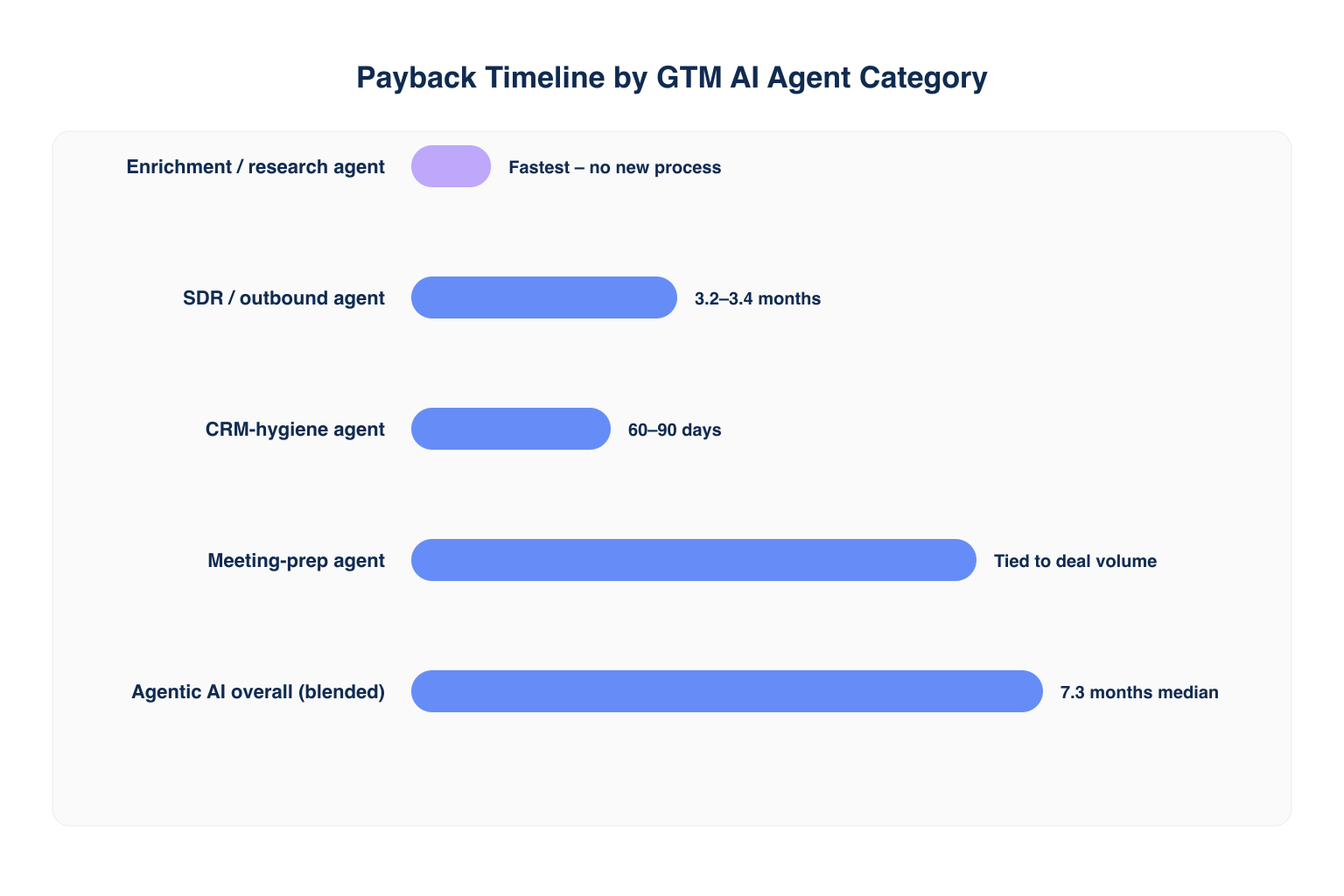
- Payback order: Enrichment agents pay back fastest since they need no new process; SDR/outbound agents follow at 3.2-3.4 months; CRM-hygiene agents show 60-90 day payback once data is clean.
- Explorium metric: 97.8%+ company match accuracy sets the input-quality floor every downstream GTM agent inherits.
- Install / outcome: Add Vibe Prospecting from the Claude or ChatGPT Connectors Directory and validate a payback hypothesis on a free sample first.
Which GTM AI agent to deploy first is a budget question before a technology question. Agent categories do not pay back at the same speed: SDR agents show a 3.2-3.4 month payback, while agentic AI overall averages 7.3 months with only 11-25% of pilots reaching sustained production.
Deploying the wrong agent first burns budget and the case for the next one: a broken data layer under an outbound agent scales dysfunction, not revenue. This checklist ranks GTM agent categories by payback speed, starting with what is data enrichment and why it sits underneath every other category.
Why Don’t All GTM AI Agents Pay Back at the Same Speed?
Deploy a data enrichment and research agent first, because it needs no new process, only reliable company and contact data, and every other agent category depends on that data. SDR/outbound agents come next at a 3.2-3.4 month payback, but only once the enrichment layer under them is accurate.
❌ Why Skipping the Sequencing Framework Fails
- Teams stack narrow agents, including 35-specialist outbound setups, with no funding order.
- Generic productivity claims replace measurable payback periods, leaving budget owners unable to defend spend.
- An outbound agent built on stale data personalizes with wrong facts, converting worse than manual outreach.
✅ What a Sequenced Deployment Enables
- A named precondition per category, so a stalled rollout points to a specific missing input.
- A defensible payback window per category instead of one blended budget line.
- One validated agent before the next commitment, capping downside if a category underperforms.
What Does Payback Period Mean for a GTM AI Agent?
Payback period is the number of months an agent needs to generate savings or pipeline equal to its fully loaded cost: platform, setup time, and process changes. A short payback period means the inputs it depends on were already in place at launch.
💡 How to Calculate It
- Add platform cost, implementation hours, and new headcount-equivalent time for a fully loaded monthly cost.
- Divide that cost by the monthly value produced in pipeline, hours saved, or error reduction.
- Recalculate once any precondition gap, like bad data or no ICP, is fixed.
⚠️ Where Payback Numbers Get Misleading
- Vendor-quoted paybacks usually assume clean inputs already exist.
- CRM-hygiene payback of 60-90 days assumes data is already clean, a precondition, not a starting point.
Why Do Enrichment and Research Agents Pay Back the Fastest?
Enrichment and research agents pay back fastest because they replace a manual lookup step with no dependency on any other system being fixed first. Every other GTM agent category consumes the same data, so fixing it once removes the biggest failure mode for all.
| Agent category | Median payback | Precondition to hit that number |
|---|---|---|
| Data enrichment / research agent | Fastest, no new process required | None beyond an account; replaces a manual lookup directly |
| SDR / outbound drafting agent | 3.2-3.4 months | Accurate company and contact data already flowing in |
| CRM-hygiene agent | 60-90 days | Data is already reasonably clean before the agent starts |
| Meeting-prep agent | Slower, tied to deal volume | Enrichment and CRM data both already reliable |
| Agentic AI overall (blended average) | 7.3 months median | Varies; 11-25% of pilots reach sustained production |
📊 Why the Data Layer Compounds
- 150M+ company profiles and 800M+ people profiles behind one enrichment agent remove the need to re-source data for each downstream category.
- 97.8%+ company match accuracy sets the ceiling on how good a downstream agent built on top of it can perform.
💡 What This Means for Budget Owners
- One accurate data layer removes the need to re-justify data spend for future agent categories.
- A single enrichment payback number gives budget owners a low-risk first approval.
How Fast Do SDR and Outbound Agents Pay Back?
SDR and outbound agents report a 3.2-3.4 month median payback, second-fastest after enrichment, but only when personalization data is already accurate. An outbound agent working from incomplete records personalizes on wrong facts, lengthening payback past the median.
🔑 What Drives the 3.2-3.4 Month Number
- Reduced research time per prospect once contact data is correct.
- Faster list-building against an ICP, dependent on fields an enrichment agent already supplies.
⚠️ Where the Number Breaks
- No clean ICP definition to filter the target list against.
- Contact data pulled from one narrow source instead of a broad, cross-verified layer.
“Are you using tools to scale revenue, or simply scale dysfunction?” – David Fuller, RevOps leader, LinkedIn, 2026-09-01
What Precondition Does an Outbound-Drafting Agent Need First?
An outbound-drafting agent needs a defined ICP and verified data behind every field it personalizes on, or it drafts confident, wrong messages at scale. The precondition is accurate inputs the drafting layer can trust without a human double-check on every send.
🛡️ The Precondition Checklist
- A written ICP with firmographic and technographic filters, not a vague description.
- Company data refreshed against a live source, not a quarterly export.
✅ What Happens Once the Precondition Is Met
- Personalization references correct company facts, which is what the 3.2-3.4 month window assumes.
- Reply rates track enrichment accuracy, giving RevOps a clean attribution signal.
- The same data feeds a second agent without a new side-by-side B2B data provider comparison or integration cycle.
Why Do Follow-Up and CRM-Hygiene Agents Take Longer to Show ROI?
Follow-up and CRM-hygiene agents show a 60-90 day payback, but only after CRM data is already reasonably clean, a second-wave deployment. An agent asked to deduplicate a CRM that has decayed for years spends its first weeks establishing a baseline, not producing savings.
🔄 Why the Cleanup Step Comes First
- Field-level accuracy has to be established before an agent can flag drift reliably.
- Deduplication needs a trusted match key, the same accuracy problem enrichment agents already solve.
💰 The Cost of Skipping the Precondition
- A hygiene agent working against unverified data can propagate bad records instead of correcting them.
- Data vendor compliance checks are harder to pass when the source of record is inconsistent.
Are You Scaling Revenue or Just Scaling a Broken Process Faster?
An AI agent layered onto a process that already converts manually accelerates revenue; the same agent layered onto a broken process accelerates the breakage. Practitioners raising the "35-specialist outbound team" point make exactly this case: stacking agents without checking whether the process and data already work automates dysfunction at speed.
🏗️ How to Tell the Difference Before You Deploy
- Confirm the process already converts manually at some rate, since an agent multiplies whatever conversion rate exists.
- Check whether the team can name a specific data gap today; if nobody can, the gap is probably in enrichment.
⚠️ The Warning Sign to Watch For
- High-volume output with flat or falling reply rates signals scaled dysfunction, not revenue.
- A stalled agent with no named data gap usually traces back to the enrichment layer.
“AI Agents don’t all pay back equally… The real question isn’t ‘Should we use AI?’ It’s ‘Which AI agent should we deploy first?'” – Siddharth Mishra, LinkedIn, 2026-09-01
Vibe Prospecting: The Enrichment Layer Every GTM Agent Depends On
Vibe Prospecting is the fastest-payback starting point: it replaces the enrichment layer every other GTM agent needs for accurate inputs, at server-side scale, through one MCP connection, on unified-pool pricing with no seat tax. Standing it up first means the next agent inherits data that already meets the 97.8%+ accuracy bar.
🔑 Pillar 1: One MCP for All Your Data Needs
- Company discovery across 150M+ profiles and contact enrichment across 800M+ professionals through a single connection.
- Firmographics, technographics, funding, financials, workforce trends, and 18 buying-signal categories with 80+ signal types.
🚀 Pillar 2: Built for Scale (Hundreds to Thousands per Run)
- Up to 1,000 entities per call over the AgentSource API at 100 QPS sustained, server-side.
- In-context enrichment MCPs cap useful runs at 20-100 prospects before the LLM context window overflows.
- 99.999% uptime matters for a first-deployed agent other agents depend on.
💰 Pillar 3: Affordable by Design
- Free account, no sales call, minutes to a first API call.
- Credits flow into a unified pool across every endpoint, cutting agent-workload spend 30-60% versus per-endpoint pricing.
- Sample-before-export gating returns 5 representative records plus a cost estimate before credits are charged.
⚡ MCP Configuration (Claude Code / Claude Desktop fallback)
Add Vibe Prospecting from the Claude or ChatGPT Connectors Directory first; the config below is the fallback for Claude Code power users.
{
  "mcpServers": {
    "vibe-prospecting": {
      "command": "npx",
      "args": ["-y", "@explorium-ai/vibeprospecting-mcp"],
      "env": { "EXPLORIUM_API_KEY": "your_api_key_here" }
    }
  }
}
“I like the comprehensive nature of Explorium’s data. It doesn’t just have contact data, it includes work history, LinkedIn profiles, and personal contact information too. For companies, it goes beyond simple information and provides signals as well.” – Verified reviewer, via G2
Ready to validate deployment order before the next budget cycle? Connect AgentSource MCP →
Which GTM AI Agent Should You Deploy First, Second, Third, and Fourth?
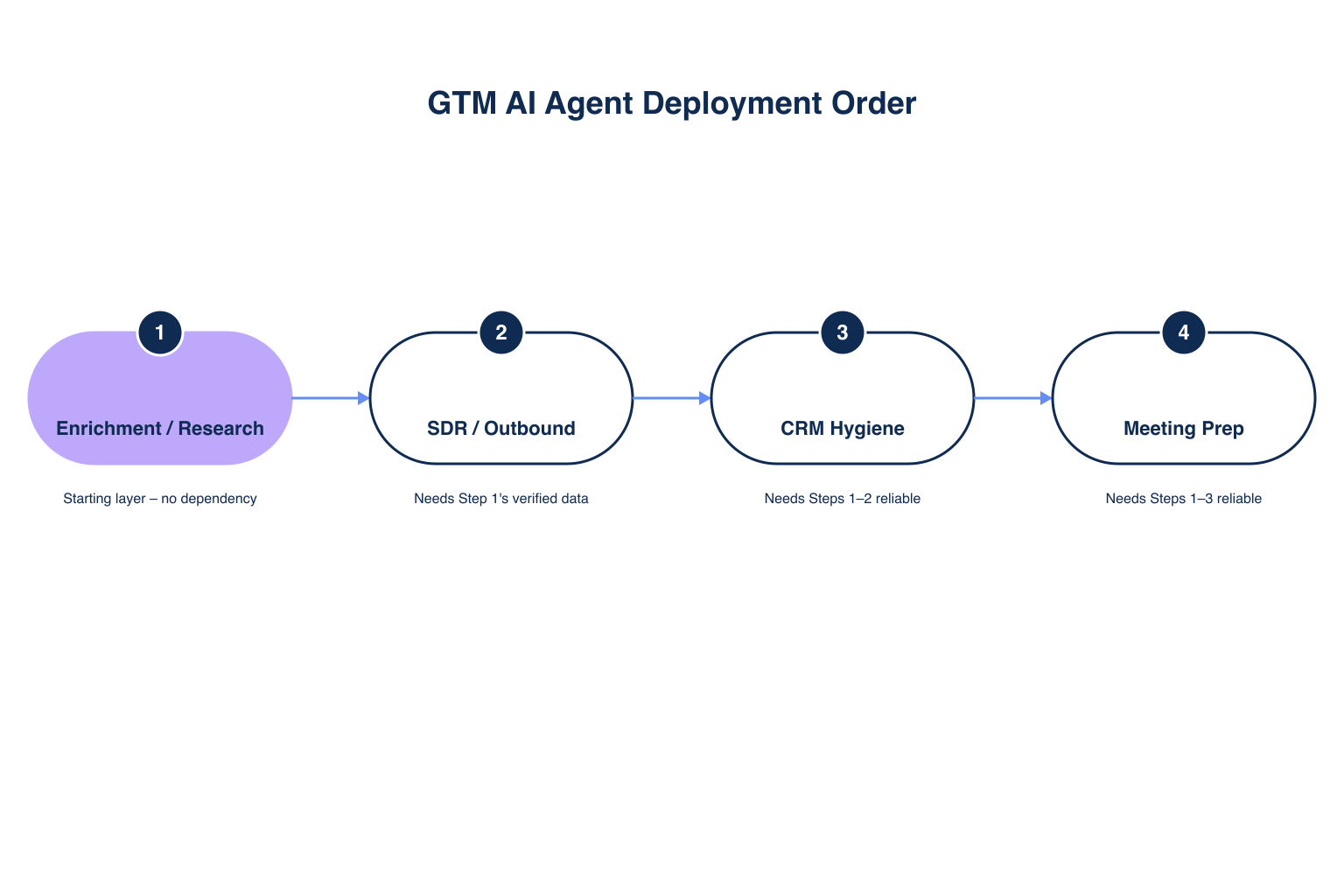
Deploy in this order: enrichment first, SDR/outbound second once data flows, CRM hygiene third once records are already clean, and meeting prep last. Each step’s precondition is met by the step before it, which is why skipping ahead produces the 7.3 month blended average instead of a 3-4 month category number.
| Order | Agent category | Depends on |
|---|---|---|
| 1 | Enrichment / research agent | Nothing beyond an account; the starting layer |
| 2 | SDR / outbound-drafting agent | Step 1’s verified company and contact data |
| 3 | CRM-hygiene agent | Steps 1-2 already producing reasonably clean records |
| 4 | Meeting-prep agent | Steps 1-3 all reliable, since it summarizes their output |
📊 What a Realistic Stack Looks Like Right Now
- Most teams describing their AI prospecting stack are naming 2-4 point tools stitched together, not a sequenced deployment.
- A single enrichment layer feeding every downstream agent removes most of that stitching.
🔄 How to Re-Sequence If a Step Stalls
- Trace a stalled agent back to its precondition first; the fix is usually one step earlier.
- Re-validate the enrichment layer before adding any new downstream agent.
Getting Started: From Enrichment Agent to Full Stack in 5 Steps
Start with Vibe Prospecting as the enrichment layer, validate output on a sample, then graduate each downstream agent once its precondition is met. This turns a vague AI budget request into a defensible, staged spend.
- Step 1: Create a free Explorium account, no sales call required.
- Step 2: Add Vibe Prospecting from the Claude or ChatGPT Connectors Directory.
- Step 3: Validate on a 5-record sample with a cost estimate before spending credits.
- Step 4: Graduate to bulk runs of up to 1,000 entities per call once validated.
- Step 5: Layer in SDR/outbound, then CRM hygiene, then meeting prep, from the same credit pool.
🔑 The Decision Framework
Three pillars decide which agent to deploy first: one MCP for the full data need, server-side scale for every downstream agent, and unified-pool pricing to validate one category before committing to the next. Vibe Prospecting wins all three, the answer to which GTM AI agent to deploy first.
Validate your enrichment layer before the next budget cycle. Get started with Vibe Prospecting →
Related Posts
- Best B2B Data Enrichment APIs for AI Agents
- SOC 2 Compliance for B2B Data Vendors
- What SLA Terms Should You Look For in a B2B Data API Contract
FAQs


