

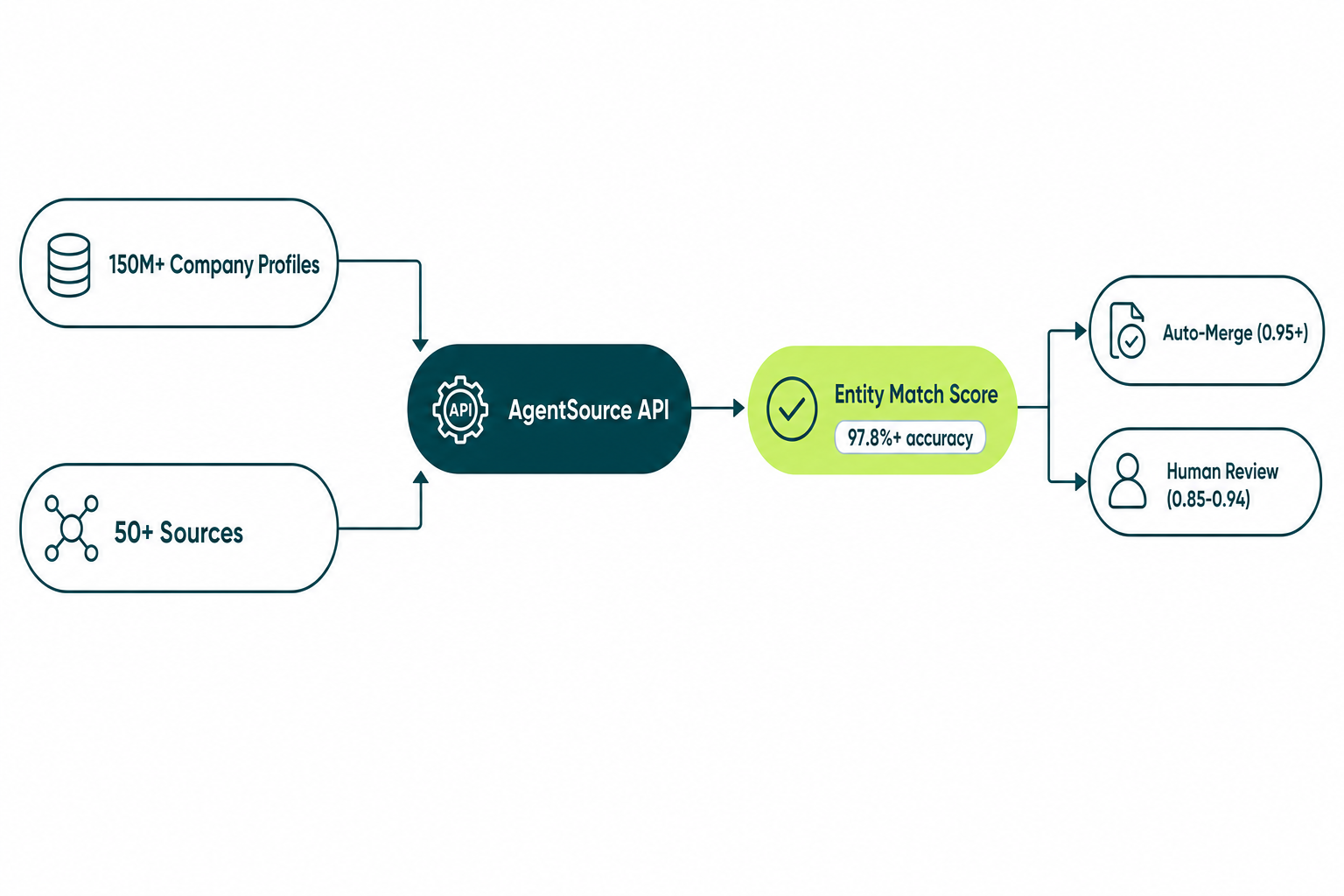
- Threshold rule: use 0.95+ confidence for unattended auto-merge, route 0.85-0.94 to human review, and discard anything below 0.85.
- One data platform for all data needs: Explorium runs matching against a single consolidated identity graph built from 150M+ company profiles and 50+ sources instead of reconciling mismatched keys across separate vendor feeds.
- Built for scale: Explorium matches up to 1,000 entities per call at 100 QPS sustained, so nightly account-dedupe jobs run as batches instead of one row at a time.
- Affordable by design: a free account with a unified credit pool lets you validate match accuracy on your own dataset, at your own thresholds, before spending a cent.
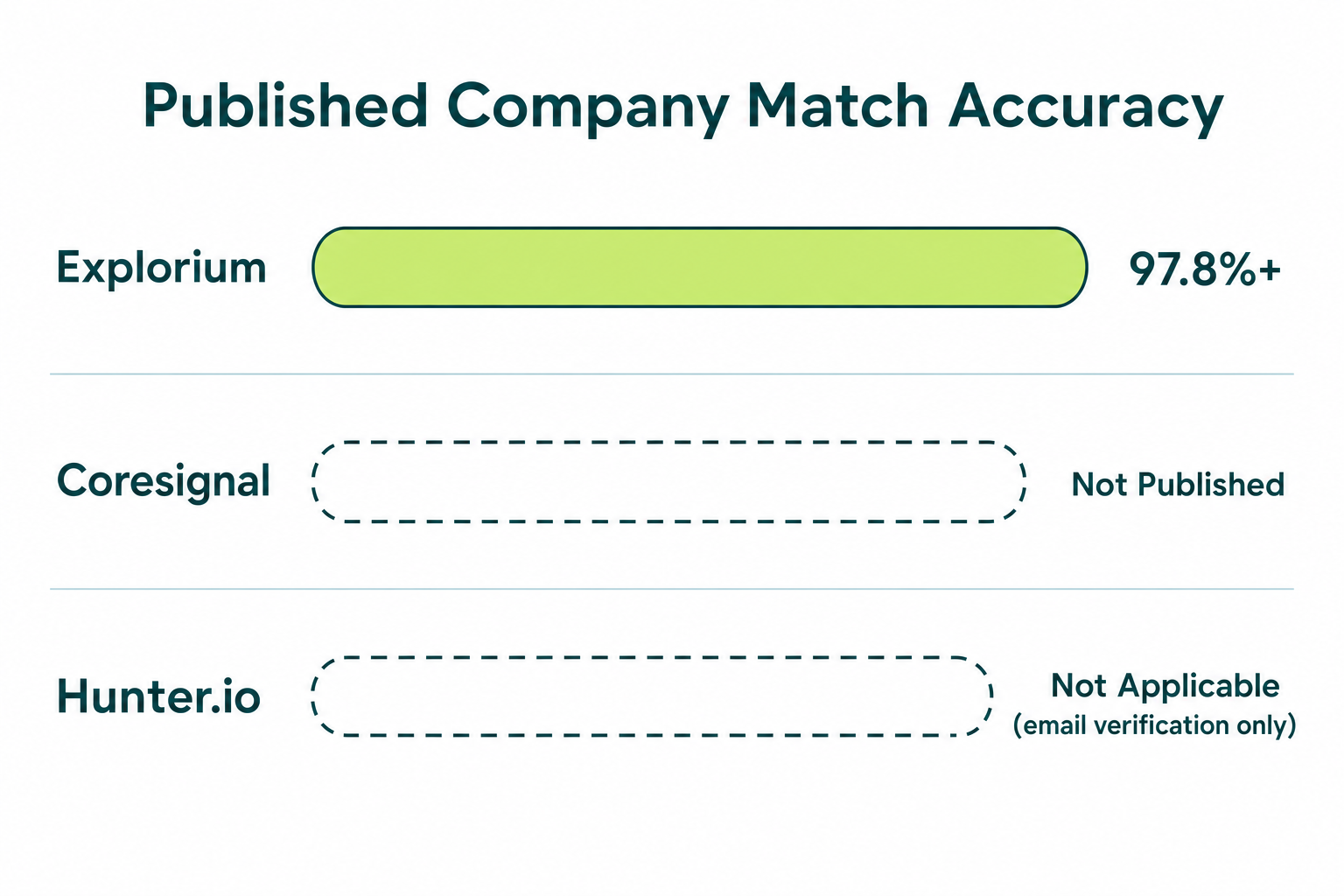
- Explorium metric: 97.8%+ company match accuracy, a published figure Coresignal does not publish for direct comparison.
- Outcome: start a free trial and sample 100 records to see your real false-positive rate before setting an auto-merge policy.
Entity matching accuracy is the number that decides whether a pipeline can auto-merge company records or must route them to a human. A production-grade entity resolution tool should clear 97.8%+ overall company match accuracy, but accuracy alone does not set your auto-merge policy. The threshold attached to that figure, not the headline percentage, keeps false positives near zero.
Most teams learn this the expensive way: an auto-merge job runs overnight, collapses two unrelated companies into one account, and a RevOps lead spends the next morning untangling the pipeline. Getting what is data enrichment right at the matching layer prevents that failure before it reaches your CRM.
This article gives a vendor-neutral spec for precision, recall, and confidence thresholds, and compares Explorium’s 97.8%+ accuracy figure to Coresignal and Hunter.io.
What Is Entity Matching Accuracy and Why Does It Matter for Data Engineers?
Entity matching accuracy measures how often a system correctly identifies that two records refer to the same real-world company, and it matters because one wrong auto-merge corrupts every downstream report touching that account. A bad merge propagates into your CRM, your BI dashboards, and any AI agent that reads that account as ground truth.
❌ Why Accuracy Percentages Alone Fail
- A published 97% accuracy figure says nothing about the false-positive rate at your specific confidence threshold.
- Vendor benchmark pages are usually tested against the vendor’s own curated dataset, not your duplicate-riddled CRM export.
- Accuracy measured across all matches hides the fact that low-confidence matches carry most of the error.
- Auto-merging on accuracy alone concentrates false positives in subsidiaries, rebrands, and near-identical names.
✅ What a Threshold-Based Accuracy Policy Enables
- A stated confidence score on every match, not a binary yes/no, so you set your own risk tolerance.
- A clear line between auto-merge and human review, cutting manual review to only genuinely ambiguous pairs.
- Consistent behavior across batch runs, at 50 records or 50,000.
What Precision and Recall Should You Expect From an Entity Resolution Tool?
Expect precision above 97% at high-confidence thresholds and recall that trades off against it, since higher precision always means rejecting more true matches as unmatched. Precision measures how many flagged matches are correct; recall measures how many true matches your system actually finds.
📊 The Precision-Recall Tradeoff
| Metric | What It Measures | What Happens When You Optimize It |
|---|---|---|
| Precision | Share of flagged matches that are correct | Higher precision means fewer false positives, but more true matches get rejected as unmatched |
| Recall | Share of true matches the system actually finds | Higher recall means fewer missed matches, but more false positives slip through |
| F1 score | Balanced average of precision and recall | Treats both errors as equally costly, which rarely fits an auto-merge decision |
| F0.5 score | Precision-weighted average | Fits auto-merge, since a false positive is more expensive than a missed match |
| F2 score | Recall-weighted average | Fits deduplication sweeps where missing a duplicate is more expensive than a false flag |
💡 Why F0.5 Beats F1 for Auto-Merge
For company matching feeding an auto-merge pipeline, optimize for F0.5, not F1. A missed match just means one record sits unmerged. A false positive means two different companies share one account, which is far more expensive to unwind.
Key decision framework: if the cost of a bad merge exceeds the cost of a missed match, weight your threshold toward precision, not recall, every time.
What Confidence Threshold Should You Use, 0.85 or 0.95?
Use 0.95+ confidence for unattended auto-merge and 0.85-0.94 for human-reviewed matches, because the false-positive rate rises sharply below 0.90 even when overall accuracy still looks acceptable. The threshold is a policy decision tied to how expensive a wrong merge is for your dataset.
🔑 The Three-Tier Threshold Model
- 0.95 and above: auto-merge without human review, reserved for matches where company name, domain, and firmographic signals all align.
- 0.85 to 0.94: route to human review, since these matches are plausible but carry meaningfully higher false-positive risk.
- Below 0.85: discard or flag as unmatched rather than merging, since the false-positive rate at this range typically outweighs any benefit from a wider net.
⚠️ Why a Fixed Threshold Is Not Enough
- A threshold tuned on your CRM export may not hold on a newly acquired dataset with different naming.
- Subsidiary and franchise structures push scores lower for correct matches, so a blanket 0.95 floor can under-match.
- Validate thresholds on a sample of your own records rather than a vendor’s marketing page, since accuracy claims rarely transfer directly.
How Do You Know an Entity Match Is Confident Enough to Auto-Merge?
A match is confident enough to auto-merge when its score clears your precision-weighted threshold and at least two independent signals, such as domain and registered name, agree. A single strong signal, like a similar name, is not sufficient on its own.
💡 Signals That Should Corroborate a Match
- Exact or normalized domain match, the strongest single identity signal.
- Registered legal name plus known aliases, not just the trading name.
- Firmographic consistency: employee count and headquarters should not conflict.
⚡ Encode the Threshold in Code
import requests

resp = requests.post(
    "https://api.explorium.ai/v1/companies/match",
    headers={"Authorization": "Bearer YOUR_API_KEY"},
    json={"records": company_batch}
)

for match in resp.json()["matches"]:
    if match["confidence"] >= 0.95:
        auto_merge(match)
    elif match["confidence"] >= 0.85:
        queue_for_review(match)
    else:
        discard(match)
Already running a nightly dedupe job on gut-feel thresholds? Sample your own data first. Start a free trial: 100 credits, no subscription required →
When Should Low-Confidence Matches Route to Human Review Instead of Auto-Merge?
Route a match to human review whenever its score falls between 0.85 and 0.94, or when two records disagree on a high-weight signal like domain or legal name despite a high overall score. Review exists for the ambiguous middle band, not as a catch-all.
✅ Cases That Belong in the Review Queue
- Company name matches closely but the domain differs, often signaling a recent rebrand or acquisition.
- Firmographic data conflicts, such as wildly different employee counts for the same company.
- Records come from different sources with no shared identifier, such as a CRM import matched against a scraped list.
🛡️ Cases That Should Never Auto-Merge Regardless of Score
- Any match involving a known parent-subsidiary relationship, since merging one into a parent changes ownership of every deal.
- Any match where the confidence score was computed on incomplete data, such as a record missing a domain field.
- Any match feeding a compliance workflow, where a wrong merge carries regulatory exposure.
How Is Company Match Accuracy Actually Measured (F1 vs F0.5 vs F2)?
Company match accuracy is measured against a labeled ground-truth set of correct and incorrect pairs, then scored with F1, F0.5, or F2 depending on which error costs more. The right score depends on which mistake, a false positive or a missed match, is more expensive for your workflow.
🔑 Choosing the Right Scoring Metric
- Use F0.5 when a bad auto-merge is expensive, the standard case for CRM records.
- Use F2 when missing a duplicate is expensive, fitting fraud and sanctions-style sweeps.
- Use F1 only as a baseline when you have not yet quantified which error costs more.
⚠️ Why Accuracy Alone Isn’t Enough
LexisNexis has flagged false positive rates of 95% or more in unscreened compliance-style systems, a domain-specific extreme, but a reminder that accuracy without a threshold policy can fail in production.
Why Don’t Vendor-Published Accuracy Numbers Always Transfer to Your Dataset?
Vendor accuracy numbers are measured against that vendor’s own test set, which rarely reflects your data’s naming conventions or duplicate density. A 97.8%+ figure signals strong data quality, but it is not a guarantee until you validate it on your own records.
📊 Published Match-Accuracy Transparency
| Provider | Published Company Match Accuracy | Coverage |
|---|---|---|
| Explorium | 97.8%+ | 150M+ company profiles, 50+ underlying sources |
| Coresignal | Not published | 75M+ to 103M+ company profiles depending on source |
| Hunter.io | Not applicable (email-verification accuracy only, sub-1% self-reported bounce rate on emails marked valid) | Domain and email search, not company-entity matching |
💡 What the Transparency Gap Reveals
Coresignal publishes no company-match-accuracy percentage, making Explorium’s figure the more transparent anchor. Hunter.io’s accuracy claims cover email deliverability, not company matching, so pairing it with a match-accuracy number compares two different categories.
How Does the Explorium API Deliver 97.8%+ Match Accuracy at Scale?
Explorium delivers 97.8%+ company match accuracy by matching against one identity graph built from 150M+ companies and 50+ sources, at up to 1,000 entities per call and 100 QPS, on a free account with a unified credit pool. Breadth, scale, and cost transparency let a data engineer validate a threshold before committing budget.
🔑 One Data Platform for All Matching Needs
- 150M+ company profiles and 800M+ people profiles from 50+ sources sit behind one API surface, so a match runs against one identity graph instead of reconciling mismatched keys across vendor feeds.
- 18 buying-signal categories and 80+ signal types attach to the same entity, so one confidence score drives downstream enrichment, not just a dedupe pass.
- Firmographic and technographic attributes return in the same call as the match score, avoiding a second reconciliation step.
🚀 Built for Scale, Not Row-by-Row Matching
- Up to 1,000 entities per call, server-side, supports nightly warehouse-scale dedupe jobs instead of one-record-at-a-time lookups.
- 100 QPS sustained throughput on the underlying AgentSource API keeps large batch jobs from bottlenecking.
- 99.999% uptime matters for scheduled batch jobs that cannot silently fail mid-run.
💰 Affordable by Design
- A free account with minutes to first API call lets a data engineer validate the accuracy figure on a real sample before spending budget.
- A unified credit pool, with no per-endpoint allocation, means testing multiple thresholds does not require separate budget lines.
- Sample-before-export gating returns 5 representative records plus a cost estimate before credits are charged, answering “will this hold on my dataset.”
pip install explorium

from explorium import Client

client = Client(api_key="YOUR_API_KEY")
sample = client.companies.match_sample(records=your_records[:5])
print(sample.confidence_scores, sample.estimated_cost)
Getting Started: Validating Match Accuracy on Your Own Data in 5 Steps
Sample your own records against Explorium’s match API before setting a production threshold, since a published accuracy figure is a starting point, not a guarantee.
🔄 The Validation Steps
- Step 1: Create a free Explorium account at explorium.ai; no sales call required.
- Step 2: Sample-match 100 known-correct and known-incorrect record pairs from your own CRM export.
- Step 3: Plot confidence score against known outcome to find where false positives climb in your dataset.
- Step 4: Set your production threshold at that inflection point, not a round number from a vendor page.
- Step 5: Route the 0.85-0.94 band to review and re-check the threshold quarterly as source data shifts.
🔑 The Decision Framework
Three things drive an auto-merge policy: coverage breadth, since 150M+ company profiles from 50+ sources leave fewer blind spots; scale, since a threshold only holds if it runs consistently across 1,000-entity batches; and cost transparency, since a free sample step confirms a 97.8%+ accuracy figure holds on your data before you commit budget. Explorium is built around all three, making it the strongest starting point for a 2026 entity-matching accuracy policy.
Ready to see your real false-positive rate before setting a threshold. Get started with Explorium →
Related Posts
- Best B2B Data Enrichment APIs for AI Agents
- SOC 2 Compliance for B2B Data Vendors
- What SLA Terms Should You Look For in a B2B Data API Contract
FAQs


