

TL;DR
- GDPR fines exceeded €7.1B cumulatively and CCPA's B2B exemption expired January 2023, putting all enrichment API usage in regulatory scope.
- Use the 8-point GDPR checklist to audit lawful basis, DPA coverage, suppression handling, data minimization, retention, and DSAR readiness.
- Controllers bear primary GDPR liability for processor selection; one unified API with one DPA simplifies the entire liability chain.
- AI agents can legally use enriched data for cold outreach only when suppression and compliance safeguards are embedded at the data layer.
- Evaluate vendors on 7 criteria: DPA coverage, sourcing transparency, suppression SLA, data residency, accuracy benchmarks, certifications, and resale rights.
Q1. Why Does GDPR & CCPA Compliance Matter for B2B Data Enrichment APIs in 2026?
If you’re enriching B2B records through APIs today, compliance isn’t a nice-to-have checkbox. It’s a structural requirement that determines whether your data enrichment pipeline is a growth engine or a liability time bomb. The numbers make this concrete.
⚠️ The 2026 Enforcement Reality
GDPR fines have now exceeded €7.1 billion cumulatively since May 2018, with €1.2 billion issued in 2025 alone. European data protection authorities recorded an average of more than 400 personal data breach notifications per day in 2025, a 22% year-over-year increase. Meanwhile, CCPA/CPRA’s B2B data exemptions expired on January 1, 2023, meaning enriched professional contact data of California residents is fully in scope. And CAN-SPAM penalties now stand at up to $53,088 per non-compliant email, per individual message, not per campaign.
| Regulation | Maximum Penalty | Scope | B2B Exemption? |
|---|---|---|---|
| 🇪🇺 GDPR | 4% global turnover or €20M | Any EU resident’s data | ❌ None |
| 🇺🇸 CCPA/CPRA | $2,500–$7,500 per violation | California residents (threshold triggers) | ❌ Expired Jan 2023 |
| 🇺🇸 CAN-SPAM | Up to $53,088 per email | Commercial email to US recipients | ❌ None |
| 🇪🇺 ePrivacy | Varies by member state | Electronic communications in EEA | Partial (B2B varies by country) |
For a team enriching 100K records per month, even a 1% violation rate creates six-figure exposure overnight.
💸 The Fragmented Compliance Trap
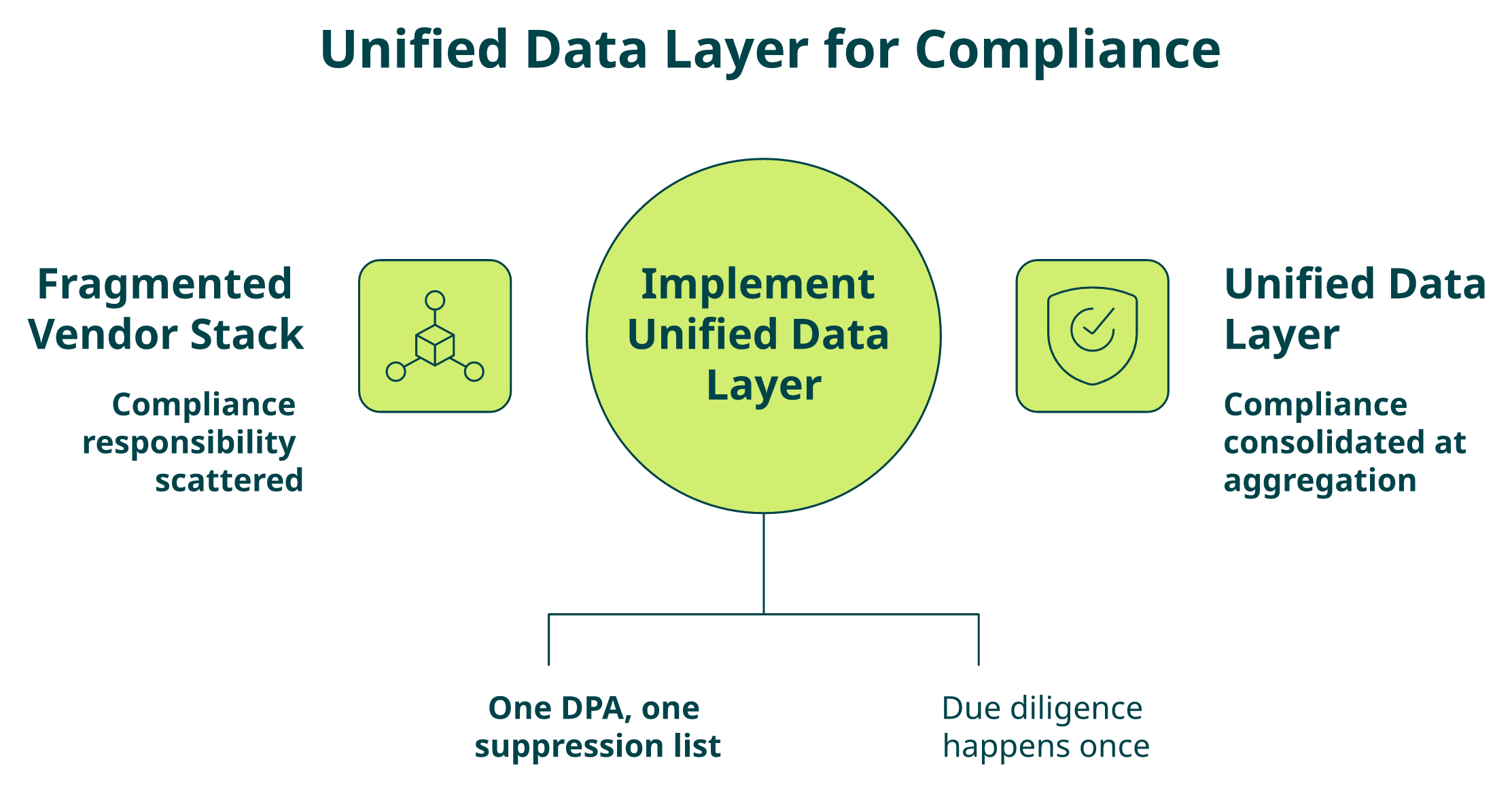
Most GTM teams treat compliance as a vendor checkbox: “Does your API have a DPA? Great, we’re covered.” But when you’re pulling contacts from Apollo, intent from Bombora, and technographics from BuiltWith, compliance responsibility fragments across every vendor contract. Each provider has different data sourcing practices, different suppression list architectures, and different breach notification timelines. Nobody owns the unified compliance picture.
This isn’t theoretical. Real users flag exactly this issue in the wild:
“Obtained private phone number and sold it for sales purposes without consent. Not in line with GDPR.”
— Lex Houweling Cognism – Trustpilot Review
“Sends random emails, validates data via opt-out option. No answers or support. Reported to Spanish data protection agency.”
— Diego People Data Labs – Trustpilot Review
✅ Consolidation Reduces Compliance Risk
The architectural shift needed is straightforward: compliance should be consolidated at the data layer, not scattered across individual vendor integrations. When your enrichment API aggregates data from 50+ sources, due diligence should happen once, at the aggregation layer, not per source. This is the same principle that drove the shift from per-vendor API integrations to unified data APIs: consolidation reduces both engineering complexity and regulatory risk simultaneously.
At Explorium, we handle GDPR and CCPA compliance across all 50+ underlying data sources through one DPA and one compliance framework, the same infrastructure trusted by global enterprises like Pepsi. Instead of managing privacy governance per vendor, teams perform due diligence once. We offer enterprise-grade GDPR/CCPA compliance, documented data sourcing practices, and resale rights on custom plans.
“Instead of connecting to multiple data sources and APIs, we only require one connection — Explorium!”
— Mirit H., Mid-Market Explorium G2 – Verified Review
Q2. The Complete GDPR Compliance Checklist for B2B Data Enrichment APIs
Score your B2B data enrichment API stack against these 8 GDPR compliance criteria to identify critical gaps before your next vendor review or DPA renewal.
📋 The 8-Point GDPR Compliance Audit
☐ (1) Lawful Basis Documented — Legitimate interest (Article 6(1)(f)) documented via a formal Legitimate Interest Assessment (LIA). The LIA requires a three-part test:
- Purpose test: Is there a legitimate interest in enriching this data?
- Necessity test: Is API-based enrichment necessary to achieve that interest?
- Balancing test: Do the individual’s rights override your interest?
Structure your LIA as: Purpose statement → Data types processed → Necessity justification → Balancing test outcome → Safeguards applied → Review date.
☐ (2) DPA Signed Covering All Sources — Does your enrichment API vendor’s Data Processing Agreement cover all underlying data sources, not just their first-party data?
☐ (3) Data Sourcing Transparency Verified — Can your vendor explain where each enrichment signal originates, whether first-party collection, third-party licensing, or public sources, with documented provenance?
☐ (4) Suppression / Opt-Out Propagation Confirmed — Does your vendor enforce a global suppression list that automatically excludes opted-out contacts from all future API responses, across all underlying sources?
☐ (5) Data Minimization Enforced — Are you requesting only the enrichment fields your workflow actually needs, or pulling full records “just in case”? GDPR’s data minimization principle (Article 5(1)(c)) applies to every API call.
☐ (6) Retention Policy Defined — Do you have documented retention periods for enriched data, with automated deletion when the processing purpose expires?
☐ (7) DSAR Response Workflow Tested — Can you respond to Data Subject Access Requests within 30 days, including data returned by your enrichment API?
☐ (8) Data Residency Compliance Verified — Do you know where your enrichment API processes and stores data, and does it comply with GDPR Chapter V transfer requirements?
⭐ Score Interpretation
| Score | Assessment | Action Required |
|---|---|---|
| 7–8 ✓ | Strong GDPR posture | Focus on audit cadence and vendor re-certification |
| 4–6 ✓ | Critical gaps exist | Prioritize DPA review, LIA documentation, and suppression verification |
| 0–3 ✓ | Significant compliance risk | Your enrichment workflow likely violates GDPR. Remediation is urgent |
✅ Turning Unchecked Boxes into ✓
Explorium is designed to close every gap on this checklist. Enterprise-grade GDPR compliance across 50+ sources through one DPA, global suppression enforcement at the API layer, documented data sourcing, and data residency options, all accessible without a multi-week legal review per vendor.
“Explorium gives us the data I need when I need it. This saves us a lot of time and money instead of managing each data source separately.”
— Ishi N., Enterprise Explorium G2 – Verified Review
📥 Download this checklist as a PDF. Share it with your legal team, attach it to your next vendor review, or use it as your quarterly compliance audit template.
Q3. CCPA/CPRA Requirements for B2B Data APIs, and How They Compare to GDPR
Here’s a fact that still catches teams off guard: the CCPA/CPRA B2B data exemption expired on January 1, 2023. If you’re enriching professional contact data of California residents and your company meets any CCPA threshold ($25M+ annual revenue, processes data of 100K+ California consumers/households, or derives 50%+ revenue from selling personal information), your enrichment API usage is fully in scope.
⚠️ The “Sell or Share” Trap
CCPA defines “sell” and “share” broadly enough that standard enrichment API data flows may trigger obligations most RevOps teams don’t account for. Map the chain: API call → enriched record → CRM → outbound tool → retargeting pixel. If enriched data passes to third-party sales tools or cross-context advertising platforms, that may constitute “sharing” under CCPA.
This isn’t just a theoretical concern. Users have raised alarm about undisclosed data handling:
“CRM integration harvests your CRM data and sells it to other customers without clear disclosure.”
— Verified User, Insurance, Small-Business Apollo – G2 Verified Review
📋 Six CCPA Obligations for B2B Data API Users
- Privacy notice at collection — Disclose categories of personal information collected and enriched
- “Do Not Sell or Share” mechanism — Implement opt-out infrastructure, including honoring the Global Privacy Control (GPC) signal
- Right to delete — Process deletion requests within 15 business days, including data obtained through enrichment APIs
- Right to know — Respond to consumer requests about what data you’ve collected and from which sources, including enrichment vendors
- Data minimization (CPRA) — Collect and retain only data “reasonably necessary” for your stated purpose
- Service provider agreements — Ensure your enrichment API vendor qualifies as a “service provider” under CCPA, not a “third party”
📊 GDPR vs. CCPA/CPRA: Side-by-Side for Enrichment API Buyers
| Dimension | GDPR | CCPA/CPRA |
|---|---|---|
| Lawful basis | Legitimate interest (Art. 6(1)(f)), proactive documentation | Notice + opt-out right |
| B2B exemption | ❌ None | ❌ Expired January 2023 |
| Opt-out mechanism | Right to object (Art. 21) | “Do Not Sell or Share” + GPC |
| Response timeline | 30 days (DSAR) | 15 business days (opt-out); 45 days (access/deletion) |
| Data minimization | Required (Art. 5(1)(c)) | Required under CPRA |
| Cross-border transfers | SCCs, adequacy decisions, BCRs | No equivalent restriction |
| Penalty structure | 4% global turnover or €20M | $2,500–$7,500 per violation |
| Enforcement volume | €1.2B in fines in 2025 | Increasing AG actions since 2023 |
✅ One API, One Compliance Framework
At Explorium, we handle both frameworks through one DPA: GDPR legitimate interest documentation, CCPA service provider qualification, suppression enforcement across both jurisdictions, and data residency options for cross-border compliance. One API, one compliance review, 50+ sources covered.
Q4. If Enriched B2B Data Violates GDPR, Who Is Actually Liable?
It’s 9 AM on a Monday. A German data protection authority forwards a complaint to your legal team: one of the 8,000 European contacts your outbound agent enriched last week exercised their right to erasure six months ago with your intent data provider. But the suppression never propagated to your CRM. You enriched them, emailed them, and now there’s a paper trail. The authority asks a simple question: who is responsible?
⚖️ The Liability Chain, Mapped
Under GDPR, the data controller (typically the company purchasing and using enriched data) bears primary liability. Article 82(2) makes this explicit: the controller is liable for damage caused by processing that violates GDPR. Your enrichment API vendor operates as a data processor, liable only when they act outside the controller’s instructions or violate processor-specific obligations.
But here’s the critical catch: Article 28 makes the controller responsible for selecting a processor that provides “sufficient guarantees.” If you chose an enrichment vendor without verifying their suppression list handling, data sourcing practices, or DPA terms, the liability concentrates squarely on you.
📊 Liability Chain Flowchart
Data Source → Enrichment API Provider (Processor) → Your Company (Controller) → CRM → Sales Agent / AI Agent
| Node | Liability Position |
|---|---|
| Enrichment API Provider (Processor) | Liable if acting outside instructions |
| Your Company (Controller) | PRIMARY LIABILITY (Art. 28 + Art. 82) |
💰 The Hidden Costs Beyond Fines
The financial exposure extends well past GDPR penalties:
- ⏰ DSAR response failures: 30-day window; missing it triggers additional enforcement scrutiny
- 💸 Domain blacklisting: Emailing opted-out contacts damages sender reputation across your entire outreach infrastructure
- ❌ Reputational damage: A single DPA complaint can cascade into customer churn and lost enterprise deals
- ⚠️ Multi-vendor audit burden: Tracing which of your 3–5 enrichment providers returned the non-compliant record
Users experience these data quality issues firsthand:
“Data inaccuracies lead to negative outcomes. Wrong personnel details, private employee info listed as company contacts, misdirected communications.”
— Anders J., Developer, Small-Business Apollo – G2 Verified Review
“Steals personal data and sells to companies. Low security measures caused data to leak to internet and dark web.”
— Stanislav V. People Data Labs – Trustpilot Review
✅ How a Unified Data Layer Simplifies the Chain
When your enrichment API aggregates 50+ sources under one DPA, the liability chain simplifies dramatically. One processor to vet. One suppression list enforced globally. One compliance framework to validate. At Explorium, we provide enterprise-grade GDPR/CCPA compliance across all underlying sources, the same infrastructure trusted by Clay, Cognism, Outreach, and global enterprises like Pepsi.
From auditing five separate processors with five separate DPAs and five suppression architectures to validating one enterprise-grade compliance framework: that’s the structural difference between fragmented enrichment stacks and a unified data layer built for compliance at scale.
“Explorium is a fast and effective platform that makes the integration and analysis of third-party data seamless.”
— David A., CEO, Mid-Market Explorium G2 – Verified Review
Q5. How to Evaluate Your B2B Data API Vendor’s Compliance Infrastructure
Before signing or renewing with any enrichment API vendor, demand documented proof for these 7 compliance criteria. This isn’t a trust exercise. It’s a liability exercise. Under GDPR Article 28, selecting a processor without “sufficient guarantees” makes you liable for their gaps.
📋 The 7-Question Vendor Compliance Audit
☐ (1) DPA Coverage Across All Sources
Is the vendor’s Data Processing Agreement signed and covering ALL underlying data sources, not just first-party data? Demand the published DPA plus a complete sub-processor list. If your vendor aggregates from 15 providers but the DPA only covers their own database, you’re exposed.
☐ (2) Data Sourcing Transparency
Can the vendor document the origin of each signal type: first-party collection, third-party licensing, public records, or web scraping? Ask for sourcing documentation. If the answer is “proprietary,” that’s a red flag for GDPR Article 14 compliance.
☐ (3) Suppression / Opt-Out Architecture (deepest criterion, ask these sub-questions)
- How fast do opt-outs propagate across ALL underlying sources? What’s the SLA: minutes, hours, or end-of-day batch?
- Does suppression prevent re-entry from alternate sources within the vendor’s database?
- Is there an audit trail for every suppression event?
- Does the vendor support client-uploaded DNC lists for cross-referencing before delivery?
☐ (4) Data Residency Guarantees
Can they guarantee EEA-only processing for EU-bound traffic? Demand the sub-processor list with data center locations, not just a verbal commitment.
☐ (5) Accuracy Benchmarks
Does the vendor provide documented accuracy per field type, not just “we have 200M records” claims? Field-level benchmarks (email deliverability rates, phone number validity, and firmographic match rates) separate serious providers from volume-first databases.
☐ (6) Security Certifications
SOC 2 Type II and/or ISO 27001 at minimum. Ask for the current audit report, not last year’s badge.
☐ (7) Resale Rights & Compliance Coverage
Can you redistribute enriched data within your own product? If you’re building a GTM tool powered by enrichment, resale rights aren’t optional. They’re foundational.
⭐ Score Interpretation
| Score | Compliance Posture | Action |
|---|---|---|
| 6–7 documented proofs | Enterprise compliance standards met | Proceed with confidence; schedule annual re-certification |
| 3–5 documented proofs | Gaps exist | Request remediation timeline, or evaluate alternatives |
| 0–2 documented proofs | Significant vendor risk | You may inherit GDPR/CCPA liability through inadequate processor selection |
✅ One Vendor Review, Not Five
At Explorium, we provide documented answers to all 7 questions: signed DPA covering 50+ sources, transparent data sourcing, global suppression enforcement with audit trails, data residency options, 97.8% firmographic accuracy benchmarks, enterprise-grade security trusted by Pepsi, and resale rights on custom plans. One vendor review replaces 3–5 separate compliance audits.
“Instead of connecting to multiple data sources and APIs, we only require one connection — Explorium!”
— Mirit H., Mid-Market Explorium G2 – Verified Review
“Contact data quality varies wildly — feels like a black box.”
— Verified User, IT Services, Mid-Market Clay – G2 Verified Review
“CRM integration harvests your CRM data and sells it to other customers without clear disclosure.”
— Verified User, Insurance, Small-Business Apollo – G2 Verified Review
Q6. Data Residency Requirements for B2B Data APIs in the EU
EU data residency for B2B data APIs isn’t just about where your database is hosted. It’s about where API requests are processed, where data transits during enrichment, where sub-processors operate, and whether your vendor can guarantee EEA-only data flows end-to-end.
🔍 What GDPR Chapter V Actually Requires
GDPR Articles 44–49 set the ground rules: any transfer of personal data outside the EEA requires one of three legal mechanisms, an adequacy decision, Standard Contractual Clauses (SCCs), or Binding Corporate Rules (BCRs). The EU-US Data Privacy Framework (DPF), adopted in July 2023 as a post-Schrems II solution, was upheld by the EU General Court in September 2025. However, uncertainty remains. Max Schrems has indicated that changes to U.S. independent oversight agencies may lead the European Commission to “pause the application of this deal” before another CJEU challenge is even necessary.
For B2B enrichment API buyers, this means vendor-level DPF certification is necessary but may not be sufficient long-term.
⚙️ Four API-Specific Residency Dimensions
When evaluating your enrichment vendor’s data residency posture, look beyond “we’re hosted on AWS EU”:
- API endpoint location: Is the gateway itself in the EEA, or does the request route through a US load balancer before reaching EU infrastructure?
- Data processing location: Where does enrichment computation actually happen? Matching, deduplication, and signal aggregation may occur on different infrastructure than the API gateway.
- Data storage and caching: Where are enriched records stored or logged? Temporary caches count under GDPR’s transfer rules.
- Sub-processor chain: Which infrastructure providers (AWS, GCP, and Azure) process data, and in which regions? The NIS2 Directive (Article 21) adds supply chain security obligations on top of GDPR transfer rules.
⚠️ The EU AI Act Adds Another Layer
Starting August 2, 2026, the EU AI Act’s Article 50 transparency obligations become enforceable. AI systems interacting with individuals must disclose they are AI-generated. For enrichment APIs powering AI SDR agents that send automated outreach to EU contacts, this creates a new compliance dimension: your agent may need to label AI-generated emails, and your data layer needs to support that audit trail. Penalties for transparency violations reach up to €15 million or 3% of global turnover.
✅ Why Residency-by-Design Matters
Teams guaranteeing EEA-only processing avoid Transfer Impact Assessments (TIAs), reduce audit burden, and eliminate transfer enforcement risk entirely. For B2B data APIs specifically, residency-by-design means the vendor’s architecture handles compliance, not your engineering team’s custom routing.
At Explorium, we support documented data residency options, transparent sub-processor disclosure, and GDPR Chapter V compliance across all 50+ sources, consolidating residency verification into one vendor review instead of auditing each provider’s infrastructure separately.
Q7. Can AI Agents Legally Use Enriched B2B Contact Data for Cold Outreach?
The short answer is yes. AI agents can legally use enriched B2B data for cold outreach. But only when compliance safeguards are architecturally embedded in the data layer, not manually bolted on after deployment.
🤖 The 2026 Reality: Agents Don’t Ask Permission
AI SDR agents in 2026 autonomously enrich contacts, write personalized emails, and trigger outreach sequences without human review on every message. The legal question this raises isn’t hypothetical: if an AI agent retrieves enriched data via API and sends cold outreach, who ensured the lawful basis? Who verified opt-out status? Who confirmed the recipient’s country allows unsolicited B2B email?
❌ The “We’ll Add Compliance Later” Trap
Most teams building AI outreach agents treat compliance as post-deployment. “We’ll add opt-out checks later.” But GDPR’s legitimate interest requires a documented LIA before processing begins, not after the first complaint arrives. The ICO confirms direct marketing may qualify as legitimate interest via the three-part test, but the agent’s workflow must enforce this at every enrichment request: checking suppression, respecting opt-outs, and limiting data retrieval to what’s necessary.
🌍 Three Regulatory Layers Your Agent Must Navigate
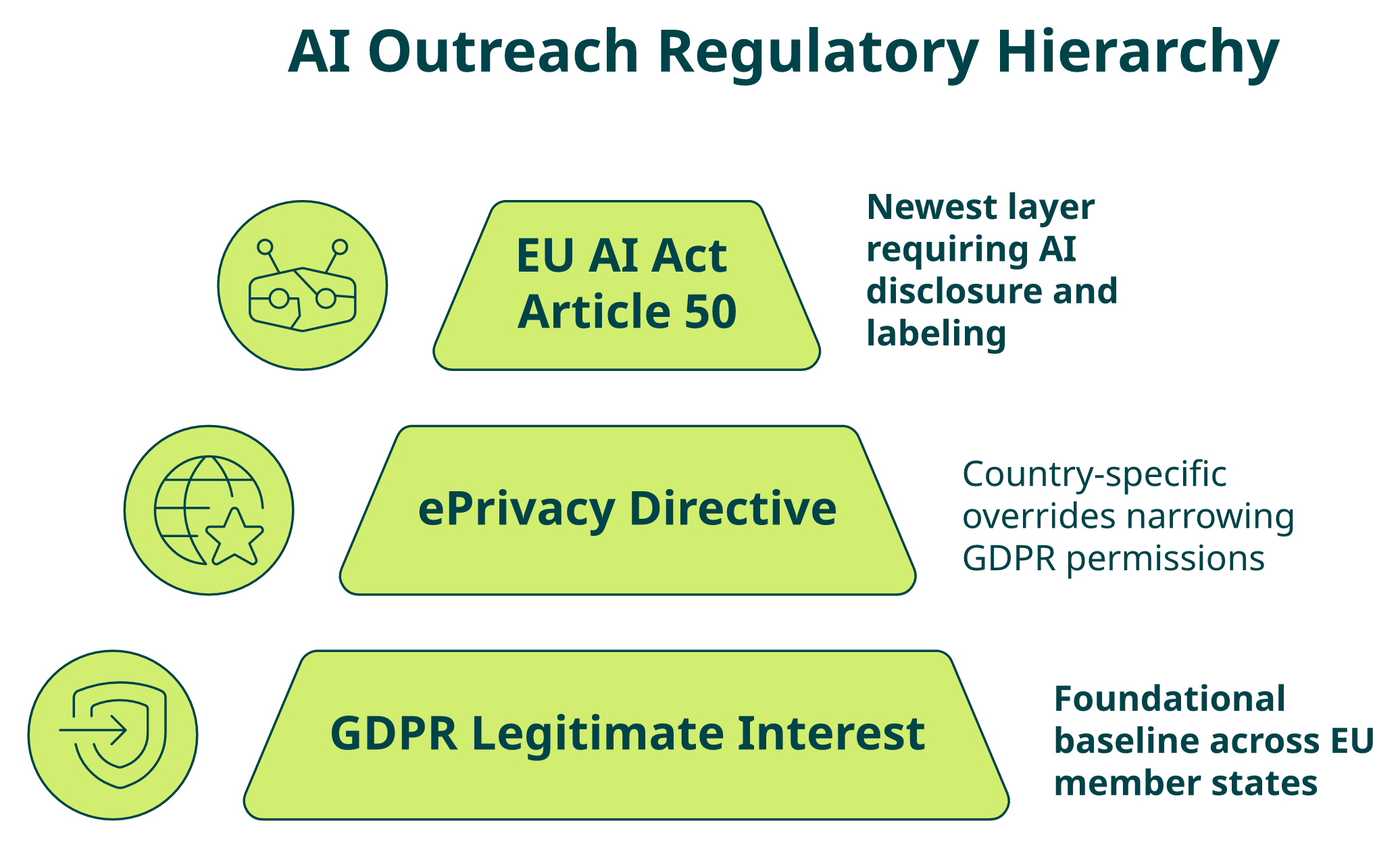
Layer 1: GDPR Legitimate Interest: Valid for B2B cold outreach when documented via LIA with easy opt-out mechanism. Applies across all EU member states as the baseline.
Layer 2: ePrivacy Directive / National Laws: This is where it gets country-specific:
| Country | B2B Cold Email? | Legal Basis | Key Restriction |
|---|---|---|---|
| 🇬🇧 UK | ✅ Allowed | PECR soft opt-in | Corporate subscribers explicitly exempt |
| 🇩🇪 Germany | ⚠️ Restricted | UWG §7 | Prior consent effectively required; strictest in EU |
| 🇫🇷 France | ✅ Allowed | CNIL practice | Role-relevant B2B outreach permitted; suppression list required |
| 🇳🇱 Netherlands | ✅ Allowed | Telecomwet | Generic business emails (info@) acceptable |
| 🇮🇹 Italy | ⚠️ Restricted | Garante guidelines | Consent-heavy; high enforcement risk |
| 🇸🇪 Nordics | ⚠️ Restricted | National implementations | Sweden requires consent; Denmark/Finland more permissive for B2B |
Layer 3: EU AI Act (August 2, 2026): Article 50 mandates that AI systems interacting with people must disclose they are AI. For AI-generated outreach emails, deployers must label content as artificially generated in a machine-readable format. Penalties for non-compliance reach €15 million or 3% of global turnover.
✅ Compliance-by-Design at the Data Layer
This is where the architecture matters. At Explorium, MCP integration enables compliance-by-design: agents query enriched data through our API/MCP with suppression enforcement at the data layer before the agent receives the record. Opted-out contacts are never returned. Data minimization is enforced per-query. Agents retrieve only relevant signals via MCP, not blanket record pulls. Audit trails are generated per API request.
The shift: from “the agent must check” to “the data layer ensures compliant delivery.” An agent that outreaches an opted-out contact in Germany isn’t an agent problem. It’s a data infrastructure problem.
Q8. How to Build a Compliance-First B2B Data Enrichment Workflow
Most teams bolt compliance onto enrichment after it’s built, adding suppression checks as an afterthought, documenting the LIA months post-launch, hoping vendor DPAs cover scenarios nobody actually reviewed. This creates compliance debt that compounds with every enrichment batch. The alternative: build compliance into the architecture from day one.
🔧 The 6-Step Implementation Guide
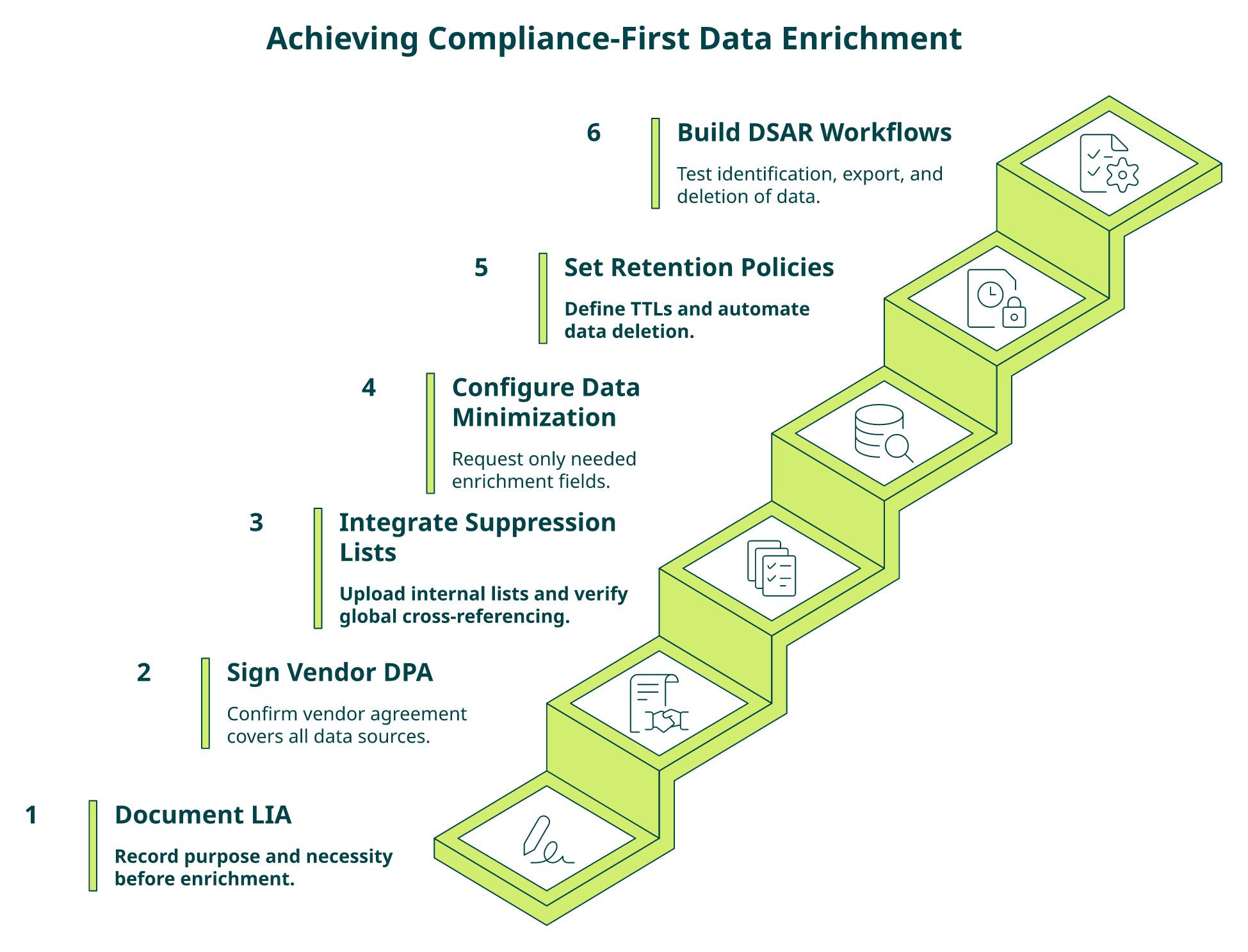
Step 1: Document Your LIA Before the First API Call
Record the purpose, necessity, and balancing test before any enrichment processing begins. This isn’t optional under GDPR. It’s a legal prerequisite. Use the LIA template from Q2: Purpose statement → Data types → Necessity justification → Balancing test → Safeguards → Review date.
Step 2: Sign Vendor DPA and Verify Sub-Processor Coverage
Confirm the DPA covers ALL underlying data sources, not just the vendor’s first-party database. Request the sub-processor list and verify data center locations against your residency requirements.
Step 3: Integrate Suppression / DNC Lists Before First Batch
Upload your internal suppression lists before running the first enrichment batch. Confirm the vendor cross-references against their own global suppression database. Verify the propagation SLA. Same-day batch processing is the minimum acceptable standard.
Step 4: Configure Data Minimization
Request only the enrichment fields your workflow actually needs. MCP-based systems handle this automatically. Agents autonomously select relevant signals per query rather than pulling full records.
Step 5: Set Retention Policies with Automated Deletion
Define TTLs for enriched data. GDPR’s storage limitation principle requires deletion when the processing purpose expires. Automate this. Manual deletion workflows break at scale.
Step 6: Build and Test DSAR Response Workflows
Ensure you can identify, export, and delete all enrichment-derived data within 30 days. Test this with real data before a request arrives, not during the 30-day compliance clock.
🤖 Agent-Specific Safeguards
For teams deploying AI outreach agents, add these layers on top:
- Ensure the agent queries enrichment through a suppression-aware data layer, not raw API calls that bypass opt-out checks
- Log every enrichment request for audit trails (per-call logging, not batch summaries)
- Implement country-level outreach rules based on the ePrivacy matrix from Q7
- Test DSAR workflows with agent-generated data before production. Agent-enriched records often live in unexpected locations across your stack
✅ The Explorium Implementation Path
At Explorium, the compliance-first workflow maps directly to our infrastructure: one DPA covering 50+ sources (Step 2), MCP-based data minimization where agents select only relevant signals (Step 4), global suppression enforcement at the API layer (Step 3), and per-request audit logging (Step 6).
The onboarding path: free account → API/MCP configuration → enrichment validation → compliance verification → production deployment. No sales calls required to start.
“Explorium gives us the data I need when I need it. This saves us a lot of time and money instead of managing each data source separately.”
— Ishi N., Enterprise Explorium G2 – Verified Review
“Credit system is broken. Pricing is broken. Not fully transparent with rollover limit.”
— Raphael A., Marketing Lead, Mid-Market Clay – G2 Verified Review
Create a free Explorium account and test your compliance workflow against 50+ unified sources. Validation takes minutes, not meetings. Start enriching compliantly at explorium.ai.
Q9. FAQ: GDPR & CCPA Compliance for B2B Data Enrichment APIs
Here are the most common compliance questions teams ask when evaluating or using B2B data enrichment APIs, each structured for FAQ schema markup (FAQPage + Question + Answer) to maximize featured snippet and People Also Ask visibility.
❓ Do I need consent to enrich B2B contacts under GDPR?
No. Legitimate interest (Article 6(1)(f)) is the accepted lawful basis for B2B data enrichment when properly documented. The CJEU’s October 2024 KNLTB judgment confirmed that purely commercial interests can qualify as legitimate, but you must pass the three-part test (purpose, necessity, and balancing) and document it in a formal Legitimate Interest Assessment before processing begins.
❓ Does CCPA apply to B2B data in 2026?
Yes. The B2B exemption expired on January 1, 2023, and the California legislature adjourned without extending it. CCPA/CPRA fully applies to enriched professional data of California residents, including work emails, job titles, and phone numbers collected through enrichment APIs.
❓ What is a Data Processing Agreement, and do I need one with my enrichment vendor?
Yes. GDPR Article 28 requires a signed DPA with any processor handling personal data on your behalf. The DPA must cover all underlying data sources your vendor accesses, not just their first-party database. If your vendor aggregates from multiple providers, the DPA should include a sub-processor list covering all of them.
❓ How fast must opt-out requests be processed?
GDPR requires processing “without undue delay.” Best practice is same-day propagation across all sources. CCPA requires response within 15 business days. For enrichment APIs specifically, verify your vendor’s suppression propagation SLA and whether opt-outs prevent re-entry from alternate sources in the database.
⚠️ Is waterfall enrichment GDPR-compliant?
It can be, but compliance depends on implementation. Each provider in the waterfall chain needs a DPA, documented data sourcing, and suppression enforcement. Article 14 obligations apply: you must track which provider sourced which field and when. A unified API that handles compliance across all underlying sources eliminates the per-provider governance burden that makes traditional waterfalls risky.
❓ Can I store enriched data indefinitely?
No. GDPR’s storage limitation principle (Article 5(1)(e)) requires defined retention periods. Delete enriched data when the processing purpose expires. Set automated TTL-based deletion. Manual retention workflows break at scale.
❓ What certifications should a compliant enrichment vendor have?
SOC 2 Type II and/or ISO 27001 at minimum. Also verify: DPA availability covering all sub-processors, suppression architecture documentation, data residency options, and documented accuracy benchmarks per field type, not just record count claims.
✅ Does Explorium handle GDPR and CCPA compliance?
Yes. We provide enterprise-grade GDPR and CCPA compliance across all 50+ underlying data sources through one DPA. The infrastructure includes global suppression enforcement, documented data sourcing, data residency options, and resale rights on custom plans. The same compliance framework trusted by Clay, Cognism, Outreach, and global enterprises like Pepsi.
💡 Schema Implementation Note
Each FAQ above is structured for JSON-LD FAQ schema implementation (FAQPage + Question + acceptedAnswer). Implement on your published page to maximize featured snippet eligibility and People Also Ask visibility.
The Architectural Answer
Most of these questions resolve to the same structural answer: use a unified enrichment API that handles compliance across all underlying sources, so your team focuses on building, not auditing.
“Instead of connecting to multiple data sources and APIs, we only require one connection — Explorium!”
— Mirit H., Mid-Market Explorium G2 – Verified Review
“Steals personal data and sells to companies. Low security measures caused data to leak to internet and dark web.”
— Stanislav V., DE People Data Labs – Trustpilot Review
“Obtained private phone number and sold it for sales purposes without consent. Not in line with GDPR.”
— Lex Houweling, NL Cognism – Trustpilot Review
Create a free Explorium account and test compliance-first enrichment against 50+ unified sources. Validation takes minutes, not meetings. Start at explorium.ai.
FAQs


