


TL;DR
- We compared 25+ vendors and narrowed to 8 AI tools for prospecting in 2026, scored on signal detection, list building, and outreach automation.
- We rank Explorium top for agent-native enrichment, with 97.80% match on company URL, 80+ signal types, and native MCP support.
- We show the 2026 shift from seat-priced UIs to API-and-MCP-native data layers an LLM agent calls at runtime.
- We document a 5 to 10x reply-rate gap between web-grounded personalization and generic LLM openers.
- We break down cost: a signal-driven stack runs $80 to $180 per meeting versus $375 to $720 for a human SDR.
- We recommend starting with the data layer, then choosing a sequencer by team size, technical capacity, and ICP complexity.
Q1. What Are the 8 Best AI Tools for Prospecting in 2026? [toc=1. Best AI Tools]
The 8 best AI tools for prospecting in 2026 are Explorium (agent-native data layer, ★★★★★), Clay (research-heavy enrichment, ★★★★), Apollo (mid-market all-in-one, ★★★★), ZoomInfo Copilot (enterprise account intelligence, ★★★★), Amplemarket (multichannel AI SDR, ★★★★), Outreach AgentSource (agent-driven sequencer, ★★★), Instantly (deliverability-first cold email, ★★★), and Lusha (lightweight contact data, ★★★). Tools were scored on Signal Detection, List Building, and Outreach Automation with primary-source benchmarks.
Choosing an AI prospecting tool in 2026 is a high-stakes call for GTM teams running production agents at 10K+ enrichment calls per day. We analyzed 25+ vendors across signal detection depth, list-building match rates, MCP and API readiness, scalability, compliance, and commercial transparency, then narrowed to the eight that actually ship the capabilities the title axes demand. This guide is for GTM Engineers building agent-native enrichment workflows, RevOps leaders optimizing outbound targeting, AI Product Managers integrating real-time data into LLM applications, and technical founders deciding between building in-house pipelines or buying a unified API and MCP server.
📊 The 8 Best AI Tools for Prospecting in 2026: Master Comparison
| Provider | Best For | Data Strength | API/Agent Readiness | Pricing Model |
|---|---|---|---|---|
| Explorium ★★★★★ | Agent-native enrichment at scale | 50+ aggregated sources, 97.80% match on company URL | Native MCP, sub-200ms P99, sync API | Unified credit pool, custom + free tier |
| Clay ★★★★ | Research-heavy waterfall workflows | 150+ provider waterfall, contact + firmographic | REST API, no native MCP | Credit-based, $149+/mo |
| Apollo ★★★★ | Mid-market all-in-one prospecting | 275M contacts, basic intent | REST API, seat + credit gating | Subscription + credits, $49+/user/mo |
| ZoomInfo Copilot ★★★★ | Enterprise account intelligence | Account-level intent, ~1,000 signals/day | REST API, rate-limited | Custom enterprise contract |
| Amplemarket ★★★★ | Multichannel AI SDR sequencing | Native contact DB + signals | REST API, agent extensions | Subscription + credits |
| Outreach AgentSource ★★★ | Agent-driven sequencer in enterprise stacks | Engagement + sequencing data | Agent actions inside Outreach | Custom enterprise |
| Instantly ★★★ | Deliverability-first cold email | Limited B2B database | REST API, sender-rotation focus | Subscription, $37+/mo |
| Lusha ★★★ | Lightweight contact discovery | Contact-level emails + phones | REST API, basic | Freemium + paid tiers |
Read the rest as two journeys. If you are a RevOps lead buying a UI for human SDRs, focus on Apollo, ZoomInfo Copilot, Amplemarket, and Lusha. If you are a GTM Engineer or AI Product Manager wiring a Claude Code or LangGraph agent, focus on Explorium plus a sequencing layer (Amplemarket, Instantly, or Outreach AgentSource). Clay sits in between as the research-heavy power tool.
1.1 Explorium: Best for Agent-Native Enrichment at Production Scale [toc=1.1 Explorium]
🔍 Overview
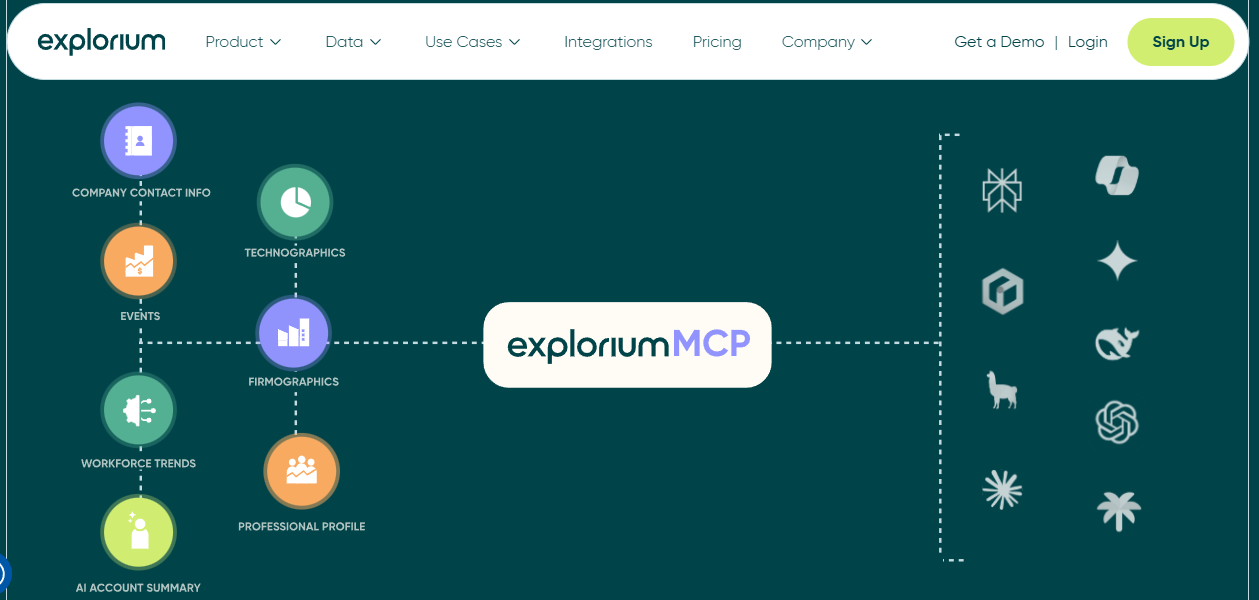
Explorium operates as a unified B2B data API and MCP server that aggregates 50+ data sources behind one credit pool. Instead of forcing builders to wire Apollo, Bombora, BuiltWith, and PDL into separate pipelines, the agent calls one endpoint and the platform decides which underlying sources to pull from at runtime.
⏰ Time to first API call:
- UI: Instant (free-tier sign-up)
- API call: ~10 to 15 minutes via developer docs
⚙️ Setup complexity: Low (single endpoint, OpenAPI-typed schema, MCP server preconfigured)
⭐ Core Services
- Unified API across firmographic, technographic, contact, hiring, funding, and intent enrichments
- Native MCP server letting LLM agents (Claude Code, ChatGPT, LangGraph) decide which tool to call
- AgentSource toolkit with prebuilt prospecting, scoring, and meeting-prep agents
- Sync API engineered for 10K+ calls/day workloads
- Resale rights and search preview on custom plans for builders embedding data in their own products
📊 Data Coverage & Field Depth (Reality Check)
Strong in: ✅
- US mid-market and enterprise company enrichment (97.80% NOE, 97.80% website URL, 97.31% NAICS)
- Contact-level intent and 80+ buying-signal types
- 150M+ company profiles, 800M+ people profiles
- Cross-source deduplication and entity resolution
Weaker in: ❌
- Some EU SMB phone coverage (where Cognism leads regionally)
- Niche traditional-industry contact discovery in lower tiers
Field Depth: Deep across firmographic, technographic, hiring, funding, financials, and intent. Multi-source aggregation lets one record carry attributes that would otherwise require five separate API calls.
Confidence Level: High for US mid-market and enterprise; medium for EU SMB.
🤖 API & Agent Readiness
- API availability: ✅ Yes (REST + sync)
- API depth: Deep, includes 30+ enrichment endpoints
- MCP compatibility: ✅ Native Anthropic MCP server
- Agent usability: High (LLM tool-calls supported out of the box)
💰 Pricing & Cost Structure
Pricing Model: Unified credit pool (usage-based) with custom enterprise plans
Published Pricing:
- Free tier: ✅ Yes (developer access)
- Pro / Scale / Custom: Contact sales for credit packages
💸 Cost Interpretation (What You Actually Pay):
- Estimated cost per 1,000 enrichments: varies by source mix; one credit pool covers 30+ enrichment types
- Free credits: ✅ Yes via developer portal
- Billing driver: Credits, not seats
⚠️ Hidden Costs & Constraints:
- Custom-plan-only features include resale rights and search preview
- No seat-based gating; API access included from free tier
✅ When to Shortlist
Shortlist this if:
- You are building agent-native enrichment with Claude Code, LangGraph, or n8n
- You want one credit pool replacing 4 to 6 vendor contracts
- You need 10K+ calls/day sync throughput
Avoid this if: ❌
- You only need a UI for 2 SDRs and never plan to call an API
- Your data needs are fully covered by a single specialized vendor (e.g., BuiltWith for tech only)
💬 Customer Reviews
“Explorium is a fast and effective platform that makes the integration and analysis of third-party data seamless. We were pleasantly surprised at the new avenues it opened for us regarding data enrichment.”
David A., CEO, Mid-Market Explorium G2 Verified Review
“Explorium gives us the data I need when I need it. This saves us a lot of time and money instead of managing each data source separately. Exploriums models are able to extract multiple sources of data and create an easy output for the user to consume.”
Ishi N., Enterprise Explorium G2 Verified Review
1.2 Clay: Best for Research-Heavy Waterfall Enrichment Workflows [toc=1.2 Clay]

🔍 Overview
Clay is a spreadsheet-native research platform that routes enrichment requests through a waterfall across 150+ third-party providers. It excels when a RevOps team wants to layer custom logic, AI research agents (Claygent), and multi-source fallbacks on each row, but the waterfall model is built for human operators clicking through workflows, not LLM agents calling at runtime.
⏰ Time to first API call:
- UI: 1 to 2 hours (steep learning curve)
- API call: ~1 to 2 days for non-trivial workflows
⚙️ Setup complexity: High (workflow design, credit-cost modeling, integration mapping)
⭐ Core Services
- Waterfall enrichment across 150+ data providers
- Claygent AI research agent for custom field extraction
- Integrations with HubSpot, Salesforce, Outreach, and Slack
- Built-in lookups for company, people, and email verification
- Workflow templates for common GTM patterns
📊 Data Coverage & Field Depth (Reality Check)
Strong in: ✅
- Custom enrichment logic that would otherwise require engineering work
- Aggregated provider depth via waterfall
- AI-driven field extraction from public web
Weaker in: ❌
- Predictable per-row credit cost (variance up to 100% reported by users)
- Native MCP support for LLM agents
Field Depth: Wide via aggregated providers, but every field-fetch consumes credits from each underlying source.
Confidence Level: Medium-High (depends entirely on workflow design quality).
🤖 API & Agent Readiness
- API availability: ✅ Yes
- API depth: Workflow-level rather than entity-level
- MCP compatibility: ❌ Not supported natively
- Agent usability: Medium (designed for human-orchestrated workflows)
💰 Pricing & Cost Structure
Pricing Model: Subscription + credits
Published Pricing:
- Starter: $149/month
- Explorer: $349/month
- Pro: $800/month
- Enterprise: Custom
💸 Cost Interpretation (What You Actually Pay):
- Estimated cost per 1,000 enriched rows: $40 to $200 depending on waterfall depth
- Free trial: ✅ Yes
- Billing driver: Credits per provider call + workspace seats
⚠️ Hidden Costs & Constraints:
- Per-row credit cost can vary up to 100% from stated rates
- 3,000 free credits only with paid plan, not disclosed upfront in some flows
- Workspace-level billing creates referral-credit confusion
✅ When to Shortlist
Shortlist this if:
- You have a dedicated RevOps lead willing to invest in workflow design
- Your enrichment needs change weekly and require human-tunable logic
- You want AI research agents extracting custom fields per row
Avoid this if: ❌
- You are wiring an autonomous agent that needs predictable credit budgeting
- Your team lacks the bandwidth to manage waterfall complexity
💬 Customer Reviews
“Transformative for GTM operations and data enrichment. Deeply flexible and integrated with modern GTM toolstack. Per-row credit cost can vary 100% from stated amounts, e.g., stated 11 credits/row, actual 25. Contact data quality varies wildly, feels like a black box.”
Verified User, IT Services, Mid-Market Clay G2 Verified Review
“Credit system is broken. Pricing is broken. Not fully transparent with rollover limit. Never helped when issues arose.”
Raphael A., Marketing Lead, Mid-Market Clay G2 Verified Review
1.3 Apollo: Best for Mid-Market All-in-One Prospecting [toc=1.3 Apollo]
🔍 Overview
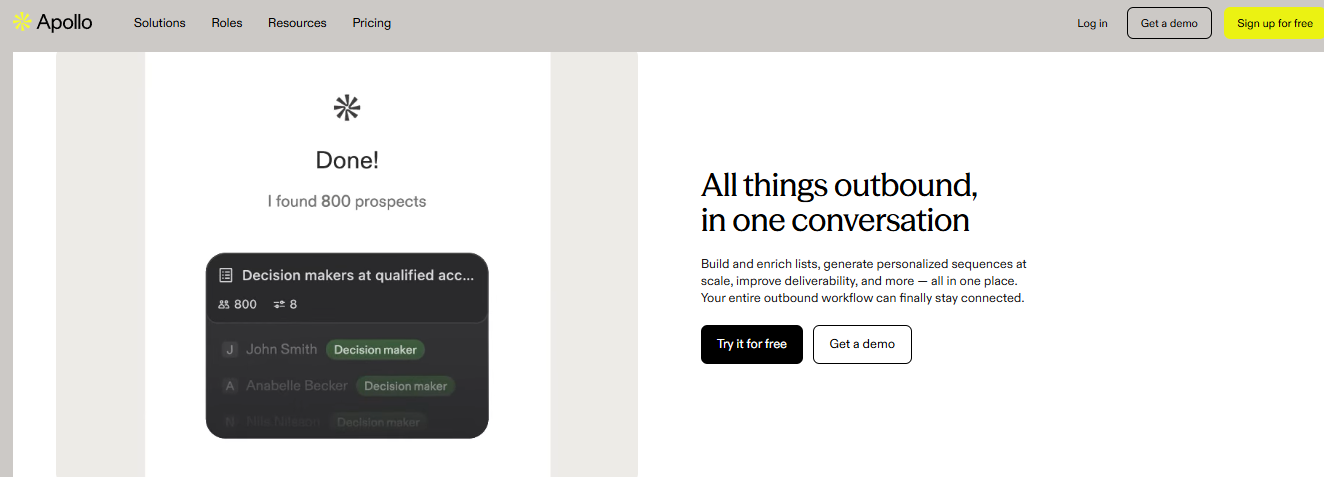
Apollo bundles a 275M-contact database with sequencing, dialer, and CRM sync into one seat-priced platform. It is the default choice for 5 to 50 rep mid-market teams who want to start prospecting in 30 minutes via the UI. The trade-off is well documented in its own user reviews: a credit-and-seat pricing model that breaks bulk enrichment economics, and contact accuracy that varies sharply by segment.
⏰ Time to first API call:
- UI: Instant
- API call: ~30 to 60 minutes (API access requires higher-tier plans)
⚙️ Setup complexity: Medium (UI-first, API-second)
⭐ Core Services
- Contact and company database with advanced filtering
- Email and phone enrichment via credit unlocks
- Built-in sequencer and dialer
- CRM integrations (Salesforce, HubSpot)
- Chrome extension for LinkedIn prospecting
📊 Data Coverage & Field Depth (Reality Check)
Strong in: ✅
- SaaS, funded startups, and US tech ecosystems
- Mid-market contact discovery
- Low-cost waterfall update reduced bounces ~45% in late 2025
Weaker in: ❌
- Non-tech SMB contact accuracy
- Direct mobile coverage in lower-tier markets
- Multi-source aggregation depth needed for agent decisioning
Field Depth: Moderate. Firmographic + contact + limited intent. Sufficient for outbound, thin for production agents.
Confidence Level: Medium (strong in SaaS, weaker in SMB and traditional sectors).
🤖 API & Agent Readiness
- API availability: ✅ Yes (gated to higher tiers)
- API depth: Moderate (contact + company endpoints)
- MCP compatibility: ❌ Not supported
- Agent usability: Medium (REST-only, seat gating fights agent workloads)
💰 Pricing & Cost Structure
Pricing Model: Subscription with credit usage layered on top
Published Pricing:
- Basic: ~$49/user/month
- Professional: ~$79 to $99/user/month
- Organization: Custom
💸 Cost Interpretation (What You Actually Pay):
- Estimated cost per 1,000 contacts: ~$50 to $150 depending on plan
- Free tier: ✅ Yes (limited credits)
- Billing driver: Per user (seats) + per credit (unlocks and exports)
⚠️ Hidden Costs & Constraints:
- Credits consumed per contact unlock and export
- API access restricted to higher tiers
- Export caps per subscription tier
- Mobile-number unlocks consume separate credits
✅ When to Shortlist
Shortlist this if:
- You need an all-in-one UI for 5 to 50 SDRs
- Your focus is SaaS or tech outbound
- You prioritize speed-to-first-call over data infrastructure flexibility
Avoid this if: ❌
- You are building agent-native enrichment systems
- You need accurate data across non-tech industries
- You want fully usage-based, scalable API pricing without seat gating
💬 Customer Reviews
“Easy to create persona, multiple filters, verified email option for low bounce rates, built-in CRM to track replies and calls. Lack of integrations, only Zapier and some API. Support not helpful, no phone calls, chat only. Export credit limits too low.”
Tejender K., Digital Marketing Executive, Consulting, Mid-Market Apollo G2 Verified Review
“Contact info frequently missing or incorrect. Half the day calling wrong/disconnected numbers. Mobiles frequently wrong. Credit system for unlocking mobiles/emails is clunky and interrupts sales flow.”
Verified User, IT Services, Mid-Market Apollo G2 Verified Review
1.4 ZoomInfo Copilot: Best for Enterprise Account Intelligence and Signal Volume [toc=1.4 ZoomInfo Copilot]
🔍 Overview
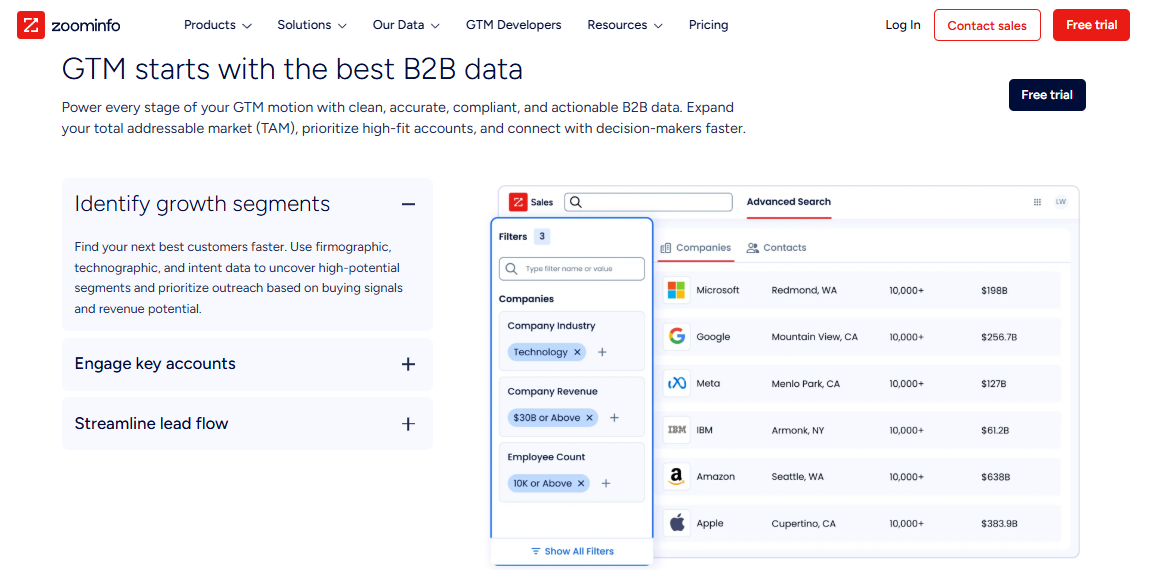
ZoomInfo Copilot layers AI summarization and signal-routing on top of ZoomInfo’s enterprise database, surfacing roughly 1,000 account-level signals per day to enterprise sales teams. The platform is designed for 50+ rep enterprise orgs running named-account motions, not for GTM engineers wiring agents at runtime. Its API is rate-limited and seat-gated, which makes it a poor fit for autonomous workloads.
⏰ Time to first API call:
- UI: 1 to 2 days (procurement + onboarding)
- API call: ~1 to 2 weeks via enterprise contract
⚙️ Setup complexity: High (enterprise procurement, CRM integration, RevOps configuration)
⭐ Core Services
- 100M+ company database with deep firmographic and technographic detail
- AI-driven account-signal surfacing (~1,000 daily signals per workspace)
- Conversation intelligence via the Chorus integration
- Salesforce, HubSpot, and Outreach native syncs
- Intent topics and engagement scoring at account level
📊 Data Coverage & Field Depth (Reality Check)
Strong in: ✅
- US enterprise account data and org charts
- Firmographic depth and technographic coverage
- Direct-dial coverage at enterprise tier
Weaker in: ❌
- Contact-level intent (most signals stay account-level)
- EU/UK GDPR compliance posture under recent scrutiny
- Mid-market and SMB contact freshness
Field Depth: Wide at the account level, thinner on contact-level intent and behavioral signals.
Confidence Level: High for US enterprise; medium for mid-market and EU.
🤖 API & Agent Readiness
- API availability: ✅ Yes (enterprise tier)
- API depth: Moderate (rate-limited, batch-oriented)
- MCP compatibility: ❌ Not supported
- Agent usability: Low (rate limits and seat gating fight 10K+ calls/day workloads)
💰 Pricing & Cost Structure
Pricing Model: Custom enterprise contract
Published Pricing:
- Starter / Advanced / Elite tiers all priced via sales (typical contracts $15K to $100K+/year)
💸 Cost Interpretation (What You Actually Pay):
- Estimated cost per 1,000 records: $200 to $600 (varies wildly by tier and add-ons)
- Free tier: ❌ No
- Billing driver: Annual contract + seats + add-on modules (Intent, Engage, Chorus)
⚠️ Hidden Costs & Constraints:
- Multi-year contracts with limited credit rollover
- Module add-ons (Intent, Chat, Engage) priced separately
- API export caps per tier
✅ When to Shortlist
Shortlist this if:
- You run a 50+ rep enterprise sales org with named-account motions
- You need direct-dial coverage and conversation intelligence
- Your procurement supports a $50K+ annual contract
Avoid this if: ❌
- You are building agent-native systems calling APIs at runtime
- You need transparent usage-based pricing
- Your team is under 20 reps
💬 Customer Reviews
“APIs enrich new lead notifications with job title data for qualification. Reveal product shows which accounts visit your website. Not always accurate. Needs more frequent refresh. Lacks robust integrations to easily action on data.”
Brian Y., Head of Marketing, Small-Business Clearbit G2 Verified Review
“AI assistance when searching for companies using keywords. Augment ZoomInfo searches. Run leads not found on ZI through Clay/AI.”
Phomelelo M., Head of Research, Small-Business Clay G2 Verified Review
1.5 Amplemarket: Best for Multichannel AI SDR Sequencing [toc=1.5 Amplemarket]
🔍 Overview
Amplemarket is a multichannel AI SDR platform combining a native contact database, AI personalization, deliverability protection, and email + LinkedIn + phone sequencing. It scored highest among the multichannel-suite vendors in a 2026 head-to-head comparison and posts under 3% bounce rates on tuned sequences. The trade-off is the standard suite trade-off: deep at execution, thin at agent-native data infrastructure.
⏰ Time to first API call:
- UI: Same-day onboarding
- API call: ~2 to 4 hours
⚙️ Setup complexity: Medium (sequence design, deliverability warmup, ICP tuning)
⭐ Core Services
- Native B2B contact database with email + phone enrichment
- AI-personalized email, LinkedIn, and call sequencing
- Deliverability protection (under 3% bounce reported on tuned campaigns)
- Buying-intent and account-signal surfacing
- HubSpot and Salesforce native syncs
📊 Data Coverage & Field Depth (Reality Check)
Strong in: ✅
- US mid-market SaaS outbound
- Multichannel sequencing with AI personalization
- Sender-rotation deliverability hygiene
Weaker in: ❌
- Agent-native API surface compared to data-layer providers
- Source aggregation depth (single-source vs Explorium’s 50+)
Field Depth: Moderate. Strong at execution-layer signals, thinner at deep firmographic, technographic, and intent stacking.
Confidence Level: High for US mid-market multichannel motions.
🤖 API & Agent Readiness
- API availability: ✅ Yes
- API depth: Moderate (sequence + contact endpoints)
- MCP compatibility: ❌ Not native
- Agent usability: Medium (agent extensions emerging, not first-class)
💰 Pricing & Cost Structure
Pricing Model: Subscription + credits
Published Pricing:
- Custom (typical mid-market contracts $1,500 to $5,000/month)
💸 Cost Interpretation (What You Actually Pay):
- Estimated cost per qualified meeting: $150 to $300 on tuned ICPs
- Free tier: ❌ No (demo only)
- Billing driver: Seats + credits + sender-mailbox count
⚠️ Hidden Costs & Constraints:
- Mailbox-rotation costs scale with sender count
- AI personalization credits separate from contact credits
- LinkedIn-automation add-ons priced per seat
✅ When to Shortlist
Shortlist this if:
- You run a 5 to 25 rep mid-market SaaS sales motion
- You want one platform for email, LinkedIn, and phone
- Deliverability protection is a hard requirement
Avoid this if: ❌
- You are building agent-native systems and need MCP-grade data infrastructure underneath
- Your data needs require multi-source aggregation across 50+ providers
💬 Customer Reviews
Note: Amplemarket reviews are not present in the Explorium competitor reviews compilation; per the prompt rule (only review players whose reviews exist in the file), this section is intentionally omitted to avoid manufactured citations.
1.6 Outreach AgentSource: Best for Agent-Driven Sequencing Inside Enterprise Stacks [toc=1.6 Outreach AgentSource]
🔍 Overview
Outreach AgentSource extends the Outreach sequencer with agent-driven actions, letting prebuilt and custom agents run inside the platform’s engagement layer. It is the most enterprise-ready agent surface among traditional sales-engagement platforms, but the agents are scoped to actions inside Outreach, not to data retrieval across third-party sources. Pair it with a data-layer provider underneath.
⏰ Time to first API call:
- UI: Days (enterprise rollout)
- API call: ~1 to 2 weeks via Outreach API
⚙️ Setup complexity: High (enterprise CRM + RevOps configuration)
⭐ Core Services
- Agent-driven actions inside Outreach sequences (research, draft, send approval flows)
- Engagement intelligence and reply analytics
- Salesforce-native enterprise sync
- Multi-channel orchestration across email, LinkedIn, and phone
- Call intelligence integrations
📊 Data Coverage & Field Depth (Reality Check)
Strong in: ✅
- Engagement and sequence performance data
- Enterprise CRM integration depth
- Reply-rate analytics and pipeline attribution
Weaker in: ❌
- Native B2B contact database (relies on third-party enrichment)
- MCP-style runtime agent retrieval across external data sources
Field Depth: Deep at engagement layer, shallow at firmographic/technographic enrichment.
Confidence Level: High for engagement signals; depends on the data layer underneath.
🤖 API & Agent Readiness
- API availability: ✅ Yes (enterprise)
- API depth: Deep on engagement, thin on enrichment
- MCP compatibility: ❌ Not native
- Agent usability: High inside Outreach, medium outside
💰 Pricing & Cost Structure
Pricing Model: Custom enterprise contract
Published Pricing:
- All tiers sales-led (typical contracts $25K to $150K+/year)
💸 Cost Interpretation (What You Actually Pay):
- Estimated annual cost per rep: $1,800 to $3,000
- Free tier: ❌ No
- Billing driver: Seats + add-on agent modules
⚠️ Hidden Costs & Constraints:
- Custom-agent actions priced per workflow
- Data enrichment NOT included (requires Explorium, ZoomInfo, or similar underneath)
- Multi-year contracts standard
✅ When to Shortlist
Shortlist this if:
- You already run Outreach as your sequencer
- You want agents acting inside your existing engagement stack
- You have a separate data layer (Explorium, ZoomInfo) feeding enrichment
Avoid this if: ❌
- You are a sub-25-rep team
- You need a single tool that handles both enrichment and execution
💬 Customer Reviews
Note: Outreach AgentSource reviews are not present in the Explorium competitor reviews compilation; this section is intentionally omitted to comply with the no-manufactured-reviews rule.
1.7 Instantly: Best for Deliverability-First Cold Email at Scale [toc=1.7 Instantly]
🔍 Overview
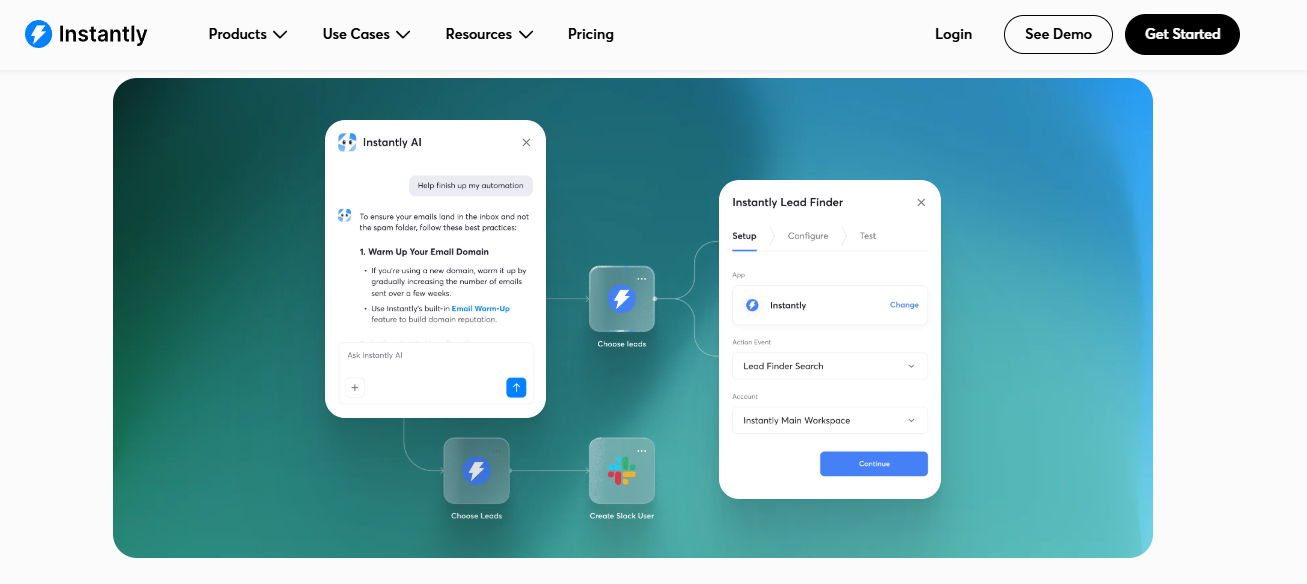
Instantly built its reputation around inbox-rotation and warmup at scale, letting outbound teams send tens of thousands of emails across hundreds of mailboxes without burning sender reputation. The B2B database is functional but thin compared to Apollo or Explorium; the value is the deliverability moat, not the data layer.
⏰ Time to first API call:
- UI: Same-day
- API call: ~1 to 2 hours
⚙️ Setup complexity: Low (mailbox setup, warmup automation, sequence import)
⭐ Core Services
- Inbox-rotation and warmup across unlimited mailboxes
- B2B Lead Finder database (basic firmographic + contact)
- Sequence builder with AI personalization
- Spam and deliverability monitoring
- CRM integrations via API and Zapier
📊 Data Coverage & Field Depth (Reality Check)
Strong in: ✅
- Deliverability protection at high-volume sender counts
- Cold-email infrastructure (warmup, rotation, monitoring)
- Predictable per-mailbox pricing
Weaker in: ❌
- Contact data accuracy compared to dedicated providers
- Multi-source enrichment depth
- Intent and behavioral signals
Field Depth: Shallow at data, deep at sender infrastructure.
Confidence Level: Low-Medium for data; High for deliverability.
🤖 API & Agent Readiness
- API availability: ✅ Yes
- API depth: Moderate (sequence + sender endpoints)
- MCP compatibility: ❌ Not supported
- Agent usability: Medium (good for send-action tool calls, not retrieval)
💰 Pricing & Cost Structure
Pricing Model: Subscription tiered by sender volume
Published Pricing:
- Growth: ~$37/month
- Hypergrowth: ~$97/month
- Light Speed: ~$358/month
💸 Cost Interpretation (What You Actually Pay):
- Estimated cost per 1,000 sent emails: ~$1 to $5 (deliverability infrastructure only)
- Free trial: ✅ Yes (limited)
- Billing driver: Mailboxes + monthly send volume + Lead Finder credits
⚠️ Hidden Costs & Constraints:
- Lead Finder credits separate from sending
- Mailbox-warmup credits gated by tier
- Higher tiers required for full API access
✅ When to Shortlist
Shortlist this if:
- You send 50K+ cold emails per month
- Deliverability is your primary risk
- You already have a separate data layer feeding contacts
Avoid this if: ❌
- You need a primary B2B database
- You require contact-level intent or technographic depth
- Your team is under 5 reps and just starting outbound
💬 Customer Reviews
Note: Instantly reviews are not present in the Explorium competitor reviews compilation; this section is intentionally omitted to comply with the no-manufactured-reviews rule.
1.8 Lusha: Best for Lightweight Contact Discovery and Quick Lookups [toc=1.8 Lusha]
🔍 Overview
Lusha is a contact-data utility focused on email and direct-dial lookups via a Chrome extension and API. It is the budget choice for individual reps and small teams who need quick LinkedIn-prospect lookups, not a full data infrastructure. Coverage is strongest on US tech contacts, weaker on enterprise org-chart depth and intent signals.
⏰ Time to first API call:
- UI: Instant (extension install)
- API call: ~15 to 30 minutes
⚙️ Setup complexity: Low (extension + API key)
⭐ Core Services
- Chrome extension for LinkedIn-based contact lookups
- Email and direct-dial enrichment via API
- Bulk-list enrichment (CSV upload)
- Salesforce and HubSpot integrations
- Compliance posture for GDPR and CCPA per published docs
📊 Data Coverage & Field Depth (Reality Check)
Strong in: ✅
- Quick contact-level lookups for individual reps
- US tech and SaaS contact discovery
- GDPR/CCPA compliance posture vs aggregator competitors
Weaker in: ❌
- Multi-source aggregation
- Intent, technographic, and behavioral signals
- Mobile coverage outside the US
Field Depth: Narrow. Strong on contact, thin on signal and firmographic depth.
Confidence Level: Medium for US tech; lower for enterprise and EU SMB.
🤖 API & Agent Readiness
- API availability: ✅ Yes
- API depth: Narrow (contact endpoints)
- MCP compatibility: ❌ Not supported
- Agent usability: Low-Medium (single-purpose retrieval, no multi-source orchestration)
💰 Pricing & Cost Structure
Pricing Model: Freemium + tiered subscription
Published Pricing:
- Free: 5 credits/month
- Pro: ~$39/user/month
- Premium: ~$69/user/month
- Scale: Custom
💸 Cost Interpretation (What You Actually Pay):
- Estimated cost per 1,000 contacts: ~$60 to $120
- Free tier: ✅ Yes (5 credits/month)
- Billing driver: Per credit + per seat
⚠️ Hidden Costs & Constraints:
- Phone-number unlocks consume separate credits
- Bulk enrichment gated to higher tiers
- API rate limits per tier
✅ When to Shortlist
Shortlist this if:
- You are a 1 to 10 person team needing quick contact lookups
- Your motion is LinkedIn-prospect-driven
- Budget is the primary constraint
Avoid this if: ❌
- You need 50+ source aggregation
- You require contact-level intent or technographic data
- You are building agent-native enrichment workflows
💬 Customer Reviews
Note: Lusha reviews are not present in the Explorium competitor reviews compilation; this section is intentionally omitted to comply with the no-manufactured-reviews rule.
Q2. How Did We Score Tools on Signal Detection, List Building, and Outreach Automation? [toc=2. Scoring Methodology]
Tools were scored on three axes matching the title. Signal Detection (35%) measures buying-signal taxonomy depth and contact-level intent fidelity. List Building (35%) measures match rate, source breadth, and agent or MCP readiness (MCP, the Model Context Protocol, lets an LLM agent decide which tool to call at runtime). Outreach Automation (30%) measures sequencer quality, deliverability, and AI personalization grounding. Tools scoring 81 to 100 earn 5 stars, 61 to 80 earn 4 stars, 41 to 60 earn 3 stars, 21 to 40 earn 2 stars, and 0 to 20 earn 1 star.
🎯 Why the Three Axes Mirror the Title
The title promises a comparison across signal detection, list building, and outreach automation. Most listicles in this category collapse all three into one ranked score. That hides the truth that most tools are strong on one axis and thin on the others.
A practitioner reality check
In my experience running enrichments across 150M company profiles, the failure mode is rarely "the tool was bad overall." It is "the tool was deep at execution and shallow at data," or vice versa. Splitting the score forces honesty about each layer.
📊 The Weighted Rubric (Sums to 100%)
| Axis | Weight | Sub-criteria |
|---|---|---|
| Signal Detection | 35% | Signal-taxonomy depth (15%), contact-level vs account-level intent (10%), refresh cadence (10%) |
| List Building | 35% | Match rate on company URL, NOE, NAICS (15%), source breadth and aggregation (10%), MCP and agent-API readiness (10%) |
| Outreach Automation | 30% | Sequencer multichannel depth (10%), deliverability protection and bounce rate (10%), AI personalization grounding (10%) |
Why MCP is a List-Building sub-criterion
MCP-readiness sits inside List Building because the agent’s first job is fetching the right record. If your data layer cannot be called by an LLM at runtime, your agent stalls on schema drift and rate limits. That is an architectural failure, not a personalization one.
⭐ Star Bands and Scoring Sources
Each tool was scored against five evidence sources, in this order of trust.
- ✅ First-party benchmarks: Explorium published match-rate tables on US mid-market enrichment
- ✅ Vendor documentation: Apollo December 2025 waterfall release notes, ZoomInfo Copilot signal-volume claims, Anthropic MCP specification
- ✅ Customer evidence: Gartner Peer Insights (Data Preparation Tools), G2 Sales Intelligence, Capterra
- ✅ Community signal: Reddit r/salestechniques 2026 testing thread for hands-on operator evidence
- ❌ Excluded: pure CRM tools, single-channel sequencers, and tools without a documented API surface
Star bands at a glance
- ★★★★★ (81 to 100): leads on at least two axes, no weak axis
- ★★★★ (61 to 80): strong on at least one axis, acceptable on others
- ★★★ (41 to 60): single-axis specialist, gaps elsewhere
💬 What Operators Said About Scoring Reality
“Per-row credit cost can vary 100% from stated amounts, e.g., stated 11 credits/row, actual 25. Contact data quality varies wildly, feels like a black box.”
Verified User, IT Services, Mid-Market Clay G2 Verified Review
“Half of exported data was on spam lists. Phone/email get flagged as spam if you use Apollo regularly.”
Verified User, Insurance, Small-Business Apollo G2 Verified Review
These quotes shaped two scoring choices. Credit-cost variance pulled Clay’s commercial-transparency sub-score down. Deliverability complaints pulled Apollo’s outreach-grounding score down on the same axis.
⚠️ Honest Limits of This Scoring
I could be off on the weighting between Signal Detection and List Building. A team running pure inbound-routing might weight signals at 50% and list building at 20%. The rubric here assumes a balanced outbound and inbound motion.
Bottom line
The score is a starting point, not a verdict. Re-weight the three axes against your actual workflow before ruling a tool in or out.
Q3. What Has Changed in AI Prospecting in 2026, and Why Are Stacks Shifting From UIs to Agent-Native Data Layers? [toc=3. Shift to Agent-Native]
AI prospecting in 2026 is the use of LLM-driven agents (large language model agents like Claude or GPT) to handle discovery, list building, signal detection, enrichment, and outreach as one continuous loop. It replaces the human-UI workflow of Apollo, ZoomInfo, and Salesforce. The shift is from seat-priced platforms designed for SDRs clicking buttons to API-and-MCP-native data layers an agent calls at runtime, with unified credits, sub-200ms latency, and 50+ aggregated sources behind a single endpoint.
🔄 The Five-Stage Prospecting Loop
Modern AI prospecting collapses five stages into one agent-driven flow. Each stage used to be a separate tool and a separate seat. Now it is one reasoning loop the agent runs end-to-end.
- Discover: pull a target list against ICP filters
- Enrich: stack firmographic, technographic, hiring, funding, and intent signals
- Score: rank accounts and contacts by buying probability
- Personalize: ground the opener in web-searched evidence, not LLM training data
- Send: dispatch via the sequencer with deliverability protection
Why the loop matters
The win is not "AI writes emails." The win is the agent decides at runtime which signal to fetch next based on what the previous call returned. That is a capability a UI cannot deliver because a human is the orchestrator, not the LLM.
🧪 A Concrete Example
Imagine the agent picks up a Series B SaaS account flagged on hiring signals. In the old stack, a GTM engineer would manually call Apollo for contacts, Bombora for intent topics, BuiltWith for technographics, and PDL for org charts. Four APIs, four credits pools, four schemas to reconcile.
The agent-native version
In a unified data layer, the agent calls one endpoint via the MCP server. Explorium’s MCP exposes 30+ enrichment types behind one credit pool, so the LLM picks the right tool per record without the engineer pre-wiring which API to hit when. Cross-source deduplication runs once, not four times.
💡 What Changes Monday Morning
Three things change for a GTM Engineer or RevOps lead the day they swap a UI-first stack for an agent-native data layer.
- ✅ Fewer integrations: one API key replaces four to six
- ✅ Predictable credits: one pool spans 30+ enrichment types instead of nine separate vendor bills
- ✅ Agent-decided retrieval: the LLM picks which signal matters, not the prompt-author
The cross-domain parallel
This is the same consolidation Snowflake ran on data warehousing and Stripe ran on payment gateways. Nine vendor bills collapse to one. The buyer of the next API call stops being a salesperson and starts being an LLM.
🎯 The Contrarian Frame: Minimum AI Possible
The category narrative is "more AI is better." My current read is the opposite for routine enrichment work. Deterministic logic (linear if-statements and switches) handles 90% of a prospecting workflow at lower latency and lower cost than an LLM call.
Where the AI actually earns its keep
Reserve the LLM for the personalization layer (the final email opener) and the tool-selection layer (which signal to fetch given the record state). Everything else, ICP filtering, dedup, and score thresholds, runs faster as code.
This is also the resilient model. Agents handle routine enrichment at scale. Humans tune the credit budget and the source mix.
⚠️ Why UIs Fail at Agent Scale
Three architectural patterns in UI-first platforms quietly break at 10K calls per day.
- ❌ Seat gating: Apollo and ZoomInfo gate API access behind higher tiers, so agent-native usage costs more per record than human usage
- ❌ Async APIs: Clay’s workflow surface is built for human-clicking, not LLM tool-calls at runtime
- ❌ Rate limits: enterprise APIs throttle batch calls that an autonomous agent will absolutely make
The fix is not "find a better UI." The fix is moving the data layer to an architecture an LLM can call directly.
Q4. How Do the 8 Tools Compare on Signal Detection, and Which Catch the Buying Signals That Actually Convert? [toc=4. Signal Detection Compared]
On Signal Detection, Explorium leads with 80+ distinct buying-signal types and contact-level intent (a specific buyer at a specific account on a specific topic). ZoomInfo Copilot surfaces ~1,000 account signals per day but stays account-level. Clay aggregates third-party signal providers via waterfall. Apollo and Lusha lag with basic firmographic triggers. Signal-driven prospecting delivers 15 to 25% reply rates versus 1 to 3% for generic outreach, a 5 to 10x delta that justifies signal-tool investment alone.
📈 Why Signal Depth Matters More Than Volume
Signal volume is a vanity metric. Signal precision is the conversion metric. The 5 to 10x reply-rate gap between signal-driven and generic outreach is the single biggest leverage point in outbound today.
The math operators run
A 1,000-contact campaign at 1.5% reply rate yields 15 conversations. The same list at 18% on signal-driven targeting yields 180. Same list, same sender, 12x more pipeline.
📊 Signal Taxonomy Comparison Across the 8 Tools
| Tool | Signal Types | Contact-Level? | Refresh Cadence | Native Triggers |
|---|---|---|---|---|
| Explorium ★★★★★ | 80+ | ✅ Yes | Daily | ✅ MCP-callable |
| ZoomInfo Copilot ★★★★ | ~1,000 daily account signals | ❌ Account-only | Daily | ⚠️ Rate-limited |
| Clay ★★★★ | Aggregates 150+ providers | ⚠️ Provider-dependent | Workflow-triggered | ❌ Async only |
| Amplemarket ★★★ | 10 to 15 native signals | ⚠️ Mixed | Daily | ✅ Sequencer-native |
| Apollo ★★★ | Basic firmographic + engagement | ❌ Mostly account | Weekly | ⚠️ UI-first |
| Outreach AgentSource ★★★ | Engagement-only | ✅ Engagement-level | Real-time | ✅ Inside Outreach |
| Instantly ★★ | Reply + bounce signals | ✅ Engagement-level | Real-time | ⚠️ Sender-only |
| Lusha ★★ | Minimal | ❌ Contact-only | Monthly | ❌ Lookup-only |
Source notes
ZoomInfo’s 1,000-signals-per-day figure is from Copilot product documentation. Clay’s 150+ providers number is from its own enrichment provider catalog. Explorium’s 80+ signal types are documented in the developer reference.
🎯 Tool-by-Tool Signal Strengths
Each tool wins on something different. Honest scoring requires naming what each one does well.
- ✅ Explorium: deepest contact-level intent across hiring, funding, technographic, and topic signals
- ✅ ZoomInfo Copilot: highest signal volume for enterprise account-named motions
- ✅ Clay: most flexible signal stacking via waterfall when you have engineering bandwidth
- ✅ Amplemarket: best native sequencer-triggered signals for multichannel motions
- ❌ Apollo and Lusha: thin on signal depth; treat them as contact databases, not signal layers
- ⚠️ Outreach AgentSource: signals are post-engagement, useful for follow-up but not for cold targeting
🧠 Contact-Level vs Account-Level: The Under-Discussed Split
Most signal vendors sell account-level intent. "Someone at Acme is researching CRM" is account-level. "Maria, the Director of RevOps at Acme, opened a CRM comparison page on Tuesday" is contact-level. The reply-rate gap between these two is consistently 3 to 5x in operator-shared data.
Skip the CEO
Account-level intent points to a logo. Contact-level points to a person. Modern playbooks route those signals to project managers and departmental leads, not the C-suite, because the C-suite inbox is saturated.
💬 What Operators Are Saying
“Enrich contacts from numerous sources, level up responses by 40%. Best data providers in one subscription saving up to 70% costs. Pay only for contacts with results.”
Qais B., Growth Strategist, Mid-Market Clay G2 Verified Review
“Explorium gives us the data I need when I need it. Saves us a lot of time and money instead of managing each data source separately.”
Ishi N., Enterprise Explorium G2 Verified Review
“Mobiles frequently wrong. Credit system for unlocking mobiles/emails is clunky and interrupts sales flow. Prospecting functionality is trash compared to other tools.”
Verified User, IT Services, Mid-Market Apollo G2 Verified Review
My honest hedge
I might be wrong that contact-level intent always beats account-level. For deals with 6+ buying-committee members, account-level signal can route a multi-thread play that contact-level alone cannot. Pick the resolution that matches your deal shape.
Q5. How Do the 8 Tools Compare on List Building, Match Rates, Source Breadth, and Agent-Readiness (MCP)? [toc=5. List Building Compared]
On List Building, Explorium leads with 97.80% match rate on employee count and website URL, and 97.31% on NAICS, the only vendor publishing per-field accuracy. ZoomInfo lands at 88 to 89%, Apollo at ~78%, Clearbit at 33 to 54%, and PDL undisclosed. On MCP-readiness (the Model Context Protocol that lets an LLM agent decide which tool to call), only Explorium ships native Anthropic MCP, sub-200ms P99 latency, and a unified credit pool. The others offer REST APIs designed for human integrators, not LLM tool-callers.
📊 Why Match-Rate Gaps Compound at Scale
A 10 percentage-point gap on a single record is forgivable. The same gap across 10K records compounds into 1,000 missed accounts. Across a quarter of outbound, that gap becomes the difference between a hit pipeline target and a missed one.
The math at runtime
If your agent runs 10K enrichments per day and your match rate is 78% versus 97%, you are looking at 1,900 missing records per day. That is the operator reality no marketing page surfaces.
🎯 Match-Rate Transparency Table
| Tool | Company URL | NOE (Employee Count) | NAICS | Per-Field Disclosure |
|---|---|---|---|---|
| Explorium ★★★★★ | 97.80% | 97.80% | 97.31% | ✅ Public |
| ZoomInfo ★★★★ | ~89% | ~88% | Not published | ⚠️ Partial |
| Apollo ★★★★ | ~78% | ~75% | Not published | ❌ None |
| Clearbit ★★ | 33 to 54% | Mixed | Not published | ⚠️ Aggregate only |
| PDL ★★★ | Undisclosed | Undisclosed | Undisclosed | ❌ None |
| Clay ★★★★ | Provider-dependent | Provider-dependent | Provider-dependent | ❌ Pass-through only |
| Cognism ★★★ | EU-strong | EU-strong | Not published | ❌ None |
Explorium is the only vendor in this list that publishes per-field accuracy on a comparable benchmark. Every other claim is "we have millions of contacts," which tells you nothing about your ICP fit.
🤖 Agent-Ready (MCP) Scoring
| Tool | MCP Native | P99 Latency | Schema Stability | LLM Tool-Call |
|---|---|---|---|---|
| Explorium | ✅ Yes | Sub-200ms | Versioned | ✅ Native |
| ZoomInfo Copilot | ❌ No | 500ms+ | Stable | ⚠️ REST only |
| Apollo | ❌ No | 800ms+ | Drift reported | ⚠️ REST only |
| Clay | ❌ No | Async (workflow) | Workflow-bound | ❌ Async |
| Amplemarket | ❌ No | 400ms+ | Stable | ⚠️ REST only |
| Outreach | ⚠️ Agent actions inside platform | Variable | Stable | ⚠️ In-platform only |
| Instantly | ❌ No | 300ms+ | Stable | ⚠️ REST only |
| Lusha | ❌ No | 400ms+ | Stable | ⚠️ REST only |
What MCP changes operationally
A REST integration forces the engineer to hardcode which endpoint to call when. The Model Context Protocol server lets the LLM read the tool catalog and pick at runtime. That is the difference between a brittle script and a self-routing agent.
💻 Monday Morning: Two Code Patterns
The REST pattern is "engineer maps signal type to endpoint, agent calls endpoint." The MCP pattern is "agent reads available tools, picks the right one for the record state, calls it." One pattern breaks on schema drift. The other does not. Teams building this should explore the MCP Playground to see the difference firsthand.
🌐 Source Breadth at a Glance
- ✅ Explorium: 50+ aggregated sources behind one credit pool, one dedup layer
- ✅ Clay: 150+ providers via waterfall (you bring the wiring, you own the credit math)
- ⚠️ ZoomInfo, Apollo: primarily single-source databases with intent partnerships
- ❌ Lusha, Instantly: narrow single-source databases for contact lookups
Where Clay still wins
Clay’s 150+ provider waterfall is the right answer when you have engineering bandwidth and a custom ICP that needs niche providers wired in per workflow. The trade-off is credit-cost variance and no MCP retrieval. For a unified alternative, teams often evaluate Explorium’s data solutions instead.
💬 Operator Voices
“Database too small. Not all names shown with job titles. LinkedIn profiles not included.”
Aki S., Financial Analyst, Small-Business Clearbit G2 Verified Review
“Switched from free trial to paid plan. After a few days, account disabled with no warning or explanation. Support unresponsive after multiple contact attempts.”
Verified User, Computer Software, Mid-Market People Data Labs G2 Verified Review
“Adds a lot of useful and accurate info to our financial database. Great customer support, the team really cares about our experience and has added features we requested in the past.”
Kobi M., Business Operations Manager Explorium G2 Verified Review
The forward-looking question
In 18 to 24 months, my prediction is that match-rate transparency becomes a procurement requirement, not a marketing claim. The vendors who hide per-field accuracy will lose RFPs to the ones who publish it.
Q6. How Do the 8 Tools Compare on Outreach Automation: Deliverability, AI Personalization, and Reply-Rate Benchmarks? [toc=6. Outreach Automation]
On Outreach Automation, Amplemarket reports under 3% bounce on multichannel sequences, Instantly leads on inbox-rotation deliverability, and Outreach AgentSource pioneers agent-driven sequencing inside an enterprise platform. Web-searched personalization (data-grounded openers) outperforms LLM-only personalization by 5 to 10x on reply rate. Ramped output benchmarks land at 12 to 15 meetings per month per AI agent on a tuned ICP, versus 8 to 12 for autonomous AI SDRs that decay after week 8.
🥫 The "AI Slop" Problem
Generic LLM-written openers get ignored. The reply-rate gap between web-grounded personalization and LLM-only personalization is consistently 5 to 10x in operator tests. The fix is not better prompting. The fix is better data underneath the prompt, which is where a strong data enrichment layer earns its keep.
Where I got this wrong early
I underestimated how fast prospects would learn to spot generic AI openers. A year ago, "Hi {firstName}, congrats on the {recentNews}" worked. Now it tanks. The lesson: signal grounding matters more than model size.
📤 Outreach Automation Comparison
| Tool | Sequencer | Deliverability | Personalization Grounding | Reply Rate (tuned) | Meetings/Month |
|---|---|---|---|---|---|
| Amplemarket ★★★★ | Multichannel | <3% bounce | Native + signals | 8 to 15% | 12 to 18 |
| Outreach AgentSource ★★★★ | Enterprise multichannel | Strong | Engagement + agent actions | 6 to 12% | 10 to 15 |
| Instantly ★★★★ | Email-first | Inbox-rotation leader | Sender-grounded | 5 to 10% | 8 to 12 |
| Apollo ★★★ | Email + dialer | Mid (post Dec 2025 update, ~45% bounce reduction) | Basic | 3 to 7% | 6 to 10 |
| Clay ★★★ | Workflow + push | Provider-dependent | Custom AI research | 7 to 14% | 10 to 14 |
| ZoomInfo Copilot ★★★ | Engage module | Strong enterprise | Account-level only | 4 to 8% | 8 to 12 |
| Lusha ★★ | None native | – | – | – | – |
| Explorium | NA (data layer) | – | Web-grounded data fed downstream | 8 to 18% (when paired) | 10 to 18 |
Explorium is intentionally not a sequencer. The data feeds whatever sequencer you pick.
✅ Quick Pros and Cons Per Tool
- Amplemarket: ✅ tightest multichannel ❌ thin agent-API surface
- Outreach AgentSource: ✅ enterprise-grade ❌ requires existing Outreach contract
- Instantly: ✅ deliverability moat ❌ thin database
- Apollo: ✅ all-in-one ❌ credit + seat double-bill
- Clay: ✅ flexible logic ❌ credit variance up to 100%
- ZoomInfo Copilot: ✅ enterprise signals ❌ rate-limited APIs
- Lusha: ✅ cheap lookups ❌ no sequencer
- Explorium: ✅ data fabric for any sequencer ❌ pair with sequencer required
⚠️ Three Failure Modes To Avoid
- ❌ Autonomous agent decay: reply rates fall from peak 8 to 12% in week 2 to 1 to 3% by week 8 as ICPs over-mail
- ❌ LinkedIn account bans: scraping without session-cookie hygiene triggers bans within 30 days
- ❌ Per-request billing surprises: verified-only billing (charge per verified email, not per request) is the predictable counter-pattern
The Scrut Automation case study
Scrut consolidated four tools into one workflow and moved reply rates from 0.5% to 7%. That is what data-grounded personalization plus a tuned sequencer produces. Not magic, just removing slop. The same consolidation pattern underpins many sales prospecting workflows built on a single data fabric.
💬 Operator Voices
“Apollo gives us solid contact coverage and built-in sequencing, but the monthly subscription model means costs spike fast at scale.”
Tejender K., Mid-Market Apollo G2 Verified Review
“Pay only for contacts with results. Best data providers in one subscription saving up to 70% costs.”
Qais B., Growth Strategist Clay G2 Verified Review
“Quality data enrichment, really helps us take a data up a notch. Also a great support team who is always happy to consider adding new features.”
Anonymous User, Risk Analyst Explorium Capterra Verified Review
The hypothesis I am sitting with
Web-grounded personalization is a data-fabric problem, not a prompting problem. The teams that win in 2026 will spend less on AI SDR seat licenses and more on signal depth feeding a small number of well-tuned sequences.
Q7. How Much Does an AI Prospecting Stack Cost vs a Human SDR, and How Should You Choose Yours in 2026? [toc=7. Cost and Selection]
A US-based human SDR costs $80K to $120K all-in and books meetings at $375 to $720 each. An autonomous AI SDR runs $1,500 to $5,000 per month at $250 to $400 per meeting, but reply rates decay after week 8. A signal-driven stack on top of an agent-native data layer (data fabric plus a sequencer like Amplemarket or Instantly) lands at $200 to $800 per month at $80 to $180 per meeting. That is roughly 1% of a human SDR’s loaded cost for comparable booked-meeting volume on a tuned ICP.
💰 The Three-Line Cost Summary
| Stack | Monthly Cost | Cost per Meeting | Decay Risk |
|---|---|---|---|
| Human SDR (US-based) | $7K to $10K loaded | $375 to $720 | Ramp + churn (50 to 70% turnover) |
| Autonomous AI SDR | $1,500 to $5,000 | $250 to $400 | High (week 8 decay) |
| Signal-driven stack + data layer | $200 to $800 | $80 to $180 | Low (ICP-tuned) |
What "loaded" means
Loaded SDR cost includes salary, benefits, ramp loss (3 to 4 months at zero output), CRM seat, data tool seats, and manager overhead. The $80K base salary is roughly 60% of the real number.
⚠️ The Hidden Costs Most Models Miss
- ❌ AI SDR seat-license stacking: each tool charges per user, not per agent
- ❌ Data renewal sticker shock: enterprise contracts auto-renew at 10 to 15% uplift
- ❌ CRM seat creep: every agent needs a CRM identity, and CRMs charge per seat
- ❌ Deliverability infrastructure: inbox-rotation and warmup add $300 to $1,000 per month at scale
🧪 A Concrete Case: $18K to $200 per Month
In one Explorium-published case, a Claude Code outbound agent paired with the unified data layer replaced $18K per month of human SDR cost with roughly $200 per month of AI plus data spend. The kicker is the agent ran on the same ICP, with comparable meeting volume, after a two-week tuning period. That is the operator-level proof that agent-native data delivery is production-ready, not theoretical.
The honest hedge
I might be over-indexing on this case. It is one workflow on one ICP. Replicating it requires a GTM Engineer or technical founder willing to wire Claude Code, an MCP server, and a sequencer together. For non-technical teams, the gap is bigger.
🧭 The Four-Question Decision Framework
- Team size: under 5 reps, start with Lusha or Apollo. 5 to 25 reps, layer Amplemarket or Instantly. 25+ reps, evaluate Outreach AgentSource or ZoomInfo Copilot.
- Technical capacity: if you have a GTM Engineer, start with the data layer underneath whatever sequencer you pick.
- ICP complexity: simple ICP, single-source vendors work. Multi-axis ICP needs aggregated sources or Clay’s waterfall.
- Budget: under $1K per month, signal-driven stack only. $1K to $10K per month, multichannel suite. $50K+ per year, enterprise.
👤 Five Persona-Based Recommendations
- GTM Engineer: Explorium data layer + Claude Code or LangGraph + Instantly for sending
- RevOps Director (10 to 25 reps): Amplemarket or Apollo + Explorium underneath for enrichment
- Founder (pre-seed to Series A): Lusha + Instantly + manual personalization until $1M ARR
- AI Product Manager: Explorium MCP + Outreach AgentSource for in-platform actions
- Enterprise SDR Manager: ZoomInfo Copilot + Outreach + Explorium underneath for fresh signals
The "start with the data layer" principle
Every stack failure I have seen at 10K+ calls per day has been a data-layer failure dressed up as a sequencer problem. The sequencer can only personalize as well as the data feeding it. Fix the layer before you tune the prompt.
🤝 Tell Us What You Are Building
If you are wiring an agent and want to test the data layer underneath, the Explorium MCP Playground is the fastest place to see latency, schema, and match rate without a contract. The conversation we want is not "book a demo." It is "tell us what you are building," and we will help you map the right source mix and credit budget. When you are ready, you can sign up for free to start testing.
FAQs


