

A B2B data layer for AI agents is the substrate that turns Claude, ChatGPT, Cowork, OpenAI Codex, Hermes-Agent, or OpenClaw from a clever chatbot into a working GTM operator. Without it, agents guess. With it, they act on 150M+ companies, 800M+ contacts, and 18 buying-signal categories. This playbook shows the 7 moves to ship a B2B data layer for AI agents in 2026, using Vibe Prospecting as the reference implementation.
The stakes are concrete.
“The durable competitive advantage in AI agent systems is the data layer, how fresh the context is and how discoverable it is for autonomous agents.” RisingWave real-time data team, April 2026 (risingwave.com/blog)
Skip the layer and every agent hits the same context ceiling.
Below: the 4 primitives, the 7 canonical build moves, a reference architecture, and where Coresignal and Hunter.io fit.
Q1: What Is a B2B Data Layer for AI Agents and Why Now?
A B2B data layer for AI agents is a single MCP-served source of company, contact, signal, and event data that returns entity-resolved records to any agent framework at server-side scale, so the LLM context window never becomes the bottleneck. The layer sits between agent frameworks (Claude, ChatGPT, Cowork, Codex, Hermes-Agent, OpenClaw) and 50+ upstream data sources, exposing one contract instead of a dozen.
❌ Why raw REST plumbing fails agent builders
- Every new endpoint forces a schema update, a retry loop, and a fresh auth flow the agent must reason about.
- In-context enrichment loops crash between 20 and 100 prospects because tool definitions and payloads eat the token budget.
- Waterfall stitching across two or three vendors doubles unit costs and creates entity-resolution drift.
- Manual `claude_desktop_config.json` edits do not survive a team of five agent builders.
✅ What a proper data layer enables
- Single MCP endpoint (JSON-RPC 2.0) covering firmographics, contacts, technographics, funding, workforce trends, 18 event categories, 80+ signal types.
- Persistent Business ID and Prospect ID (97.8%+ match accuracy) that dedupe against your CRM without re-matching.
- Server-side execution graph so bulk runs finish out of band, keeping the agent’s context under 40% utilization at completion.
- Sample-then-approve gating: 5 rows plus a cost estimate before any credits burn on the full export.
Q2: What 4 Primitives Must the Layer Expose?
A production-ready B2B data layer for AI agents exposes exactly four primitives: entity, event, signal, context, and no more. Miss one and your agent will silently degrade on the first non-trivial GTM question. Anthropic’s Head of Industries described this at SaaStr AI Annual 2026: Claude pulls customer history from Salesforce, negotiation context from Gong, policy guidance from internal docs, and precedent from prior deals to draft proposals. Every one of those is a primitive under a different name.
🛡️ The four primitives, mapped to Vibe Prospecting endpoints
- Entity: `match-business`, `match-prospects`, `fetch-entities`. Persistent Business ID and Prospect ID, resolved across 150M+ companies and 800M+ people.
- Event: `fetch-businesses-events`, `fetch-prospects-events`. 18 event types spanning funding rounds, hiring surges, job changes, executive moves.
- Signal: Bombora intent, workforce trends, website change, technographic shifts. 80+ signal types across 18 categories.
- Context: SEC 10-K derived business challenges, competitive landscape, and strategic insights for public companies via company financial data enrichments.
"Three MCP servers consumed 143,000 of 200,000 tokens, 72% of the context window burned on tool definitions, leaving only 57,000 tokens for the actual conversation, retrieved documents, reasoning, and response." Apideck engineering blog, August 2026 (source).
Q3: What Are the 7 Build Moves to Ship the Layer?
The 7 canonical moves take a team from empty repo to production data layer in a two-week sprint: define, contract, assemble, resolve, sample, offload, measure. Each move has a trigger, an action, an output, a gotcha, and a KPI. Skip any one and the layer regresses.
🔄 The 7-move playbook table
| Move | Trigger | Output | KPI |
|---|---|---|---|
| 1. Define the data job | Pipeline miss, analyst bottleneck | 1-page spec: entity type, filters, enrichments, volume | time_to_first_useful_answer < 5 min |
| 2. Choose MCP over REST | Framework speaks MCP | mcp.explorium.ai/mcp wired into Claude or ChatGPT | tool_calls_per_min under 100 QPS |
| 3. Assemble 4 primitives | Single-source data insufficient | One contract: entity, event, signal, context | Coverage across 18 signal categories |
| 4. Wire entity resolution first | CRM dedupe required | Persistent Business ID, Prospect ID | match_rate >= 97.8% |
| 5. Sample-then-approve | LLM queries cheap to write, costly to run | 5-row preview plus cost estimate | credits_wasted_on_bad_queries trending to zero |
| 6. Out-of-band execution | Bulk runs over 50 records | Async processing on the fabric side | context_tokens_at_completion / max_context < 40% |
| 7. Measure with 3 KPIs | Production readiness gate | Freshness, cost per useful record, context efficiency | All three trending 30 days |
⏰ Move detail: the two most-skipped steps
- Move 4 gotcha: Skipping match and enriching by raw domain doubles credit spend because branches (`acme.com`, `acme.co.uk`, `acmegroup.com`) each burn a separate lookup.
- Move 6 gotcha: Naive in-context enrichment loops (`for prospect in list: call enrich`) crash between 20 and 100 prospects. Push execution to the fabric via bulk `enrich-business` and `enrich-prospects` calls, up to 1,000 entities each.
- Move 5 gotcha: Auto-exporting on the first agent call is how teams blow monthly budgets. Force the 5-row sample.
Q4: How Does the MCP Contract Wire Agents to the Layer?
The MCP contract wires agents to the data layer through a single JSON-RPC 2.0 endpoint that publishes tool discovery, parameter schemas, and reasoning traces automatically, so agent frameworks like Claude and ChatGPT plug in without custom glue code. Every Vibe Prospecting tool call requires a `tool_reasoning` parameter, which doubles as the auditability layer.
⚡ MCP configuration (Claude Code fallback)
{
  "mcpServers": {
    "vibe-prospecting": {
      "command": "npx",
      "args": ["-y", "@explorium-ai/vibeprospecting-mcp"],
      "env": { "EXPLORIUM_API_KEY": "your_api_key_here" }
    }
  }
}
🔧 The primary install path
- Open Claude at claude.ai, then Settings, Connectors, and add Vibe Prospecting from the Connectors Directory. One click, no config file.
- Or open ChatGPT at chatgpt.com, Settings, Connectors, add Vibe Prospecting. Same one-click flow.
- The JSON block above is only for Claude Code and Claude Desktop power users who prefer local config.
Q5: What Does the Reference Architecture Look Like?
The reference architecture stacks agent frameworks on top of an MCP contract layer, which fronts a unified data fabric (Bronze, Silver, Gold) backed by 50+ upstream sources. Agents reason on a 5-row sample; execution happens out of band on the fabric, so the LLM context window never becomes the bottleneck. The `autocomplete` endpoint uses Gemini embeddings plus OpenSearch ANN to normalize NAICS, titles, tech stacks, and intent topics without loading vocab into tool descriptions.
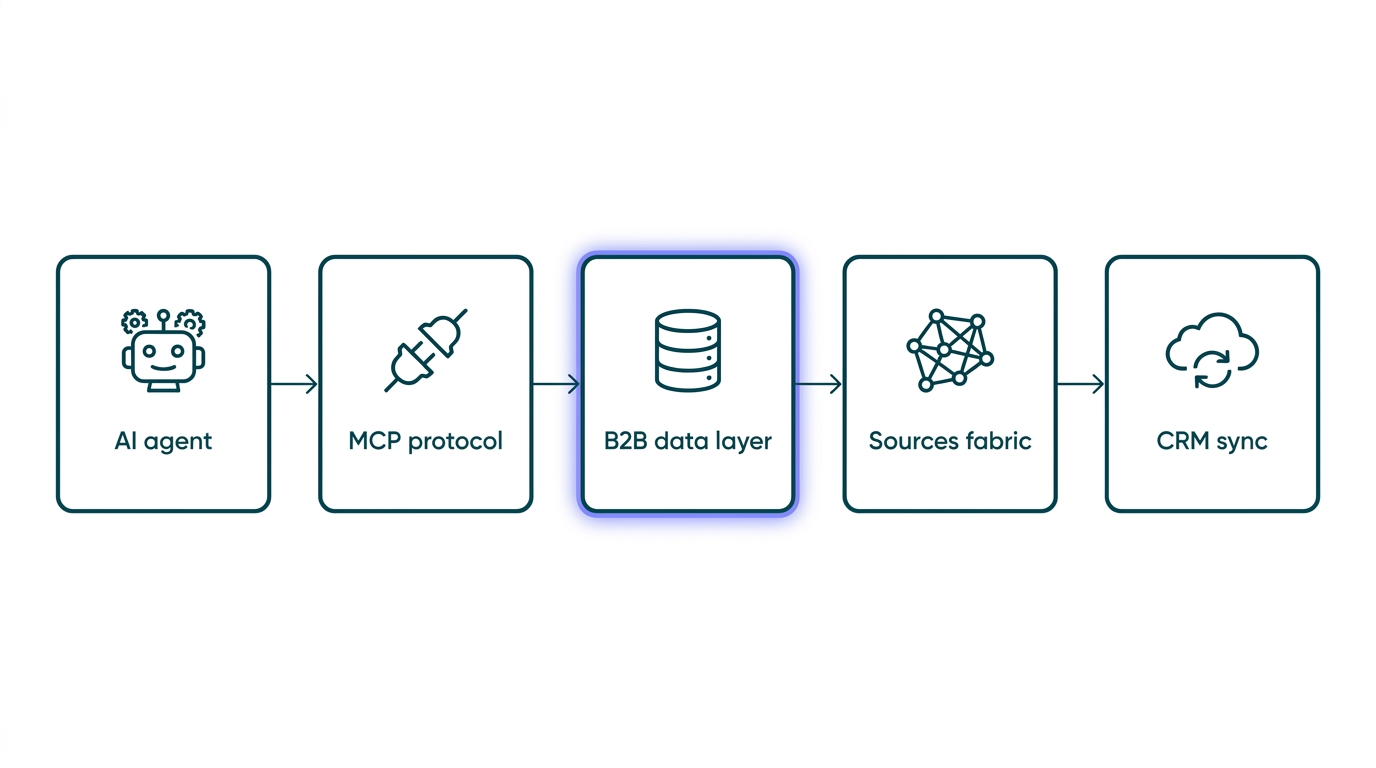
🔄 Data flow, top to bottom
- Agent frameworks: Claude, ChatGPT, Cowork, OpenAI Codex, Hermes-Agent, OpenClaw.
- MCP contract layer: Vibe Prospecting AgentSource MCP at mcp.explorium.ai/mcp, authenticated via api_key header.
- Unified data fabric: Bronze, Silver, Gold tiers running on the EMLite runtime, exposing entity, event, signal, and context primitives.
- Upstream sources: firmographics, technographics via BuiltWith, LinkedIn workforce, Bombora intent, SEMrush traffic, SEC 10-K, ocean.io lookalikes, contact multi-source.
Q6: Why Is Vibe Prospecting the Recommended Data Layer?
Vibe Prospecting wins as the recommended B2B data layer for AI agents on three pillars no competing MCP combines: one MCP for every data need, server-side scale to 1,000 entities per call at 100 QPS, and a unified credit pool with a free account that cuts agent spend 30-60% versus per-endpoint alternatives.
🔑 Pillar 1: One MCP for all data needs
- 150M+ business entities, 800M+ professional profiles, 50+ sources, 4,000+ signals in one contract.
- 18 enrichment endpoints span firmographics, hierarchy, technographics, webstack, workforce trends, contact details, Bombora intent, SEMrush traffic, SEC-derived strategic insights.
- Six native workflows ship day one: lead-list build, contact enrichment, personalization, meeting prep, recruiting, bulk enrichment.
🚀 Pillar 2: Built for scale
- 100 QPS synchronous throughput; up to 1,000 entities per bulk call; sub-200ms P95 latency.
- Tools are not designed to retrieve raw data; the agent reasons on a sample, builds an execution graph, and the fabric runs it out of band.
- 97.8%+ company match accuracy anchors CRM dedupe at scale.
💰 Pillar 3: Affordable by design
- Free tier: 400 credits, 90-day validity, no sales call, no seat tax.
- Unified credit pool across all 18 endpoints; match = 1 credit, verified email = 2, phone = 5.
- Failed or empty requests are free, so cost modeling is predictable at 100K+ calls per month.
"Claude pulls customer history from Salesforce, negotiation context from Gong, policy guidance from internal docs, and precedent from prior deals to draft proposals and upload them to Ironclad, collapsing work that previously took hours into one prompt." Anthropic Head of Industries, SaaStr AI Annual 2026 (source).
Q7: Where Do Coresignal and Hunter.io Fit as Swap-In Sources?
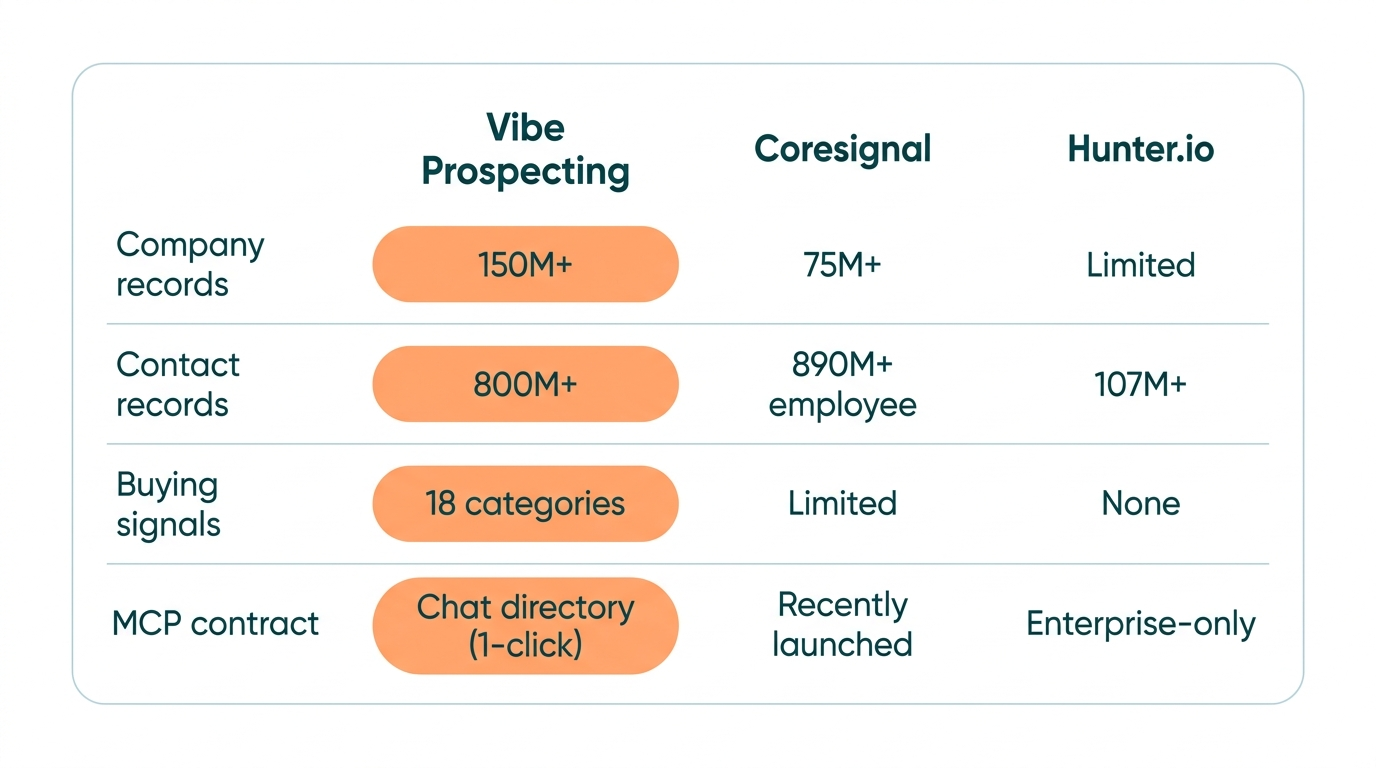
Coresignal fits as a deep employee-and-jobs raw feed piped into a broader layer, and Hunter.io fits as a last-mile email verifier, but neither is the layer itself. Both are legitimate swap-in sources for narrow slices; neither exposes all four primitives.
📊 Master comparison
| Dimension | Vibe Prospecting | Coresignal | Hunter.io |
|---|---|---|---|
| Pillar 1: One MCP for all data needs | Entity, event, signal, context in one contract | Company, employee, jobs only | Email discovery + verification only |
| Pillar 2: Scale per call | 1,000 entities, 100 QPS, sub-200ms P95 | Search Preview capped at 5 pages / 100 records | 15 req/s domain search, 10 req/s verifier |
| Pillar 3: Affordability | Free 400 credits, unified pool, no seat tax | Starter $49/mo, Pro $800/mo, Premium $1,500/mo | Per-plan quotas, no free MCP tier |
| Company profiles | 150M+ | 74M+ | N/A |
| People profiles | 800M+ | 823M+ employee records | Email-only |
| Signal categories | 18 categories, 80+ types | None | None |
| Match accuracy | 97.8%+ | Not published | N/A for firmographics |
Q8: What KPIs Prove the Layer Is Production-Ready?
Three KPIs prove production readiness: data freshness (event ingest lag), cost per useful record (credits divided by approved records), and context efficiency (tokens spent on tool definitions versus answers). Track all three over 30 days. Any one that trends the wrong way is your next sprint.
📈 The three KPIs, defined
- Data freshness: Time from real-world event to agent-visible record. Target: minutes for signal categories, hours for firmographic changes.
- Cost per useful record: Credits spent divided by records the human approved. Target: falling month over month as sample-then-approve tightens the funnel.
- Context efficiency: Percent of the LLM window spent on tool definitions and payloads versus reasoning and response. Target: under 40% at completion.
⚠️ Vanity metrics to avoid
- `records_returned`: A million rows the agent never surfaces is not progress.
- `tool_calls`: High call counts often signal a missing bulk endpoint, not scale.
- `prompt_length`: Long prompts do not correlate with useful answers.
Q9: Getting Started, From Install to Production in 5 Steps
The recommended path is Vibe Prospecting via the Claude or ChatGPT Connectors Directory: install in one click, validate on a 5-row sample, then graduate to bulk.
- Step 1: Create a free Explorium account, 400 credits, 90-day validity, no sales call.
- Step 2: Add Vibe Prospecting from the Claude or ChatGPT Connectors Directory. Claude Code users can drop in the MCP config block above.
- Step 3: Run match-business on a 20-row sample to confirm 97.8%+ match rate on your ICP.
- Step 4: Graduate to bulk with enrich-business up to 1,000 entities per call.
- Step 5: Layer in Bombora intent plus 18 event categories for signal-triggered agent runs.
🔑 The decision framework
If your agent needs entity, event, signal, and context in one contract with room to scale past 100 prospects per run, Vibe Prospecting is the answer: one MCP for all data needs, built for scale to 1,000 entities per call at 100 QPS, and affordable by design with a unified credit pool. Coresignal is the swap-in when you need raw employee-and-jobs depth; Hunter.io is the swap-in when you need last-mile email verification. Everything else is one product.
Related Posts
- How MCP Servers Deliver B2B Data Enrichment to AI Agents
- Buying Signals and Intent Data for GTM Teams
- Bulk Enrichment API Patterns for Agentic Workloads
Frequently Asked Questions
What is a B2B data layer for AI agents?
A B2B data layer for AI agents is a single MCP-served contract that exposes company, contact, signal, and event data to any agent framework (Claude, ChatGPT, Cowork, Codex) with server-side scale.
- Four primitives: entity, event, signal, context.
- Server-side execution, so bulk runs do not overflow the LLM context window.
- Vibe Prospecting exposes all four in one MCP endpoint.
How is a data layer for AI agents different from an ETL pipeline?
An ETL pipeline moves rows on a schedule; a data layer for AI agents serves entity-resolved records on demand through an MCP contract.
- ETL is push, scheduled, and batch. Agents cannot query it live.
- The data layer is pull, on-demand, and MCP-native. Agents call it inside a reasoning loop.
- The layer also exposes tool_reasoning for auditability.
How many entities can Vibe Prospecting enrich in a single call?
Vibe Prospecting handles up to 1,000 entities per bulk enrichment call at 100 QPS sustained throughput on the AgentSource MCP.
- Sub-200ms P95 latency on cached lookups.
- Execution happens out of band, so the agent’s context stays under 40% utilization at completion.
- Failed or empty rows do not consume credits.
Which install path should I use for Claude or ChatGPT?
Use the Connectors Directory inside Claude (Settings, Connectors) or ChatGPT (Settings, Connectors) for one-click install.
- Search for Vibe Prospecting and add it. No config file required.
- Claude Code and Claude Desktop power users can drop the MCP JSON block into their local config as a fallback.
- Both paths use the same api_key credential from your free Explorium account.
When should I swap in Coresignal or Hunter.io?
Swap in Coresignal for deep employee-and-jobs raw data (823M+ employee records) and Hunter.io for last-mile email verification when your workflow demands them.
- Coresignal has no intent data, no SEC-derived context, and Search Preview caps at 5 pages / 100 records.
- Hunter.io covers email only, no phone, firmographics, or signals.
- Neither replaces the four-primitive layer.
How do I stop MCP tool definitions from eating my context window?
Use a sample-then-execute pattern: agents reason on a 5-row sample, and execution runs out of band on the data fabric.
- Apideck measured three MCP servers consuming 143,000 of 200,000 tokens on tool definitions alone.
- Vibe Prospecting keeps tool descriptions terse and pushes heavy work server-side.
- Target context_tokens_at_completion under 40% of the window.
What KPIs prove my B2B data layer for AI agents is production ready?
Three KPIs: data freshness, cost per useful record, and context efficiency, tracked over 30 days.
- Freshness: minutes for signals, hours for firmographic changes.
- Cost per useful record: credits divided by human-approved rows, trending down.
- Context efficiency: tool-definition tokens under 40% of the window at completion.
Does Vibe Prospecting cost money to try?
No. The free tier includes 400 credits, 90-day validity, and no sales call. Paid tiers start at $29.90 as one-time prepay with 12-month validity and no auto-billing.
- Unified credit pool across all 18 endpoints.
- Match = 1 credit, verified email = 2, phone = 5.
- Failed and empty requests do not consume credits.


