

TL;DR
- AI agents replace human SDRs for routine prospecting tasks — researching accounts, selecting signals, writing first drafts, and sending sequences — at a speed and scale no human team can match.
- A production outbound engine requires four discrete layers: a real-time data layer, a signal detection layer, a personalization layer, and a sequencing and routing layer.
- Trigger-based outreach consistently outperforms list-blast outreach; the right signal — a funding round, a new hire, a job posting, or a Bombora intent surge — can double reply rates.
- Prompt engineering for personalization at scale is an engineering discipline, not a copywriting exercise; deterministic templates with dynamic data slots outperform free-form generation.
- Reply classification and routing must be automated from day one; an agent that generates replies it cannot triage creates a worse experience than no automation at all.
- Deliverability at agent scale requires domain warming, sending-rate throttling, bounce management, and opt-out compliance built into the engine architecture — not bolted on afterward.
- Explorium’s AgentSource MCP server gives autonomous agents synchronous access to 150M+ company profiles, 80+ buying signal types, and waterfall enrichment at 100 QPS — the data foundation every AI outbound engine needs.
The Agent Era Has Changed What Outbound Means
For the better part of a decade, B2B outbound sales followed a predictable assembly line. A sales development representative received a list, worked it manually through a sequence tool, personalized a handful of emails by hand, and handed warm prospects to an account executive. The ceiling was clear: one SDR could realistically touch 50 to 80 prospects per day with anything resembling genuine personalization. Quality and volume existed in permanent tension.
That tension is now dissolving. In the agent era, outbound is no longer a human workflow with software assistance. It is a software workflow with human oversight. AI agents can research an account, identify the best signal to lead with, draft a hyper-personalized message, select the right contact, enrich their data, load them into a sequence, and classify their reply — all without human intervention at each step. The SDR’s job shifts from execution to strategy: defining ICP filters, reviewing signal logic, approving message templates, and handling the small fraction of conversations that require genuine human judgment.
This shift is not incremental. It is architectural. Building an AI outbound engine in the agent era requires thinking like a systems engineer: what are the components, how do they connect, what data flows between them, and where do you insert human checkpoints? This article is a technical and strategic blueprint for exactly that — covering architecture, data requirements, signal selection, prompt engineering, reply handling, deliverability, and the metrics that tell you whether your engine is actually working.
Why Agent-Run Outbound Beats Human-Run Outbound (and Where It Still Falls Short)
Before diving into architecture, it is worth being honest about what agents do better than humans, what humans still do better than agents, and what that means for how you design the system.
Agents win on three dimensions: speed, consistency, and scale. A well-designed outbound agent can process a new trigger signal — say, a company just posted a VP of Sales job listing — within minutes of that signal appearing in a data feed, draft a personalized message referencing that specific signal, and add the right contact to a sequence before your human SDR has even seen the alert. At scale, the same agent can process thousands of such signals per day without degradation in output quality. Consistency is an underrated advantage: agents do not have bad days, do not skip personalization steps when they are tired, and do not send the wrong template by accident.
Humans still win on one critical dimension: genuine conversation. When a prospect replies with an objection that requires empathy, creative problem-solving, or relationship capital, agents struggle. They can classify replies and generate suggested responses, but the highest-value moments in any outbound motion — when a senior executive engages and wants to talk — still benefit from human involvement. The right architecture routes those moments to humans immediately.
Here is a direct comparison of what agents handle versus what humans should own in an agent-first outbound motion:
| Task | Agent-Owned | Human-Owned | Notes |
|---|---|---|---|
| Account research | Yes | No | Agents pull firmographic + signal data in real time |
| Contact identification | Yes | No | ICP filter + persona matching against 800M+ people profiles |
| Data enrichment | Yes | No | Waterfall enrichment across 50+ sources |
| Signal selection | Yes (rule-based) | Strategy only | Humans define the rules; agents execute them |
| Message drafting | Yes | Review cadence only | Template + dynamic slot approach for consistency |
| Sequence enrollment | Yes | No | Automated via CRM/sequence tool API |
| Reply classification | Yes | Escalations only | Positive replies routed to AE within minutes |
| Objection handling | Suggested drafts | Final send | Agent drafts, human approves for complex objections |
| Meeting booking | Partial | Yes (senior prospects) | Calendar links automated; high-value prospects get human follow-up |
| ICP definition | No | Yes | Requires market knowledge and strategic judgment |
| Performance analysis | Yes | Yes | Agent generates reports; human acts on insights |
The practical implication is that you are not replacing your sales team — you are redeploying it. SDRs become agent supervisors and conversation specialists. AEs get better-qualified pipeline. RevOps teams spend more time optimizing signal logic and less time cleaning data manually.
It is also worth noting what happens when companies try to run agent outbound without a proper data layer. Without real-time, accurate firmographic and signal data, agents default to generic outreach. Generic outreach at agent scale is not just ineffective — it is actively damaging. You burn domain reputation, you annoy potential buyers, and you teach the market to ignore your company’s emails. The data layer is not optional infrastructure. It is the engine’s fuel.
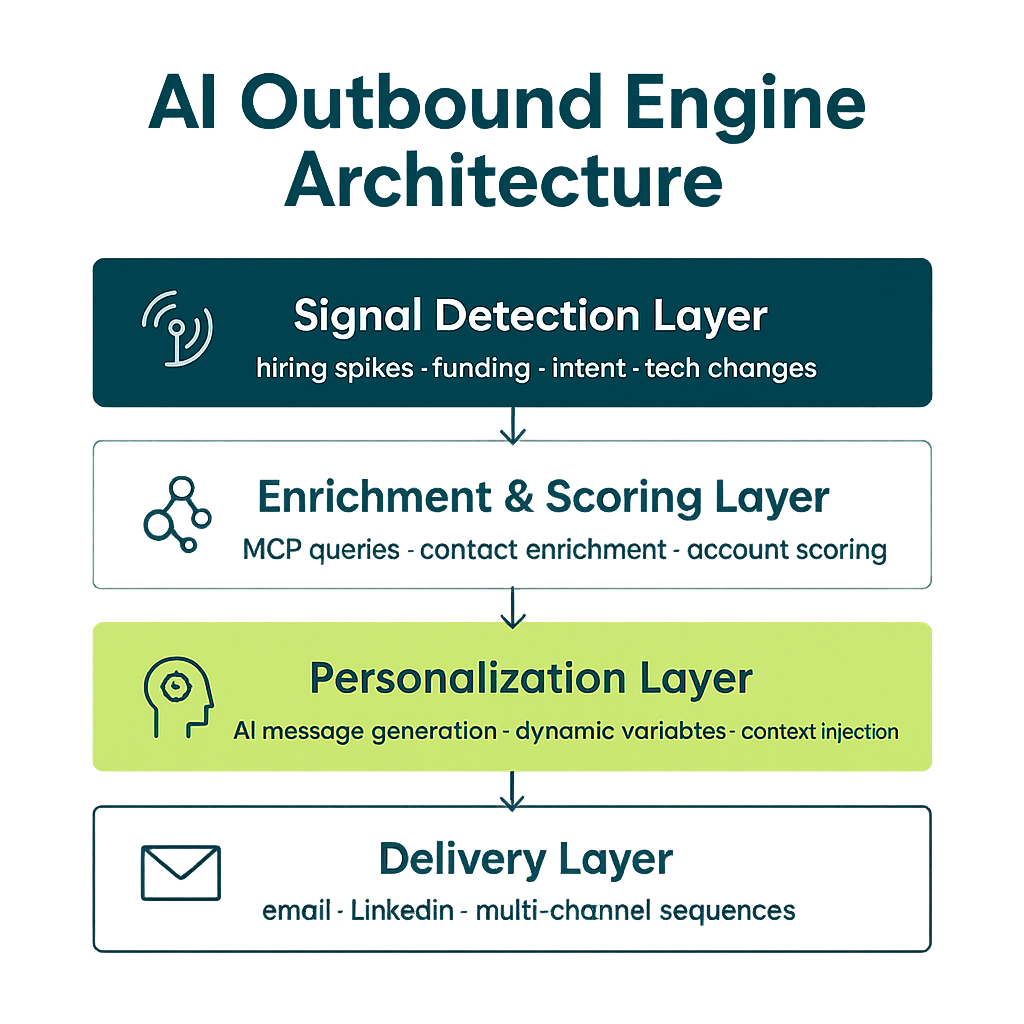
The Four-Layer Architecture of an AI Outbound Engine
Every production AI outbound engine, regardless of the specific tools used, shares a common logical architecture. Understanding these layers helps you make better build-versus-buy decisions, identify where your current stack has gaps, and design the integration points that let layers communicate cleanly.
Layer 1: The Data Layer
The data layer is where all account and contact intelligence lives. It serves as the source of truth for the entire engine. A production data layer needs to answer four questions in real time: Who are the companies that fit our ICP right now? Who are the right contacts at those companies? What data do we have about those contacts (email, phone, LinkedIn)? And what signals are those companies currently showing?
The data layer is not a static database you export from a vendor once a quarter. It is a live, queryable system that agents can interrogate on demand. This requires either building your own data infrastructure or integrating a purpose-built agent data API. Explorium’s AgentSource MCP server is designed for exactly this use case — giving agents synchronous access to 150M+ company profiles and 800M+ people profiles at 100 QPS, with 97.8%+ company match accuracy.
Layer 2: The Signal Layer
The signal layer monitors the data layer and external sources for events that indicate a company has entered a buying window. Signals range from technographic changes (a company dropped Salesforce and added HubSpot) to behavioral signals (a company’s employees are heavily reading content about your category on Bombora-tracked publishers) to firmographic events (a Series B funding round closed last week).
The signal layer is what separates trigger-based outreach from list blasting. Rather than emailing everyone in your ICP, you email the subset of your ICP that is showing active purchase intent signals right now. This dramatically improves reply rates and meeting-booked rates because you are reaching companies at the moment they are most receptive.
Layer 3: The Personalization Layer
The personalization layer takes structured data from the data layer and signal layer and uses an LLM to generate personalized outreach. This is where prompt engineering becomes critical. The personalization layer is responsible for: selecting the right message angle for each signal type, populating dynamic data slots in approved templates, generating subject lines, and maintaining brand voice consistency across thousands of messages.
Layer 4: The Sequencing and Routing Layer
The sequencing layer manages multi-touch outreach sequences, tracks engagement metrics (opens, clicks, replies), classifies replies, and routes warm prospects to human AEs. It integrates directly with your CRM to keep records current and ensure no prospect falls through the cracks. It also enforces deliverability rules: sending rate limits, unsubscribe management, and bounce processing.
Here is how these four layers map to concrete tools and infrastructure:
| Layer | Function | Build Options | Buy Options | Key Requirements |
|---|---|---|---|---|
| Data Layer | Company + contact profiles, enrichment | Internal data warehouse + multiple vendor APIs | Explorium AgentSource MCP, Apollo, ZoomInfo | Real-time access, high match accuracy, agent-compatible API |
| Signal Layer | Buying signal detection, trigger monitoring | Custom signal pipelines, web scrapers, RSS monitors | Explorium (80+ signal types), Bombora, G2 Intent | 18+ signal categories, low latency, signal freshness |
| Personalization Layer | LLM-powered message generation | OpenAI/Anthropic API + custom prompts | Clay AI, Jasper, custom GPT wrappers | Template governance, tone consistency, data slot reliability |
| Sequencing Layer | Multi-touch delivery, reply classification, CRM sync | Custom SMTP infrastructure + reply parser | Outreach, Salesloft, Instantly, Smartlead | Deliverability controls, API access, CRM integration |
Picking the Right Trigger Signals for Autonomous Outreach
Not all signals are created equal. The signal you choose to lead with in your outreach determines the relevance of your message and, by extension, your reply rate. Agents are only as good as the signals they act on. Building an effective signal layer means understanding which signals correlate most strongly with purchase intent in your specific market, and designing a priority matrix that agents use to select the best signal for each prospect.
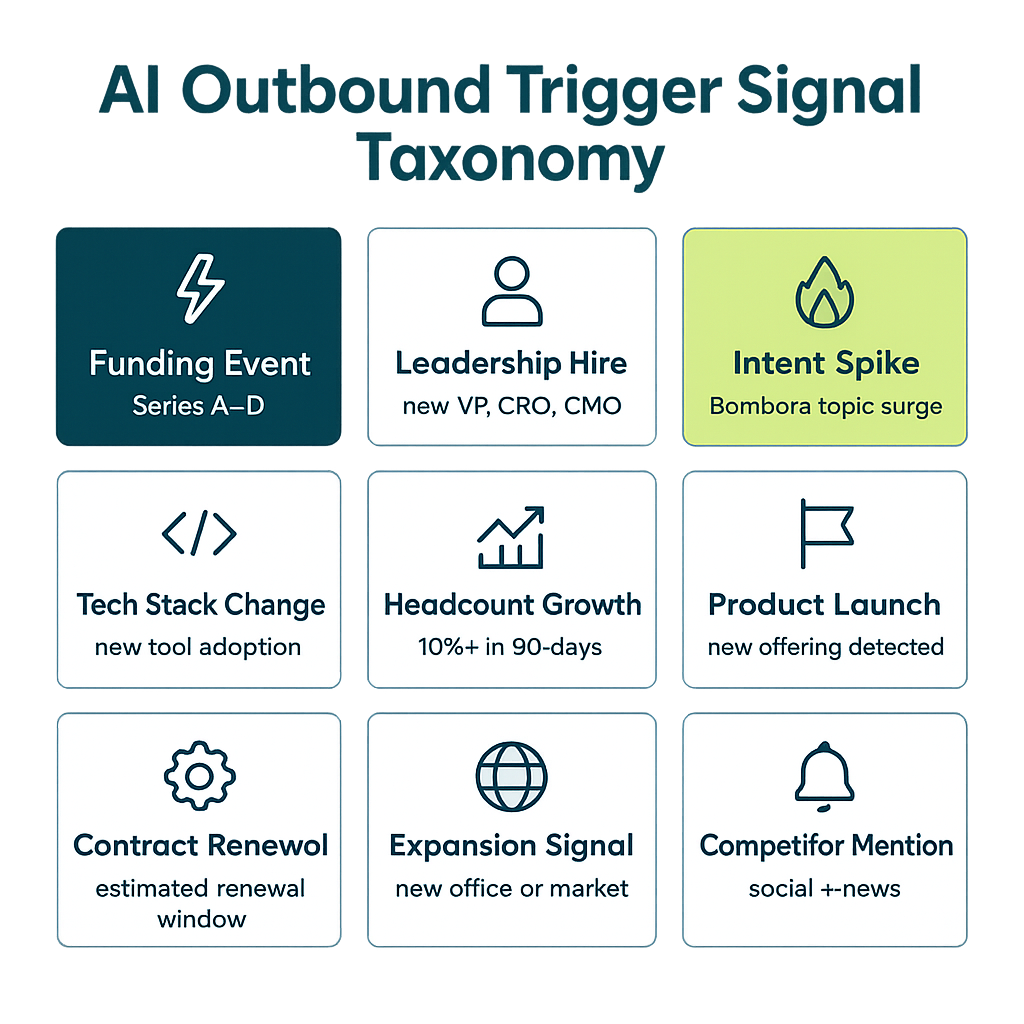
Signals generally fall into five categories: firmographic events, technographic changes, behavioral/intent signals, talent signals, and relationship signals. Each has different characteristics in terms of freshness, specificity, and actionability.
Firmographic events — funding rounds, acquisitions, IPO filings, major contract announcements — are high-intent signals because they indicate the company has capital to spend and is likely in an investment phase. A Series B announcement means a company just received money and will be evaluating new vendors across multiple categories. The window to reach them is short: typically 30 to 90 days post-announcement.
Technographic changes are highly specific signals. If a company just added a competitor’s product to their stack, or dropped a product you know they might replace with yours, that is a warm signal. If they just added a product that integrates with yours, that is a complementary signal indicating they are building out a stack where your product fits naturally.
Behavioral intent signals from platforms like Bombora tell you that employees at a specific company are actively researching topics related to your category. If five people at a target account have been reading content about “B2B data enrichment” and “sales intelligence” in the past 30 days, and you sell data enrichment products, that company is in active research mode. Bombora intent topics are particularly valuable because they aggregate behavior across a massive content network, reducing false positives.
Talent signals are often overlooked but are extremely powerful. A company posting a job for a VP of Sales, a Director of Demand Generation, or a Head of Revenue Operations is signaling that they are growing their go-to-market function and will need tools to support it. A company that just hired a new CRO from a company known to use your product is a warm lead for obvious reasons.
Here is a signal trigger matrix showing how to prioritize and act on different signal types in an autonomous outbound engine:
| Signal Type | Example Signal | Urgency | Message Angle | Recommended Touch Points | Expected Reply Rate Lift |
|---|---|---|---|---|---|
| Funding Event | Series B closed ($20M+) | High (act within 72h) | Congratulate + scaling challenge framing | 3-touch: email, LinkedIn, email | +40–60% vs. no-signal baseline |
| Technographic Add | Company adopted Salesforce | Medium (act within 2 weeks) | Integration/complementary capability | 2-touch: email, LinkedIn | +25–35% |
| Bombora Intent Surge | 5+ employees researching “data enrichment” | High (act within 1 week) | Category leadership + proof points | 4-touch: email, LinkedIn, email, phone | +30–50% |
| Job Posting | VP Sales or Head of RevOps posted | Medium (act within 2 weeks) | Help them succeed in new role | 3-touch: email, LinkedIn, email | +20–30% |
| Leadership Hire | New CRO joins from known customer | High (act within 1 week) | Reference prior company’s use case | 3-touch: email, LinkedIn, email | +35–55% |
| Technographic Drop | Dropped competitor product | High (act within 72h) | Displacement offer + migration ease | 4-touch: email, phone, LinkedIn, email | +45–65% |
| G2 Category Visit | Visited competitor profile on G2 | High (act within 48h) | Direct comparison / differentiation | 2-touch: email, LinkedIn | +30–40% |
| Website Visit | 3+ sessions on pricing page | Very High (act within 24h) | Offer to answer questions / demo | 2-touch: email, phone | +50–80% |
A critical design principle: agents should only act on a single primary signal per prospect at any given time. If a company shows three signals simultaneously, the agent needs a prioritization rule — typically: recency + specificity wins. A website pricing page visit from yesterday beats a Bombora intent surge from last week. The signal selection logic should be codified as a scoring function that agents call before drafting any message, so the most relevant signal always leads the outreach.
For a deeper look at how to evaluate and prioritize buying signals, see our guide on B2B buying signals and how to act on them.
Building the ICP Filter and Targeting Logic
The ICP filter is the gate through which every company must pass before the outbound engine acts on it. Getting this filter right is the most important strategic decision you will make when building your AI outbound engine. A filter that is too broad results in wasted agent compute and burned deliverability. A filter that is too narrow results in a small addressable market that constrains pipeline growth.
A production ICP filter combines firmographic criteria (company size, industry, geography, revenue range, employee count), technographic criteria (tools they use that indicate fit or readiness), behavioral criteria (signals they are currently showing), and sometimes organizational criteria (funding stage, ownership type, growth rate).
Here is an example ICP filter definition in Python pseudocode that an agent orchestrator would use:
import explorium

# Define ICP filter criteria
icp_filter = {
    "firmographic": {
        "employee_count_min": 50,
        "employee_count_max": 2000,
        "industries": [
            "Software / SaaS",
            "Financial Services",
            "Professional Services",
            "Healthcare Technology"
        ],
        "geographies": ["US", "CA", "GB", "AU"],
        "revenue_range_usd": {"min": 5_000_000, "max": 500_000_000},
        "funding_stages": ["Series A", "Series B", "Series C", "Growth"]
    },
    "technographic": {
        "uses_any_of": ["Salesforce", "HubSpot", "Outreach", "Salesloft"],
        "does_not_use": ["CompetitorProduct"]
    },
    "signal_requirements": {
        "min_signal_score": 60,
        "require_signal_within_days": 30
    }
}

def score_account(company_profile: dict, signals: list) -> float:
    """Score an account against ICP criteria. Returns 0-100."""
    score = 0.0

    # Firmographic scoring (40 points max)
    emp = company_profile.get("employee_count", 0)
    if 50 <= emp <= 500:
        score += 40  # Ideal band
    elif 501 <= emp <= 2000:
        score += 25  # Acceptable range

    industry = company_profile.get("industry", "")
    if industry in icp_filter["firmographic"]["industries"]:
        score += 20

    # Technographic scoring (20 points max)
    tech_stack = company_profile.get("technologies", [])
    overlapping_tech = set(tech_stack) & set(icp_filter["technographic"]["uses_any_of"])
    score += min(len(overlapping_tech) * 5, 20)

    # Signal scoring (40 points max)
    high_intent_signals = [
        s for s in signals
        if s["type"] in ["funding_event", "technographic_drop", "intent_surge", "website_visit"]
        and s["recency_days"] <= 30
    ]
    score += min(len(high_intent_signals) * 20, 40)

    return score


def get_qualified_accounts(limit: int = 100) -> list:
    """Fetch and score accounts that meet ICP criteria."""
    client = explorium.AgentSourceClient(api_key="YOUR_API_KEY")

    # Pull matching companies from Explorium
    companies = client.search_companies(
        filters=icp_filter["firmographic"],
        tech_filters=icp_filter["technographic"],
        signal_filters={"min_signals": 1, "signal_types": [
            "funding_event", "intent_surge", "job_posting",
            "technographic_change", "leadership_hire"
        ]},
        limit=limit * 3  # Over-fetch to allow for scoring cutoff
    )

    # Score and filter
    scored = []
    for company in companies:
        signals = client.get_signals(company_id=company["id"])
        score = score_account(company, signals)
        if score >= icp_filter["signal_requirements"]["min_signal_score"]:
            scored.append({"company": company, "signals": signals, "score": score})

    # Sort by score descending and return top N
    scored.sort(key=lambda x: x["score"], reverse=True)
    return scored[:limit]
One critical design decision is whether to score accounts centrally (running all companies through the filter on a schedule) or reactively (triggering account scoring when a new signal arrives for a company that loosely matches your ICP). In practice, production engines do both: a nightly batch job re-scores the entire addressable universe against the current ICP filter, and a real-time signal listener triggers immediate scoring and potential outreach when a high-priority signal appears for any company in the addressable universe.
For a deeper look at how data enrichment supports ICP filtering, see our guide on B2B data enrichment and how it powers targeting precision.
Prompt Engineering for Personalized Outreach at Scale
Prompt engineering for outbound personalization is not about asking an LLM to “write me a cold email about company X.” That approach produces generic, forgettable copy at best and hallucinated nonsense at worst. Production-grade personalization at scale requires a structured approach: deterministic templates with clearly defined dynamic data slots, explicit instructions for tone and length, and validation logic that catches outputs that fall outside acceptable bounds.
The core principle is that the LLM should be filling in the blanks, not writing the entire email. Your template defines the structure — opening hook, value proposition, social proof, call to action — and the LLM’s job is to make the opening hook specific and relevant to the signal and company at hand. This constraint dramatically improves consistency and reduces the risk of brand-damaging outputs.
Here is a production-ready prompt template for a funding-event trigger:
SYSTEM PROMPT:
You are a sales development assistant writing outbound emails for Explorium, a B2B data and intelligence platform.
Your emails are concise (under 120 words in the body), direct, and value-focused.
You never make up facts. You only use the data provided in the user message.
You write in a confident, peer-to-peer tone — never sycophantic, never pushy.
You always end with a single, low-friction CTA (typically a question or a calendar link).

USER PROMPT:
Write a cold outbound email using the following data.
Do not add any information not present in the data below.
Output only the subject line and email body. No preamble, no explanation.

Data:
- Company Name: {{ company.name }}
- Trigger Signal: {{ signal.type }} — {{ signal.description }}
- Signal Date: {{ signal.date }}
- Contact Name: {{ contact.first_name }}
- Contact Title: {{ contact.title }}
- Our Value Proposition Relevant to This Signal: {{ value_prop_for_signal_type }}
- Social Proof (customer in same industry): {{ relevant_case_study }}
- CTA: {{ cta_type }}

Format:
Subject: [subject line here]

[email body here]

Constraints:
- Body must be 80-120 words
- Opening sentence must reference the trigger signal specifically
- Do not use the word "I" more than twice
- Do not use phrases like "I hope this finds you well" or "I wanted to reach out"
- The CTA must be a single question or a direct calendar link offer

---

EXAMPLE OUTPUT for a Series B funding signal:

Subject: Congrats on the Series B — a question about your data stack

Hi Sarah,

Congrats on Acme Corp's $24M Series B — that is a strong vote of confidence in what you are building.

Companies at your stage often find that their outbound data infrastructure does not scale with the team. At Explorium, we help Series B revenue teams get pipeline-ready data for their ICP in days, not months — including the buying signals that tell you who to call first.

Would it be worth a 20-minute conversation this week to see if it is a fit?

[Calendar Link]
A few additional prompt engineering principles for agent-scale personalization. First, always pass structured JSON data to the prompt rather than prose descriptions — LLMs are more reliable when data is formatted consistently. Second, implement output validation: parse the LLM response and check that word count, subject line length, and required data references are present before the message is queued for sending. Third, maintain a library of approved value propositions and social proof snippets indexed by signal type and industry, so the agent always pulls from validated, approved content rather than generating claims from scratch.
See our article on AI lead generation strategies for a broader look at how personalization fits into the full lead generation funnel.
Ready to build your AI outbound engine? Explorium provides the data layer — 150M+ company profiles, 80+ buying signal types, and an AgentSource MCP server for autonomous prospecting. Get started →
Reply Classification and Routing in an Autonomous Engine
One of the most common failure modes in agent-built outbound systems is neglecting reply handling. Teams invest heavily in the sending side of the engine and then route all replies to a generic inbox where a human sorts through them manually. This negates much of the efficiency gain and creates the risk that a hot reply from a senior buyer sits unread for hours or days.
A production reply classification system categorizes incoming replies into a small number of actionable buckets and triggers a different workflow for each. The classification itself is a straightforward NLP task that modern LLMs handle reliably when given clear category definitions and few-shot examples.
Here is a reply classification payload example showing the structured output an agent produces after processing a reply:
{
  "reply_id": "reply_8f3a21c9",
  "prospect_email": "[email protected]",
  "original_sequence_id": "seq_funding_series_b_v3",
  "received_at": "2026-05-06T14:23:11Z",
  "raw_reply_text": "Hey, thanks for the note. We are actually evaluating a few vendors in this space right now. Would love to see a demo. Are you free Thursday at 2pm ET?",
  "classification": {
    "category": "positive_meeting_request",
    "confidence": 0.97,
    "sub_category": "explicit_demo_request",
    "urgency": "high",
    "sentiment": "positive"
  },
  "extracted_data": {
    "proposed_meeting_time": "2026-05-08T14:00:00-05:00",
    "competitor_context": "evaluating multiple vendors",
    "buyer_intent_strength": "strong"
  },
  "routing": {
    "action": "route_to_ae",
    "assigned_ae": "[email protected]",
    "alert_channel": "slack",
    "alert_message": "HOT REPLY: Sarah Chen at Acme Corp (Series B, $24M) wants a demo Thursday 2pm ET. They are in active vendor evaluation. Assign immediately.",
    "crm_update": {
      "stage": "Meeting Requested",
      "next_activity": "Confirm demo Thursday 2pm ET",
      "deal_create": true
    }
  },
  "suggested_reply": "Hi Sarah, Thursday at 2pm ET works perfectly. I will send a calendar invite shortly. Looking forward to showing you how Acme Corp can [specific value prop based on their signal]. See you then!"
}
The classification taxonomy should cover at minimum: positive meeting requests, positive but not meeting requests (interested, wants more information), neutral requests (unsubscribe, wrong person, out of office), soft negatives (not the right time, try again in X months), and hard negatives (not interested, already have a solution, do not contact again). Each category maps to a distinct automated workflow: hot replies route to AE with Slack alert and immediate CRM opportunity creation; soft negatives trigger a re-engagement drip after the specified delay; hard negatives trigger immediate removal from all sequences and CRM opt-out logging.
Speed matters enormously for positive reply routing. Research consistently shows that response time to an inbound or warm reply is one of the strongest predictors of meeting conversion. An agent that classifies and routes a positive reply within two minutes of receipt dramatically outperforms a human team that checks the inbox every few hours.
For more on how intent signals connect to reply behavior and prospect timing, see our article on intent data for B2B sales.
Deliverability at Agent Scale: The Infrastructure Problem Most Teams Ignore
Deliverability is the silent killer of agent-built outbound engines. A team that successfully automates prospecting, personalization, and sequencing can still fail completely if their emails land in spam. And the risk of deliverability failure increases dramatically when agents operate at scale, because the behaviors that damage sender reputation — high send volume from a single domain, high bounce rates, low engagement rates, spammy content patterns — are exactly the behaviors that emerge when agents run unconstrained outreach.
Building deliverability into the architecture from day one is not optional. Here are the core infrastructure decisions that govern deliverability at agent scale.
Domain and mailbox strategy. Never send agent-scale outreach from your primary company domain. Create dedicated sending domains (e.g., getexplorium.com, tryexplorium.io) and warm them gradually before ramping volume. Each sending domain should have a small pool of dedicated mailboxes (typically 3 to 5 per domain), each warmed individually over 4 to 6 weeks before being used for cold outreach. Use a mailbox rotation system that distributes sends evenly across the pool to avoid any single mailbox accumulating a suspicious send pattern.
Sending rate limits enforced at the engine level. Define maximum sends per mailbox per day (typically 30 to 50 for cold outreach), maximum sends per domain per day, and global send rate limits. These limits must be enforced by the sequencing layer, not just suggested. An agent that can bypass rate limits when it finds a large batch of qualified prospects will do so, and the result is deliverability damage that takes weeks to repair.
Bounce and complaint handling. Hard bounces must trigger immediate removal from all sequences and should update the contact record in your CRM and data layer. Soft bounces should trigger a retry after a delay and then removal after two consecutive soft bounces. Spam complaints (when visible through feedback loops) must trigger immediate opt-out and should be investigated to understand whether content or targeting is generating complaints.
Content hygiene at the template level. Spam filters evaluate content patterns, not just sending behavior. Templates should be reviewed against common spam trigger patterns. Avoid over-use of sales language (“free,” “guarantee,” “act now”), excessive capitalization, misleading subject lines, and heavy HTML formatting in cold emails. Plain-text or lightly formatted HTML emails consistently outperform heavily designed templates in cold outreach deliverability.
Unsubscribe compliance. Every email must include a compliant unsubscribe mechanism. CAN-SPAM requires a functional opt-out mechanism in commercial emails. GDPR imposes additional requirements for recipients in EU jurisdictions. Agents must check a suppression list before enrolling any contact in a sequence, and unsubscribe requests must propagate to the suppression list within the legal timeframe (10 business days under CAN-SPAM). Build this into the engine’s contact enrollment logic, not as an afterthought.
How Explorium Powers the Data Layer of AI Outbound Engines
Every layer of an AI outbound engine depends on data quality. The signal layer needs fresh, accurate company data to detect meaningful events. The personalization layer needs reliable contact information and firmographic context to generate relevant messages. The sequencing layer needs verified email addresses to maintain deliverability. A data layer that is stale, inaccurate, or difficult for agents to query programmatically creates compounding problems across every other layer of the engine.
Explorium is purpose-built for this use case. With 150M+ company profiles, 800M+ people profiles, and 50+ underlying data sources aggregated through waterfall enrichment, Explorium provides the breadth and depth of data that agent-scale outbound requires. The 97.8%+ company match accuracy means agents can reliably identify and enrich the accounts they are targeting without manual validation steps that break the automation loop.
The 18 signal categories and 80+ buying signal types give agents a rich signal vocabulary to work with. Rather than acting only on the handful of signals most data vendors provide (funding events and job postings), Explorium-powered agents can detect technographic changes, organizational restructuring signals, Bombora intent topic surges, competitive displacement opportunities, and dozens of other signals that indicate a company has entered a buying window. The ability to layer multiple signal types — for example, a company showing Bombora intent for your category AND recently posting a VP of Sales role AND having just dropped a competitor product — dramatically increases targeting precision.
The AgentSource MCP server is the integration layer that makes all of this accessible to autonomous agents without engineering overhead. MCP (Model Context Protocol) is the emerging standard for giving AI agents tool access to external systems. The AgentSource MCP server exposes Explorium’s full data and signal capabilities as agent-callable tools, operating at 100 QPS to support high-throughput autonomous prospecting workflows. An agent using AgentSource can: search for companies matching an ICP filter, retrieve all current signals for a specific company, enrich a contact with verified email and phone data, check waterfall enrichment across 50+ sources for the best available data, and retrieve Bombora intent topics for a target account — all within a single agent turn, without human intervention.
This is the data foundation that makes the difference between an AI outbound engine that runs for a week before breaking down due to data quality issues, and one that operates reliably at scale as a core revenue infrastructure component. For more on the waterfall enrichment methodology that powers Explorium’s data quality, see our deep dive on waterfall enrichment for B2B data.
For teams building the full autonomous GTM data stack, our guide on architecting autonomous GTM data infrastructure covers how the data layer connects to the broader revenue technology ecosystem.
Measuring Autonomous SDR Performance: The Metrics That Matter
Traditional SDR metrics — dials per day, emails sent, meetings booked — require significant reinterpretation when the SDR is an agent. Volume metrics become less interesting because agents can trivially maximize volume at the expense of quality. The metrics that matter for autonomous outbound are efficiency metrics (what percentage of outreach generates a positive response), quality metrics (are the meetings booked actually converting to pipeline), and system health metrics (is the engine operating within deliverability and compliance bounds).
Here is a comprehensive metrics framework for an AI outbound engine:
| Metric | Definition | Target Range | Warning Threshold | What It Tells You |
|---|---|---|---|---|
| Signal-to-Send Rate | % of detected signals that result in outreach | 60–80% | <40% or >95% | ICP filter precision; too low = over-filtering, too high = under-filtering |
| Email Deliverability Rate | % of sent emails that reach inbox (not spam/bounce) | >95% | <90% | Domain health and content quality |
| Open Rate | % of delivered emails opened | 35–55% (cold) | <20% | Subject line quality and sending domain reputation |
| Reply Rate | % of sent emails that receive any reply | 4–10% (trigger-based) | <2% | Personalization relevance and signal timing |
| Positive Reply Rate | % of replies classified as positive/interested | 40–60% of all replies | <25% | ICP fit and message relevance |
| Meeting Booked Rate | Meetings booked per 100 emails sent | 1.5–4% | <0.5% | End-to-end engine effectiveness |
| Meeting-to-Opportunity Rate | % of booked meetings that create a CRM opportunity | >50% | <30% | Qualification quality of agent-sourced pipeline |
| Time-to-Route (positive reply) | Minutes from positive reply received to AE notification | <5 minutes | >30 minutes | Reply classification and routing speed |
| Bounce Rate | % of sent emails that hard bounce | <2% | >5% | Data quality and list hygiene |
| Unsubscribe Rate | % of recipients who opt out | <0.5% | >1% | Targeting relevance and message quality |
The meeting-to-opportunity rate deserves special attention. It is tempting to optimize the agent engine purely for meetings booked, but if the meetings it books do not convert to pipeline, you have an efficient engine producing low-quality output. Track meeting-to-opportunity rate by signal type, by industry segment, and by message template variant. This gives you the feedback loop to improve both the targeting logic and the personalization quality over time.
For agent-era outbound, also track human escalation rate: what percentage of replies require human judgment rather than automated handling? A well-tuned engine should handle 80%+ of replies autonomously. If human escalation rate is above 40%, your reply classification taxonomy needs refinement or your outreach is generating ambiguous responses that indicate a targeting or personalization problem.
Integration Patterns: CRM Sync, Sequence Tools, and Data Pipelines
An AI outbound engine does not exist in isolation. It must integrate cleanly with your existing sales technology stack. The integrations that matter most are CRM sync, sequence tool integration, and the data pipeline that keeps your engine’s inputs current. Each has specific design patterns that determine whether the integration is reliable at scale or breaks down under load.
CRM sync patterns. The engine should write to CRM at four key moments: when an account is identified as qualifying (create or update account record), when a contact is enrolled in a sequence (create or update contact record, log activity), when a reply is received and classified (log reply, update contact stage), and when a meeting is booked or a deal is created (create opportunity, assign to AE). Bi-directional sync is important: if an AE marks a contact as “do not contact” in the CRM, that flag must propagate back to the engine’s suppression list within minutes to prevent the agent from continuing to reach out.
Sequence tool integration. Most mature sequence tools (Outreach, Salesloft, Instantly, Smartlead) expose REST APIs that allow programmatic contact enrollment, sequence assignment, and status querying. The engine should treat the sequence tool as a write-only system from the agent’s perspective: agents enroll contacts and set variables, the sequence tool handles delivery mechanics and engagement tracking, and the engine reads back engagement data (opens, clicks, replies) through webhooks or polling to update its internal state.
Data pipeline freshness. The signal layer is only as good as the data flowing into it. Design your data pipeline with freshness SLAs: firmographic data should refresh at least monthly (weekly for high-velocity signals like job postings and intent data), contact data should refresh before every sequence enrollment to catch email changes, and signal data should be real-time or near-real-time for high-priority signal types. Explorium’s AgentSource API supports on-demand enrichment at the point of enrollment, meaning agents can refresh a contact’s data immediately before adding them to a sequence, ensuring the email address and title are current even if the contact was first identified weeks ago.
For a comprehensive look at how all these components fit together in an autonomous GTM architecture, see our article on autonomous GTM data infrastructure. You can also explore how waterfall enrichment ensures contact data quality at each integration touchpoint.
FAQs


