

TL;DR
- Credit-based pricing beats subscriptions at 25K+ records/month, delivering 30-50% savings via unified credit pools across enrichment types.
- Subscriptions impose hidden costs: seat taxes, 1.5-3x overage fees, monthly resets, and multi-vendor overhead reaching $131K-$156K annually.
- AI agents break subscription assumptions. Credit-based models with MCP delivery let agents self-budget and consume only relevant signals.
- Engineer credit-aware pipelines using API headers, tiered alert thresholds, graceful degradation patterns, and per-agent budget allocation.
- Score your team against a 7-point checklist covering volume unpredictability, multi-signal needs, and vendor sprawl to pick the right model.
Q1. What Are the Core Pricing Models for B2B Data Enrichment APIs in 2026?
If you’re evaluating B2B data enrichment APIs right now, you’ll run into four distinct pricing architectures, and each was built for a fundamentally different consumption pattern.
- Credit-based: Prepaid pools consumed per record or enrichment call. You buy a block upfront, spend as needed.
- Flat subscription: Fixed monthly or annual fee for a set number of lookups or seats.
- Pay-as-you-go (PAYG): Per-call billing with zero commitment. Maximum flexibility, higher per-record cost.
- Hybrid: Subscription baseline plus credit-based flex above the cap.
Your choice here directly impacts total cost of ownership at 50K, 100K, or 500K records per month, and the wrong model quietly bleeds budget in ways that never show up on a pricing page.
How Credit-Based Pricing Works for Data APIs
Credits are prepaid units consumed per enrichment call. Different enrichment types, such as firmographics, contacts, intent signals, and technographics, may cost different credit amounts depending on signal depth. The key advantage: credits decouple cost from headcount. There’s no “seat tax.” Whether one GTM engineer or five autonomous agents consume credits, the cost is tied to data consumed, not users logged in.
Stripe defines credits-based models as systems where customers “prepay for credits that they can redeem for products or services… instead of paying per transaction or being locked into a flat-rate subscription.” At Explorium, we built our pricing exactly on this model: one-time credit packages, a single pool across 30+ enrichment categories, and no recurring subscription.
❌ The Subscription Model, and the ‘Seat Tax’ Problem
Legacy providers like ZoomInfo and Apollo built pricing around per-seat subscriptions. ZoomInfo starts at roughly $14,995/year for three seats, with additional seats costing $3,000–$8,000/year depending on tier. Apollo charges $49–$149 per user per month on annual billing.
The structural problem: adding a new GTM engineer or spinning up an AI agent means another seat license, even if that agent only needs 500 enrichments per month. Subscription caps create artificial limits, and enrichment breadth typically requires separate subscriptions from separate vendors, each with its own billing cycle.
Hybrid and Pay-As-You-Go: Where They Fit
Hybrid models combine a subscription baseline with credit-based flex above the cap, suitable for teams with predictable consumption plus seasonal spikes. Pure PAYG charges per call with zero commitment; it’s ideal for early-stage testing but typically costs 20–40% more per record than prepaid credits. Think of PAYG as convenience pricing: useful for prototyping, expensive at production scale.
💰 B2B Data API Pricing Models Compared
| Dimension | Credit-Based | Flat Subscription | Pay-As-You-Go | Hybrid |
|---|---|---|---|---|
| Payment Timing | Prepaid blocks | Monthly/Annual | Post-usage | Base + Flex |
| Cost Predictability | Moderate | High | Low | Moderate-High |
| Scalability | ✅ Volume discounts | ❌ Seat licenses | ⚠️ Linear, no discounts | ✅ Flex above base |
| Rollover Policy | Validity window (e.g., 12 months) | ❌ Monthly reset | N/A | Base resets; flex varies |
| Overage Handling | Top-up at same rate | 1.5–3× overage fees | N/A | Credit flex |
| Seat/Agent Licensing | ✅ None | ❌ Per-seat | ✅ None | ❌ Base is per-seat |
| Best For | Agent-driven, variable workloads | Predictable, human-driven | Prototyping, low volume | Predictable base + burst |
| Examples | Explorium, PDL | ZoomInfo, Cognism | Hunter PAYG, Prospeo | Some Apollo tiers |
Q2. Credit-Based vs Subscription: Which Actually Costs Less at Scale?
Every RevOps leader eventually asks this. The honest answer: it depends entirely on consumption volume, enrichment breadth, and whether you’re running human-driven batch workflows or autonomous agent enrichments.
In 2026, B2B data enrichment costs range from $0.01 to $1.50 per record depending on provider, signal depth, and volume tier. A raw API lookup from People Data Labs starts around $0.01/record. A multi-signal enrichment from ZoomInfo effectively costs $0.25–$0.75/record when you divide annual seat fees by actual usage. The spread is enormous, and sticker prices are nearly useless for real cost comparison.
❌ When Flat Subscription Fees Stop Being Flat
Subscriptions look attractive at low volumes. A $500/month plan covering 10K lookups works out to $0.05/record, hard to beat on paper. But costs compound at scale in three specific ways:
- Overage fees: Most providers charge 1.5–3× the base rate once you exceed allocation. Apollo’s overage credits cost $0.20 each with a 250-credit minimum. A team of five SDRs doing aggressive prospecting can burn through monthly credits in two weeks.
- Per-seat multiplication: ZoomInfo’s additional seats cost $3,000–$8,000/year each. Scale from 3 to 10 users and your $15K contract becomes $36K–$71K.
- Multi-signal stacking: Contacts (Apollo, ~$24K/yr), intent (Bombora, ~$18K/yr), technographics (BuiltWith, ~$6K/yr). That’s $48K/yr for three signal types alone, each on separate billing.
Volume Discount Tiers: What to Expect
Most credit-based B2B data APIs offer 3–5 volume discount tiers:
| Volume Tier | Records/Month | Typical Discount | Effective Cost/Record |
|---|---|---|---|
| Tier 1 | 0–10K | Base rate | $0.10–$0.50 |
| Tier 2 | 10K–50K | 15–25% | $0.075–$0.40 |
| Tier 3 | 50K–100K | 25–40% | $0.05–$0.30 |
| Tier 4 | 100K+ | 40–60% | $0.01–$0.10 |
One critical distinction: some providers apply discounts only to incremental volume above each tier (graduated), while others apply retroactively across all records (flat tier). Credit-based models typically use flat-tier pricing, which becomes significantly more favorable at higher volumes.
✅ The Crossover Point: Where Credits Win
Based on 2026 benchmarks, credit-based models typically beat equivalent subscription coverage at ~25K–50K records/month. At 100K+, the gap widens to 30–50% savings.

The decisive variable is multi-signal enrichment. Three subscriptions mean three separate volume tiers. A unified credit pool aggregates all enrichment types into one tier, so 100K total enrichments earns enterprise-level discounts that 33K per vendor never would.
This is exactly why we designed Explorium’s pricing around a single credit pool across all 30+ enrichment categories. Your total consumption, including firmographics, contacts, intent, technographics, and funding signals, aggregates into one discount tier. The more signals you consume, the cheaper every signal gets.
💸 Estimated Monthly Cost at Scale (2026)
| Records/Month | Unified Credit Pool | Single-Vendor Sub | Multi-Vendor Stack (3+) |
|---|---|---|---|
| 10K | ~$200–$500 | ~$500–$600 | ~$1,200–$1,800 |
| 50K | ~$1,500–$2,500 | ~$2,500–$4,000 | ~$5,000–$8,000 |
| 100K | ~$3,000–$5,000 | ~$6,000–$10,000 | ~$10,000–$16,000 |
| 500K | ~$7,500–$15,000 | ~$25,000–$40,000+ | ~$40,000–$65,000+ |
Assumptions: Multi-signal enrichment (firmographics + contacts + intent). Subscription costs include estimated seat licenses for a 5-person team. Unified credit figures based on published 2026 pricing tiers.
Q3. What Happens When You Run Out of B2B Data API Credits Mid-Month?
It’s 2:47 AM on a Thursday. Your autonomous outbound agent is enriching 10K records overnight for Monday’s pipeline launch. Suddenly, API calls start returning 402 errors: credits exhausted. The agent stalls. Half the pipeline sits unenriched. Your team discovers the gap at 8 AM, and the vendor’s dashboard shows the balance hit zero at 2:30 AM. No alert was sent because programmatic alerting requires their premium tier.
This scenario is far more common than most pricing pages would suggest.
⚠️ Four Ways Vendors Handle Credit Exhaustion
Different providers respond to zero-balance situations in fundamentally different ways, and the operational implications of each are significant:
| Approach | What Happens | Financial Impact | Common Providers |
|---|---|---|---|
| Hard stop | API returns errors; workflow breaks immediately | Pipeline downtime, cold leads | Apollo (standard), PDL |
| Soft cap | Rate limits drop drastically; service degrades | Slow enrichment, partial data | Some enterprise tiers |
| Auto-top-up | Automatically purchases credits at a premium | Can silently double costs | Select providers |
| Overage billing | Service continues; charges 1.5–3× at month-end | Budget surprise on invoice | ZoomInfo (enterprise) |
None of these are good options when you’re running production agent workflows. Hard stops break pipelines. Auto-top-ups break budgets. Overage billing breaks trust with finance.
💸 The Hidden Costs Nobody Talks About
The direct cost of credit exhaustion is only the beginning. Factor in:
- Engineering monitoring overhead: 10–15 hours/week tracking credit balances across multiple vendors when you should be building features
- Agent pipeline failures: Leads that went unenriched during downtime are cold by the time credits are replenished
- Overage rate asymmetry: Apollo’s overage credits cost $0.20 each, which can effectively double your per-record cost if you consistently exceed allocation
- Opportunity cost: A stalled Monday pipeline doesn’t just delay outreach; it hands warm leads to competitors who moved faster
✅ How Credit-Aware Infrastructure Should Work
The right system gives engineers programmatic visibility into credit consumption, not a dashboard you check manually. At Explorium, every single API response includes X-RateLimit-Remaining and X-RateLimit-Reset headers as standard, not as a premium feature. That means your agent knows its budget before it enriches.
In practice, this enables three engineering patterns that subscription-based providers simply can’t support:
- Pre-enrichment budget checks: The agent queries remaining credits before each batch and adjusts batch size accordingly.
- Priority-based degradation: When credits drop below 10%, the agent enriches only records above an ICP score threshold, prioritizing high-value leads first.
- On-demand top-up: Explorium’s one-time credit packages can be purchased instantly at the same per-credit rate. No auto-renewing subscriptions, no overage multiplier, no sales call required.
From silent 2 AM pipeline failures to credit-aware agents that budget their own enrichment: that’s the difference between opaque billing and transparent credit infrastructure.
Q4. Do Unused B2B Data API Credits Expire or Roll Over?
Most B2B data API credits expire, and the fine print on rollover policies quietly erodes ROI faster than overage fees do. Subscription-based providers like Apollo and ZoomInfo reset credits at the end of each billing cycle with no rollover on standard plans. Pay-as-you-go providers like Prospeo typically let purchased credits persist indefinitely. The differences are stark enough to change which vendor is actually cheapest.
📊 Vendor-by-Vendor Expiration Policies (2026)
| Provider | Pricing Model | Credit Expiry | Rollover? | Refund on Unused? |
|---|---|---|---|---|
| Apollo | Monthly/Annual sub | End of billing cycle | ❌ No | ❌ No |
| ZoomInfo | Annual contract | Contract end | ❌ No | ❌ No |
| Lusha | Monthly sub | End of month | ❌ No | ❌ No |
| Hunter.io | Monthly sub | End of month | ❌ No | ❌ No |
| Prospeo | PAYG + Sub | PAYG: never; Sub: monthly | ⚠️ PAYG only | ❌ No |
| Clay | Credit-based | Per-plan terms | ⚠️ Unclear | ❌ No |
| Explorium | One-time packages | 12 months from purchase | ⚠️ 12-month window | ❌ No |
Apollo’s own documentation confirms it explicitly: “Per our terms of service, unused credits expire at the end of your billing cycle and do not roll over to the next billing cycle.” That means if you buy 30,000 annual credits and use 22,000, those 8,000 remaining credits vanish.
⏰ What to Watch For
- Auto-renewal traps: ZoomInfo requires annual contracts with auto-renewal clauses. Miss the cancellation window, and you’ve committed to another year of use-it-or-lose-it credits.
- Promotional vs. purchased credits: Promotional credits often have shorter expiration windows than paid credits. Stripe’s billing documentation specifically supports setting different “expiration dates on credits” and “specific start and end dates” for promotional vs. standard credits.
- Opaque rollover limits: Clay’s credit system has drawn pointed criticism for transparency issues around rollover.
“I think their credit system is broken. Their pricing is broken. Not fully transparent with rollover limit. Never helped when issues arose.”
— Raphael A., Marketing Lead Clay – G2 Verified Review
“Per-row credit cost can vary 100%+ from stated amounts (e.g., stated 11 credits/row, actual 25+). Contact data quality varies wildly, feels like a black box.”
— Verified User, IT Services Clay – G2 Verified Review
✅ Explorium’s Approach: One-Time Packages, No Monthly Reset
Explorium credits are purchased as one-time packages, not monthly subscriptions, so there’s no monthly reset and no billing-cycle forfeiture. Credits are valid for 12 months from purchase and consumed against a single unified pool across all 30+ enrichment types. The practical difference: you buy credits when you need them, use them at your own pace across firmographics, contacts, intent, technographics, and funding signals, and top up when the balance runs low.
For custom enterprise plans, Explorium offers search preview. Agents check data availability before consuming credits, so zero credits are wasted on records where data doesn’t exist.
“Instead of connecting to multiple data sources and APIs, we only require one connection, Explorium!”
— Mirit H., Mid-Market Explorium G2 – Verified Review
Q5. Annual Contract vs Pay-As-You-Go: How to Choose for B2B Data Enrichment APIs
Choosing between an annual contract and pay-as-you-go for a data enrichment API sounds like a straightforward discount-vs-flexibility tradeoff. It’s not. The actual decision is more nuanced, and most teams get it wrong by evaluating the question per vendor rather than across their entire data spend.
Annual contracts offer 20–40% discounts but lock you into consumption commitments that may not match the unpredictable volumes of agent-driven enrichment workflows. Pay-as-you-go eliminates commitment risk but costs 20–40% more per record. Both models multiply when you’re managing 3–5 separate vendor contracts for different signal types.
❌ The Wrong Way to Decide
The most common mistake: choosing based solely on discount percentage without modeling actual consumption patterns. The second most common: defaulting to PAYG “because we don’t know our volume yet” when three months of API logs would reveal the answer.
But the bigger structural mistake is evaluating annual vs PAYG per vendor instead of looking at total multi-vendor data spend. A RevOps team managing Apollo ($24K/yr) + Bombora ($18K/yr) + BuiltWith ($6K/yr) + Hunter ($3.6K/yr) + PDL ($12K/yr) pays $63.6K in direct costs alone. Add the hidden costs, including engineering normalization at 10–15 hours/week (~$39K–$58.5K/yr), ~30% unused subscription capacity (~$19K/yr), and procurement overhead across five vendor renewals ($10K–$15K/yr), and real spend reaches $131K–$156K annually.

“We had a $16.5k annual contract with ZoomInfo last year, they contacted us 27 days before the end of the contract about renewing.”
— u/deleted, r/sales Reddit Thread
“The pricing doesn’t make sense because the data itself is decaying faster than ever. A $20k seat usually just buys you a bigger list of people…”
— u/deleted, r/b2bmarketing Reddit Thread
✅ The Right Evaluation Framework
Score each vendor or pricing model against these five criteria:
| Criterion | What to Evaluate | Annual Contract | PAYG | Explorium Credits |
|---|---|---|---|---|
| Consumption predictability | Can you forecast ±20%? | Requires it | Doesn’t matter | Flexible either way |
| Enrichment breadth | Does one contract cover all signals? | ❌ Usually one signal | ❌ One signal | ✅ 30+ categories |
| Overage penalty | What if you exceed allocation? | 1.5–3× overage | N/A | Top-up at same rate |
| Mid-contract flexibility | Can you add capacity? | ❌ Amendment needed | ✅ Instant | ✅ Instant purchase |
| Vendor consolidation | Replace 3–5 contracts? | ❌ One vendor per contract | ❌ One vendor per contract | ✅ Single pool |
💰 Where Explorium Stands
Explorium sidesteps the annual vs PAYG dilemma entirely. One-time credit packages can be purchased at any time, volume discounts apply regardless of contract length, and a single credit pool covers all enrichment types. That means one line item on the P&L instead of five vendor invoices with five billing cycles.
“Explorium gives us the data I need when I need it. This saves us a lot of time and money instead of managing each data source separately.”
— Ishi N., Enterprise Explorium G2 – Verified Review
Choose annual contracts only if you can predict ±20% monthly usage AND the contract covers all enrichment types you need. Choose PAYG for early-stage experimentation. Choose Explorium’s credit packages if you want volume-discount economics without annual lock-in or multi-vendor sprawl.
Q6. How to Estimate Monthly Credit Usage for a B2B Data Enrichment API
Accurate credit estimation is the difference between a well-budgeted enrichment pipeline and a mid-month credit exhaustion that stalls your GTM agents. Most teams eyeball it. That works until an autonomous agent decides to request five signal types per record instead of the planned three, and your credit balance hits zero on a Thursday night.
The formula below accounts for record volume, enrichment depth, retry rates, and the unpredictability factor that’s unique to agent-driven workflows.
📊 The Estimation Formula
Monthly Credit Need = (Records/Month × Credits per Enrichment × Number of Enrichment Types) + Retry Buffer (10–15%) + Agent Autonomy Buffer (20–30%)
Worked Example
A GTM engineering team enriching 50K records/month with three signal types (firmographics, contacts, intent) at 1 credit each:
| Component | Calculation | Credits |
|---|---|---|
| Base consumption | 50,000 × 1 × 3 | 150,000 |
| Retry buffer (15%) | 150,000 × 0.15 | 22,500 |
| Agent autonomy buffer (25%) | 150,000 × 0.25 | 37,500 |
| Total estimated | ~210,000 |
Why the Agent Autonomy Buffer?
Human-driven batch workflows are predictable; the rep requests exactly what was configured. Autonomous agents aren’t. An event-driven sales agent monitoring funding-round triggers might request firmographics + contacts + intent + technographics + funding history for a hot lead, consuming 5 credits per record instead of the planned 3. Over thousands of records, that variance compounds fast.
✅ What This Formula Enables
- Budget forecasting: RevOps can present finance with a defensible monthly credit estimate, not a guess
- Credit package sizing: Buy the right tier upfront and avoid overage penalties or mid-month exhaustion
- Per-agent credit limits: Allocate sub-budgets per agent to prevent one high-volume agent from starving others
- Vendor normalization: Convert different providers’ credit definitions (some charge 1 credit per field, others per record, others per enrichment type) to an apples-to-apples cost per enriched record
💡 Why Unified Credit Pools Simplify Forecasting
With fragmented vendors, you run separate forecasts for contacts (Apollo), intent (Bombora), and technographics (BuiltWith): three models, three error margins, three budget line items. With Explorium’s unified credit pool, you estimate once for all signals. The API response headers (X-RateLimit-Remaining) provide real-time balance monitoring, so agents can self-regulate consumption against the forecast as the month progresses.
That’s the engineering foundation for credit-aware agent design: the agent knows its budget, adjusts enrichment depth accordingly, and alerts when consumption exceeds the projected run rate.
Q7. How Does AI Agent-Driven Enrichment Change the Pricing Model Equation?
Both credit-based and subscription models were designed for a world where humans initiated enrichment: a sales rep runs a list on Tuesday, enriches 5K records, done. Subscription caps worked because consumption was predictable. Monthly budgets held because nobody enriched records at 2 AM without explicit instruction.
Autonomous GTM agents broke that assumption completely.

⚠️ Why Subscriptions Fail for Agent Workflows
Agents don’t follow schedules. An event-driven agent monitoring real-time funding triggers might need 50K enrichments in a single day during a surge, then barely 2K the following week. Subscription models create three specific failure modes in this context:
- Monthly caps throttle opportunity: The agent stops enriching when the allocation is hit, regardless of pipeline opportunity. A subscription that seemed generous for human use becomes a hard ceiling for agents running 24/7.
- Per-seat billing doesn’t map to agents: Do you pay a “seat” for each autonomous agent? ZoomInfo’s per-seat model at $3,000–$8,000/year per seat would make a five-agent architecture cost $15K–$40K in seat licenses alone, before a single enrichment.
- Fixed allocations can’t absorb burst consumption: An agent processing a batch of 500 newly funded companies doesn’t negotiate with your billing cycle. It enriches now or the signals go stale.
✅ Credit-Based Pricing as Agent-Native Infrastructure
Credits align with agent behavior architecturally. They’re consumed on-demand (matching unpredictability), shared across multiple agents (no per-agent licensing), and monitored in real-time so agents can self-budget via API headers.
MCP takes this further. Instead of hard-coding which enrichment endpoints an agent calls (the traditional REST API approach), MCP lets agents autonomously decide which signals to request based on workflow context. An agent might request firmographics for one record, intent + contacts for another, and technographics for a third. Each request consumes only the credits relevant to that specific query.
💡 Explorium’s MCP-Native Credit Efficiency
At Explorium, MCP integration means the agent queries our data layer and autonomously selects enrichments per workflow, consuming only what’s needed from a single unified credit pool. Compare that to an agent querying Apollo (contacts) + Bombora (intent) + BuiltWith (technographics): three separate credit balances, three billing systems, three rate-limit configurations, and three points of failure at 2 AM.
On custom plans, we also offer search preview. Agents check data availability before consuming credits. If an enrichment would return empty fields, zero credits are spent. That’s credit efficiency you can’t achieve when billing is per-call regardless of result quality.
The question isn’t just credit-based vs subscription. It’s whether your pricing model was designed for humans clicking buttons or agents making autonomous decisions at 2 AM. In the agent era, credit-based pricing with MCP delivery isn’t cheaper by accident; it’s cheaper by architecture.
Q8. Engineering Essentials: Credit Monitoring, Auto-Top-Up, and Graceful Degradation
Production-grade credit management isn’t a billing feature; it’s an engineering requirement. When autonomous agents consume credits at variable rates across multiple enrichment types, your system needs three things: real-time balance visibility, automated replenishment logic, and degradation strategies that preserve pipeline quality when budget is constrained.
No top-ranking article on B2B data API pricing covers this. That’s a gap, because it’s exactly what breaks in production.
🔧 Four Engineering Patterns for Credit Management
1. Real-Time Credit Monitoring via API Headers
Track balance programmatically, not by checking a dashboard. Explorium’s API returns X-RateLimit-Remaining and X-RateLimit-Reset in every response header. Your agent reads these after each call and adjusts behavior before credits hit zero, not after.
2. Alert Thresholds
Set webhook alerts at three levels:
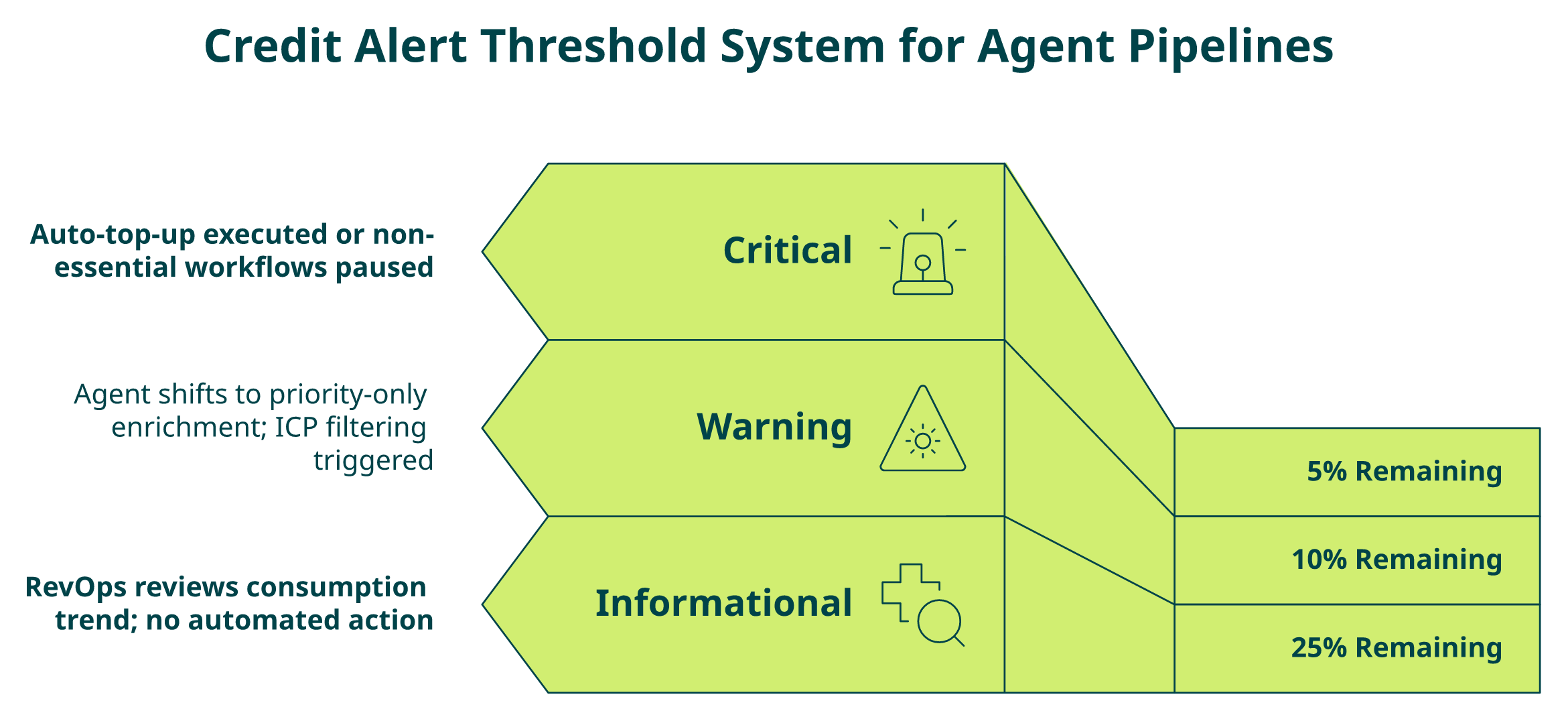
- ⚠️ 25% remaining: Informational. RevOps reviews consumption trend.
- ⚠️ 10% remaining: Warning. Agent shifts to priority-only enrichment.
- 🚨 5% remaining: Critical. Trigger auto-top-up or pause non-essential workflows.
3. Auto-Top-Up vs Manual Replenishment
Configure auto-purchase at the 10% threshold with a maximum cap to prevent runaway spend. Or use manual top-up for tighter budget control. With Explorium’s one-time credit packages, top-ups are purchased at the same per-credit rate: no overage multiplier, no sales call.
4. Per-Agent Credit Budgets
Allocate credit sub-pools per agent to prevent one high-volume agent from starving others. A lead scoring agent might get 50K credits/month while a market research agent gets 10K. If one exceeds its allocation, the others keep running.
✅ Graceful Degradation Patterns
When credits drop below your alert threshold, four patterns keep pipelines running without breaking budgets:
| Pattern | How It Works | Credit Impact |
|---|---|---|
| Priority enrichment | Enrich only records above ICP score threshold | Reduces consumption 40–60% |
| Signal reduction | Request firmographics only (1 credit) instead of full multi-signal (3 credits) | 3× fewer credits per record |
| Queue and defer | Low-priority records queued until credits replenished | Zero consumption, delayed delivery |
| Fallback to cache | Return previously enriched data for known companies | Zero new credits consumed |
The right pattern depends on your workflow. Event-driven agents should use priority enrichment: you want the funding-round trigger enriched immediately even if the batch job waits. Lead scoring agents handle signal reduction well because firmographics alone often give enough data for a preliminary score.
💡 Why This Matters for Vendor Selection
Most B2B data providers offer only dashboard-level credit monitoring. Some require contacting sales to add credits mid-cycle. ZoomInfo’s annual contract model means you can’t top up; you wait until renewal or pay overages at premium rates.
Explorium’s published pricing tiers and one-time credit packages mean engineers can pre-calculate top-up costs, automate purchase triggers, and build credit-aware agent logic, all without a sales conversation. The API headers give agents the same real-time visibility that engineering teams need to build resilient, budget-aware enrichment pipelines.
“Their product enables us to test multiple data sources and to save money by removing sources that have a poor benefit.”
— Verified User, Financial Services Explorium G2 – Verified Review
Q9. How to Choose the Right B2B Data API Pricing Model for Your Team
The eight sections above covered mechanics, costs, tradeoffs, and engineering patterns. This one converts all of that into a decision you can act on today. Score your team against the seven criteria below to determine whether credit-based, subscription, or hybrid pricing fits your enrichment workflow, and where your current model is silently costing you money.
📋 The 7-Point Pricing Model Fit Checklist
Run through each item honestly. Check every box that applies to your team’s current operational reality:
- ☐ Unpredictable monthly volume: Enrichment volume fluctuates >20% month-to-month based on campaigns, agent triggers, or seasonal pipeline surges
- ☐ Multi-signal enrichment needs: You require more than one enrichment type (firmographics + contacts + intent + technographics) from a single provider rather than cobbling together separate tools
- ☐ Agent-driven enrichment decisions: Autonomous AI agents are making enrichment requests at runtime without human approval for each call
- ☐ Multi-vendor contract sprawl: Your team currently manages more than two separate data vendor contracts with different billing cycles, renewal dates, and procurement workflows
- ☐ Recent credit exhaustion or overage charges: You’ve experienced mid-month credit exhaustion or surprise subscription overage fees in the past six months
- ☐ Per-record cost transparency required: Your CFO or finance team needs cost attribution at the record level (not per-seat or per-platform billing) for budget forecasting
- ☐ On-demand capacity without sales conversations: You need the ability to purchase additional enrichment capacity immediately, without a contract amendment or waiting for a sales rep to respond
✅ Score Interpretation
| Your Score | What It Means | Recommended Model |
|---|---|---|
| 5–7 checks | Credit-based pricing with a unified provider is your clear best fit. Subscriptions are actively costing you money through wasted capacity, overage penalties, or engineering overhead. | Unified credit pool (e.g., Explorium) |
| 3–4 checks | You’re likely overpaying on subscriptions. Model a credit-based alternative against your last 3 months of actual usage; the math usually favors credits at this stage. | Credit-based or hybrid |
| 0–2 checks | A simple subscription may still work for now. But re-evaluate in 6–12 months as agent-driven enrichment grows and volume unpredictability increases. | Subscription (for now) |
“Contact info frequently missing or incorrect. Half the day calling wrong/disconnected numbers. Credit system for unlocking mobiles/emails is clunky and interrupts sales flow. Prospecting functionality is 100% trash compared to other tools.”
— Verified User, IT Services Apollo – G2 Verified Review
“Credit pricing not transparent, should show dollar equivalents. UI complex for new users; workspace-level billing confuses referral credits.”
— Farzana N., CEO, IT Services Clay – G2 Verified Review
💡 If You Checked 4+ Boxes
Explorium’s unified credit model was built for exactly this situation: one API covering 30+ enrichment types, one credit pool with published volume tiers ($200 for 5K credits up to $7,500 for 500K credits), MCP-native delivery for autonomous agent workflows, no seat-based licensing, and a free account with 100 credits to validate, no sales call required.
“Explorium is a great tool for getting data from multiple subscriptions, databases but at a consolidated cost for Finance and Data professionals.”
— Omar G., Mid-Market Explorium G2 – Verified Review
Q10. FAQ: B2B Data API Pricing at Scale
Credit-based vs subscription pricing for B2B data APIs: which costs less at scale?
At low volumes (under 10K records/month), subscriptions often appear cheaper on a per-record basis. But credit-based pricing typically becomes more cost-effective at 25K–50K records/month once volume discounts kick in, and the gap widens to 30–50% savings at 100K+ records when using a unified credit pool across multiple enrichment types rather than stacking separate vendor subscriptions. The crossover point depends on whether you need single-signal or multi-signal enrichment: multi-signal heavily favors unified credit pools.
What happens when you run out of B2B data API credits mid-month?
Vendors handle credit exhaustion in four ways: hard stop (API returns errors and workflows break), soft cap (rate limits drop), auto-top-up (automatically purchases more credits at a premium rate), and overage billing (continues service but charges 1.5–3× at month-end). Explorium uses one-time credit top-ups at the same per-credit rate: no overage multiplier, no auto-renewing subscriptions, and real-time balance visibility via API response headers so agents can self-budget before credits reach zero.
Do unused B2B data API credits expire or roll over?
Most subscription-based providers (Apollo, ZoomInfo, Lusha, and Hunter) reset credits at the end of each billing cycle with no rollover on standard plans. Explorium credits are valid for 12 months from purchase and don’t reset monthly; they’re consumed against a single pool across all enrichment types until used or expired.
Annual contract vs pay-as-you-go for data enrichment APIs: which saves more?
Annual contracts offer 20–40% discounts but lock you into consumption commitments. PAYG eliminates risk but costs 20–40% more per record. The hidden factor most teams miss: both models multiply across 3–5 separate vendor contracts, creating $68K–$92.5K in hidden costs from engineering normalization, unused capacity, and procurement overhead. Unified credit packages, like Explorium’s, offer volume-discount economics without annual lock-in.
What volume discount structures should you expect from B2B data APIs?
Most B2B data APIs offer 3–5 volume tiers: base rate for 0–10K records, 15–25% discount at 10K–50K, 25–40% at 50K–100K, and 40–60% at 100K+. The critical distinction is graduated vs flat-tier pricing. Graduated discounts apply only to incremental volume above each threshold; flat-tier pricing applies retroactively across all records. Credit-based models typically use flat-tier structures, which become significantly more favorable at higher volumes.
How do you estimate monthly credit usage for a B2B data enrichment API?
Use this formula: Monthly Credits = (Records × Credits per Enrichment × Number of Enrichment Types) + Retry Buffer (10–15%) + Agent Autonomy Buffer (20–30%). For example, 50K records enriched across 3 signal types at 1 credit each yields 150K base credits. Add a 15% retry buffer (22.5K) and a 25% agent autonomy buffer (37.5K) for a total of ~210K credits/month. The agent buffer accounts for autonomous agents requesting additional signal types beyond the planned configuration at runtime.
FAQs


