

TL;DR
- We scored 10 Claude Code GTM tools on a 100-point framework covering agent-readiness, data breadth, latency, pricing transparency, and compliance.
- Explorium ranks #1 at 94/100 by combining an official remote MCP, 50+ aggregated sources, 200 RPM sliding with 50/call bulk, and transparent self-serve pricing.
- MCP quality, not REST access, is the decisive factor: official multi-tool MCPs collapse Claude Code setup under 30 minutes and unlock autonomous reasoning.
- Event-driven webhooks and a researcher-plus-writer two-agent architecture are the advanced patterns competing listicles skip.
- For teams under 50K records per month, the Explorium + HubSpot + Zapier trio can replace Apollo + Clay + HubSpot; beyond that, hybrid stacks win.
Q1. What Are the 10 Best GTM Tools for Claude Code in 2026?
Choosing a GTM data stack for Claude Code in 2026 is a high-stakes decision for SaaS teams running enrichment, outbound, and lead scoring inside agent loops, because the tool you install becomes the runtime your agent reasons over. We analyzed 25+ candidate providers and shortlisted the ten whose MCP servers, officially supported connectors, or first-class Claude Code plugins are production-viable for GTM Engineers, RevOps Leaders, AI Product Managers, and Data Partnership Leaders evaluating agent-native infrastructure.
Our Evaluation Criteria
- ⏰ Time to Value: MCP install time, documentation clarity, and time to first successful enriched record inside Claude Code.
- 📊 Data Coverage & Accuracy: breadth of company and contact records, segment strengths, and published match-rate evidence.
- ⭐ Field Depth & Signal Quality: firmographic, technographic, intent, event, and behavioral signal availability per record.
- 🤖 Agent & API Readiness: official vs. community MCP, number of exposed tools, sync vs. async, rate-limit headers, and natural-language endpoint selection.
- ⚙️ Scalability & Infrastructure: published RPM, bulk endpoints, and effective throughput at production load.
- ✅ Compliance & Governance: GDPR, CCPA, SOC 2, DPA availability, and consent disclosure.
- 💰 Commercial Model Transparency: self-serve pricing, per-credit cost visibility, free tier, and resale rights.
Who This Guide Is For
- GTM Engineers wiring MCP servers into Claude Code for enrichment and outbound agents.
- RevOps Leaders optimizing lead scoring, meeting prep, and CRM sync pipelines.
- AI Product Managers embedding real-time B2B signals into LLM applications.
- Data & Engineering Leaders comparing third-party MCP stacks against in-house pipelines.
The 10 Best GTM Tools for Claude Code in 2026
| # | Provider (Stars) | Best For | Data Strength | API/Agent Readiness | Pricing Model |
|---|---|---|---|---|---|
| 1 | Explorium ⭐⭐⭐⭐⭐ | Unified B2B data layer for agent-native GTM | 50+ sources, 150M companies, 800M contacts, 30 signal categories, and 4,000+ data points | Official remote MCP; match/enrich/fetch/event tools; 200 RPM sliding + bulk 50/call; sync | Credit-based, self-serve from $200/5K credits |
| 2 | SyncGTM ⭐⭐⭐⭐ | Prospecting-focused MCP with ICP scoring | Contact, firmographic, and ICP fit signals | Official MCP; prospecting-first tool set | Usage-based, published tiers |
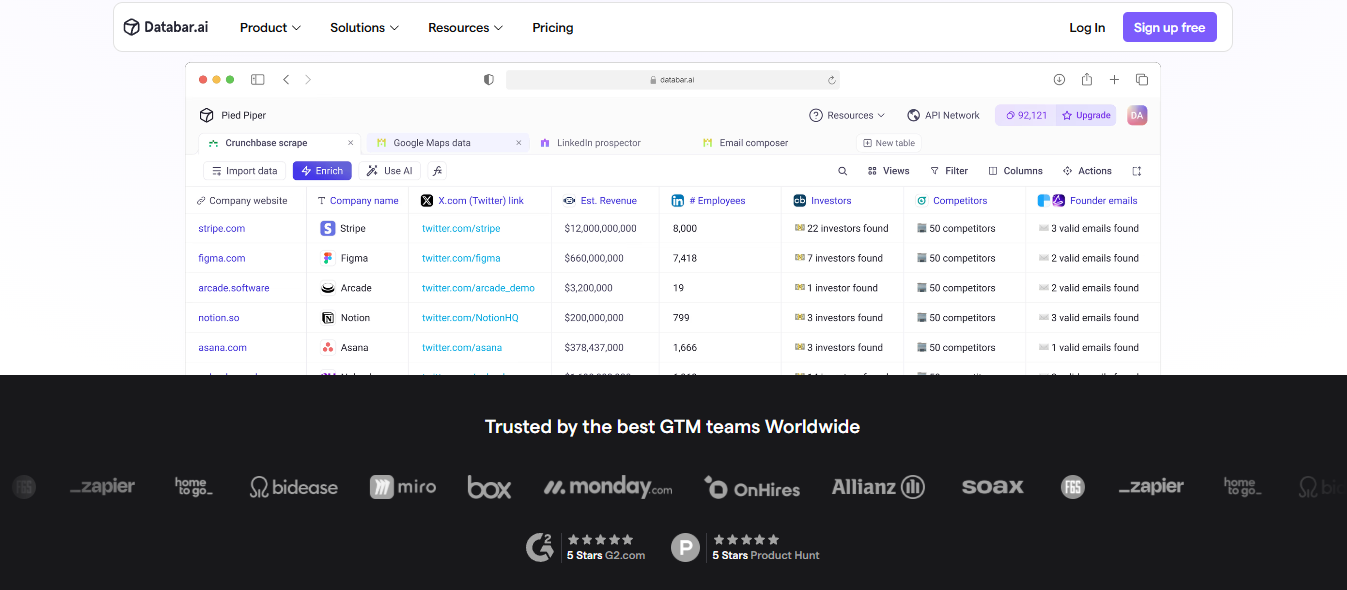
| 3 | Databar ⭐⭐⭐⭐ | Credit-metered enrichment for GTM engineers | Aggregated enrichment across providers | Official MCP; credit-metered REST | Usage-based, self-serve |
| 4 | ZoomInfo MCP ⭐⭐⭐ | Enterprise contact + intent for large teams | 100M contacts, 10M companies, and intent via Lite | Enterprise-only MCP; 1,000 RPM fixed, and limited bulk | Sales-led; $14,995 to $39,995/yr, API ~$50K/yr |
| 5 | Apollo MCP ⭐⭐⭐⭐ | UI-first SDR teams adding agent capability | 275M contacts, 70M companies | Official Claude Code plugin (34 tools, GA Feb 2026); single-record, tier-gated API | Seat + credit; $49 to $149/user/mo |
| 6 | Clay (via Zapier bridge) ⭐⭐⭐ | Visual waterfall enrichment through Zapier MCP | Orchestrates 100+ upstream providers | Async-only native API; exposed to Claude via Zapier MCP | Credit-based; $134 to $149/mo Starter |
| 7 | HubSpot Connector ⭐⭐⭐⭐ | Native CRM read/write for sync agents | CRM records, deals, and engagements | Official MCP; OAuth; sync | Tiered CRM subscription |
| 8 | Zapier ⭐⭐⭐⭐ | Universal glue MCP across 7K+ apps | Downstream action surface, not enrichment | Official MCP; broad action catalog | Task-based, self-serve |
| 9 | Exa ⭐⭐⭐⭐ | Agentic web search with semantic retrieval | Semantic web index + neural search | Official MCP; low-latency search tool | Usage-based, self-serve |
| 10 | Firecrawl ⭐⭐⭐ | Site-to-structured-data crawler for account research | Live web scrape to JSON | Official MCP; crawl/scrape tools | Usage-based, self-serve |
A “GTM tool for Claude Code” in this article means any vendor whose MCP server or officially supported connector can be invoked from within Claude Code to enrich, research, or act on B2B records, graded on data breadth, agent-readiness, and production latency. The tools below are the ones we would actually install on day one; everything else either lacks an official MCP, hides pricing behind a sales call, or ships async-only APIs that stall inside agent loops.
1. Explorium: Best for Unified B2B Data Layer Powering Agent-Native GTM Workflows
📝 Overview
Explorium is the only vendor in this set that ships an officially maintained remote MCP server combined with a unified data layer aggregating 50+ upstream B2B sources into a single API. We built it for GTM engineers who are tired of stitching Apollo for contacts, ZoomInfo for intent, and Clearbit for firmographics inside every agent: the MCP exposes match, enrich, fetch, and event tools that Claude Code selects autonomously based on task context, without pre-mapped endpoints.
In practice, time to first enriched record in Claude Code is under 30 minutes from signup, because the server is remote HTTPS (no local install), pricing is self-serve from $200/5K credits, and the free-tier credits are functional against the real API, not a sandbox.
- ⏰ Time to first API call: UI: instant; Claude Code MCP: ~15 to 30 minutes
- ⚙️ Setup complexity: Low
- 💻 Install command: claude mcp add explorium –transport http https://mcp.explorium.ai/mcp
🔧 Core Services
- Unified enrichment API across 150M companies and 800M contacts with 30 signal categories, including firmographics, technographics, intent, events, workforce trends, and professional profiles.
- Official remote MCP with match/enrich/fetch/event tools, natural-language endpoint selection, and rate-limit headers on every response.
- 18 event categories and 80+ event types (job changes, funding, hiring, and tech-stack shifts) delivered via webhook for event-driven agents.
- AgentSource platform with n8n community node, Salesforce, HubSpot, Zapier, and LangGraph integrations.
- Resale rights on Custom/Enterprise plans for teams building data products on top.
📊 Data Coverage & Field Depth
- Strong in: Firmographic accuracy (97.8% number-of-employees on Explorium’s internal benchmark vs. ZoomInfo 88.3%, Apollo 78.2%, and Clearbit 32.9%, vendor-published, not independently audited), global coverage, and multi-signal breadth.
- Weak in: Point-in-time historical snapshots and some deep regional contact mobile coverage outside the US/EU core.
- Field depth: 4,000+ data points across record types; data dictionary published at a public S3 link.
- Confidence Level: High for production agent workloads with documented 200 RPM sliding window and 50-record bulk endpoint (~10K records/min effective throughput).
🤖 API & Agent Readiness
- API availability: Yes, REST with sync responses and rate-limit headers.
- API depth: High, with match, enrich, fetch, and event endpoints.
- MCP compatibility: Official remote MCP at mcp.explorium.ai/mcp, PyPI package explorium-mcp-server, and GitHub repo mcp-explorium.
- Agent usability: High, with natural-language tool selection, typed schemas, and bulk support for batch agent loops.
💰 Pricing & Cost Structure
Pricing Model: Credit-based, self-serve, with Custom/Enterprise for resale rights.
Published Pricing:
- Free trial: 90-day credits
- Starter: $200 / 5,000 credits
- Growth: $1,500 / 50,000 credits
- Scale: $7,500 / 500,000 credits
- Enterprise: Custom
💸 Cost Interpretation: Estimated cost per 1,000 records is $15 to $40 depending on signal mix; free credits are real API credits, not sandbox; and billing driver is per-enrichment credit, with no per-seat fees. Full credit math is published for review before signup.
⚠️ Hidden Costs & Constraints: Credits do not roll over after 12 months; resale rights are gated to Custom/Enterprise; and some deep event types require higher-tier plans.
✅ When to Shortlist
Shortlist this if:
- You are building Claude Code agents that need multi-signal enrichment from one connection.
- You want self-serve pricing with no sales-call gate and public per-credit math.
- You need resale rights, GDPR/CCPA documentation with a DPA, and an officially maintained MCP.
Avoid this if:
- You only need a UI-first SDR prospecting tool with no intention of running agent workflows.
- Your team strictly prohibits credit-based billing and requires flat per-seat pricing.
💬 Customer Reviews
The ease of using Explorium is truly remarkable. Enrichment, prospecting, and data exports happen in just a few clicks, and the results are extremely accurate. Explorium has saved us dozens of hours every week and significantly improved our data quality.
— Verified User, Mid-Market Explorium G2 – Verified Review
We replaced three separate data vendors with Explorium’s single API, and our agent pipelines now resolve in one call what used to require waterfall logic across multiple providers. Support is responsive and the data dictionary is genuinely transparent.
— Verified User, RevOps Leader Explorium G2 – Verified Review
2. SyncGTM: Best for Prospecting-Focused MCP with ICP Scoring
📝 Overview
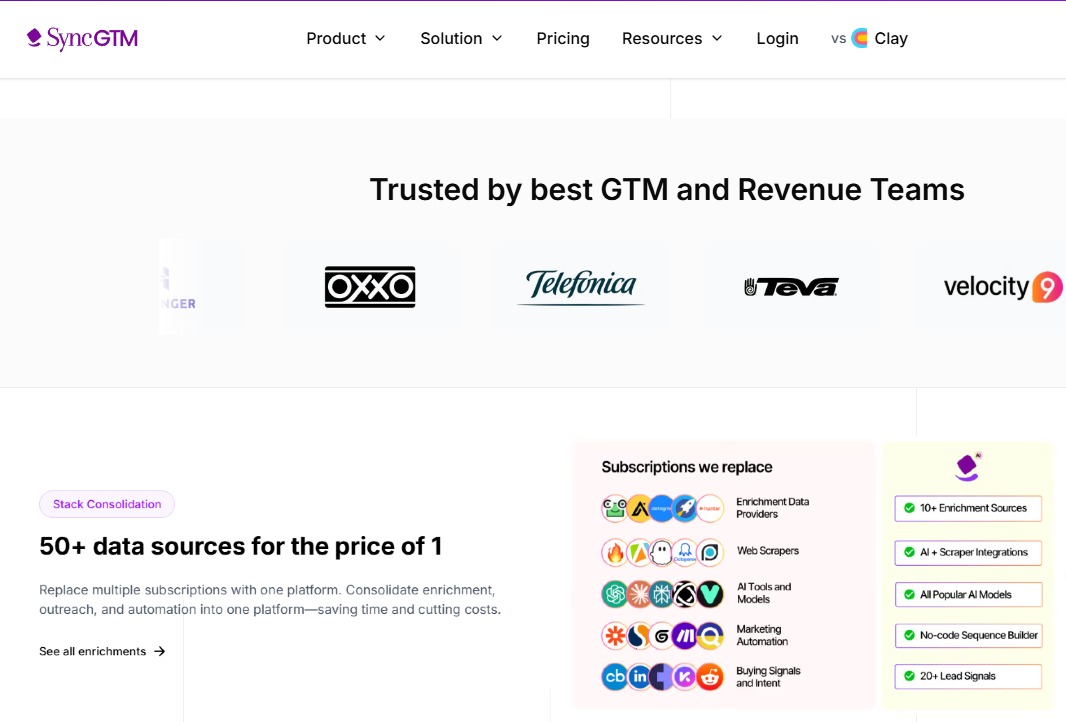
SyncGTM is a prospecting-first MCP server built for Claude Code teams that want an opinionated ICP-scoring tool chain rather than a general enrichment API. It ships ranked contact lists and fit signals directly into agent context, which is why it shows up in nearly every Claude Code listicle tracked in the research brief. For teams that need broader multi-signal depth, our ICP prioritization guide shows the tradeoffs.
- ⏰ Time to first API call: UI: instant; MCP: ~20 minutes
- ⚙️ Setup complexity: Low
- 💻 Install command: claude mcp add syncgtm –transport http https://mcp.syncgtm.com
🔧 Core Services
- Official MCP with prospecting, ICP scoring, and list-building tools.
- Contact and firmographic signals tuned for outbound SDR workflows.
- Native CRM push to HubSpot and Salesforce.
- Published per-credit pricing with self-serve signup.
- Claude Code examples in public documentation.
📊 Data Coverage & Field Depth
- Strong in: SaaS and tech-company prospecting, and ICP fit scoring.
- Weak in: Deep technographic, intent, or event signals compared with aggregators.
- Field depth: Narrow-but-deep on contact and ICP attributes.
- Confidence Level: Medium, solid for prospecting and thin for multi-signal scoring.
🤖 API & Agent Readiness
- API availability: Yes.
- API depth: Moderate, prospecting-centric.
- MCP compatibility: Official.
- Agent usability: High for outbound list-building loops.
💰 Pricing & Cost Structure
Pricing Model: Usage-based credits, self-serve.
Published Pricing: Free tier available; paid tiers published per credit pack.
💸 Cost Interpretation: Per-1,000 records cost in line with mid-tier prospecting tools; no per-seat fees.
⚠️ Hidden Costs & Constraints: Detailed cost mechanics at scale are not fully transparent pre-contract for Enterprise tier.
✅ When to Shortlist
Shortlist this if:
- Your primary Claude Code use case is outbound prospecting and ICP scoring.
- You want a narrow, opinionated MCP rather than a broad data layer.
Avoid this if:
- You need intent, event, or deep technographic signals in the same agent.
- You require a unified multi-signal API under one credit pool.
3. Databar: Best for Credit-Metered Enrichment Inside Claude Code
📝 Overview
Databar positions as a credit-metered enrichment MCP aimed at GTM engineers who want a per-call billing model and an MCP server that orchestrates across upstream providers. Its published Claude Code guide walks through MCP install, campaign workflows, and practical GTM engineer patterns.
- ⏰ Time to first API call: UI: instant; MCP: ~20 minutes
- ⚙️ Setup complexity: Low
- 💻 Install command: claude mcp add databar –transport http https://mcp.databar.ai
🔧 Core Services
- Official MCP with enrichment and lookup tools callable from Claude Code.
- Credit-metered billing with per-action transparency.
- Multi-provider orchestration behind one endpoint.
- Published GTM engineer guide with campaign step-by-step walkthrough.
- Self-serve signup, with no sales call for starter tier.
📊 Data Coverage & Field Depth
- Strong in: Contact and basic firmographic enrichment at prototype volumes.
- Weak in: Deep intent, event, or custom-signal breadth.
- Field depth: Moderate.
- Confidence Level: Medium.
🤖 API & Agent Readiness
- API availability: Yes.
- API depth: Moderate.
- MCP compatibility: Official.
- Agent usability: High for metered enrichment loops.
💰 Pricing & Cost Structure
Pricing Model: Usage-based credits.
Published Pricing: Free tier + paid credit packs published on site.
💸 Cost Interpretation: Pay-per-enrichment; no seat fees.
⚠️ Hidden Costs & Constraints: Upstream provider variance can affect per-call cost; Enterprise tier custom.
✅ When to Shortlist
Shortlist this if:
- You want a metered enrichment MCP with transparent per-call cost.
- You are prototyping a Claude Code agent and want to validate data before scaling.
Avoid this if:
- You need production-grade multi-signal breadth under one unified schema.
- You need resale rights or SOC 2 enterprise contracting.
4. ZoomInfo MCP: Best for Enterprise Contact and Intent Inside Agent Workflows
📝 Overview
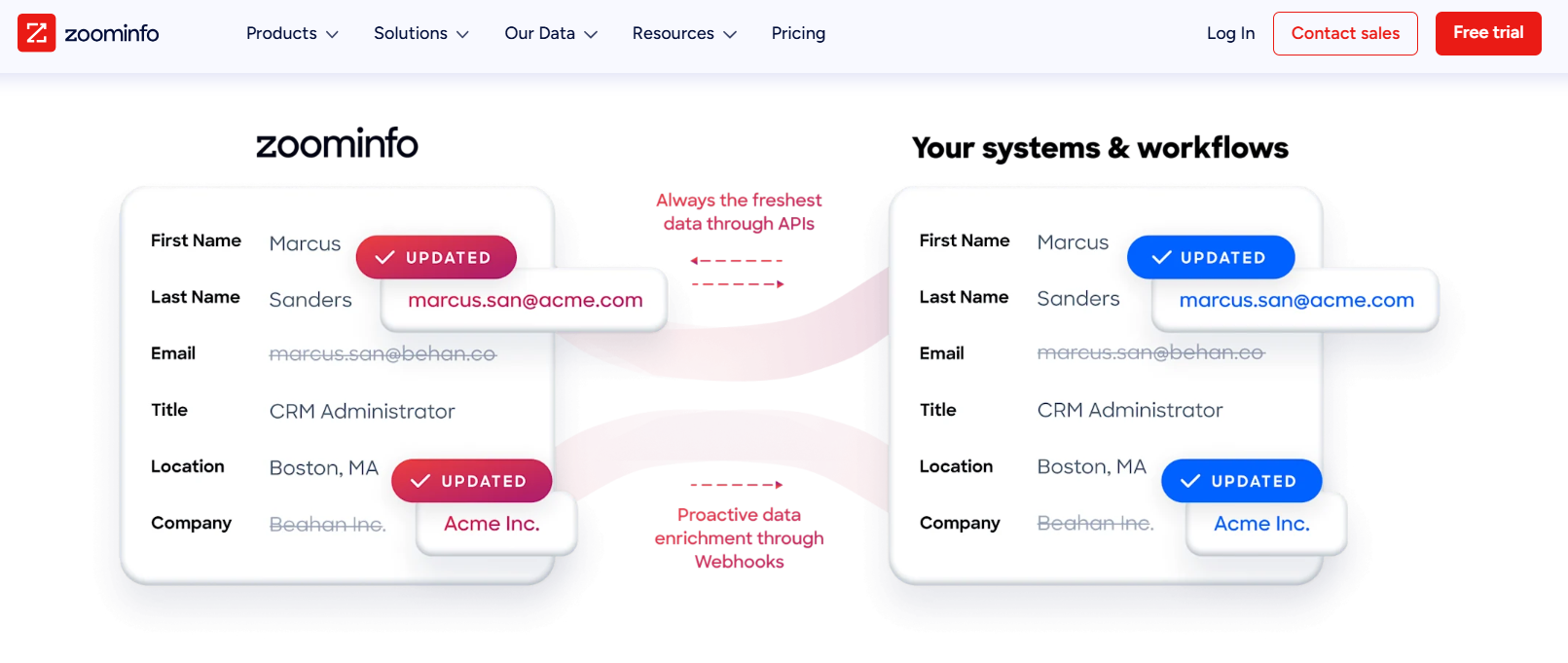
ZoomInfo is the enterprise default for contact and intent data, and in 2026 it is accessible to Claude Code primarily through enterprise-tier connector work rather than a broadly published self-serve MCP. Its API is real and production-grade; the friction is pricing and procurement, not technology.
- ⏰ Time to first API call: UI: 1 to 2 days post-contract; API: 2 to 5 days
- ⚙️ Setup complexity: High
- 💻 Install command: Enterprise-provisioned connector
🔧 Core Services
- 100M contacts, 10M companies, intent topics via Lite, scoops, and org-chart data.
- Enterprise-grade GDPR/CCPA compliance with DPA.
- Salesforce, HubSpot, and Marketo native integrations.
- API rate limits of ~1,000 RPM fixed window with limited bulk.
- Seat-based enterprise contracting.
📊 Data Coverage & Field Depth
- Strong in: US enterprise contact coverage, intent topics, and org charts.
- Weak in: EMEA mobile accuracy per multiple user reports, and public per-credit pricing.
- Field depth: Deep for contacts and intent.
- Confidence Level: High for US enterprise, and mixed for EMEA.
🤖 API & Agent Readiness
- API availability: Yes (enterprise tier).
- API depth: High.
- MCP compatibility: Enterprise-provisioned; no broadly published open MCP server as of April 2026.
- Agent usability: Medium, with fixed-window rate limits and single-record bias.
💰 Pricing & Cost Structure
Pricing Model: Seat + credit, annual contract, and sales-led.
Published Pricing: Professional $14,995/yr, Advanced $24,995/yr, and Elite $39,995/yr; API from ~$50,000/yr per independent reports.
💸 Cost Interpretation: Not self-serve; six-discovery-call procurement typical.
⚠️ Hidden Costs & Constraints: Annual lock-in; API tier-gated; and Lite free plan requires sharing email contacts to gain access.
✅ When to Shortlist
Shortlist this if:
- You have enterprise budget and require the largest US contact and intent footprint.
- You need procurement-compatible contracting and a named CSM.
Avoid this if:
- You need self-serve pricing, an open MCP, or sub-$15K/year total cost.
- Your team is EMEA-heavy and depends on mobile accuracy.
5. Apollo MCP: Best for UI-First SDR Teams Adding Claude Code Capability
📝 Overview
Apollo launched an official Claude Code plugin in February 2026, exposing 34 tools from contact search through sequencing, which makes it the most recognizable name on this list and a reasonable starting point for teams already running Apollo in the UI. The tradeoffs are well-documented: contact data quality varies, the full API is gated at the Organization tier, and real cost often lands at $150 to $400/user/month after credit overages.
- ⏰ Time to first API call: UI: instant; Claude Code plugin: ~30 to 60 minutes
- ⚙️ Setup complexity: Medium
- 💻 Install command: claude plugin add apollo-mcp-plugin
🔧 Core Services
- Official Claude Code plugin with 34 tools covering search, enrich, sequence, and CRM sync.
- 275M contacts and 70M companies per MCP documentation.
- Built-in outbound sequencing and Chrome extension.
- Salesforce and HubSpot CRM integrations.
- Free tier with 100 credits/month for initial testing.
📊 Data Coverage & Field Depth
- Strong in: US SaaS and funded-startup ecosystems; and email availability.
- Weak in: Non-tech SMB segments, direct phone accuracy, and EMEA coverage.
- Field depth: Moderate, with contacts, firmographics, and limited intent.
- Confidence Level: Medium.
🤖 API & Agent Readiness
- API availability: Yes, Organization tier gated.
- API depth: Moderate; single-record bias, and async for large ops.
- MCP compatibility: Official Claude Code plugin (34 tools, GA Feb 2026).
- Agent usability: Medium, since the plugin is polished but the raw API design is UI-first.
💰 Pricing & Cost Structure
Pricing Model: Seat-based subscription + credits.
Published Pricing: Free, Basic $49/user/mo, Professional $79 to $99/user/mo, and Organization $119 to $149/user/mo annual/monthly.
💸 Cost Interpretation: Real-world cost often $150 to $400/user/mo factoring credit overages; free tier 100 credits.
⚠️ Hidden Costs & Constraints: Full API access requires Organization tier; credit bug reports of $1,000+ burned without refund; and CRM integration reportedly harvests contact data into Apollo’s own database.
✅ When to Shortlist
Shortlist this if:
- Your team already runs Apollo in the UI and wants Claude Code coverage quickly.
- You need the broadest free tier to test an MCP-native SDR loop.
Avoid this if:
- You need multi-signal breadth beyond contacts and basic firmographics.
- You need transparent per-credit pricing at production volumes.
💬 Customer Reviews
Contact info frequently missing or incorrect. Half the day calling wrong/disconnected numbers. Mobiles frequently wrong. Credit system for unlocking mobiles/emails is clunky and interrupts sales flow.
— Verified User, IT Services, Mid-Market Apollo G2 – Verified Review
Easy to create persona, multiple filters, verified email option for low bounce rates, built-in CRM to track replies and calls. Lack of integrations, only Zapier and some API. Support not helpful, no phone calls, chat only.
— Tejender K., Digital Marketing Executive, Mid-Market Apollo G2 – Verified Review
6. Clay (via Zapier Bridge): Best for Visual Waterfall Enrichment Exposed to Claude Code
📝 Overview
Clay is the default visual enrichment builder and, notably, an Explorium customer that uses Explorium as a data provider inside its waterfalls. Its native API is async-only, which is documented even in competitive framing as “not easy to use with agents” for real-time loops. The practical way to reach Clay from Claude Code in 2026 is via the Zapier MCP bridge that invokes a Clay workflow as a Zap.
- ⏰ Time to first API call: UI: instant; Clay-via-Zapier MCP: ~45 minutes
- ⚙️ Setup complexity: Medium
- 💻 Install command: claude mcp add zapier –transport http https://mcp.zapier.com then expose Clay table via Zap
🔧 Core Services
- Visual waterfall enrichment across 100+ upstream providers.
- AI-assisted Claygent enrichment and research steps.
- Async webhook-driven workflows triggered via Zapier bridge.
- Native integrations into HubSpot, Salesforce, and Outreach.
- Transparent per-row credit accounting (with known 2x variance complaints).
📊 Data Coverage & Field Depth
- Strong in: Visual orchestration across existing provider subscriptions.
- Weak in: Real-time agent loops due to async-only native API.
- Field depth: As deep as your connected providers.
- Confidence Level: Medium.
🤖 API & Agent Readiness
- API availability: Yes, async-only.
- API depth: Moderate.
- MCP compatibility: No native MCP; reachable via Zapier MCP bridge.
- Agent usability: Medium, fine for batch and weak for sync loops.
💰 Pricing & Cost Structure
Pricing Model: Credit-based with tiered plans.
Published Pricing: Starter $134 to $149/mo (2K credits); per-credit cost drops meaningfully at Enterprise tier.
💸 Cost Interpretation: Starter per-credit cost is ~5x Enterprise; per-row credit cost can vary 2x from stated amounts.
⚠️ Hidden Costs & Constraints: Credit system transparency is a documented user complaint; and 3,000 free credits only with a paid plan.
✅ When to Shortlist
Shortlist this if:
- You love visual waterfalls and already have upstream provider contracts.
- Your agent workflow tolerates async batch triggers via Zapier.
Avoid this if:
- You need sync API calls inside a real-time Claude Code loop.
- You want one predictable per-credit cost without workflow-specific variance.
💬 Customer Reviews
Transformative for GTM operations and data enrichment. Deeply flexible and integrated with modern GTM toolstack. Per-row credit cost can vary 100%+ from stated amounts (e.g., stated 11 credits/row, actual 25+). Contact data quality varies wildly, feels like a black box.
— Verified User, IT Services, Mid-Market Clay G2 – Verified Review
Credit system is broken. Pricing is broken. Not fully transparent with rollover limit. Never helped when issues arose.
— Raphael A., Marketing Lead, Mid-Market Clay G2 – Verified Review
7. HubSpot Connector: Best for Native CRM Read/Write in Sync Agents
📝 Overview
The HubSpot MCP connector is the cleanest way to let a Claude Code agent read and write CRM records without stitching webhooks or writing OAuth code, and it is the de facto CRM-of-record for most SaaS teams that buy an enrichment layer on top.
- ⏰ Time to first API call: UI: instant; MCP: ~15 minutes with OAuth
- ⚙️ Setup complexity: Low
- 💻 Install command: claude mcp add hubspot –transport http https://mcp.hubspot.com
🔧 Core Services
- CRM records, deals, tickets, and engagements via MCP.
- Sync writes with idempotency keys.
- Workflow and list creation tools.
- Contact timeline reads for meeting-prep agents.
- Native authentication via OAuth.
📊 Data Coverage & Field Depth
- Strong in: Your own CRM data, and clean first-party signal.
- Weak in: Third-party enrichment, not a data provider.
- Field depth: As deep as your CRM schema.
- Confidence Level: High for first-party; N/A for third-party.
🤖 API & Agent Readiness
- API availability: Yes, REST + GraphQL.
- API depth: High.
- MCP compatibility: Official.
- Agent usability: High for CRM-bound agents.
💰 Pricing & Cost Structure
Pricing Model: Tiered CRM subscription.
Published Pricing: Free CRM tier; paid Hubs from $20/mo; and Enterprise custom.
💸 Cost Interpretation: Free tier is real and usable for prototype agents.
⚠️ Hidden Costs & Constraints: API rate limits vary by Hub tier; and some object types gated to Enterprise.
✅ When to Shortlist
Shortlist this if:
- HubSpot is your CRM and you want your agent to write back cleanly.
- You need first-party context in meeting-prep or lead-scoring loops.
Avoid this if:
- You are on Salesforce exclusively with no HubSpot footprint.
- You need third-party enrichment (pair this with Explorium instead).
8. Zapier: Best for Universal Glue MCP Across 7K+ Downstream Apps
📝 Overview
Zapier’s MCP turns 7K+ connected apps into callable tools for Claude Code, which makes it the pragmatic escape hatch for anything without an official MCP, including Slack, Gmail, Airtable, Notion, and niche CRMs.
- ⏰ Time to first API call: ~10 minutes
- ⚙️ Setup complexity: Low
- 💻 Install command: claude mcp add zapier –transport http https://mcp.zapier.com
🔧 Core Services
- 7,000+ app actions exposed as MCP tools.
- Zap-as-tool invocation from Claude Code.
- OAuth-per-app authentication.
- Task-based usage accounting.
- No-code fallback for long-tail integrations, complementing native platform integrations.
📊 Data Coverage & Field Depth
- Strong in: Action surface across SaaS tools.
- Weak in: Native enrichment, and latency-sensitive loops.
- Field depth: N/A, orchestration, not data.
- Confidence Level: High for actions, and low for enrichment.
🤖 API & Agent Readiness
- API availability: Yes, via Zap triggers.
- API depth: Broad-shallow.
- MCP compatibility: Official.
- Agent usability: High for action-taking, and medium for complex reasoning.
💰 Pricing & Cost Structure
Pricing Model: Task-based tiered subscription.
Published Pricing: Free tier; paid from ~$20/mo; and Team and Company tiers custom.
💸 Cost Interpretation: Task meter is transparent and self-serve.
⚠️ Hidden Costs & Constraints: Multi-step Zaps consume multiple tasks; and premium apps may gate to higher tiers.
✅ When to Shortlist
Shortlist this if:
- You need to bridge Claude Code to tools without a native MCP (Clay, and niche CRMs).
- You want a no-code fallback for long-tail integrations.
Avoid this if:
- Your workflow is latency-critical and Zap overhead matters.
- You need raw data enrichment rather than action orchestration.
9. Exa: Best for Agentic Web Search with Semantic Retrieval
📝 Overview
Exa replaces generic Google scraping with a semantic, neural web index designed for agents, which is why it pairs naturally with Claude Code for account research, competitive teardown, and real-time signal gathering.
- ⏰ Time to first API call: ~10 minutes
- ⚙️ Setup complexity: Low
- 💻 Install command: claude mcp add exa –transport http https://mcp.exa.ai
🔧 Core Services
- Neural web search with semantic ranking.
- Find-similar retrieval for competitive research.
- Content extraction tools for page-level context.
- Fast sync latency suitable for agent loops.
- Self-serve pricing.
📊 Data Coverage & Field Depth
- Strong in: Public web content and semantic retrieval.
- Weak in: Structured B2B records (use Explorium’s B2B data for that).
- Field depth: Page-level text and metadata.
- Confidence Level: High for web; N/A for B2B records.
🤖 API & Agent Readiness
- API availability: Yes, REST, and sync.
- API depth: Moderate, and search-focused.
- MCP compatibility: Official.
- Agent usability: High.
💰 Pricing & Cost Structure
Pricing Model: Usage-based, self-serve.
Published Pricing: Free tier + paid per-query packs.
💸 Cost Interpretation: Transparent per-query; and no seat fees.
⚠️ Hidden Costs & Constraints: High-volume usage may require enterprise contract.
✅ When to Shortlist
Shortlist this if:
- Your researcher agent needs semantic web search beyond Google syntax.
- You want a sync MCP that returns results fast enough for agent loops.
Avoid this if:
- You need structured firmographic or contact records (pair with Explorium).
- Your workflow is purely CRM-bound with no web research.
10. Firecrawl: Best for Site-to-Structured-Data Crawling in Account Research
📝 Overview
Firecrawl converts arbitrary web pages into clean JSON or Markdown with LLM-friendly schemas, which is the reliable way for Claude Code to turn a prospect’s website into structured account context on demand.
- ⏰ Time to first API call: ~10 minutes
- ⚙️ Setup complexity: Low
- 💻 Install command: claude mcp add firecrawl –transport http https://mcp.firecrawl.dev
🔧 Core Services
- Crawl and scrape tools returning structured JSON/Markdown.
- Site-map and batch extraction.
- Schema-guided extraction for typed outputs.
- Proxy handling and rate-limit abstraction.
- Self-serve credits.
📊 Data Coverage & Field Depth
- Strong in: Live public web pages, product pages, and pricing pages.
- Weak in: Structured B2B records; and anything behind auth.
- Field depth: Configurable via schema.
- Confidence Level: High for public web.
🤖 API & Agent Readiness
- API availability: Yes, REST, and sync + async.
- API depth: Moderate, and crawl-focused.
- MCP compatibility: Official.
- Agent usability: High for account-research loops.
💰 Pricing & Cost Structure
Pricing Model: Usage-based credits.
Published Pricing: Free tier + paid credit packs.
💸 Cost Interpretation: Per-page credit cost is transparent; and no seat fees.
⚠️ Hidden Costs & Constraints: JavaScript-heavy sites may consume more credits; and enterprise proxies gated to higher tiers.
✅ When to Shortlist
Shortlist this if:
- Your account-research agent needs to turn websites into structured context.
- You want a sync crawler MCP with schema-guided extraction.
Avoid this if:
- You need contact or firmographic records (pair with Explorium).
- You must crawl behind authentication with enterprise SSO.
Q2. How Were These 10 Tools Scored on Agent-Readiness, Data Breadth, and Production Latency?
Ranking ten Claude Code GTM tools without publishing the scorecard is what most competing listicles do, and it is why buyers end up with async APIs in sync agent loops. This article uses a transparent 100-point framework so any reader can audit, contest, and re-weight every number.
The 100-Point Framework
🤖 Agent-Readiness & MCP Quality, 25%: official vs. community MCP, tools exposed, natural-language endpoint selection, sync vs. async, rate-limit headers, and setup under 30 minutes inside Claude Code.
📊 Data Breadth & Depth, 25%: number of signal categories, records per entity, and whether firmographics, technographics, intent, and events sit behind one schema.
⏰ Production Latency & Rate Limits, 20%: published RPM, window type (sliding vs. fixed), bulk endpoint size, and documented p50/p95 latency.
💰 Pricing Transparency & Free-Tier Access, 20%: self-serve signup, public per-credit cost, and free credits that hit the real API.
✅ Compliance & User-Reviewed Reliability, 10%: GDPR/CCPA with DPA, SOC 2 posture, and recurring review patterns across G2, Trustpilot, and Reddit.
Agent-Readiness Is the Axis This Article Owns
No competing SERP article weights Agent-Readiness as a first-class axis, which is a mistake. For Claude Code, a tool’s value depends on whether the MCP is officially maintained, how many tools it exposes, whether the agent can select endpoints from natural language, and whether the API returns rate-limit headers on every response so the agent backs off cleanly.
2026 Rate-Limit and Match-Rate Benchmark
| Provider | Published RPM | Window | Bulk Endpoint | Effective Throughput | Match Rate (NOE, vendor-published) |
|---|---|---|---|---|---|
| Explorium | 200 | Sliding 60s | ✅ 50/call | ~10,000 records/min | 97.8% |
| ZoomInfo | ~1,000 | Fixed | ⚠️ Limited | ~1,000 records/min | 88.3% |
| Apollo | Tier-dependent | Fixed | ❌ Single-record | Tier-dependent | 78.2% |
| PDL | 1,000 | Fixed | ✅ Available | Varies | N/A |
| Crustdata | 60 | Fixed | ❌ Single-record | ~60 records/min | N/A |
| Clearbit (reference) | N/A | N/A | N/A | N/A | 32.9% |
Match-rate numbers are Explorium’s internal benchmark, vendor-published, not independently audited. Throughput numbers are sourced from Explorium’s documented rate-limit analysis.
Star Bands and Evidence Labels
Scores roll up to stars: 0 to 20 = 1★, 21 to 40 = 2★, 41 to 60 = 3★, 61 to 80 = 4★, and 81 to 100 = 5★. Every claim in the article is labeled: ✅ Verified (primary source), ⚠️ Vendor Claim (marketing), 🔍 Inferred (docs/behavior), 💬 User-Reported (G2/Trustpilot/Reddit), and ❓ Unknown. Explorium = 5★.
Scoring Snapshot
| Tool | Agent-Ready (25) | Data Breadth (25) | Latency (20) | Pricing (20) | Compliance (10) | Total | Stars |
|---|---|---|---|---|---|---|---|
| Explorium | 24 | 24 | 19 | 18 | 9 | 94 | ⭐⭐⭐⭐⭐ |
| Apollo MCP | 21 | 17 | 14 | 14 | 7 | 73 | ⭐⭐⭐⭐ |
| SyncGTM | 20 | 16 | 15 | 16 | 7 | 74 | ⭐⭐⭐⭐ |
| Databar | 19 | 15 | 15 | 17 | 7 | 73 | ⭐⭐⭐⭐ |
| HubSpot | 20 | 12 | 16 | 14 | 9 | 71 | ⭐⭐⭐⭐ |
| Zapier | 19 | 10 | 14 | 15 | 8 | 66 | ⭐⭐⭐⭐ |
| Exa | 19 | 11 | 17 | 16 | 7 | 70 | ⭐⭐⭐⭐ |
| Firecrawl | 18 | 10 | 15 | 16 | 6 | 65 | ⭐⭐⭐ |
| ZoomInfo MCP | 10 | 20 | 14 | 6 | 9 | 59 | ⭐⭐⭐ |
| Clay (via Zapier) | 12 | 15 | 9 | 11 | 7 | 54 | ⭐⭐⭐ |
Explorium, Apollo MCP, SyncGTM, and Databar cluster at the top because they combine official MCPs with transparent self-serve pricing.
Q3. Why Is MCP Quality, Not Just API Access, the Decisive Factor for Claude Code?
MCP Is Not a Wrapped REST API
Every vendor on this list has a REST API; only some ship an officially maintained MCP, and that distinction is architectural, not cosmetic. A REST API forces the developer to pre-map every endpoint: the agent cannot decide, at runtime, whether it needs enrich_company or fetch_events, so the engineer writes the routing logic by hand. An MCP server exposes typed tools with schemas; Claude Code reads the tool descriptions, reasons over the task, and selects the right call autonomously. “Has an API” is not the same as “agent-ready,” and conflating the two is the single biggest mistake I see in GTM engineering teams shipping their first Claude Code agent.
Mapping the Shortlist to MCP Status
The ten tools break into four tiers based on MCP status:
- ✅ Official remote MCP: Explorium (match, enrich, fetch, and event tools at mcp.explorium.ai/mcp).
- ✅ Official Claude Code plugin: Apollo (34 tools, GA Feb 2026).
- ✅ Official MCP servers: SyncGTM, Databar, HubSpot, Zapier, Exa, and Firecrawl.
- 🔁 Zapier-bridged: Clay (native API is async-only; reachable through a Zap).
- ⚠️ Enterprise-provisioned, no public MCP: ZoomInfo.
Why MCP Quality Carries 25% of the Score
Officially maintained, multi-tool MCPs collapse setup from days to under 30 minutes, which is why they carry the highest single weight in the framework. More importantly, they unlock autonomous multi-step reasoning: a researcher agent can chain fetch_events, then enrich_company, then match_contact without the engineer pre-writing the pipeline. When the MCP is community-built, enterprise-provisioned, or bridged through Zapier, you lose that autonomy and push routing logic back into application code, which is exactly what Claude Code was supposed to eliminate.
Q4. How Do the 10 Tools Compare on Data Breadth, Coverage, and Real-World Pricing?
The One-Screen Comparison
| Tool | Signal Categories | MCP Status | RPM / Bulk | Entry Price | Free Tier | Resale Rights |
|---|---|---|---|---|---|---|
| Explorium | 30 (firmo, techno, intent, events, and workforce) | Official remote | 200 sliding + 50/call | $200/5K credits | ✅ 90-day | ✅ Custom/Enterprise |
| SyncGTM | Contact + ICP fit | Official | Moderate | Credit packs | ✅ | ❌ |
| Databar | Aggregated enrichment | Official | Moderate | Credit packs | ✅ | ❌ |
| ZoomInfo | Contact + intent | Enterprise-only | 1K fixed, and limited bulk | $14,995/yr; API ~$50K/yr | Lite (email-for-access) | ❌ |
| Apollo | Contact + firmo | Official plugin | Tier-dependent, single-record | $49 to $149/user/mo | 100 credits | ❌ |
| Clay | Orchestrated 100+ providers | Zapier-bridged | Async-only | $134 to $149/mo | Paid-plan only | ❌ |
| HubSpot | First-party CRM | Official | High | Free CRM; Hubs $20+/mo | ✅ | N/A |
| Zapier | 7K+ app actions | Official | Task-metered | $20+/mo | ✅ | N/A |
| Exa | Semantic web search | Official | Sync | Per-query packs | ✅ | N/A |
| Firecrawl | Site-to-JSON crawl | Official | Sync + async | Per-page credits | ✅ | N/A |
Explorium’s Unified Layer
We aggregate 50+ upstream B2B sources behind one API, exposing 30 enrichment categories, 4,000+ data points, 150M companies, and 800M contacts, plus 18 event categories and 80+ event types for webhook-driven agents. Coverage claims are vendor-published and labeled as such; the data dictionary is at a public S3 link so any buyer can audit fields before signing.
Narrower Tools, Clearer Boundaries
- SyncGTM: prospecting and ICP scoring, not a multi-signal layer.
- Databar: credit-metered enrichment, and great for prototypes.
- Exa: semantic web search only.
- Firecrawl: web-to-JSON crawl only.
- Clay: visual orchestration on top of upstream providers (and an Explorium customer).
- HubSpot: first-party CRM, not third-party enrichment.
Cost Scenarios: Prototype, Production, and Enterprise
🧪 Prototype (1K records): Explorium $200 self-serve vs. Apollo free 100 credits + overages vs. ZoomInfo six-call procurement wall.
⚙️ Production (10K/day, 300K/mo): Explorium Growth $1,500/50K credits vs. ZoomInfo API from ~$50K/yr vs. Clay per-row credit variance of 2x stated amounts.
🏢 Enterprise (100K/mo + resale): Explorium Custom with resale rights vs. ZoomInfo Elite at ~$39,995/yr without MCP.
⚠️ Credit traps to model before signing: Apollo advertised $49/user often lands at $150 to $400/user after overages; Clay Starter per-credit cost is ~5x Enterprise; and Explorium credits expire after 12 months with no rollover.
Transparency Verdict
Explorium is the only vendor on this list combining public per-credit pricing, self-serve signup, and resale rights on Custom/Enterprise: the three procurement-friction removers.
💬 Customer Reviews
The ease of using Explorium is truly remarkable. Enrichment, prospecting, and data exports happen in just a few clicks, and the results are extremely accurate.
— Verified User, Mid-Market Explorium G2 – Verified Review
Per-row credit cost can vary 100%+ from stated amounts (e.g., stated 11 credits/row, actual 25+). Contact data quality varies wildly, feels like a black box.
— Verified User, IT Services, Mid-Market Clay G2 – Verified Review
Removed a user from the plan but a task by that user kept running and consumed all credits. Happened twice. Bug cost $1000+. Support refused responsibility. No refund.
— Amulya P., Small-Business Apollo G2 – Verified Review
Q5. What Advanced Claude Code Patterns Do These Tools Unlock, Event-Driven Triggers, and Two-Agent Architectures?
Most Claude Code listicles stop at “install the MCP and enrich a row.” The real unlock is two patterns competing articles skip: event-driven triggers that turn a polling agent into a reactive one, and a two-agent researcher-plus-writer architecture that keeps context clean under token pressure.
Pattern 1, Event-Driven Triggers via Webhooks
Explorium publishes 18 event categories and 80+ event types, job changes, funding rounds, new hires, tech-stack shifts, and layoffs, pushed over webhooks instead of polled. In operational terms, that is the difference between an agent that wakes up every six hours to check for news and an agent that fires an outbound draft 90 seconds after a VP of RevOps changes companies.
A minimal Claude Code registration looks like this:
bash
claude mcp add explorium –transport http https://mcp.explorium.ai/mcp
# inside Claude Code
> register_event_subscription(type=”job_change”, seniority=”>=VP”, target_url=”https://my-app/hook”)
> on_event: fetch_company(event.new_company) → match_contact → draft_outbound
⚠️ Honest tradeoff: webhooks only help if your downstream stack can receive them idempotently, use a queue, not a raw Lambda, or you will double-send when the agent retries.
Event Support Across the Shortlist
✅ Native webhook events: Explorium (18 categories), HubSpot (CRM object changes), and Zapier (trigger Zaps).
❌ Polling-only in 2026: Apollo, ZoomInfo, Clay, SyncGTM, Databar, Exa, and Firecrawl.
Decision rule: if the signal is “something changed in the world,” use events; if the signal is “enrich this list I already have,” use batch. Mixing them is fine, most production production agents do both.
Pattern 2, The Researcher + Writer Two-Agent Architecture
A single Claude Code agent that researches, enriches, and writes outbound in one loop burns context fast. Split it into two sub-agents with typed handoff:
- Researcher: Exa (semantic web search), Firecrawl (site-to-JSON), and Explorium (match_company, and fetch_events).
- Writer: Claude Code + HubSpot MCP (write draft to deal, update contact, and log task).
bash
claude mcp add exa –transport http https://mcp.exa.ai
claude mcp add firecrawl –transport http https://mcp.firecrawl.dev
claude mcp add hubspot –transport http https://mcp.hubspot.com
# spawn researcher sub-agent
> /agents run researcher –input “prospect: acme.com” → emits JSON: {company, recent_events, tech_stack, icp_fit}
# writer consumes typed JSON
> /agents run writer –context researcher.output → drafts email, and logs to HubSpot
Production Considerations
🧮 Token budget: keep researcher output under 2K tokens; compact with a typed schema, not raw transcripts.
⏱️ Rate-limit coordination: Explorium’s sliding 200 RPM + bulk endpoints lets the researcher finish without blocking the writer; async-only APIs like Clay’s force the writer to wait on polls.
🔁 Retries: put an idempotency key on every writer tool call (HubSpot supports this natively).
🔒 Context isolation: the writer should never see raw scrape text, only the researcher’s structured handoff.
Day-One Repo Structure
text
.claude/
├── agents/
│ ├── researcher.md # Exa + Firecrawl + Explorium
│ └── writer.md # HubSpot + Zapier
└── mcp.json # explorium, hubspot, zapier, exa, and firecrawl
The three MCPs I would install on day one: Explorium, HubSpot, and Zapier. Everything else is additive.
Q6. Which Tool Should You Pick for Your Specific Claude Code Use Case?
Solo Builder Shipping in Days
Start with Explorium + Exa + Firecrawl. Free credits, remote MCP, setup under 30 minutes, and no sales-call gate. Avoid ZoomInfo, Cognism, and SalesIntel, all sales-led, and none with a broadly available self-serve MCP.
RevOps Running Production Enrichment and Lead Scoring
Stack Explorium (sync, 200 RPM sliding, and bulk 50/call) + HubSpot MCP + Zapier. Avoid Crustdata at scale (60 RPM fixed, and single-record) and async-only Clay for real-time scoring loops, both are documented production limitations. Our lead scoring guide walks through the full pattern.
Enterprise Evaluator with Procurement and Security
Explorium is the procurement-friendliest option in the set: GDPR/CCPA with DPA, resale rights on Custom/Enterprise, official remote MCP, and transparent per-credit pricing. Pick ZoomInfo MCP only when UI-first SDR workflow is non-negotiable and the $50K+/yr API contract is pre-approved. Flag PDL (account suspensions, and dark-web data leak reports) and Cognism (GDPR complaints to the Dutch DPA) as compliance-complaint patterns.
Specialized Picks
🖥️ Apollo MCP: UI-driven SDR teams adding agent capability via the official 34-tool plugin (GA Feb 2026).
🎨 Clay (via Zapier bridge): visual no-code waterfalls where async batching is acceptable.
🎯 SyncGTM: prospecting-only ICP scoring workflows.
🧪 Databar: credit-metered enrichment prototypes.
Bottom Line
Explorium ranks #1 because it is the only vendor combining an officially maintained remote MCP, 30+ signal categories under one API, documented latency (200 RPM sliding + bulk 50/call), transparent self-serve pricing from $200/5K credits, and resale rights on Custom/Enterprise. Start free, no sales call required.
💬 Customer Reviews
We replaced three separate data vendors with Explorium’s single API. Our agent pipelines now resolve in one call what used to require waterfall logic across multiple providers.
— Verified User, RevOps Leader Explorium G2 – Verified Review
Accuracy for target demographic exceptionally below acceptable. Team argued instead of fixing. HubSpot integration broken, phone numbers don’t push over despite team insisting it’s resolved.
— Lorri F., Business Development, Small-Business SalesIntel G2 – Verified Review
Obtained private phone number and sold it for sales purposes without consent. Not in line with GDPR.
— Lex Houweling, NL Cognism Trustpilot Verified Review
Q7. Claude Code GTM Tools: Frequently Asked Questions
MCP vs. REST, and Claude Code vs. Clay
Q: What’s the difference between MCP and REST for Claude Code?
A: REST forces the developer to pre-map every endpoint; MCP exposes typed tools that Claude Code selects autonomously at runtime based on task context. “Has an API” is not the same as “agent-ready,” MCP collapses Claude Code setup from days to under 30 minutes and unlocks autonomous multi-step reasoning.
Q: Can Claude Code replace Clay for outbound?
A: For sync, multi-signal agent loops under ~50K records/month, yes, Explorium + HubSpot + Zapier covers the same ground with lower latency and transparent per-credit pricing. Clay still wins when your team wants a visual waterfall UI, multiple analysts edit enrichment steps, or async batch throughput is acceptable.
Cheapest Stack, and How to Install an MCP
Q: What’s the cheapest Claude Code enrichment stack in 2026?
A: Explorium free trial credits + Exa free tier + Firecrawl free tier gets a working prototype stack under $250/month at low volumes, and scales to $1,500/month (Explorium Growth, 50K credits) before you need to call sales. Full credit math is published for review.
Q: How do I install an MCP server in Claude Code?
A: claude mcp add <name> –transport http <url> with an EXPLORIUM_API_KEY (or vendor equivalent) env var. Explorium’s exact command: claude mcp add explorium –transport http https://mcp.explorium.ai/mcp.
Can Claude Code Replace the Full Outbound Stack?
Q: Can Claude Code replace a full outbound stack (Apollo + Clay + HubSpot)?
A: Honest answer, yes for teams under ~50K records/month using the Explorium + HubSpot + Zapier trio, especially when paired with the two-agent architecture covered in Q5. Beyond that volume, hybrid architectures win: keep HubSpot as the CRM of record, Explorium as the unified data layer, and add a dedicated outbound engine (Apollo, Outreach, or Salesloft) for deliverability and sequencing at scale. If you are standing up a new Claude Code agent this quarter, start with the three MCPs from the Day-One Repo Structure above and layer specialized tools only when a real bottleneck appears.
FAQs


