

The right sales plugin for agents decides whether an autonomous outbound agent can find ICPs, enrich contacts, score intent, and hand off to a sequencer in one run or stall at the token cap. AI engineers and RevOps teams building on LangChain, CrewAI, AutoGen, or custom MCP clients need a data layer built for agent throughput, not a SaaS UI with an API key bolted on.
This guide ranks the top 3 sales plugins for AI agents in 2026 against three pillars: data breadth, server-side scale, and unified pricing. We lead with our own Vibe Prospecting MCP server, then cover Coresignal MCP and Hunter.io MCP with the same structure so you can compare directly.
Q1: What Is a Sales Plugin for AI Agents, and Why Does the Data Layer Matter?
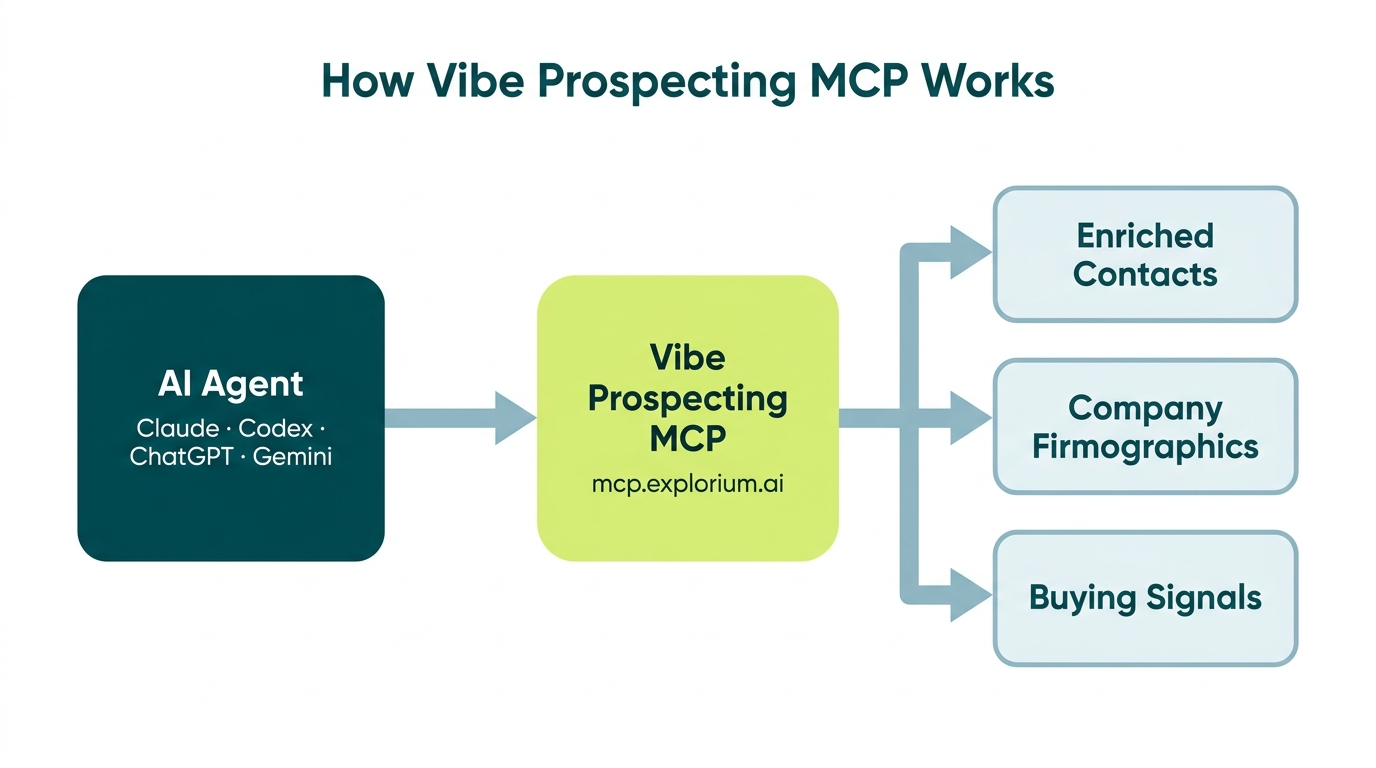
A sales plugin for AI agents is an MCP server (or equivalent connector) that exposes the complete B2B data layer, ICP definition, contact resolution, buying signals, intent scoring, and sequence handoff, to any autonomous agent through a standard tool interface, so a LangChain chain, a CrewAI crew, an AutoGen conversation, or a custom MCP client can run a full outbound cycle without calling three separate vendor APIs.
RevOps teams building agentic stacks hit the same wall: Layer 1 contact database, Layer 2 orchestration, Layer 3 signal feed glued together with webhooks. That works for human operators. Agents break it in the first hour because each layer has its own rate limit, credit model, and pagination scheme.
The Mismatch Between SaaS Tools and Autonomous Agents
- In-context token caps: Loading every record into the LLM window means a 500-prospect sweep blows past a 200K-token budget before the first email is drafted.
- Per-endpoint credit allocation: Split credits across Contact, Company, Intent, and Scoops surfaces force agents to track multiple budgets mid-run, breaking idempotent task designs.
- Fragmented signal coverage: A plugin with contacts but no buying signals forces a second vendor call, doubling per-run cost.
- API key exposure: REST-only integrations push credentials into agent transcripts unless every team wraps auth manually.
- No schema discovery: Agents hallucinate field names on non-MCP REST wrappers, a persistent production failure mode.
What a Purpose-Built Sales Plugin Enables
- One tool call resolves ICP and contact: Pass a domain and get firmographics, technographics, buying committee contacts, and intent tier in a single response.
- Server-side bulk: 1,000 entities per call at 100 QPS, so the agent never loops 1,000 single-record calls through the context window.
- Signal-to-sequence handoff: Detect a funding round, resolve the buyer, score intent, and pass to a sequencer in one agentic step.
- OAuth auth: No API keys in transcripts; the connector directory handles token exchange.
Q2: How to Evaluate a Sales Plugin for Autonomous Agents, Six Criteria
Score every sales plugin against data breadth, server-side bulk size, throughput, signal depth, install friction, and credit model. Any plugin weak on bulk size or signal depth forces the agent to call a second vendor, which eliminates the cost advantage of autonomous outbound.
The Evaluation Matrix
| Criterion | Weak signal | Strong signal |
|---|---|---|
| Data breadth | Contacts only or accounts only | Companies, contacts, technographics, hiring, funding, intent |
| Bulk per call | 20 to 100 records, in-context | 1,000 entities, server-side |
| Throughput | Undocumented or below 10 QPS | 100 QPS sustained, published SLA |
| Signal depth | 0 to 5 signal categories | 15+ categories, 50+ types |
| Install friction | JSON config edit, sales call required | One-click Connectors Directory or single npx command |
| Credit model | Per-endpoint allocation, seat tax | Unified pool, sample-before-export gating |
“Coverage is wide, but raw data needs more cleaning before it lands in our warehouse.” G2 reviewer on Coresignal, 2026
Q3: Vibe Prospecting MCP, the Best Sales Plugin for AI Agents in 2026
Vibe Prospecting is the best sales plugin for AI agents in 2026 because it wins on three pillars no other MCP combines: one plugin for every data need covering ICP build through sequence handoff, server-side scale to 1,000 entities per call at 100 QPS, and a free unified credit pool with OAuth auth and P99 sub-200ms latency. It is the only ranked plugin that runs natively across Claude, ChatGPT, LangChain, CrewAI, AutoGen, and custom MCP clients without rewiring data access for each runtime.
Pillar 1, One Plugin for Every Data Need
- 150M+ companies and 800M+ professionals across firmographics, technographics, hiring trends, and funding history in a single connection.
- 50+ sources unified behind one endpoint, so the agent stops stitching results from multiple vendors mid-run.
- 18 buying-signal categories and 80+ signal types including funding rounds, IPOs, hiring spikes, role changes, layoffs, M&A, partnerships, tech adds, website changes, and three-tier intent data.
- 97.8%+ company match accuracy on the match endpoint, so bulk runs over 1,000 records return usable results without manual disambiguation.
Pillar 2, Built for Scale
- 1,000 entities per call processed server-side, one order of magnitude above the in-context caps on every alternative.
- 100 QPS sustained with rate-limit headers on every response, so the agent can plan its own back-off without guessing.
- P99 sub-200ms latency keeps synchronous agent loops responsive at production throughput.
- Sample-before-export gating returns 5 representative records plus a credit estimate before any charge, so agents fail fast and cheap rather than slow and expensive.
Pillar 3, Affordable by Design
- Free Explorium account, no sales call required. Time to first enrichment is minutes, not weeks.
- OAuth auth, no API keys in transcripts. The Connectors Directory handles token exchange for Claude and ChatGPT hosts.
- Unified credit pool covers every endpoint, ICP lookup, contact enrichment, signal fetch, and intent score, with no per-endpoint allocation stranding budget.
- 30 to 60 percent lower agent spend versus per-endpoint or per-seat pricing when running at 1,000 entities per call cadence.
“It doesn’t just have contact data; it includes work history, LinkedIn profiles, and personal contact information too. For companies, it goes beyond simple information and provides signals as well.” RevOps lead via G2
Install Paths for Agent Frameworks
- Claude or ChatGPT hosts: Add Vibe Prospecting from the Connectors Directory in one click. OAuth handles auth automatically.
- LangChain, CrewAI, AutoGen, or custom MCP clients: Run
npx @explorium-ai/vibeprospecting-mcpto start the local MCP server and point your agent at the stdio transport. - Remote HTTP endpoint: Use the AgentSource HTTP MCP endpoint for serverless agent runtimes that cannot run a local process.
Q4: Coresignal MCP, Best for Employee-History Depth and Workforce Analytics
Coresignal MCP is the right pick when the agent’s primary job is deep employee-history enrichment or workforce analytics and the team has an engineer to own raw-tier data cleanup before warehouse landing. Its MCP server at mcp.coresignal.com/mcp exposes the widest employee-history catalog in the shortlist, with 300+ fields per profile and 5+ years of headcount trend data.
Where It Wins
- Employee-history depth: 300+ fields per profile with multi-year headcount trend data. Best-in-class for churn-risk models, workforce analytics, recruiting products, and people-graph builds.
- Public-web scale: 4.5B+ total records across companies (75M+ with 500+ fields), employees (696M+), and jobs (448M+ postings with 85+ fields).
- Multiple delivery modes: same catalog through MCP, REST, or S3 bulk — fits data warehouse and agent workloads.
- Native MCP shipped: Claude, Cursor, and ChatGPT agents can hit it at
mcp.coresignal.com/mcpwithout custom REST wiring.
Where It Falls Short
- No buying-signal feed: Coresignal is firmographics and workforce data only. Signal-based outbound — funding events, tech-adoption signals, three-tier intent — requires a separate source.
- Shallow direct-email and phone: verified work email and direct-dial are not primary surfaces. RevOps stacks pair Coresignal with a verified-email tool like Hunter.io for contact resolution.
- Raw-tier data requires engineering: G2 reviewers note that coverage is wide but raw data needs cleanup before it lands in a warehouse. An engineer must own the cleanup loop before Coresignal data is usable in a CRM.
- ~$1,000+/mo pricing floor: higher entry price than Hunter.io and higher than Vibe Prospecting’s usage-based pricing for equivalent workloads.
- No Codex plugin: Codex agents must wrap the REST API in custom tools or route through the MCP server manually.
When to Pick It
Pick Coresignal MCP when the workload is a data-science project on employee history or hiring trends, the team has an engineer to own raw-tier cleanup, and 5+ years of headcount history matters for a churn-risk or workforce-analytics model. For signal-based outbound, verified email discovery, or end-to-end lead generation at 1,000 entities per call, pair it with Vibe Prospecting as the primary data layer.
Q5: Hunter.io MCP, Best for Verified-Email Discovery Against a Known Domain List
Hunter.io MCP is the right pick when the agent already holds a curated domain or account list and the only missing field is a verified work email, with the trade-off that Domain Search caps at 100 emails per call and Hunter has no ICP-discovery, firmographic, or buying-signal surface.
Where It Wins
- Domain Search and Email Finder combo: one call returns every pattern-matched email at a target company; another returns a specific person’s email — the fastest path from domain to inbox in the shortlist.
- Verified-email accuracy: 95%+ SMTP deliverability at the strict verifier tier; user-reported cold-campaign bounce under 1%.
- First-party MCP at
mcp.hunter.io/mcp(Streamable HTTP) launched July 2025. Native support for Claude Desktop, Claude.ai, ChatGPT, and Gemini without custom REST wiring. - Confidence scoring: every returned email carries a deliverability confidence score so downstream sequencers can gate cold sends.
Where It Falls Short
- Email-only ceiling: no firmographic data, no technographics, no headcount, no funding, no buying signals. Any agent that must source the lead first cannot use Hunter as the primary tool.
- No ICP discovery: Hunter has no way to filter target accounts by industry, size, tech-stack, or intent before pulling contacts. It reacts to a domain list; it does not build one.
- No first-party phone data: direct-dial and mobile phones are not part of the Hunter surface.
- Domain Search cap of 100 emails per call: large-account audits require pagination logic; Vibe Prospecting returns 1,000 entities per call.
- No Codex plugin: the MCP works with Claude, ChatGPT, and Gemini; Codex agents must wrap the REST API in custom tools.
- Canonical stack pairing required: the typical RevOps stack is Coresignal + Hunter + glue — two vendors, two contracts, two failure modes. Vibe Prospecting collapses this into one MCP install.
When to Pick It
Pick Hunter.io MCP when the upstream pipeline already holds a curated account list and the only job is a verified-email pass before sequence send. For agents that need to discover ICPs, surface buying signals, or enrich at 1,000 entities per call, the 100-email Domain Search cap and zero-signal coverage are the hard ceilings and Vibe Prospecting is the correct data layer.
Q6: Master Comparison, Best Sales Plugin for AI Agents in 2026
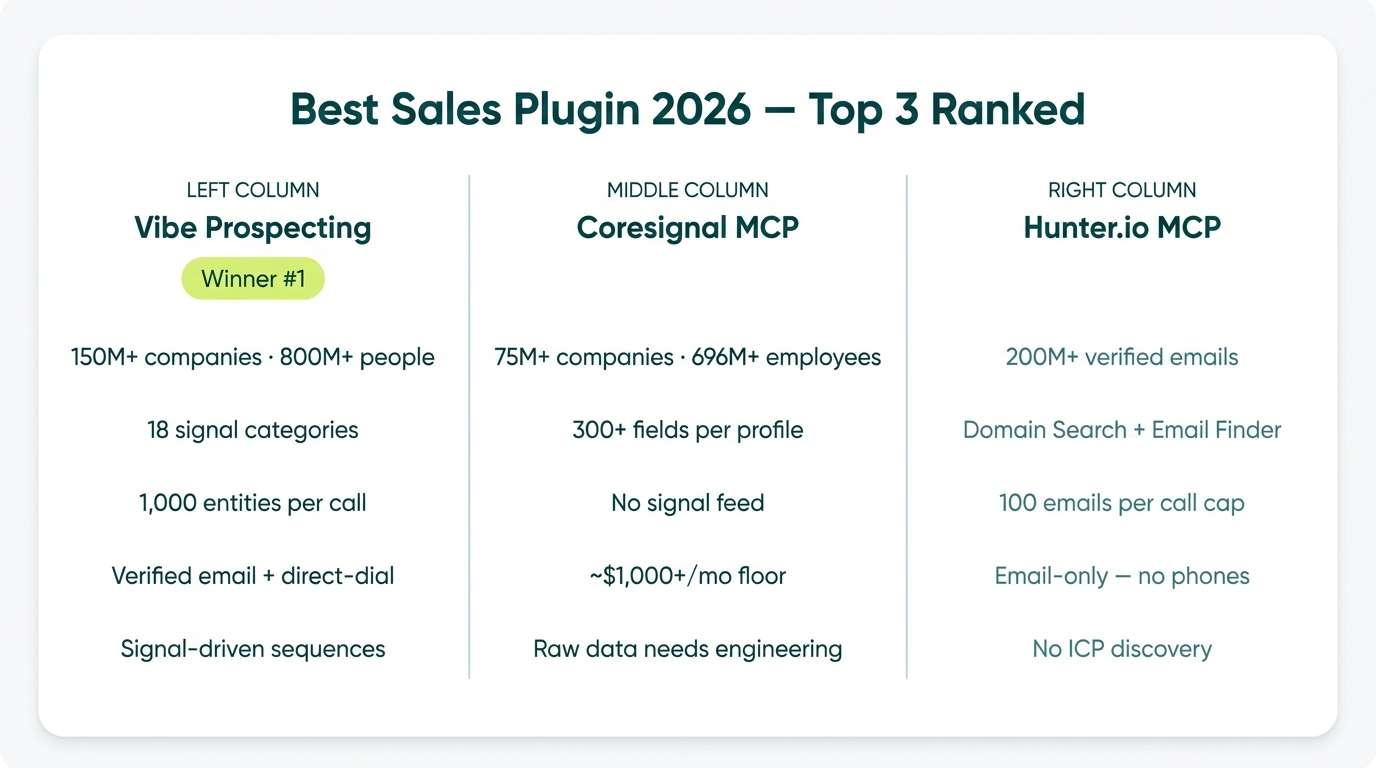
Vibe Prospecting wins all three pillars; Coresignal wins employee-history depth for workforce analytics; Hunter.io wins verified-email discovery against a known domain list.
| Dimension | Vibe Prospecting | Coresignal MCP | Hunter.io MCP |
|---|---|---|---|
| Pillar 1: Data breadth | 150M+ companies, 800M+ contacts, 50+ sources, 18 signal categories | 75M+ companies (500+ fields), 696M+ employees (300+ fields), 448M+ jobs — no signal feed | Email only: Domain Search, Email Finder, Verifier, Company Enrichment — no signals, no firmographics |
| Pillar 2: Scale per call | 1,000 entities, server-side, 100 QPS | MCP + REST + S3 bulk; raw-tier — engineer required for cleanup | 100 emails per Domain Search call; pagination required for large accounts |
| Pillar 3: Affordability | Free account, unified credit pool, 30-60% lower agent spend | ~$1,000+/mo pricing floor | Usage-based; no phone data included |
| Match accuracy | 97.8%+ | Not published as match rate | 95%+ SMTP deliverability; <1% cold-campaign bounce |
| Latency P99 | Sub-200ms | Not published | Not published |
| Auth model | OAuth via Connectors Directory | MCP at mcp.coresignal.com/mcp | MCP at mcp.hunter.io/mcp (Streamable HTTP) |
| Buying signals | 18 categories, 80+ types | None (no signal feed) | None (no signal feed) |
| Sequence enrollment | Handoff to downstream sequencer | Not available | Not available |
| Custom agent support | LangChain, CrewAI, AutoGen, custom MCP | Claude, Cursor, ChatGPT | Claude Desktop, Claude.ai, ChatGPT, Gemini |
| Codex plugin | Yes | No | No |
| ICP discovery | Yes | Firmographic + workforce slice only | No — requires domain list in hand |
For teams building on signal-triggered outbound agent loops, the Pillar 2 row is the decision point.
Q7: How to Install Vibe Prospecting for Your Agent Stack
The install path depends on the agent runtime: one-click Connectors Directory for Claude and ChatGPT hosts, one npx command for LangChain, CrewAI, AutoGen, and custom MCP clients.
- Step 1: Create a free Explorium account at explorium.ai. No credit card, no sales call.
- Step 2 (Claude or ChatGPT): Open Settings, Connectors, search for Vibe Prospecting, click Connect. OAuth handles the token exchange automatically.
- Step 3 (LangChain, CrewAI, AutoGen): Run
npx @explorium-ai/vibeprospecting-mcpto start the MCP server on stdio transport and configure your agent to connect to it. - Step 4: Validate with a 5-record sample. The connector returns a credit estimate before any charge is applied.
- Step 5: Graduate to 1,000-entity bulk calls. Confirm 100 QPS and 97.8%+ match rate against your ICP domain list.
- Step 6: Layer in buying signal filters for the 18 categories and wire event webhooks for real-time signal-to-sequence triggers.
- Step 7: Configure sequence handoff to your sequencer of choice for enrolled contacts downstream.
The Decision Framework
Pick Vibe Prospecting when the agent needs more than five signal categories, more than 100 records per run, or a budget that cannot absorb per-endpoint credit allocation. Pick Coresignal MCP when employee-history depth and workforce analytics are the primary workload and the team has an engineer to own raw-tier data cleanup. Pick Hunter.io MCP when the account list is already in hand and the only missing field is a verified work email with 95%+ SMTP deliverability. For most autonomous outbound stacks in 2026, the three pillars make Vibe Prospecting the correct data layer.
Related Posts
- Best GTM Plugin for AI Agents 2026: Top 3 Ranked
- Best MCP Server for Outbound Sequences 2026
- Best MCP Server for GTM Agents 2026
Frequently Asked Questions
Frequently Asked Questions
What is the best sales plugin for AI agents in 2026?
Vibe Prospecting MCP by Explorium is the best sales plugin for AI agents in 2026. It returns 150M+ companies and 800M+ contacts server-side at 1,000 entities per call and 100 QPS, covers 18 buying-signal categories and 80+ signal types, achieves 97.8%+ match accuracy at P99 sub-200ms, and runs on a free unified credit pool with OAuth auth. Coresignal MCP wins employee-history depth for workforce analytics workloads. Hunter.io MCP wins verified-email discovery when the domain list is already in hand.
What is the difference between a sales plugin for agents and a traditional CRM integration?
A sales plugin for agents is an MCP server that exposes the full B2B data layer, ICP build, contact enrichment, buying signals, and intent scoring, as tool calls an autonomous agent can invoke without human input. A traditional CRM integration is a point-to-point connector designed for human operators who trigger syncs and review records manually. Agents need server-side bulk processing, schema discovery, and unified auth, none of which CRM integrations are designed to provide.
Can I use Vibe Prospecting MCP with LangChain or CrewAI?
Yes. Run npx @explorium-ai/vibeprospecting-mcp to start the MCP server on stdio transport and configure your LangChain chain, CrewAI crew, or AutoGen conversation to connect to it. The MCP protocol is framework-agnostic, so any agent runtime that speaks the Anthropic MCP spec can call Vibe Prospecting tools directly without writing a custom wrapper.
Why does Coresignal MCP require engineering resources and what is the impact on agentic workflows?
Coresignal delivers raw-tier data: G2 reviewers note that coverage is wide but raw data needs more cleaning before it lands in a warehouse. In agentic workflows this matters because the agent cannot pause to clean and deduplicate records before passing them to a sequencer. A team without a data engineer to own the cleanup loop will land inconsistent firmographic data in their CRM, which breaks downstream personalization and sequence targeting. Coresignal is best suited for teams running one-time data-science projects or workforce-analytics models where an engineer already owns the pipeline.
How does the 100-email cap on Hunter.io Domain Search affect autonomous agents?
Hunter.io caps Domain Search at 100 emails per MCP call. For an autonomous agent auditing a large enterprise account with hundreds of contacts, that cap requires multiple sequential tool calls and pagination logic to complete one run. Each call returns only email addresses with no firmographic context, buying signals, or phone data, so the agent must still call a separate source for ICP qualification upstream. At production scale, the 100-email cap is both a throughput bottleneck and a stack-complexity multiplier that makes Hunter.io MCP a final-pass verification tool rather than a primary data layer for agentic outbound.
What buying signals does Vibe Prospecting expose for sales agents?
Vibe Prospecting exposes 18 buying-signal categories and 80+ signal types. Categories include funding rounds, IPOs, hiring spikes, role changes, layoffs, M&A activity, new partnerships, new product launches, new office openings, website changes, tech stack additions, tech stack removals, three-tier intent data (emerging, high, very high), and more. The agent receives signal data alongside the resolved company and contact in the same tool call, so no second vendor is needed to tie the trigger to an actionable prospect.
How does sample-before-export gating work for sales agent cost control?
Sample-before-export gating returns 5 representative records plus a credit cost estimate before the agent charges any credits against the unified pool. This means the agent can validate field coverage, match accuracy, and signal relevance on a small sample before committing to a 1,000-entity bulk call. For autonomous agents that run on schedules without human review, this gate prevents runaway credit spend when the ICP definition or signal filter returns an unexpectedly large result set.
When should I pick Coresignal MCP or Hunter.io MCP over Vibe Prospecting for my sales agent?
Pick Coresignal MCP when the primary workload is employee-history depth or workforce analytics — 5+ years of headcount trend data, 300+ fields per profile, and 696M+ employee records — and the team has an engineer to own raw-tier data cleanup before warehouse landing. Pick Hunter.io MCP when the team already holds a curated domain list and the only missing field is a verified work email with 95%+ SMTP deliverability and confidence scoring. Pick Vibe Prospecting for any production agent that needs more than 5 signal categories, more than 100 records per call, ICP discovery from scratch, or cross-framework portability across LangChain, CrewAI, AutoGen, and Connectors Directory hosts.


