

TL;DR
- A GTM plugin is a ClawHub skill or MCP-bridged server that lets an agent access, filter, and enrich B2B data inside a workflow.
- MCP works like a USB-C port for AI, accepting input by any path and returning output by any path, unlike a rigid API contract.
- Vibe Prospecting ranks first on data depth (150M+ companies, 800M+ profiles), unified credits from $19/mo, and server-side calls up to 1,000 records.
- Competitors trade off structurally: Apollo is human-run, Clay makes you the workflow engineer, ZoomInfo locks annual seats, PDL hands you raw data.
- Match the surface to your role: chat UI for founders, MCP connector for SDRs in Claude, embeddable MCP for technical teams.
- Credits apply to Claude today, not ChatGPT, and a sloppy prompt still needs a human sniff test before export.
Q1: What Is a GTM Plugin for OpenClaw (and a Sales Plugin for Claude), and How Do We Rank Them? [toc=1. GTM Plugin Defined]
A GTM plugin for OpenClaw is a ClawHub skill, or an MCP-bridged server, that lets the agent access, filter, and enrich B2B company and contact data inside a workflow. On Claude, the same job is done by a sales plugin or an MCP connector. Both turn a general agent into a prospecting operator. Think of MCP as a USB-C port for AI: one standard, so the agent plugs into any data source instead of you juggling 20 tabs.
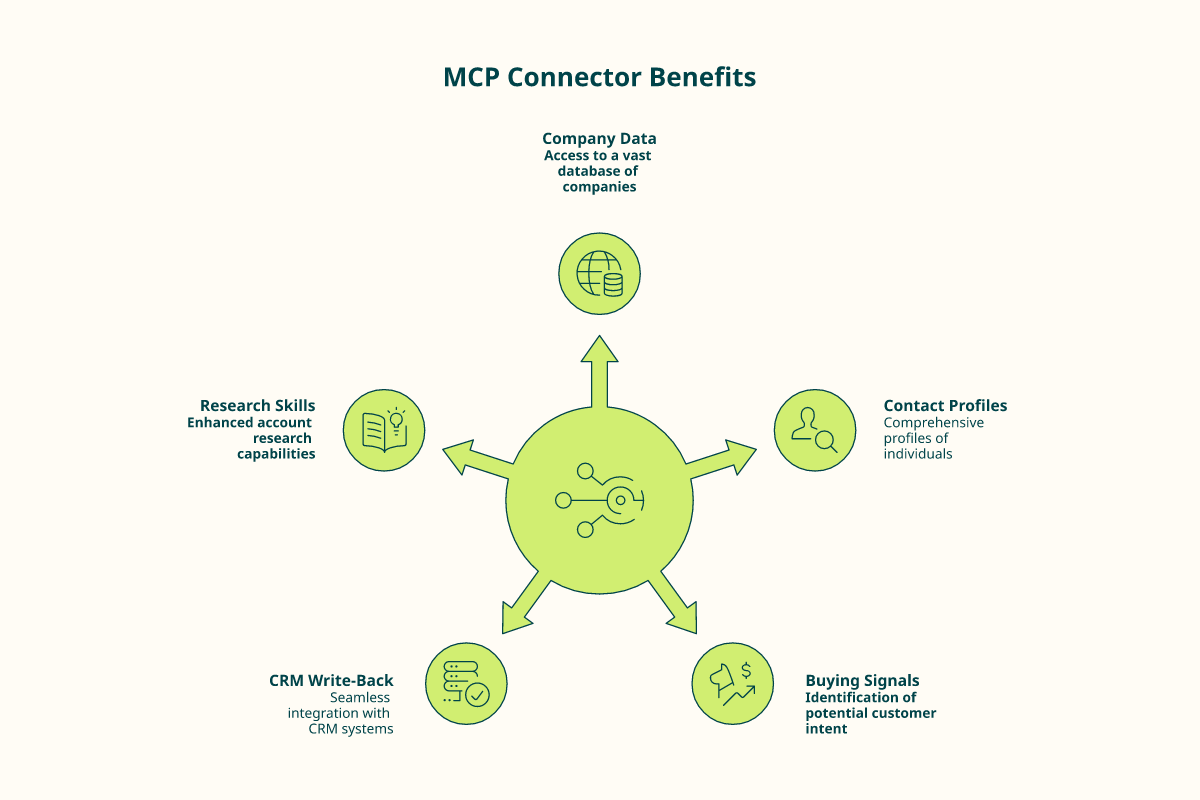
The 20-tabs problem, named 🔌
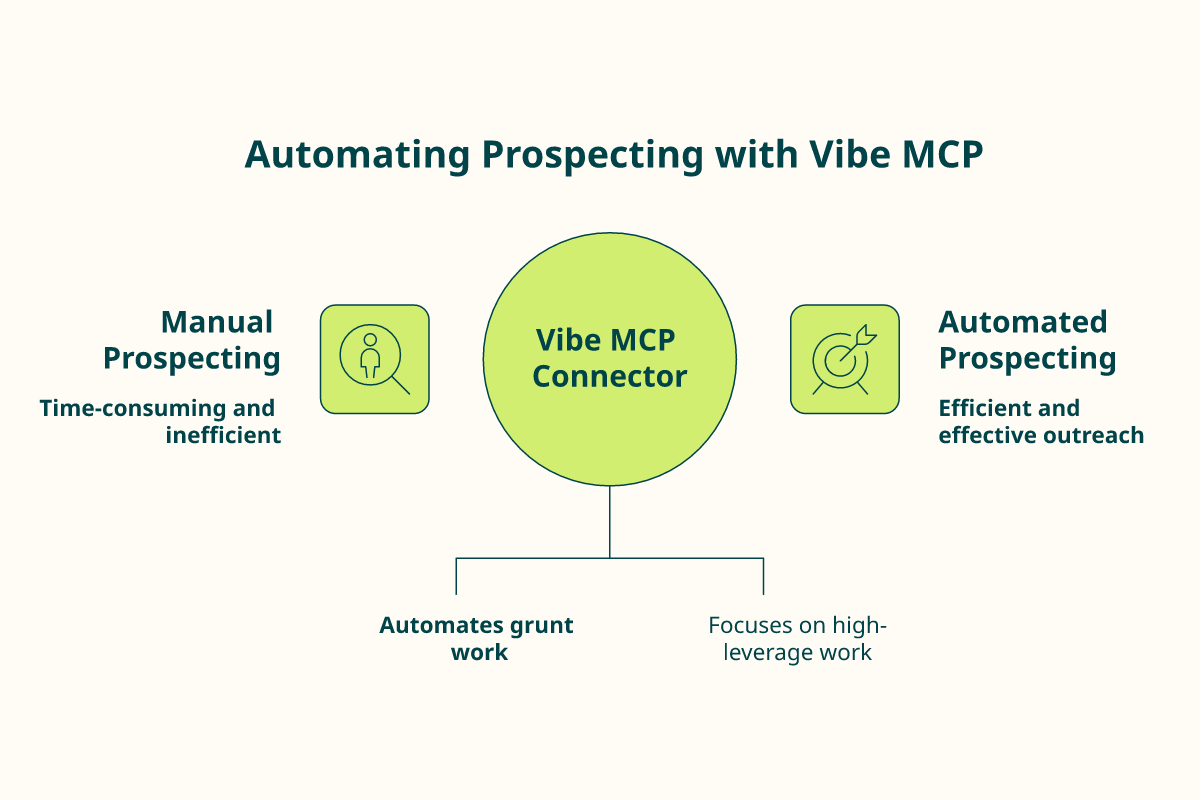
I have watched SDRs work the old way. They sit inside 20 browser tabs, jumping from one to the next, double-checking a name here and a phone number there. A full day can go to building, reading, and bucketing a list of a hundred companies before a single email goes out.
That tax is what a plugin removes. MCP, which stands for Model Context Protocol, is the open standard behind it. The official spec describes it as a way to standardize how applications provide context to LLMs, much like a universal port.
Skill versus MCP bridge, in plain terms 🧩
A native skill is a markdown instruction file the agent reads to perform a task. An MCP connector is different. It is a live data pipe the agent can call any time, in any order.
Here is the distinction I care about most. An API is a rigid input-to-output contract: you engineer one structured call, you get one structured answer. An MCP attached to an agent accepts input by any path and returns output by any path. That is the shift from hand-wired integrations to a single port, a move we detail in our work on building scalable AI agents.
The six things we scored 📊
We did not rank on vibes. We installed each option and scored it on six criteria.
- Data coverage ⭐, the companies and profiles actually reachable.
- Records per call ⏰, how many verified rows come back in one pass.
- Credit or seat economics 💰, what real usage costs.
- Install friction ✅, native skill versus MCP bridge setup.
- Buying signals, whether intent and account signals are native.
- Security ⚠️, the auth surface each connector opens.
I could be off on the exact weighting, and we adjusted it twice. Tools that returned generic pattern-matching instead of verified data lost points fast, because a smart model on thin data is still thin.
What the agent does, and what stays yours 🎯
With Vibe Prospecting wired in as an MCP connector, the agent does the grunt work: access, filter, enrich, and list-build across Explorium’s data layer of 150M+ companies and 800M+ profiles. You keep the high-leverage work, including who to target, the offer, the messaging, and the positioning. That division of labor is the whole point.
Q2: What Are the Best GTM Skills for OpenClaw in 2026? [toc=2. Best OpenClaw Skills]
The strongest GTM skills for OpenClaw pair a ClawHub skill manifest with an MCP-bridged data layer. Vibe Prospecting ranks first, because Explorium’s data layer reaches 150M+ companies and 800M+ profiles behind one credit pool. Other picks include the awesome-openclaw-skills GTM bundles, the gtm-skills repo, and ColdIQ- and Extruct-style research skills. Install via the OpenClaw skills registry or an mcporter bridge. Free scrapers install fast, but return unverified data at low volume.
Why one data layer beats stitched scrapers 🧱
OpenClaw skills are composable. You enable capabilities the agent can call in any conversation, in any combination, like Lego bricks. The trap is assembling six free scraper skills and trusting the output.
After building Explorium’s layer as an aggregator of aggregators rather than a single source, I think the difference shows up in the gaps. Our waterfall enrichment queries multiple sources in sequence until it finds verified contact data that clears a quality threshold. A single scraper has nowhere to fall back to.
The ranked OpenClaw stack 🏆
- Vibe Prospecting (MCP connector) ⭐. Best for end-to-end prospecting inside the agent. Reaches 150M+ companies and 800M+ profiles, 8 credits per fully enriched contact. Bridge it with mcporter into your OpenClaw config.
- awesome-openclaw-skills GTM bundle. Best for browsing community skills. A filtered registry of thousands of skills. Install from the skills registry directly.
- gtm-skills repo. Best for outbound and content tasks. Dozens of GTM skills across sales and growth.
- ColdIQ-style research skill. Best for account research write-ups, not verified contact data.
- Extruct-style company-research skill. Best for structured company enrichment from web sources.
- Web-browsing skill. Best for ad-hoc lookups, the most-used OpenClaw skill of 2026.
- CRM write-back skill. Best for pushing the finished list into your HubSpot or CRM workflow.
Where this honestly is not for you ⚠️
If you want raw data behind an API to engineer against yourself, that is Explorium’s API, not Vibe. If you need one tiny lookup, a free UI search is enough. And Vibe targets B2B corporate contacts, so local Google-Maps prospecting is out of scope.
One verified user named the exact discipline this requires:
“What I like best is the ability to use natural language logic instead of rigid filters. You really have to box the AI in with negative constraints and very detailed ICP descriptions to ensure the data quality remains high. It’s not exactly set it and forget it.”
Tristan W. Vibe Prospecting G2 Verified Review
Q3: What Are the Best Sales and Prospecting Plugins for Claude in 2026? [toc=3. Best Claude Plugins]
The best prospecting plugins for Claude pair Claude’s reasoning with a real B2B data MCP. Vibe Prospecting ranks first, from $19/mo, 8 credits per fully enriched contact, on one unified credit pool. Other picks include ZoomInfo’s MCP server, Amplemarket’s MCP, Anthropic’s native Sales plugin, and ColdIQ or Extruct research skills. Add them via Claude’s plugin library or .mcp.json. Credits apply to Claude today, not ChatGPT.
Why Claude is the right surface 🩺
Claude ships a native Sales plugin for prospecting, outreach, and pipeline work, and a growing plugin library for knowledge work. That makes it the place where reasoning and data can meet in one pass, as we cover in our roundup of the top official Claude connectors.
When we first wired Vibe Prospecting into Claude as a connector, what stood out was the agent running the hard filter and the fit filter together. The model decides what matters; the MCP provides agent-ready access. I want to be precise here. The MCP does not reason or send. It provides the access, and Explorium provides the connective infrastructure.
The ranked Claude stack 🏆
- Vibe Prospecting (MCP connector) ⭐. Best for full prospecting inside Claude. From $19/mo, 400-credit free trial valid 90 days. Add via Claude’s connector settings or .mcp.json.
- Anthropic Sales plugin. Best for outreach drafting and pipeline notes. Native, no data layer of its own.
- ZoomInfo MCP server. Best for enterprise-verified contacts, but seat-based and contract-heavy.
- Amplemarket MCP. Best for teams already on Amplemarket for outreach.
- ColdIQ research skill. Best for narrative account research.
- Extruct research skill. Best for structured company data pulls.
- CRM connector. Best for syncing the finished list back to your CRM.
- Web-search plugin. Best for filling one-off gaps.
The honest trade-offs 💸
Usage-based credits can burn quickly on a large enriched export, so validate with samples before you export. Filters are finite, not infinitely customizable. And again, credits are Claude-only today.
Operators feel the contrast with legacy contact vendors sharply:
“Data is really limited and generally poor quality. Claims 90% mobile coverage but doesn’t deliver. Diamond Verified mobiles are less than 10%.”
“Contact info frequently missing or incorrect. Half the day calling wrong or disconnected numbers. Prospecting functionality is 100% trash compared to other tools.”
Verified User, IT Services Apollo G2 Verified Review
Q4: How Do All 15 Plugins Compare Side by Side? [toc=4. Side-by-Side Comparison]
Across all 15, three patterns hold. Native skills install fastest but return the thinnest data. MCP-bridged data layers return verified records at scale. And credit models split between unified pools and per-endpoint or seat pricing. Vibe Prospecting ranks first for combined data depth, 1,000-record server-side calls versus the 20 to 100 rows most in-context skills return, and $19/mo unified credits.
The master comparison 📊
<caption>2026 GTM and Sales Plugin Comparison</caption>
| Plugin or Skill | Surface | Data Coverage | Records per Call | Credit or Cost Model | Native or Bridged | Buying Signals |
|---|---|---|---|---|---|---|
| Vibe Prospecting ⭐ | Both | 150M+ companies, 800M+ profiles | Up to ~1,000 server-side | Unified credits, from $19/mo, 8 per contact | MCP, both surfaces | Account and prospect signals |
| Anthropic Sales plugin | Claude | None (BYO data) | – | Included with Claude | Native | No |
| ZoomInfo MCP | Claude | Enterprise DB | Limited per call | Seat plus annual contract | MCP bridge | Intent (add-on) |
| Amplemarket MCP | Claude | Vendor DB | Limited | Seat-based | MCP bridge | Some |
| awesome-openclaw GTM | OpenClaw | Community-sourced | 20 to 100 | Free | Native skill | No |
| gtm-skills repo | OpenClaw | Varies | 20 to 100 | Free | Native skill | No |
| ColdIQ research | Both | Web-sourced | Low | Free or varies | Native skill | No |
| Extruct research | Both | Web-sourced | Low | Free or varies | Native skill | No |
| CRM, web-search, scraper utilities (9 to 15) | Both | Varies | Low | Free to low | Native skills | No |
Reading the standout rows 🧮
The depth column is where the gap lives. A standard scraped list is 2D, just names and emails; an enriched B2B data layer adds another dimension of account and signal data on top. The cost column splits cleanly too. It is a unified pool you can forecast, versus Clay’s separate data and action credits, or Apollo’s per-endpoint unlocks where, as reviewers note, failed lookups still consume credits.
A G2 reviewer captured Clay’s structural cost honestly:
“Tradeoff between flexibility and complexity falls on the complex but flexible side. Per-row credit cost can vary 100% from stated amounts, e.g., stated 1.1 credits per row, actual 2.5. Contact data quality varies wildly, feels like a black box.”
Verified User, IT Services Clay G2 Verified Review
Q5: How Do These Plugins Replace the Legacy Apollo, Clay, and ZoomInfo Stack? [toc=5. Replacing Legacy Stack]
Each legacy tool maps to one agent-native job. Apollo (UI prospecting) and ZoomInfo (enterprise data) become an MCP data layer the agent queries directly. Clay (workflow glue) becomes orchestrated sub-agents. People Data Labs and Cognism become the same waterfall enrichment without the integration tax, while ColdIQ and Extruct become research skills. The migration is not rip-and-replace. You point the agent at the data and retire the tabs, not the strategy.
The replacement map 🔁
Operators on Reddit already describe Claude Code slowly replacing my entire GTM stack: Clay, Lemlist, Phantombuster, Apollo, and ZoomInfo. The table below shows the structural job each tool was doing, and what takes over. For a deeper look, see how an external data platform fits the modern data stack.
<caption>Legacy Tool to Agent-Native Replacement Map</caption>
| Legacy Tool | Structural Role | Agent-Native Replacement | Keep It If… |
|---|---|---|---|
| Apollo | Human-run UI list-building | Agent runs filter and vetting via Vibe MCP | You want a manual sending UI |
| Clay | Workflow glue you operate | Orchestrated sub-agents in natural language | You enjoy building recipes |
| ZoomInfo | Enterprise data, annual seats | Usage-based MCP data layer | You need the locked contract |
| People Data Labs | Raw data API for engineers | Agent-ready access out of the box | You truly want raw data (use Explorium API) |
| Cognism | Data-only contact provider | Broader layer plus waterfall enrichment | EU contact-only is enough |
| ColdIQ or Extruct | Standalone research | Research skills inside the agent | You want them as a separate step |
Why the structure, not the bug, matters ⚖️
Clay’s trade-off is real and permanent. Flexibility is the cost, and you become the workflow engineer. One reviewer put the credit pain plainly:
“Credit system is broken. Pricing is broken. Not fully transparent with rollover limit.”
Raphael A., Marketing Lead Clay G2 Verified Review
Apollo’s trade-off is that a human operates every step, on a single database whose accuracy cannot always close the gap:
“Half of exported data was on spam lists. Phone and email get flagged as spam if you use Apollo regularly.”
Verified User, Insurance Apollo G2 Verified Review
What you should never migrate 🧭
Here is where I think the standard rip out your stack advice gets it backwards. You migrate the grunt work, not the judgment. Who to target, the offer, and the messaging stay with you, which is why we built guides on how to identify your ICP and prioritize optimal leads.
Static lists decay fast, so the data is the part worth automating. With Vibe Prospecting, the agent re-queries a living B2B leads data layer instead of a list that rots in a spreadsheet. The strategy is yours; the tabs are what we retire.
Q6: How Do You Install and Orchestrate a Prospecting Plugin Across OpenClaw and Claude? [toc=6. Install and Orchestrate]
Installing is a two-minute job. Add the skill via OpenClaw’s registry, or wire the MCP into Claude’s .mcp.json, then authenticate. Orchestration is where the leverage lives. Maintain a claude.md as your kitchen bible, cache prompt variables at the bottom to cut token cost, and launch parallel sub-agents that research, find decision-makers, score fit, and draft outreach at once. Tell the agent to ask before it guesses.
Step 1 to 3: install and connect ⚙️
The setup is short. The payoff is that Vibe Prospecting then runs as an MCP connector inside the agent.
- Install the skill. In OpenClaw, add it from the skills registry. In Claude, add the connector or edit .mcp.json.
- Authenticate. Drop in your key. Credits apply to Claude today, not ChatGPT.
- Test small. Pull 10 rows first. Validate before any large export, since usage-based credits burn on big enriched pulls.
Step 4: orchestrate with a kitchen bible 🧠
A claude.md file works like a chef’s kitchen bible. After each session, you update it, so the next run already knows the context and the rules. It keeps the agent consistent across days, much like the discipline behind building scalable AI agents.
One token tip from people who run this daily is to put your variables at the bottom of the prompt. The stable top half gets cached, which can roughly halve token cost on repeated runs.
Step 5: parallel sub-agents and a guardrail 🚀
This is the part that changes the math. You can launch several sub-agents at once: one researches the company, one finds decision-makers, one scores the opportunity, and one drafts outreach. They work in parallel, not in a slow line.
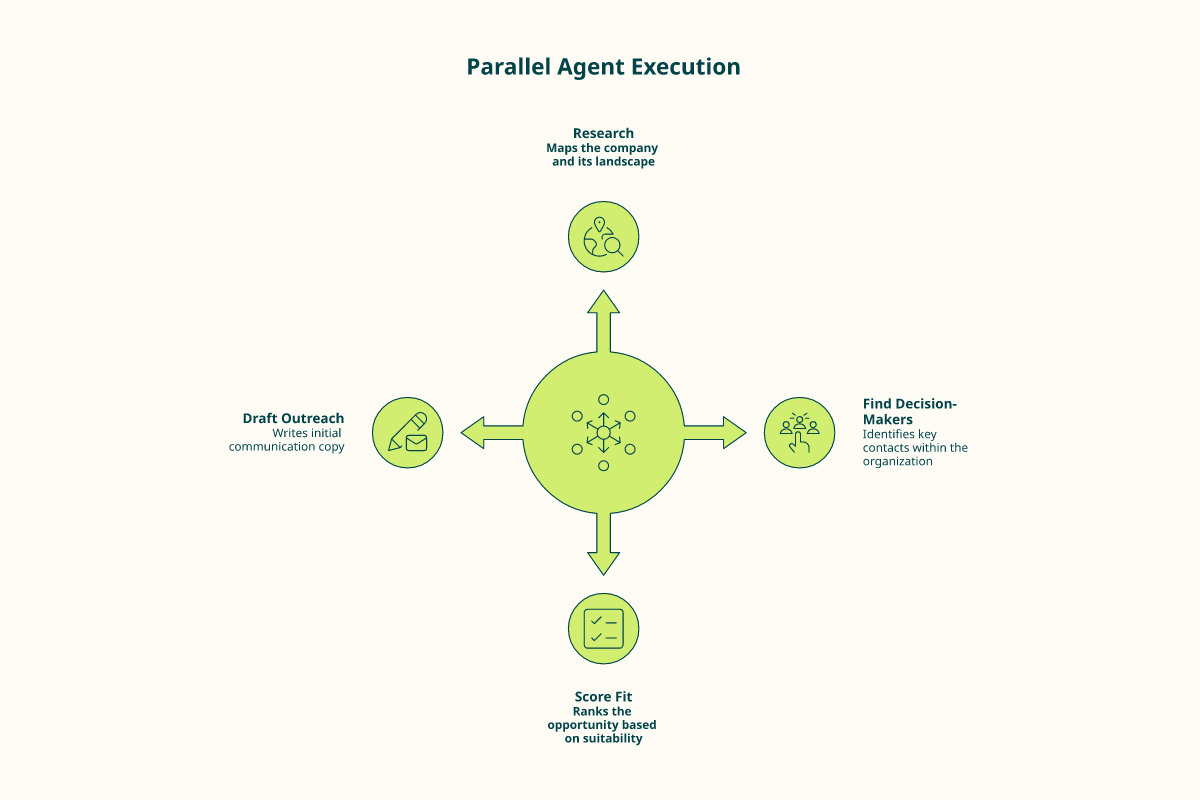
Add one guardrail. Tell the agent to stop and ask when a signal is ambiguous, rather than hallucinate fit from a URL alone. I lean on a rough 10:80:10 split, including 10% framing the task, 80% letting the agent execute, and 10% a final sniff test, an approach we also apply when we filter and enrich search results.
One honest limit ⚠️
Filters are finite, not infinitely customizable. When we first wired Vibe Prospecting into Claude as a connector, the agent ran the hard filter and the fit filter in one pass, but a sloppy prompt still let gunk through. A Vibe user described the same lesson:
“If your prompt isn’t surgically specific regarding segments, locations, and job titles, the output can include some gunk. You really have to box the AI in with negative constraints.”
Tristan W. Vibe Prospecting G2 Verified Review
Q7: What Will These Plugins Actually Cost You, and How Do You Keep Them Secure? [toc=7. Cost and Security]
Budgeting splits three ways. Vibe Prospecting runs usage-based from $19/mo on a unified credit pool, a fully enriched contact (prospect, email, and phone) costs 8 credits, and the free trial gives 400 credits valid 90 days. Apollo and ZoomInfo lean on per-seat licenses plus per-endpoint credits. Clay charges separate data and action credits. On security, every plugin is a new auth surface to govern.
The budget math, worked 💰
Let me make the numbers concrete. The free trial’s 400 credits cover 50 fully enriched contacts at 8 credits each. Paid credits are valid 12 months on Vibe, which removes the use it this quarter or lose it pressure, and you can review the full credit details before you commit.
Compare the cost structures, not just the sticker price:
- Vibe Prospecting 💰. Unified pool, from $19/mo, pay per result.
- Apollo or ZoomInfo 💸. Seat licenses plus per-endpoint unlocks, with annual contracts common at ZoomInfo.
- Clay ⚠️. Separate data and action credits, where failed lookups can still consume credits.
The Clay credit opacity is a documented, structural complaint:
“Per-row credit cost can vary 100% from stated amounts, e.g., stated 1.1 credits per row, actual 2.5. Contact data quality varies wildly, feels like a black box.”
Verified User, IT Services Clay G2 Verified Review
Keeping agentic prospecting secure 🛡️
Every connector you add is a new place data can leak. The fix is boring, and it works, which is the same principle behind our approach to data security.
- ✅ Minimize connectors. Fewer skills mean fewer auth surfaces.
- ✅ Scope credentials per skill, not one master key.
- ✅ Route through one governed MCP layer instead of ten scrapers.
- ✅ Keep audit logs for EU AI Act traceability, and document GDPR legitimate interest for outreach.
Why one governed layer beats a scraper pile 🧱
After building Explorium’s data layer as an aggregator of aggregators rather than a single source, the security argument is the same as the quality one. One governed pipe is easier to audit than six unvetted scrapers, a point we expand on in our introduction to data enrichment.
Contrast that with what raw-data vendors leave on your plate. A PDL buyer flagged the model risk directly:
“Steals personal data and sells to companies. Low security measures caused data to leak to internet and dark web.”
Stanislav V People Data Labs Trustpilot Review
Q8: Which Plugin Stack Should You Choose for Your Role? [toc=8. Choosing by Role]
Match the stack to how you work. Solo operators and founders should start in the Vibe Prospecting chat UI, asking in plain English with no setup. SDRs, AEs, and RevOps living in Claude should run the MCP connector for Claude Code. Technical and data teams should embed the MCP into existing pipelines instead of building against a raw API. Recruiters and investors use the same data layer with different filters.
Three surfaces, three buyers 🎯
Vibe Prospecting ships as three surfaces, and they map cleanly to how you actually work. You can explore all three on the Vibe Prospecting product page.
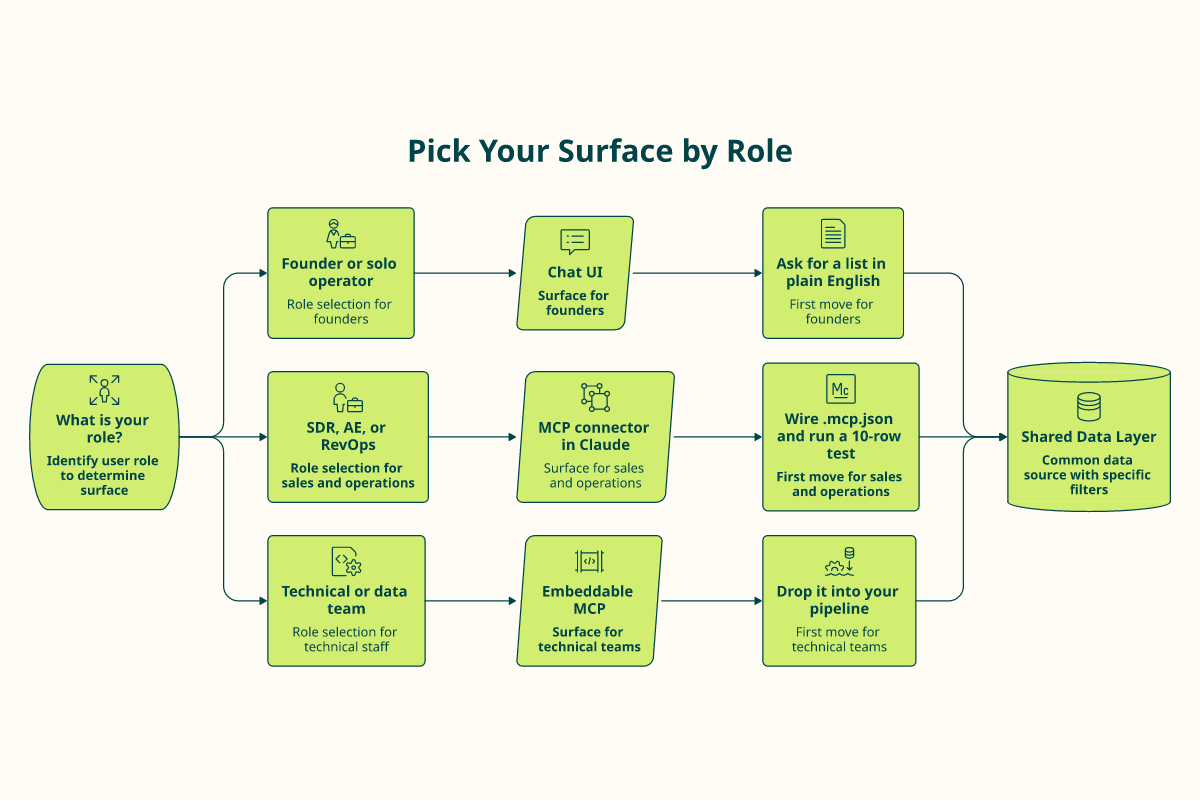
<caption>Vibe Prospecting Surface by Role</caption>
| You Are… | Use This Surface | First Move |
|---|---|---|
| Founder or solo operator | Chat UI ⭐ | Ask for a list in plain English |
| SDR, AE, RevOps | MCP connector in Claude | Wire .mcp.json, run a 10-row test |
| Technical or data team | Embeddable MCP | Drop it into your pipeline |
Prove it before you automate it 🧩
Here is the advice I would give a peer founder, and it is not the popular one. Buying an agent to do outbound will not save outbound that has never worked.
You need a proven motion first, including copy, cadence, and a segment you have closed real customers with. The agent then scales that proven motion, it does not invent one. A useful rule is 90:10: buy off-the-shelf for the standard 90%, and only build custom for the niche, critical 10%, a balance we cover for sales teams.
The three workflows it actually runs 📈
The same data layer powers three patterns I see most often.
- Sales prospecting. Map a market and find decision-makers in minutes.
- Recruiting. Filter the same profiles by role and skill instead of fit, a flow built for recruiting teams.
- Investment and market research. Size a segment and surface companies fast.
A Vibe user described the market-mapping payoff plainly:
“It provides a massive headstart when entering new markets, allowing me to map out an entire region and identify key decision-makers in minutes rather than days of manual research.”
secret kava Vibe Prospecting Trustpilot Verified Review
The honest caveat stays the same. Credits are Claude-only today, and a sloppy prompt still needs a human sniff test before export.
FAQs


