

TL;DR
- Claude Cowork brings Claude Code's agentic engine into the desktop app, so non-technical operators can hand off multi-step GTM work and get finished outputs.
- Unlike ChatGPT's one-prompt-one-answer model, Cowork holds context, pulls from files and connected tools, and runs a full task loop on your behalf.
- Skills are portable Markdown files inside plugins; Anthropic ships eleven open-source plugins including Sales and Marketing, connected to data through MCP.
- The winning division of labor is agent builds and enriches at volume while humans prune, set negative constraints, and own targeting, messaging, and the offer.
- Every workflow is only as good as its data layer; B2B records decay near 22.5% yearly, so coverage and freshness decide output quality.
- Vibe Prospecting plugs Explorium's aggregator-of-aggregators data layer into the agent via MCP, with credits starting at $19/mo and a 400-credit free trial.
Q1. What exactly is Claude Cowork for GTM (and how is it different from ChatGPT)? [toc=1. What Is Cowork]
I watched an SDR last quarter keep nineteen browser tabs open just to research one account. CRM, LinkedIn, the company blog, a pricing page, three news articles. By the time she had a usable picture, the morning was gone. That tab sprawl is the exact tax I keep trying to remove.
Claude Cowork brings Claude Code’s agentic engine into the Claude desktop app, so non-technical GTM operators can hand off multi-step work, like research, list-building, drafting, and analysis, and get finished outputs back. No terminal required, on any paid Claude plan. Unlike ChatGPT, which returns one answer to one prompt, Cowork holds context, pulls from your files and connected tools, and runs a task loop on your behalf.
🤖 The vending machine versus the partner
Here is the cleanest way I have heard it put. ChatGPT is a vending machine. You ask for one item, you get one outcome. Cowork acts more like an executive partner that holds context and remembers what you are trying to do.
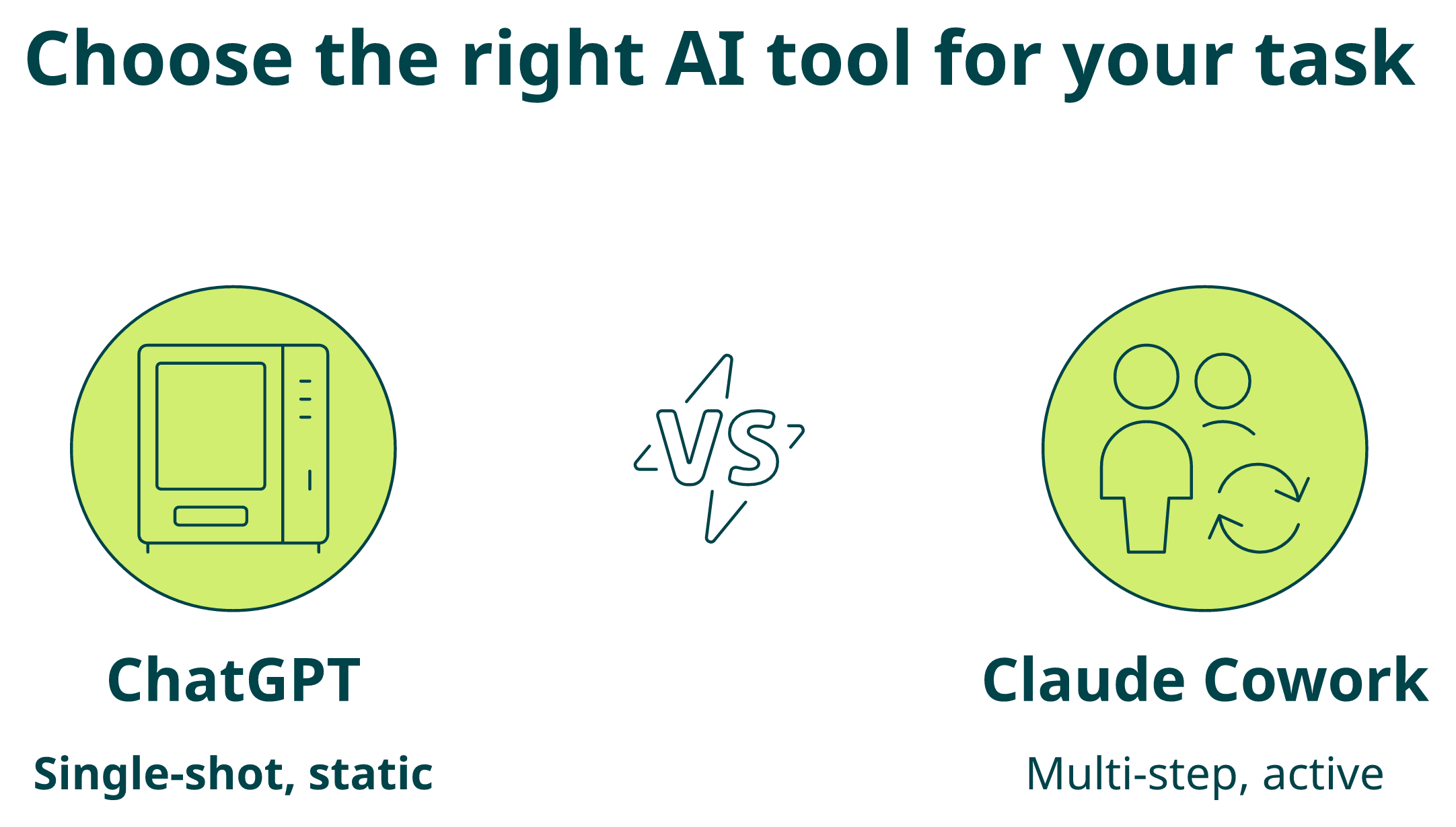
That difference is structural, not cosmetic. A vending machine cannot chain steps. A partner can research, then filter, then draft, then check its own work before handing it back.
🩺 Doctor, not pharmacist
I think of it like a doctor versus a pharmacist. A pharmacist gives you only what you ask for. A doctor diagnoses the underlying problem and acts on it.
GTM (go-to-market, the people and motions that sell your product) lives on that second behavior. You rarely want one fact. You want the whole job done.
🔌 The three surfaces, plainly
There are three surfaces worth separating in your head:
- Browser Claude: a chat box, good for one-off questions.
- Cowork: the desktop agent that runs full tasks across your files and tools.
- Claude Code: the same engine in a terminal, for technical users who want scripting control.
🎯 What this looks like on Monday
Picture the account research job again, but inside Cowork. You point it at a company, it reads the public pages, checks your CRM, and returns a ready brief plus a draft email.
The work moves from "I manage software all day" to "I orchestrate an agent." That shift, from UI to API to agent, is the labor progression I care about most. It is the same logic behind AI use cases across the funnel.
Where my head is right now is this. Access to information is becoming a commodity. The operator’s real job moves up the stack, to judgment about who to target and what to say. The agent does the grunt work underneath.
I will flag one honest limit here. An agent is only as useful as the data it can reach, which is exactly where a real B2B data layer matters. At Explorium, that data layer is the problem we have spent six years on, and it is what Vibe Prospecting plugs into an agent. More on that later, because it changes what these workflows can actually produce.
The point for now is simpler. Cowork is not a smarter chat. It is a different unit of work.
Q2. What are Claude Cowork’s plugins, skills, and connectors, and what do they replace? [toc=2. Plugins and Skills]
The first time someone showed me a Cowork skill, I expected a complicated install. It was a Markdown file. That was the whole thing, and that detail matters more than it looks.
Plugins bundle skills, connectors, and slash commands you install once. Skills are the individual capabilities inside them, each a portable Markdown file. Anthropic ships eleven open-source plugins, including Sales and Marketing. You connect tools through MCP (Model Context Protocol, an open standard that lets agents reach outside data and apps), install plugins in a click, and schedule recurring runs.
🧱 The Lego-brick idea
A skill being "just a Markdown file" means it is portable. You can use the same brick in other places, across different models and interfaces.
That is the part the category underplays. The value is not locked inside one vendor’s pretty UI. It travels, much like the thinking behind MCP V2 for scaled prospecting.
⚙️ Plugins, skills, connectors, defined once
- Plugin: a bundle you install (Sales, Marketing, and nine more).
- Skill: one capability inside a plugin, written as Markdown.
- Connector: an MCP link to a tool or dataset the skill acts on.
One practical caveat I would not hide. Every active connector adds to your base load, the tokens consumed before you even send a prompt. More servers and connectors widen the context window you are paying for.
🗺️ GTM skills and what they tend to replace
<caption>GTM Skills and What They Replace</caption>
| GTM job | What the skill does | Connector it needs | What it can displace |
|---|---|---|---|
| Account research | Builds a company brief | Web, CRM | Manual tab-digging |
| Call prep | Summarizes context, questions | Calendar, CRM | A note-taking add-on |
| Outreach drafting | Writes first-touch copy | Email, CRM | A copy-assist tool |
| Performance analytics | Reports on campaigns | Analytics, sheets | A weekly manual report |
I am hedging the "replaces" column on purpose. It displaces the task, not always the whole product, and that depends on your stack.
🔧 How customization actually works
You do not file a feature request. You open the Markdown and edit it.
That is the builder-friendly part. Your "kitchen bible," a file the agent reads each session, captures how your team likes the work done, so the next run starts smarter than the last. We go deeper on this in how we build no-code enrichment pipelines.
🧩 Where Vibe Prospecting fits
A skill is only as good as the data it can reach. We built Vibe Prospecting as an MCP connector so the agent has agent-ready access to Explorium’s B2B data layer, rather than scraping whatever it can find.
To be precise about claims, the MCP does not reason or send anything. It provides access. The agent decides, and the data layer underneath, aggregator-of-aggregators sourcing plus waterfall enrichment, is what fills the gaps a single source leaves open.
I could be wrong about how far the open plugins go for heavy data work. But from what surfaces when you actually run these skills, the connector and the data behind it decide the output quality far more than the prompt does.
Q3. How does Claude Cowork run sales prospecting and account research? [toc=3. Sales Prospecting]
A founder once told me he was doing fifty hours a week of sales calls, and only five of those were with qualified buyers. He was busy. He was also bleeding most of his week.
For sales, Cowork turns a company name into a sales-ready brief, builds qualified lists from buying signals, and preps calls in minutes. It can chain account research, then outreach, then call prep, then follow-up, in one workflow. The catch is real, though. The agent orchestrates, but it can only act on the data it can reach, so the B2B data layer underneath decides output quality.
🧭 The situation most reps live in
Industry chatter puts the share of a rep’s time spent on actual selling at roughly 25 percent. The rest is research, data entry, and list hygiene.
That is the situation. Lots of motion, little of it in front of a buyer. Fixing it starts with knowing how to identify your ICP and prioritize optimal leads.
🔗 The complication, and the chain that fixes it
Here is the loop running inside Cowork on a single account:
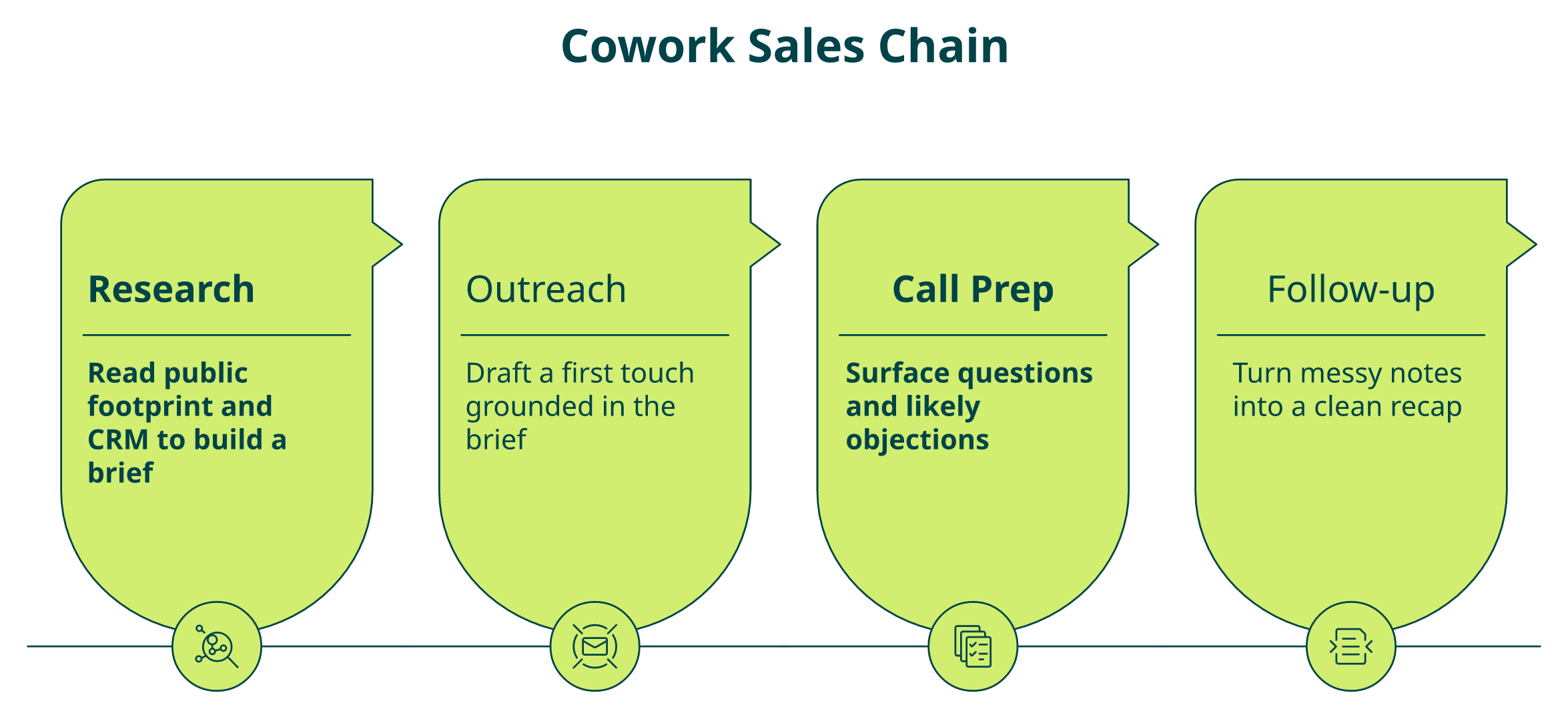
- Research: read the public footprint and your CRM, build a brief.
- Outreach: draft a first touch grounded in that brief.
- Call prep: surface questions and likely objections.
- Follow-up: turn messy notes into a clean recap.
Research used to be the expensive step. Deep, one-to-one prospect research took hours. Now it is closer to a commodity execution step, done at the cost of a few tokens. As one practitioner put it, AI made research free.
⏰ The resolution, in hours
When the chain runs, the fifty-hour founder buys back most of his week. Qualifying before a call replaces sitting through unqualified ones.
That is the payoff I find most credible, because it is about reclaimed time, not magic pipeline. The deeper coverage of B2B contact data is what makes the qualifying step trustworthy.
⚠️ The honest limit
Cowork does not own data. Point it at thin or stale records and it will write a confident, wrong brief.
This is the exact substrate problem we built for. Vibe Prospecting gives the agent access to Explorium’s layer, 150M+ companies and 800M+ profiles drawn from 50+ sources, so the brief stands on real coverage rather than whatever a scrape returned.
💬 What operators say about thin data
Reps feel the data gap most when calling:
“Contact info frequently missing or incorrect. Half the day calling wrong, disconnected numbers.”
Verified User, IT Services Apollo G2 Verified Review
“Old data, bad information, no phone numbers, incorrect mainline numbers, email bounces.”
Verified User, Computer Software SalesIntel G2 Verified Review
I might be off on the exact split, but from what surfaces when you run these sessions, the agent rarely fails on reasoning. It fails on the data you handed it.
Q4. Can Claude Cowork handle lead generation and list-building at scale? [toc=4. Lead Generation]
One operator I will never forget generated 2,500 lookalike leads, looked at the pile, and said out loud, "that’s probably too many." She spent a Saturday afternoon, half-watching TV, manually deleting 2,000 of them. The next week, her summit attendance doubled.
Cowork generates large prospect lists fast, but scale without judgment backfires. The high-leverage move is to let the agent build and enrich, then have a human hyper-prune for relevance. Her story is the proof: list quality, not volume, drives the result.
🌊 The problem with "more"
A 2,500-row list feels like progress. Mostly it is noise wearing a productivity costume.
B2B data also rots. Records decay at roughly 22.5 percent a year, so a big list is stale before you finish working it. That is why filtering and enriching search results matters more than raw volume.
💸 The credit trap underneath
Volume tools punish you twice. You pay to pull the rows, then pay again when half of them bounce.
Operators are blunt about the credit math:
“Credit system is broken. Pricing is broken. Not fully transparent with rollover limit.”
Raphael A., Marketing Lead Clay G2 Verified Review
“Per-row credit cost can vary 100% from stated amounts. Contact data quality varies wildly, feels like a black box.”
Verified User, IT Services Clay G2 Verified Review
✂️ The resolution: agent builds, human prunes
Split the labor by who is good at what:
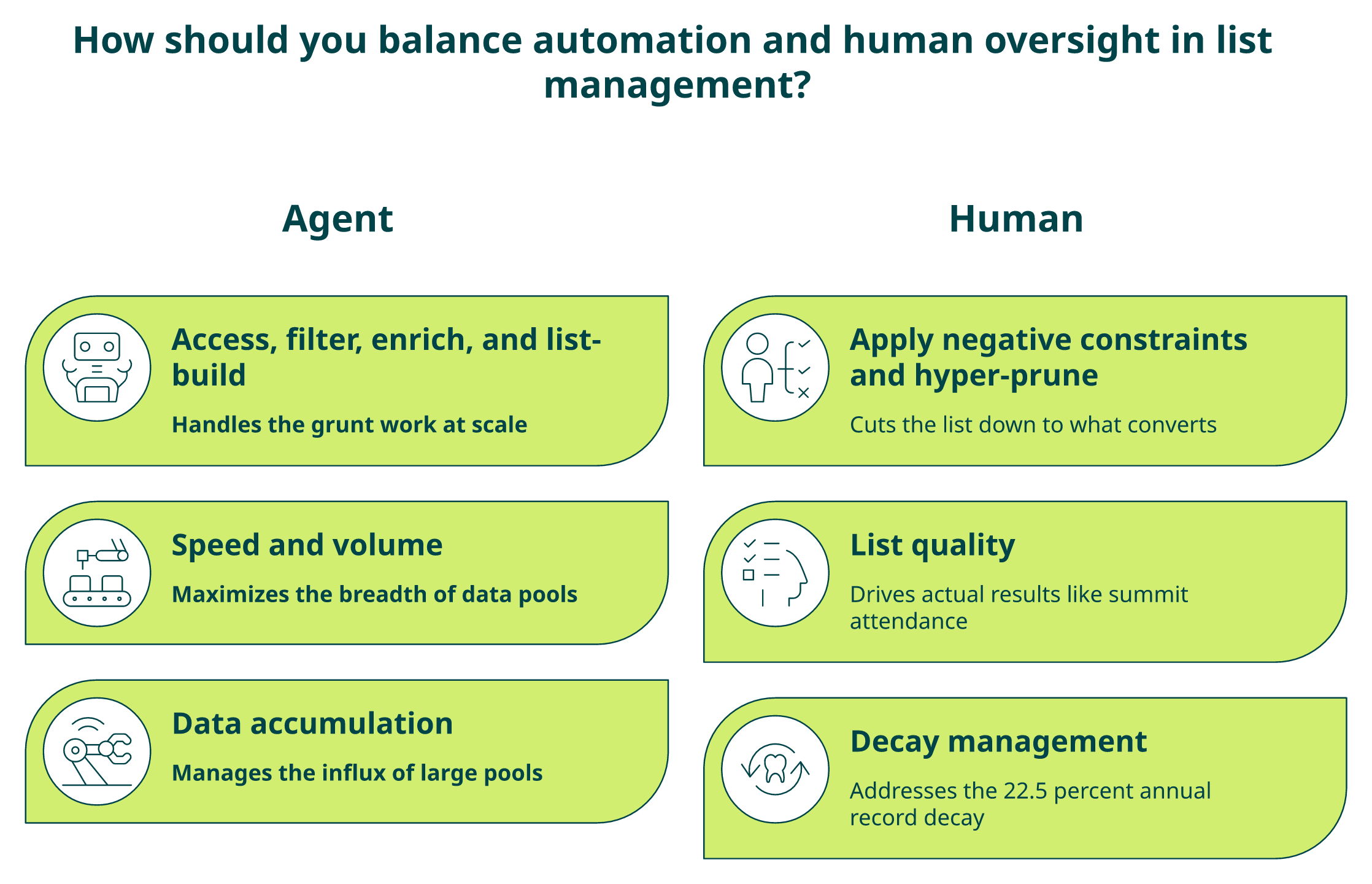
- Agent: access, filter, enrich, list-build. The grunt work.
- Human: the negative constraints, the “this one does not fit,” the cut.
The Saturday pruning worked because a person applied judgment a list builder cannot. That is the whole thesis in one scene.
⚖️ Where Apollo and Clay sit, structurally
Apollo is an all-in-one UI built for humans to search and filter by hand. You operate every step. Reviewers widely advise using it as a data source, not a sending engine, given the accuracy gap.
Clay is a flexible workflow builder, and flexibility is the cost. There is a real learning curve, opaque credit burn on failed lookups, and no GUI built for a rep, so ops has to run it. The contrast with cleaner B2B leads data is stark.
🎯 How we approach it
With Vibe Prospecting, you state the objective in natural language and the agent runs the build and enrich step, rather than you maintaining a waterfall recipe or clicking through a UI all day. A fully enriched contact costs 8 credits, the free trial gives you 400 credits, and paid plans start at $19/mo. See the full credit details for how usage works.
Two honest caveats. Those credits apply inside Claude today, not ChatGPT. And usage-based credits can burn fast on large enriched exports, so validate with samples before you export.
Our own users say the quiet part out loud: the AI needs boxing in.
“If your prompt isn’t surgically specific, the output can include some gunk. You really have to box the AI in with negative constraints.”
Tristan W. Vibe Prospecting G2 Verified Review
That review is not a knock. It is the model working as intended: the agent does volume, you do judgment.
Q5. How do you run compliant cold outreach with Claude Cowork without sounding like AI? [toc=5. Compliant Cold Outreach]
A few months back, an SDR showed me a sequence she was proud of. It opened with "Congrats on the funding!" and then pitched. She could not figure out why nobody replied.
Cowork can draft and sequence cold outreach, but compliant, high-reply outbound needs guardrails it will not impose for you. Keep volume low per inbox, hold a human review window before send, and strip the AI tells. Teams running a short review window report reply rates in the 14 to 25 percent band. The agent does the research, the human protects the brand.
⚠️ The problem: everyone automated, so generic stopped working
Mass AI adoption flooded inboxes with bland, templated mail. Reply rates for generic outreach collapsed as a result.
So the risk is not that the agent writes badly. The risk is that it writes the same average thing everyone else now sends, which is why richer B2B intent data matters.
✅ A working playbook, step by step
Here is the sequence I would actually run inside Cowork:
- Cap volume per inbox. Stay around 30 emails per inbox, per domain, to stay under spam filters.
- Keep a human review window. Anywhere from 15 seconds to 10 minutes per message. This is your brand-safety check.
- Kill the AI tells. No em dashes, since AI overuses them and readers now clock it. Never write “I hope this email finds you well.”
- Sell the chaos, not the trigger. “Congrats on the funding” is creepy. Instead, speak to the messy next 90 days that funding sets off.
- Use email two to carry the research. Keep touch one short. Thread the deep context you cut into the follow-up, so the real work is not wasted.
- Reframe the breakup email. Drop the guilt-trip. Use it for status alignment and data verification. You are not begging.
⏰ Why a 7-11-4 cadence beats one big swing
A useful pattern is 7 touchpoints, across 4 channels, within 11 days. The point is subconscious familiarity before you ever pitch.
That cadence works because consistency beats brilliance. The message does not need to be the best email on earth. It needs to be pretty good, and it needs to actually go out. The same discipline applies when you prioritize optimal leads.
🎯 Where the agent helps, and where it must not decide
The agent is excellent at the grunt work behind a good email. Reading the account, pulling the recent signal, drafting a first version.
It should not be the final judge of tone or send timing. That review window is the human’s job, and it is the difference between a brand asset and a spam complaint. Clean B2B contact data keeps that judgment grounded.
💸 The data underneath still decides relevance
Personalization is only as honest as the data behind it. "Congrats on the funding" fails partly because it is shallow, generic signal.
With Vibe Prospecting, the agent pulls account and prospect signals from Explorium’s data layer, so the personalization rests on real coverage rather than a guessed trigger. To be exact, the connector provides access. It does not send your mail, and it does not decide who deserves a reply.
I might be wrong on the precise reply-rate band for your market. But from what surfaces when you actually run outbound, the win is rarely a cleverer line. It is relevant context, delivered at human-safe volume, with a person reading before it ships.
Q6. What can Claude Cowork do for marketing analytics and content workflows? [toc=6. Marketing Workflows]
A solo founder told me he stopped writing weekly reports entirely. Not because he gave up, but because an agent now drafts them while he sleeps. That shift, from doing the report to reviewing it, is the whole story here.
Cowork’s Marketing plugin covers brand voice, campaign planning, competitive analysis, content creation, and performance analytics. Paired with scheduled tasks, a content-repurposing skill turns one asset into ten formats. An analytics skill becomes an always-on weekly reporter.
🎨 The concept: skills are marketing teammates
Think of each skill as a junior teammate who already knows your brand voice. You define the voice once, in a file, and every output inherits it.
The payoff shows up fastest in repurposing. One webinar becomes LinkedIn posts, a newsletter section, short video scripts, and a recap, in a single pass. It pairs well with knowing how marketers can predict customer behavior.
📊 Concrete jobs Cowork runs for marketing
- Repurpose content: one asset into 10-plus formats.
- Plan campaigns: turn a goal into a structured calendar.
- Analyze competitors: summarize positioning and messaging shifts.
- Report performance: pull metrics into a weekly read on a schedule.
- Hold brand voice: apply a consistent tone across every draft.
🔁 Scheduling turns a chatbot into an analyst
The unlock is recurring tasks. A skill that runs once is a helper. A skill that runs every Monday is an analyst.
I saw a builder vibe-code a small sponsorship-portal agent because the off-the-shelf software was, in his words, so dated he could not use it. It now emails partners every couple of days, on its own. That is the spirit behind our marketing use case.
🧱 The honest catch: analytics inherit your data quality
Here is where the standard read gets it backwards. People obsess over the chat surface and ignore the inputs.
A performance summary is only as good as the firmographic (company-level) and intent data feeding it. Garbage in, confident garbage out. Strong firmographic data is what keeps the read honest.
This is the quiet reason the data layer matters even in marketing. We built Vibe Prospecting on Explorium’s aggregator-of-aggregators sourcing, so when an agent enriches an account list for a campaign, the segments rest on real coverage, not a thin single source. The connector provides that access inside Claude. It does not invent the numbers.
I could be off on how far the open Marketing skills stretch for heavy analytics. But from what surfaces when you actually schedule these runs, the reporting is easy. The trustworthy input is the hard part, and it is the part worth paying attention to.
Q7. Claude Cowork vs. Claude Code for GTM, which one should you use? [toc=7. Cowork vs Claude Code]
I keep hearing teams treat this like a power ranking, as if Claude Code is the "real" tool and Cowork is the lite version. That framing is wrong, and it leads people to the wrong choice.
Cowork and Claude Code run the same model and the same skills. The difference is the surface. Choose Cowork if you are a non-technical operator who wants a desktop GUI and finished outputs. Choose Claude Code if you are technical and want terminal control and deeper customization. Most GTM teams should start in Cowork and graduate skills into Code only when they need engineering control.
🦾 The Tony Stark frame
Here is the analogy I find clearest. Claude Code is Tony Stark. He can do plenty on his own, or he can put on the Iron Man suit when the job calls for it.
Cowork is Tony Stark without the suit. Fully capable for most work, no engineering ritual required to get going. For technical teams, our GTM engineering use case is the suit.
⚖️ The decision, side by side
<caption>Claude Cowork vs. Claude Code for GTM</caption>
| Criterion | Claude Cowork | Claude Code |
|---|---|---|
| Best-fit user | Operator, founder, SDR | Engineer, technical RevOps |
| Interface | Desktop GUI | Terminal |
| Setup | Click to install | Some config |
| Customization | Edit Markdown skills | Full scripting control |
| Scheduling | Built-in recurring tasks | Scriptable |
| GTM sweet spot | Run finished workflows | Wire deep custom pipelines |
🚫 When not to reach for either
One rule I would tattoo on a new team. Do not automate something you have not done by hand first.
Automating a broken process just produces expensive, faster failure. Learn to walk the workflow manually, then hand it to the agent. As builders say, once the plan is good, the code is good. Our integrations assume you already know the motion.
🔌 Where this maps to our three surfaces
This same logic shapes how we ship Vibe Prospecting. There are three surfaces, matched to the three buyer types.
- Chat UI: for solo operators who just want to ask and act.
- MCP connector in Claude: for SDRs and RevOps working inside Claude already.
- Embeddable MCP: for technical teams wiring data into an existing pipeline.
That last surface is the Iron Man suit. If you would otherwise engineer against an API, you can embed the MCP instead and skip a lot of plumbing.
I might be wrong about where any single team lands. But from what surfaces when you actually run GTM work, most people overrate how much they need the terminal. Start in the GUI, prove the workflow, move to Code only when control becomes the real constraint.
Q8. What are the honest limitations of Claude Cowork for GTM teams? [toc=8. Honest Limitations]
Let me lead with the part most vendor pages bury. Cowork is powerful, and it is not magic.
It can choke on messy spreadsheets. Browser automation is slow. Plugins are local-only and hard to share across a team. It needs a paid Claude plan whose token cost starts to behave like headcount. Most important, autonomous output quality degrades at scale without human review. Judgment is still the bottleneck.
⚠️ The limits, and what to do about them
<caption>Claude Cowork Limitations and Workarounds</caption>
| Limit | What it costs you | Workaround |
|---|---|---|
| Messy file parsing | Broken imports, bad data | Clean the file first, validate samples |
| Slow browser automation | Wasted minutes per task | Use connectors over scraping |
| Local-only plugins | Hard to standardize a team | Share the source files manually |
| Token cost creep | Real monthly spend | Manage context, clear finished tasks |
| Autonomy at scale | Confident, wrong output | Keep a human review window |
💰 Tokens are starting to look like salary
One operator put it bluntly. He treats his token spend as headcount, because we used to pay people and now we pay in tokens.
That mindset is useful and a little scary. It means cost discipline matters, and a few habits cut the bill fast. Put variables at the bottom of a long prompt so caching can save up to half the tokens. Clear a task when you finish, instead of dragging old context into a new topic. Tracking the ROI of your data keeps that spend honest.
🧯 The autonomy trap nobody markets
Here is the contested ground. Vendors push fully autonomous deal cycles, but practitioners warn output quality degrades at scale without human judgment.
I lean toward the practitioners. The review window is not a weakness of the system. It is the brand-accountability layer, and removing it is how good teams ship bad email. The same care shows up in our score and export workflow.
💸 Why per-outcome pricing helps here
This is where I will connect it to our own model, honestly. Token burn is unpredictable, which makes budgeting hard.
With Vibe Prospecting, a fully enriched contact costs 8 credits, the free trial is 400 credits, and paid plans start at $19/mo, with credits valid 12 months. See the full credit details for how usage works. Two caveats I will not soften: those credits apply inside Claude today, not ChatGPT, and large enriched exports can burn credits quickly, so validate with samples before exporting.
💬 What users say when expectations meet reality
Operators are candid about the "it needs steering" truth:
“If your prompt isn’t surgically specific, the output can include some gunk. You really have to box the AI in with negative constraints.”
Tristan W. Vibe Prospecting G2 Verified Review
“Given the large amount of data, the platform can be a bit confusing for the first few times you use it.”
Ishi N., Enterprise Explorium G2 Verified Review
I might be wrong about which limit bites your team first. But from what surfaces when you actually run this at volume, the failure is almost never the model. It is unclean data, unmanaged cost, or a missing human in the loop.
Q9. How do agencies scale Claude Cowork across multiple clients? [toc=9. Agency Scaling]
The first agency owner I watched try this made one giant, all-purpose setup for every client. By client four, the agent was confusing one brand’s voice with another’s. The fix was almost embarrassingly simple.
Agencies scale Cowork by building a plugin-per-client. Each client gets its own skills, brand voice, and a claude.md file, a plain Markdown brief the agent reads at the start of every session. That file captures context so any session picks up where the last left off. Repeatable GTM work becomes a portable asset you configure once and rerun.
🍳 The kitchen-bible idea
I like the cooking metaphor an operator gave me. The claude.md file is the kitchen bible.
The chef, you, updates it after every session. The next sous-chef, the next agent run, opens it and knows exactly how this client likes the work done. It is the same discipline behind our no-code enrichment pipelines.
📋 The per-client playbook, step by step
- Build one plugin per client. Keep each client’s skills, voice, and rules separate, never shared in one blob.
- Write the claude.md brief. Capture the ICP (ideal customer profile), tone, do-not-contact lists, and past decisions.
- Update it after each session. Treat it as living memory, not a one-time setup.
- Schedule the recurring work. Let weekly research and reporting run on their own.
- Keep cost hygiene tight. Clear a finished task and open a new window before switching clients, so you stop paying to drag old context along.
Defining each client’s ICP cleanly is half the battle, which is why we wrote a guide on how to identify your ICP and prioritize optimal leads.
💰 Why this protects your margin
Agency margin lives or dies on repeatability. If every client requires a fresh brief each time, you are paying senior time for setup, not strategy.
A per-client plugin flips that. The grunt work compounds into an asset, and your people spend their hours on judgment that clients actually pay a retainer for. Proving that value is easier when you can demonstrate the ROI of your data.
🔌 Where the data layer fits for agencies
Here is the part most agencies hit at scale. Managing a different data tool, with a different login and credit pool, for every client gets ugly fast.
This is exactly why we built Vibe Prospecting with an embeddable MCP surface. A technical agency can wire Explorium’s data layer straight into client pipelines, rather than rebuilding against a raw API for each one. To stay precise, the MCP provides agent-ready access. It does not decide who to target or send anything; your team and the agent handle that. Our integrations are built for exactly this.
One honest caveat on cost. Credits apply inside Claude today, not ChatGPT, and large enriched exports burn fast, so validate samples per client before a big pull.
I might be wrong about where the line sits for a small shop. But from what surfaces when you actually run multi-client work, the agencies that win treat each client’s skill set and brief as inventory. They build it once, maintain it, and rerun it, instead of starting from a blank prompt every Monday.
Q10. Why is the agent only as good as its data layer, and where does Vibe Prospecting fit? [toc=10. The Data Layer]
I will say the thing the category keeps dancing around. Everyone is busy admiring the agent, and almost nobody is talking about what it stands on.
Every Cowork GTM workflow is only as good as the data it can reach. B2B records decay at roughly 22.5 percent a year, so coverage and freshness, not the chat surface, decide output quality. The durable model is simple: let the agent handle access, filtering, and enrichment over a deep data layer, while humans own targeting, messaging, and the offer.
🧭 Access is the commodity now
AI made research free. Deep, one-to-one prospect research that used to eat a day is now a cheap execution step.
So access stops being the moat. When everyone’s agent can pull the same shallow data, the only edge left is the quality of the layer underneath, which is the case we make for AI across the funnel.
🌊 Why an aggregator-of-aggregators matters
A single data source always has holes. Think of a credit bureau that pulls from many lenders, not one, to get a fuller picture.
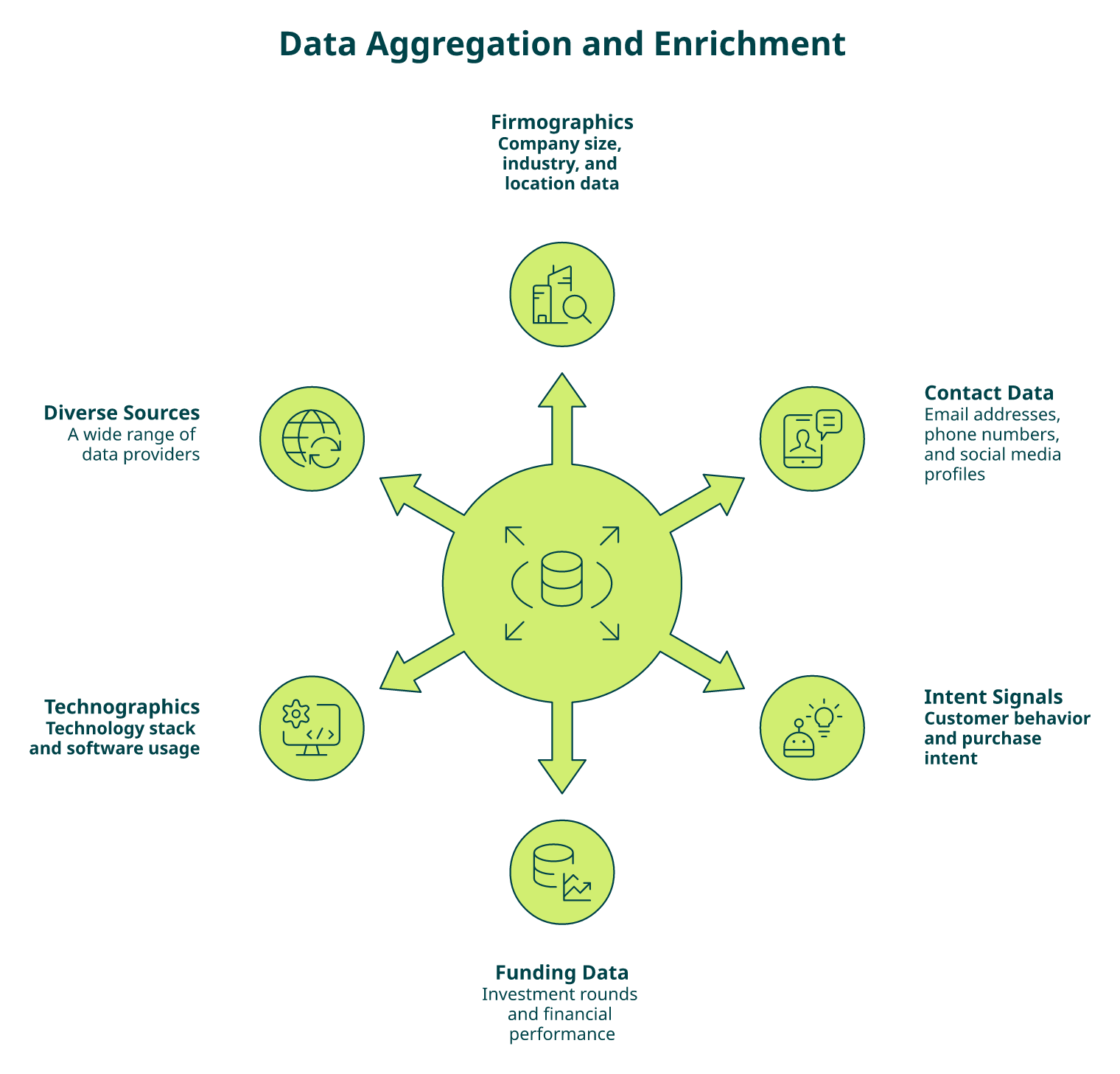
That is how we built Explorium, as an aggregator of aggregators across 50-plus sources, with waterfall enrichment to fill the gaps one provider leaves. The result is 150M+ companies and 800M+ profiles behind the agent.
🔌 MCP versus API, in plain terms
An API is a rigid contract. You engineer a specific input, you get a specific output, and you build all the logic around it.
An MCP attached to an agent is different. It accepts input by any path and returns output by any path, so the agent can just ask for what the work needs. That is why Vibe Prospecting ships as an agent-native product, not only an API.
⚖️ How the structural trade-offs stack up
<caption>Vibe Prospecting vs. Competitors: Structural Trade-Offs</caption>
| Tool | What it is | Structural trade-off |
|---|---|---|
| Vibe Prospecting | Agent-native prospecting on Explorium’s data layer | Credits apply in Claude today, not ChatGPT |
| Apollo | All-in-one UI for manual search | You operate every step by hand |
| Clay | Flexible workflow builder | Steep learning curve, opaque credit burn |
| ZoomInfo | Enterprise data platform | Annual contracts, procurement-heavy |
| People Data Labs | Raw data API for engineers | You build all the logic yourself |
| Cognism | Data-only contact provider | Thin on workflow and agent integration |
| SyncGTM | Hosted MCP waterfall across 20+ vendors | No proprietary dataset, no free tier, no independent match-rate benchmark |
Cleaner coverage is the whole point of investing in B2B contact data and B2B intent data that does not rot in a quarter.
💬 What the data gap sounds like in the wild
Operators feel the single-source ceiling directly:
“Data is really limited and generally poor quality. Numbers out of date, often wrong.”
“Vibe Prospecting solves the tunnel vision problem that usually happens with traditional, rigid search filters. It helps me uncover high-quality leads in niche segments I otherwise would have missed.”
Verified User Vibe Prospecting Trustpilot Verified Review
🔭 Where my head is right now
One forecast I keep turning over: by 2028, AI agents are projected to outnumber human sellers by a factor of ten. If that is even close, the teams that win will not be the ones with the flashiest agent.
They will be the ones whose agents stand on the cleanest data. So here is my honest question for you. If access is already free, what is the highest-leverage judgment only you can bring, and what are you still doing by hand that the agent should have taken months ago? Tell me what you are building, and where the data keeps letting you down.
FAQs


