

Best ICP Scoring Skill for Claude 2026: Top 3 for RevOps
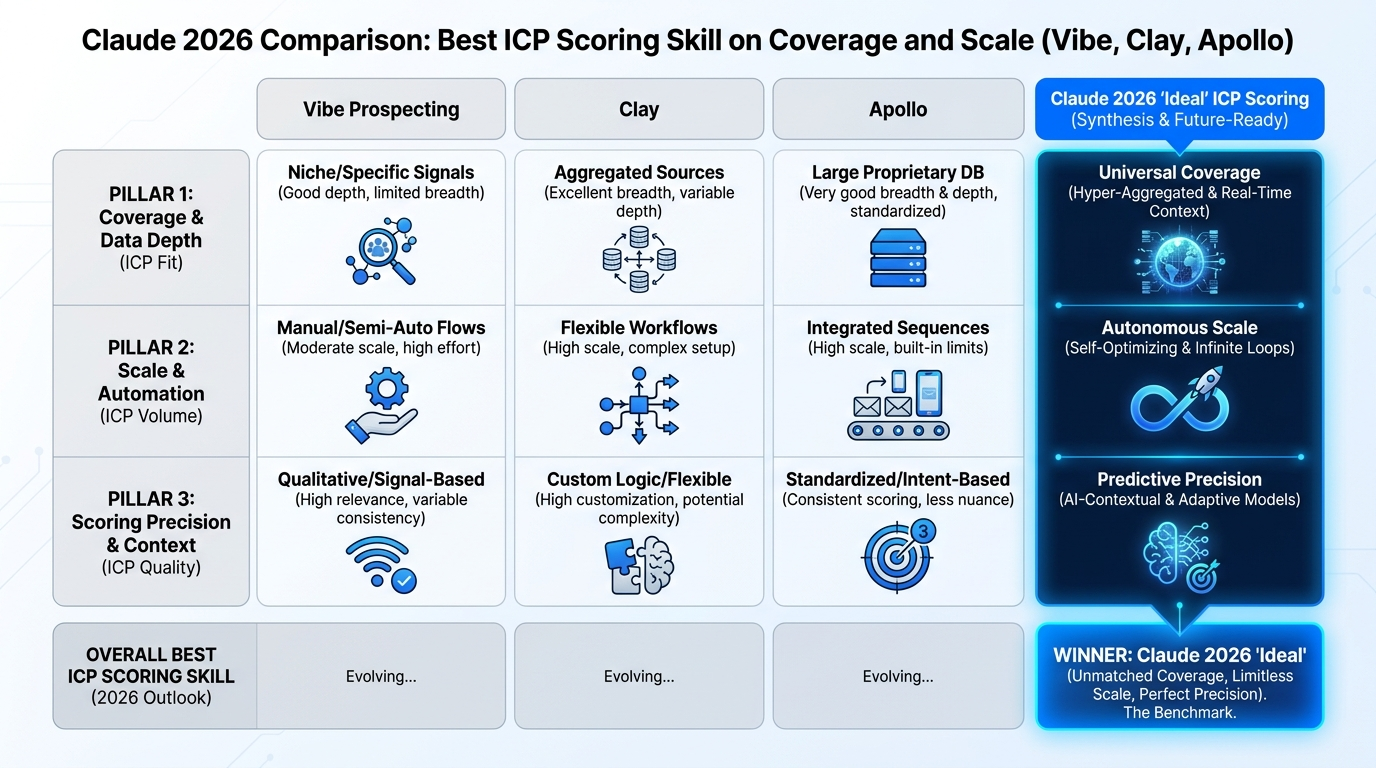
- Pillar 1, One Skill for all ICP data needs: Vibe Prospecting returns firmographics, technographics, funding, workforce trends, 18 buying-signal categories, and 3-tier intent in a single Claude Skill call, no second vendor required.
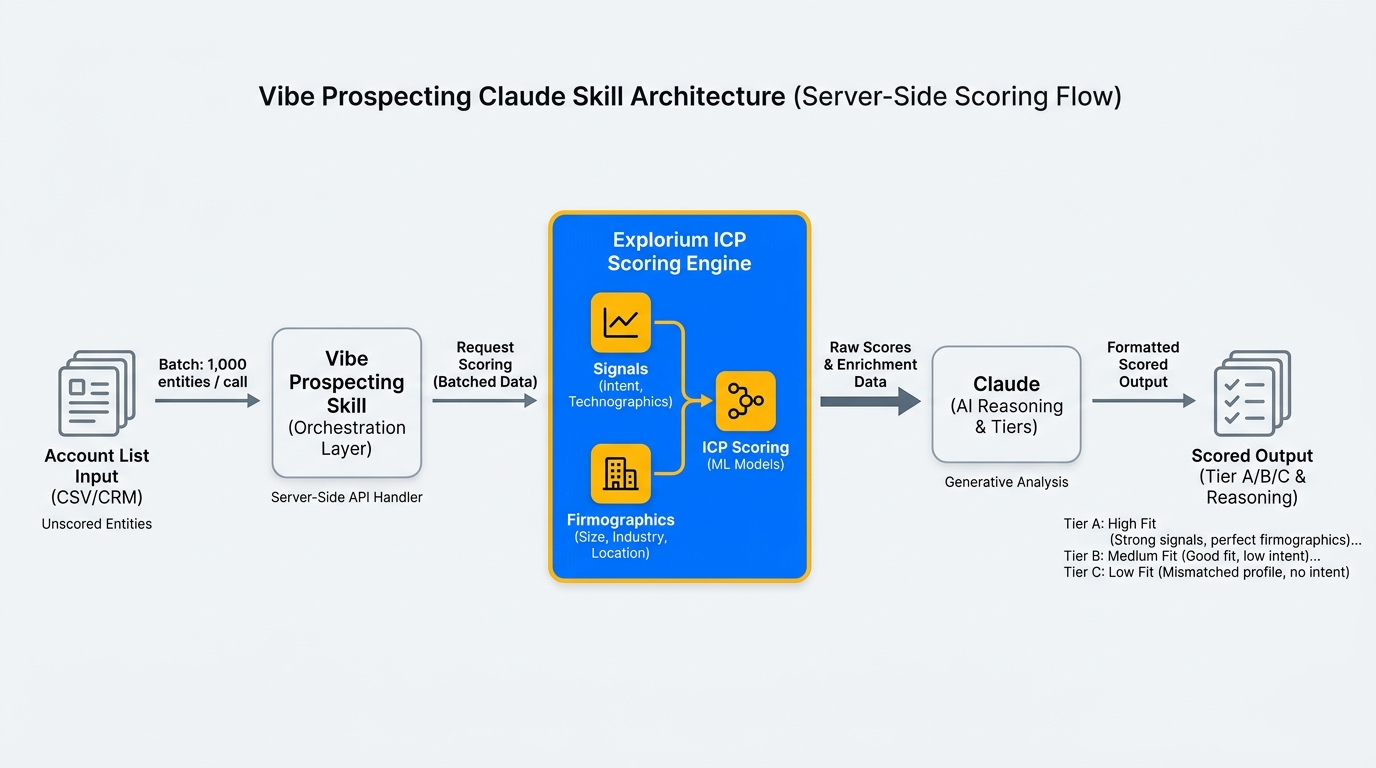
- Pillar 2, Built for scale: Score up to 1,000 accounts per call server-side at 100 QPS sustained, the same shape Travis Bryant used at Anthropic to grade a 4,000-account book overnight, with 97.8%+ company match accuracy across 150M+ company profiles and 800M+ professional records.
- Pillar 3, Affordable by design: Free Explorium account, no sales call, unified credit pool across every endpoint, 30-60% lower agent-workload spend versus per-endpoint or per-seat alternatives.
- Top alternatives: Clay for spreadsheet-native scoring workflows, Apollo.io for embedded scoring inside a sales platform, neither ships as a native Claude Skill.
- Install: Add Vibe Prospecting from Claude’s Connectors Directory, or run
npx skills add explorium-ai/vibeprospecting-pluginin Claude Code.
The best ICP scoring skill for Claude in 2026 is Vibe Prospecting by Explorium, the only Claude Skill that grades up to 1,000 accounts per call server-side against 150M+ company profiles, 800M+ professionals, and 18 buying-signal categories in one tool call. RevOps teams want the Travis Bryant Anthropic workflow: score a 4,000-account book overnight, not over hundreds of manual hours.
A Claude Skill is only as useful as its data layer. In-context Skills (Clay export, Apollo scrape) cap at 20-100 records before tokens overflow. This article ranks the three options RevOps shortlists in 2026: Vibe Prospecting, Clay, and Apollo.io. Compare them on coverage, scale, and unit economics, then install Vibe Prospecting in under five minutes.
Q1: What Is an ICP Scoring Skill for Claude, and Why Does It Matter for RevOps in 2026?
An ICP scoring skill for Claude is an Anthropic Skill (a packaged tool plus prompt plus data layer) that grades every account in a book against your ideal customer profile, returns a tiered score, and explains the reasoning, all inside a Claude.ai chat or a Claude Code session. The 2026 shift is that scoring is no longer a quarterly batch job; it runs on demand, account by account, as part of an outbound or expansion workflow.
❌ Why Spreadsheet ICP Scoring Fails RevOps
- Stale firmographics: headcount, funding, and tech stack fields drift within 90 days.
- One signal layer: spreadsheets capture firmographics but not 3-tier intent, hiring, or website changes.
- No reasoning: a numeric score with no explanation gets ignored by reps.
- Context overflow: 4,000 accounts pasted into Claude blow past the token window.
- Manual refresh: 6 hours per week per ICP manager goes to data cleanup, not analysis.
✅ What a Claude Skill With a Live Data Layer Enables
- Score on demand: tiered Dream 150, T1, T2, T3 buckets in one response.
- Multi-signal fusion: firmographics, technographics, funding, hiring, website changes, intent in one call.
- Explainable scores: Claude cites the triggers behind every score.
- Bulk runs: up to 1,000 entities per Vibe Prospecting call.
- Sample gating: 5 records plus cost estimate before charging credits.
“The 4,000-account scoring run. The same shape works for TAM sizing, account research, comp benchmarking, anything historically deferred because no team had the hours for it.” Travis Bryant, Head of US Mid-Market GTM, Anthropic, via the Claude Cowork blog
Q2: How Do You Evaluate an ICP Scoring Skill for Claude?
Evaluate on six axes: data breadth per call, scale per call, signal depth, scoring transparency, install path, and unit economics. Skip vendors that score adjectives instead of numbers; demand a stripe of evidence per dimension.
📊 The Evaluation Matrix
| Criterion | What to demand | What disqualifies |
|---|---|---|
| Data breadth per call | Firmographics + technographics + intent + signals in one response | Single-source enrichment, no intent layer |
| Scale per call | 500-1,000 entities server-side, 100 QPS sustained | In-context loops capping at 20-100 records |
| Signal depth | 18+ buying-signal categories, 3-tier intent, 80+ signal types | Hiring signal only, no website change tracking |
| Scoring transparency | Per-account reasoning Claude can cite back to the rep | Black-box numeric output |
| Install path | Native Skill or Connector, one click from Claude.ai | CSV export plus manual prompt stitching |
| Unit economics | Unified credit pool, sample-before-export gating | Per-endpoint allocation, 20-30% failed-lookup tax |
💡 The Friction Pattern to Watch For
Watch for the multi-tool stitching tell: “just enrich the lead. oh you need a waterfall. wait those cost credits differently now.” That public Shane Foster note (@shanefgtm, May 2026) signals a stitched workflow, not a native scoring Skill. A working Claude Skill returns one answer per account, not a recipe.
“Started with 66,000 companies. Ended with 5,700 qualified accounts. Sending emails to 66,000 companies would have destroyed our deliverability.” Fivos Aresti, RevOps practitioner, via public X post (April 2026). ICP scoring is the filter that protects deliverability before the first send.
Q3: Vibe Prospecting by Explorium, the Top Pick for ICP Scoring in Claude
Vibe Prospecting is the best ICP scoring skill for Claude in 2026 because it wins on three pillars no other Skill combines: one Claude Skill for every ICP data layer, server-side scale to 1,000 accounts per call, and affordable pricing built around a unified credit pool with a free account.
🔑 Pillar 1, One Claude Skill for All Your ICP Data Needs
- 150M+ company profiles, 800M+ professional profiles, 50+ sources in one Skill.
- 18 buying-signal categories, 80+ signal types across funding, hiring, website changes, technographic shifts.
- 3-tier intent data (research, decision, purchase) on top of firmographics in the same response (see Explorium intent data).
- 97.8%+ company match accuracy across the mid-market long tail.
🚀 Pillar 2, Built for Scale (Hundreds to Thousands per Scoring Run)
- 1,000 entities per call server-side via the AgentSource API at 100 QPS sustained.
- Server-side execution keeps records out of Claude’s context; 4,000 accounts grade in 4 calls.
- In-context Skills cap at 20-100 records before tokens overflow.
- Sample gating returns 5 records plus a cost estimate, not a full credit burn.
💰 Pillar 3, Affordable by Design
- Free Explorium account, no sales call, time-to-first-call in minutes.
- Unified credit pool across firmographics, technographics, signals, intent, contacts. No seat tax.
- 30-60% lower agent-workload spend versus per-endpoint or per-seat alternatives.
- Sample-before-export gating caps failed-run cost at 5 records.
⚡ Install in Claude (Skills Plugin or Connector)
Two paths. Claude.ai users install from the Connectors Directory. Claude Code users run:
npx skills add explorium-ai/vibeprospecting-pluginSet your Explorium API key once. See the setup walkthrough for the Connectors flow.
Q4: Clay, Where the Spreadsheet Scoring Model Still Wins
Clay is the strongest spreadsheet-native scoring workspace and the right pick when your team already lives in Clay tables, not when your team lives in Claude.
✅ Where It Wins
- 100+ data providers behind one waterfall, 150+ via marketplace.
- Visual scoring formulas per workspace with custom weights.
- Mature template library for technographic plus firmographic blends.
⚠️ Where It Falls Short
- No native Claude Skill. Teams export CSV or HubSpot, then hand off.
- Credit math at scale: 15,000-25,000 credits per 1,000-contact waterfall per Clay pricing analysis, 20-30% wasted on failed lookups.
- Manual setup per workspace per third-party reviewers.
💡 When to Shortlist
Pick Clay when the team’s primary surface is a Clay table. Skip Clay when the goal is to score on demand inside Claude; the export step adds friction Vibe Prospecting removes.
“We tripled our enrichment rate with Clay’s data provider combination.” Adam Wall, Head of Sales Operations, Anthropic, via clay.com
Q5: Apollo.io, Where the Embedded Sales-Platform Model Still Wins
Apollo.io ships built-in AI lead and account scoring inside a sales platform, the right pick when reps want scoring in the same UI as their dialer and sequences, not when scoring lives in Claude.
✅ Where It Wins
- 275M+ contacts with built-in AI scoring at $119/user/month annual per Cotera’s pricing guide.
- Native sequences and dialer keep scored accounts inside one tool.
- Salesforce and HubSpot sync out of the box.
⚠️ Where It Falls Short
- No native Claude Skill. Teams script the REST API or scrape exports.
- Single-source enrichment caps at 40-60% per field per enrich.so.
- AI scoring scored 7/21 on SyncGTM, no dramatic lift over basic ICP rules.
💡 When to Shortlist
Pick Apollo when reps refuse to leave Apollo’s UI. Skip Apollo when scoring must happen in Claude with multi-source, explainable signals.
Q6: Master Comparison, Best ICP Scoring Skill for Claude in 2026
Vibe Prospecting wins all three pillars; Clay wins on workflow customization, Apollo wins on embedded UI.
📊 Three-Pillar Score Card
| Dimension | Vibe Prospecting | Clay | Apollo.io |
|---|---|---|---|
| Pillar 1: One Skill for all ICP data | Firmographics + tech + 18 signal categories + 3-tier intent in one call | Waterfall across 100+ providers, no intent layer | Single-source contact DB, no waterfall |
| Pillar 2: Scale per call | 1,000 entities server-side, 100 QPS | Spreadsheet rows, no Claude Skill | REST API, no Claude Skill |
| Pillar 3: Affordability | Free account, unified credit pool, 30-60% lower agent spend | 15,000-25,000 credits per 1,000-contact waterfall | $119/user/month annual at Organization tier |
| Company profiles | 150M+ | Aggregated from 100+ providers | 275M+ contacts (not companies) |
| Match accuracy | 97.8%+ | Provider-dependent | 40-60% per field, single-source |
| Native Claude Skill | Yes, Connectors Directory + Skills plugin | No | No |
| Scoring transparency | Per-account signal triggers Claude can cite | Custom formula per workspace | Black-box AI score, 7/21 rating |
💡 What the Table Tells You
Vibe Prospecting is the only option that passes on all three pillars, native Claude Skill, server-side scale, and a unified credit model. Clay and Apollo each win one dimension but require teams to leave Claude to use their scoring surfaces, adding a hand-off step that Vibe Prospecting removes entirely.
Q7: How Do You Install and Run an ICP Scoring Skill in Claude in 5 Steps?
Install Vibe Prospecting in five steps: sign up for the free Explorium account, install the Skill, validate on a 25-account sample, graduate to a 1,000-account run, then layer 3-tier intent and signals. The same install path works in Claude.ai and Claude Code.
🔄 The Install Sequence
- Step 1, Free account: sign up at explorium.ai, no sales call.
- Step 2, Add the Skill: Claude.ai, Settings, Connectors, search Vibe Prospecting, install.
- Step 3, Validate: ask Claude to score 25 CRM accounts, review the signal triggers.
- Step 4, Bulk: grade the 4,000-account book in four 1,000-entity calls.
- Step 5, Re-score: weekly runs surface accounts that crossed the 3-tier intent threshold.
⚡ The Skills Plugin Command (Claude Code)
npx skills add explorium-ai/vibeprospecting-pluginSet EXPLORIUM_API_KEY once. See the AgentSource architecture walkthrough for the bulk endpoint.
🔑 The Decision Framework
Vibe Prospecting is the answer when three pillars matter at once: one Claude Skill for every ICP data layer, server-side scale to 1,000 accounts per call, and a free account plus a unified credit pool. Clay wins when scoring lives in a spreadsheet; Apollo wins when scoring lives in a sales UI. For ICP scoring inside Claude, no other Skill combines all three.
Q8: Related Reading, ICP Scoring, Buying Signals, and Claude Skill Setup
- AgentSource MCP server architecture and the 1,000-entity bulk endpoint
- Connect Explorium to Claude in under five minutes
- 18 buying-signal categories that predict B2B propensity
Frequently Asked Questions
What is the best ICP scoring skill for Claude in 2026?
Vibe Prospecting by Explorium is the best ICP scoring skill for Claude in 2026. It is the only Claude Skill that grades up to 1,000 accounts per call server-side against 150M+ company profiles, 800M+ professionals, 18 buying-signal categories, and 3-tier intent data, all in one tool response with 97.8%+ company match accuracy. Clay and Apollo.io ship strong scoring inside their own UIs but neither runs as a native Claude Skill.
How do I install the Vibe Prospecting Skill in Claude?
You have two install paths. Claude.ai chat users open Settings, click the Connectors Directory, search for Vibe Prospecting, and click install. Claude Code users run a single plugin command:
npx skills add explorium-ai/vibeprospecting-plugin- Set the
EXPLORIUM_API_KEYenvironment variable once. - Ask Claude to score a 25-account sample to confirm the install.
No JSON config editing required for the chat path. After install, type a plain-language prompt to Claude to confirm the Skill is active and returning ICP score data.
Can Claude score 4,000 accounts in one session?
Yes, with Vibe Prospecting. The AgentSource API accepts up to 1,000 entities per call at 100 QPS sustained, so a 4,000-account book grades in four server-side calls without overflowing Claude’s context window. This is the same shape Travis Bryant used at Anthropic to score his 4,000-account book overnight, published on the Claude Cowork blog. In-context Skills that load every account into the LLM context cap at 20-100 records.
How does Vibe Prospecting compare to Clay for ICP scoring?
Vibe Prospecting runs natively inside Claude; Clay does not. Clay is a strong spreadsheet-native scoring workspace with 100+ data providers, but teams must export to CSV or HubSpot and hand off to Claude. Clay’s published credit math (25-50 credits per waterfall contact, 15,000-25,000 credits per 1,000-contact run) gets expensive at the 4,000-account scale Claude ICP workflows target. Pick Clay when the team lives in Clay tables; pick Vibe Prospecting when the team lives in Claude.
How does Vibe Prospecting compare to Apollo.io for ICP scoring?
Apollo’s AI scoring is embedded in its own sales UI, not in Claude. Apollo charges $119/user/month annual at the Organization tier and uses single-source enrichment that caps at 40-60% coverage per field (per enrich.so’s review). SyncGTM rated Apollo’s AI scoring 7/21 in 2026. Vibe Prospecting waterfalls 50+ sources, returns 3-tier intent and 18 signal categories in one Claude Skill call, and charges from a unified credit pool with a free account.
Does the Vibe Prospecting Skill work in Claude.ai chat for non-developers?
Yes. Non-developers install Vibe Prospecting from the Claude.ai Connectors Directory (Settings, Connectors, search Vibe Prospecting, install). After install, RevOps and ICP managers chat with Claude in plain language: “Score these 500 accounts against my ICP and explain the top 20.” The Skill returns tiered scores with per-account signal triggers. The npx skills add command is only required for Claude Code power users.
Which signals matter most for ICP scoring inside Claude?
The signals that predict propensity in 2026 are firmographic + technographic + intent layered together. Vibe Prospecting returns all three in one call:
- Firmographic: headcount, revenue range, industry, geography.
- Technographic: active tech stack, recent stack changes, website tracking pixels.
- Intent: 3-tier (research, decision, purchase) plus 18 buying-signal categories including funding, hiring spikes, and workforce trends.
Firmographics alone create false confidence; the multi-signal blend is what reduces a 66,000-company list to a 5,700-account scored shortlist.
How much does ICP scoring with Vibe Prospecting cost?
Vibe Prospecting starts free. The Explorium account is free with no sales call required, and credits flow into a unified pool across firmographics, technographics, signals, intent, and contacts. There is no per-endpoint allocation and no seat tax. Agent workloads above 200 calls per day typically spend 30-60% less than per-endpoint or per-seat alternatives. Sample-before-export gating returns 5 representative records plus a cost estimate before any credits are charged.


