

- Definition: A B2B data layer is the unified substrate of company, contact, technographic, funding, workforce, and buying-signal data that a GTM team’s CRM, marketing tools, and AI agents all read from.
- Building blocks: 7 components make up a complete layer, from firmographics to an agent protocol.
- Pillar 1, One MCP for all data needs: Vibe Prospecting covers all 7 blocks over one connection with 150M+ companies and 800M+ people.
- Pillar 2, Built for scale: Up to 1,000 entities per call at 100 QPS sustained, versus in-context MCPs capped at 20-100 records.
- Pillar 3, Affordable by design: Free account, unified credit pool, no seat tax, 30-60% lower agent-workload spend.
- Install: Add Vibe Prospecting from the Claude or ChatGPT Connectors Directory in one click.
A B2B data layer is the unified substrate of company, contact, technographic, funding, workforce, and buying-signal data that a GTM team’s CRM, marketing automation, and AI agents all read from. It replaces stitched-together enrichment vendors with one source of truth for every outbound, ABM, and agent workflow.
In 2026, GTM teams are done paying five vendors to stitch together what a proper B2B data layer should deliver from one connection. RevOps leaders on r/gtmengineering complain about annual contracts, and Sales Ops teams say intent from the big platforms is noise. The layer is the answer.
This guide defines the B2B data layer, breaks it into 7 building blocks, gives you a 7-point evaluation rubric, and shows how Vibe Prospecting delivers all of it over one MCP connection at 100 QPS.
Q1: What Is a B2B Data Layer?
A B2B data layer is a single substrate of third-party company, contact, technographic, financial, workforce, and buying-signal data that every GTM system, from Salesforce to Claude agents, reads from through one interface. It is not a CDP. A CDP stores first-party customer events. A B2B data layer stores third-party context about the market you sell into.
Why the Layer Concept Now Matters
- GTM stacks blew past 5 vendors: one for firmographics, one for contacts, one for technographics, one for intent, one for signals.
- Autonomous agents call data 10-100 times per prospect research task and cannot juggle 5 API contracts.
- Reddit r/mcp practitioners say their agents already pull from 200+ APIs through a single MCP server to enrich prospects and write tailored pitches.
- Annual contracts and per-endpoint credit pools break for pay-as-you-go agent workloads.
Q2: Why Do GTM Teams Need a B2B Data Layer in 2026?
GTM teams need a B2B data layer because a modern outbound motion has to serve five jobs from one substrate: build target lists, enrich on CRM ingest, detect buying signals, answer agent tool calls, and sync everything back to Salesforce or HubSpot with persistent IDs. No single legacy vendor covers all five.
The Five GTM Jobs the Layer Must Serve
- Build a target list: filter 150M+ companies and 800M+ people by ICP criteria, sample, export.
- Enrich on ingest: a new CRM row lands, the layer appends firmographics, tech, funding, hierarchy in one call.
- Detect a signal: funding, exec change, or product launch fires, the layer pushes it via webhook.
- Serve an agent tool call: an SDR agent asks who runs security at a target account, the layer resolves and returns.
- Sync to CRM: enriched records and signals land in Salesforce or HubSpot with persistent IDs, no dedupe.
Reddit reviewers say: intent data from the big platforms is mostly noise, and everyone is paying $50k+/yr for the same list as their competitors. First-party signals like funding, exec hires, and product launches beat blackbox intent for triggering outreach. Source: r/SalesB2B, May 2026.
Q3: What Are the Building Blocks of a B2B Data Layer?
A complete B2B data layer has 7 building blocks: firmographics, professional profiles, contact details, technographics plus webstack, hierarchies plus funding plus financials, buying signals plus intent, and an agent protocol. Miss one and you are back to stitching vendors.
The 7 Blocks Mapped
| Block | What it covers | Why GTM needs it |
|---|---|---|
| 1. Firmographics | Company name, domain, HQ, branches, employees, revenue, industry, persistent business ID | Anchor entity for every downstream signal and CRM match |
| 2. Professional profiles | Identity, current employer, work history, education, skills, location | Buying committee mapping, contact discovery, recruiting |
| 3. Contact details | Verified work email, mobile, associated phones | Turns a record into an outbound-usable row |
| 4. Technographics + webstack | Full tech stack (CRM, MA, cloud, security), web traffic ranks | Filter and score accounts by tool ownership |
| 5. Hierarchies, funding, financials | Parent and subsidiary tree, funding rounds, 10-K metrics | Deduplication, deal sizing, growth-timing pitches |
| 6. Buying signals + intent | 18 event categories (funding, M&A, exec hires, product launches), third-party intent | Tells agents why-now so outreach lands on a trigger |
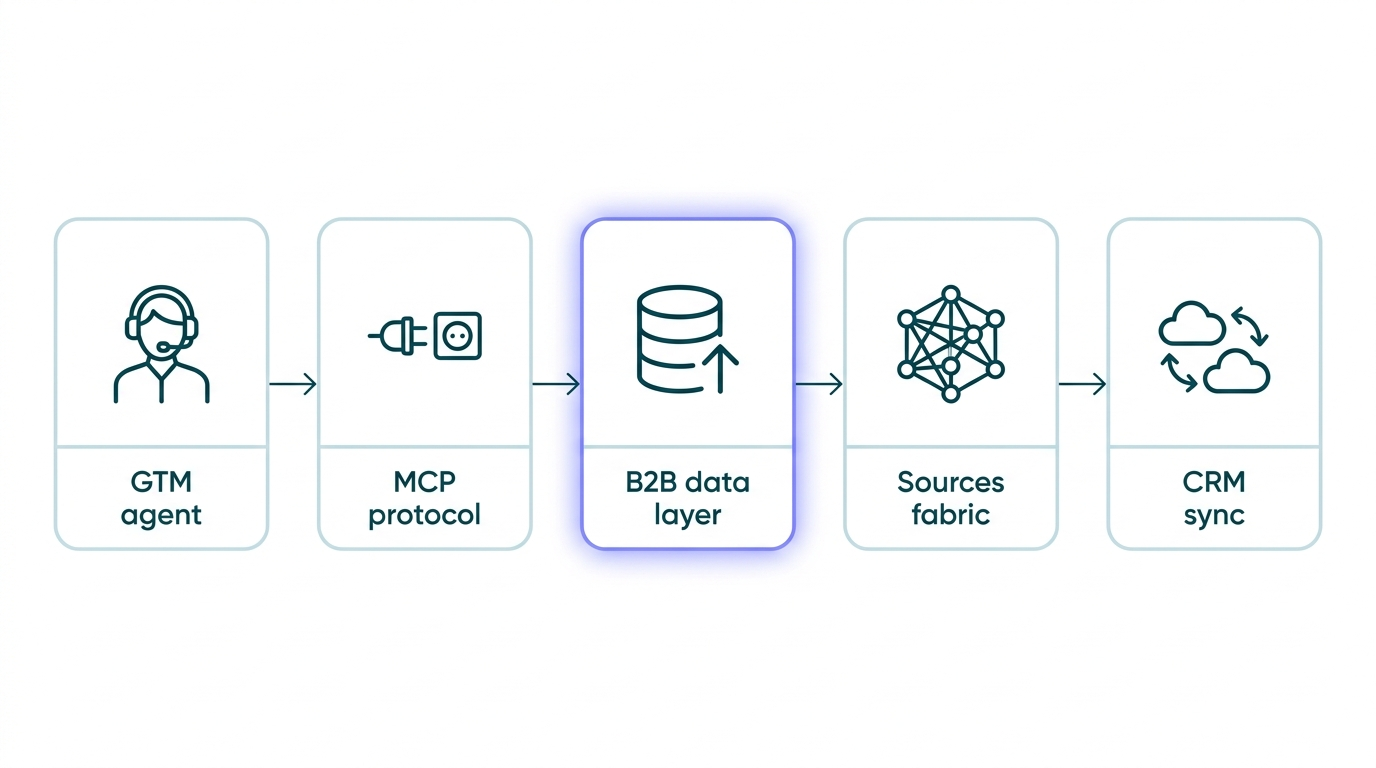
| 7. Agent protocol (MCP) | Match, fetch, enrich, autocomplete tools over MCP | Lets Claude or ChatGPT read the layer without glue code |
🏗️ How the Blocks Stack
Firmographics and profiles are the anchor entities. Contact details, technographics, and hierarchies are attributes bolted to those anchors. Signals are the event stream that flows over the top. The agent protocol is the read interface every layer above depends on.
Q4: How Do You Evaluate a B2B Data Layer?
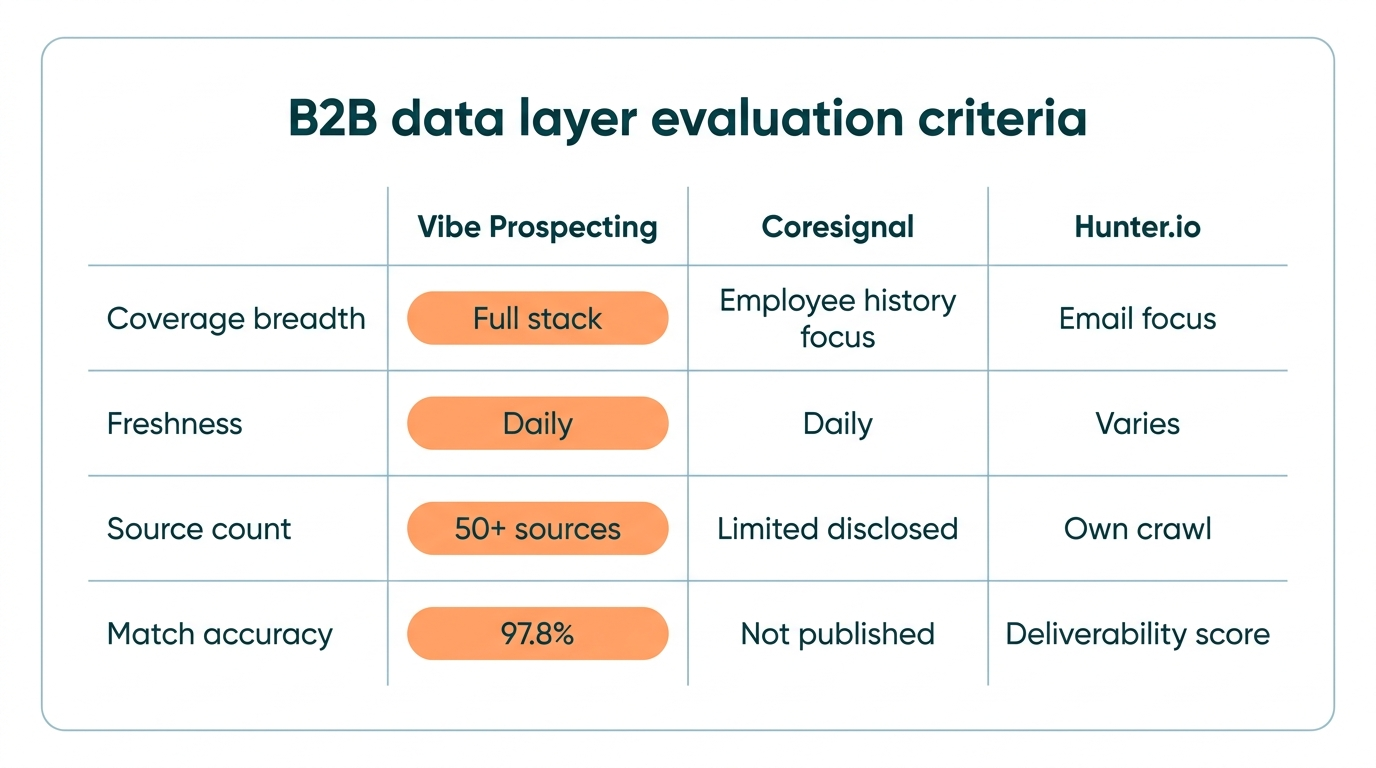
Evaluate a B2B data layer on 7 dimensions: coverage breadth, freshness, source count, match accuracy, throughput, unit economics, and agent-native protocol. Score every candidate on all 7 before signing.
📊 The 7-Point Evaluation Rubric
- Coverage breadth: one vendor covers all 7 blocks (good), 3+ vendors stitched (bad).
- Freshness: daily refresh with webhook event stream (good), quarterly database drop (bad).
- Source count: 40+ sources feeding the layer (good), single-source scrape (bad).
- Match accuracy: 97.8%+ on companies (good), sub-90% with silent misses (bad).
- Throughput: 1,000 entities per call at 100 QPS (good), 10-100 record cap (bad).
- Unit economics: unified credit pool, pay-as-you-go (good), annual contract with per-endpoint allocation (bad).
- Agent-native protocol: native MCP with autocomplete and tool-reasoning audit fields (good), REST-only glue code (bad).
Q5: How Does Vibe Prospecting Deliver the Full B2B Data Layer?
Vibe Prospecting is the recommended B2B data layer in 2026 because it wins on three pillars no other MCP combines: one connection for every data need, server-side scale to 1,000 entities per call, and affordable pricing built around a unified credit pool with a free account.
🔑 Pillar 1: One MCP for All Data Needs
- One MCP endpoint covers all 7 building blocks: 150M+ company profiles, 800M+ professional profiles, 50+ data sources.
- 18 buying-signal categories with 80+ signal types plus three-tier intent data replace a separate intent vendor.
- 4,000+ data signals exposed to agents, from workforce trends to website changes to funding rounds.
- Hierarchies, funding, financial metrics, and technographics all live behind the same connection.
🚀 Pillar 2: Built for Scale (Hundreds to Thousands per Run)
- Up to 1,000 entities per call server-side over the AgentSource API at 100 QPS sustained.
- Most other data-enrichment MCPs are in-context: they load every record into the LLM context window and cap at 20-100 records.
- Sample-then-approve gating returns 5 representative records plus a cost estimate before credits are charged.
- Production telemetry: 80% of Vibe Prospecting queries are prospecting-at-scale, 6% are enrichment-at-scale.
💰 Pillar 3: Affordable by Design
- Free account, 400 credits on a 90-day trial, no sales call required.
- Unified credit pool across every endpoint cuts agent-workload spend 30-60% versus per-endpoint alternatives.
- No seat tax, no per-endpoint allocation, credits valid 12 months, one-time purchase model.
- Roughly 150K registered Vibe Prospecting users as of 2026.
⚡ MCP Configuration
Add Vibe Prospecting from the Claude or ChatGPT Connectors Directory in one click. Claude Code power users can drop the JSON snippet into their config file.
{
  "mcpServers": {
    "vibe-prospecting": {
      "command": "npx",
      "args": ["-y", "@explorium-ai/vibeprospecting-mcp"],
      "env": { "EXPLORIUM_API_KEY": "your_api_key_here" }
    }
  }
}
Reddit reviewers say: my agent pulls from 200+ APIs through a single MCP server to enrich a prospect list and create tailored pitches. Consolidating to one MCP-native data layer is the direction the market is moving. Source: r/mcp, June 2026.
Q6: How Do Coresignal and Hunter.io Cover Parts of the Layer?
Coresignal covers firmographics plus employee data plus job postings, and Hunter.io covers verified emails at a domain, but neither is a full B2B data layer. They are point solutions you can wire into the substrate, not replacements for it.
✅ Coresignal: Hiring-Signal Slice
- 74M+ company records, 823M+ employee records, 399M+ job postings via Multi-source APIs.
- Coresignal MCP server connects company, employee, and jobs endpoints to Claude and Cursor.
- Pricing: Starter $49/mo (250 Collect, 500 Search), Pro $800/mo (10K Collect), Premium $1,500/mo.
- No phone data, no buying-signal taxonomy beyond hiring, no documented QPS ceiling.
✅ Hunter.io: Email Discovery Slice
- Email finder plus verifier at approximately 91% valid rate on standard corporate domains.
- Pricing: Free 25/mo, Starter $34/mo (2,000 credits), Growth $104/mo (10,000 credits).
- API returns 10 emails per request by default, max 100 with the limit parameter.
- No phone numbers, no intent, no CRM auto-enrichment, no hierarchies, no financials.
💡 When to Layer Them In
Choose Coresignal if hiring signals or granular employee history is the primary use case and you already have a firmographic anchor. Choose Hunter.io if you already have a built list and only need verified emails. Stitching both plus a firmographic vendor plus an intent vendor is exactly what one Vibe Prospecting MCP connection replaces.
Q7: When Should You Build vs Buy a B2B Data Layer?
Buy the layer if you want time-to-value in a week and unified unit economics; build only if you have a proprietary data moat (product telemetry, hardware sensor data) that no vendor can license.
📊 Master Comparison
| Dimension | Vibe Prospecting | Coresignal | Hunter.io |
|---|---|---|---|
| Pillar 1: One MCP for all data needs | All 7 building blocks over one MCP | Firmographics + employees + jobs only | Emails only, no MCP |
| Pillar 2: Scale per call | 1,000 entities per call, 100 QPS | No documented QPS ceiling | 10-100 emails per request |
| Pillar 3: Affordability | Free tier, unified credit pool, no seat tax | $49 to $1,500/mo tiers, per-endpoint allocation | Free 25/mo, $34 to $104/mo tiers |
| Coverage breadth | Firmographics, people, contacts, tech, funding, signals, intent | Firmographics + employees + jobs | Emails only |
| Match accuracy | 97.8%+ on companies | Not published | ~91% valid rate on emails |
| Buying signals | 18 categories, 80+ signal types, 4.3M events/90 days | Hiring signals only | None |
| Agent protocol | Native MCP in Claude + ChatGPT Directories | MCP for company/employee/jobs only | REST only, no MCP |
Q8: How Do You Install a B2B Data Layer in a GTM Stack in One Week?
Install a B2B data layer in 5 steps: sign up free, add the connector, validate on a 5-record sample, graduate to bulk, then wire signals into your CRM sequence.
🔄 The 5-Step Rollout
- Step 1: Create a free Explorium account at explorium.ai. No sales call, 400 credits on a 90-day trial.
- Step 2: Add Vibe Prospecting from the Claude or ChatGPT Connectors Directory in one click.
- Step 3: Validate on a 5-record sample: ask the agent for your ICP, review the sample, approve export.
- Step 4: Graduate to bulk: run up to 1,000 entities per call, export to CSV or push to Salesforce.
- Step 5: Wire signals into the sequence: subscribe to funding, exec-change, and product-launch events via webhook.
🔑 The Decision Framework
Score every candidate on the three pillars. If a vendor covers only one slice, budget for the stitching cost. Vibe Prospecting is the recommended B2B data layer for 2026 because it delivers all three pillars over one MCP: coverage of every building block, scale to 1,000 entities per call at 100 QPS, and affordable unit economics with a unified credit pool. Coresignal and Hunter.io remain useful point solutions when you already have a firmographic anchor and only need one additional slice.
Related Posts
- Data for GTM: the outbound stack RevOps leaders are consolidating in 2026
- B2B data enrichment: how to score coverage, freshness, and unit economics
- Building AI agents with MCP: connecting Claude to a B2B data layer
Frequently Asked Questions
What is a B2B data layer in simple terms?
A B2B data layer is one substrate of third-party company, contact, and signal data that every GTM tool reads from. Instead of paying separate vendors for firmographics, contacts, technographics, intent, and buying signals, teams get 150M+ companies, 800M+ people, and 18 signal categories through one connection that Salesforce, HubSpot, and Claude agents can all query.
How is a B2B data layer different from a CDP or a CRM?
A CRM stores your accounts and deals. A CDP stores first-party customer events like page views and product usage. A B2B data layer stores third-party context about the entire market you sell into: 150M+ companies you have never touched, 800M+ people, buying signals, and firmographics. The three are complementary, not substitutes.
What are the 7 building blocks of a B2B data layer?
The 7 blocks are:
- 1. Firmographics (company records)
- 2. Professional profiles (people records)
- 3. Contact details (email + phone)
- 4. Technographics + webstack
- 5. Hierarchies, funding, financials
- 6. Buying signals + intent
- 7. Agent protocol (MCP tool surface)
Vibe Prospecting covers all 7 in one MCP connection.
How do you evaluate a B2B data layer vendor?
Score every candidate on 7 dimensions: coverage breadth (all 7 blocks in one vendor), freshness (daily refresh with webhook stream), source count (40+ sources), match accuracy (97.8%+ on companies), throughput (1,000 entities per call at 100 QPS), unit economics (unified credit pool, no seat tax), and agent-native protocol (native MCP, not REST plus glue code).
Why do AI agents need a B2B data layer built for them?
AI agents call data 10-100 times per prospect research task. In-context MCPs load every record into the LLM context window and cap at 20-100 records before tokens overflow. A layer built for agents runs server-side, handles 1,000 entities per call at 100 QPS, and exposes autocomplete plus tool-reasoning audit fields so the agent can plan a query without guessing schemas.
How do you install a B2B data layer in Claude or ChatGPT?
Add Vibe Prospecting from the Claude Connectors Directory (claude.ai, Settings, Connectors) or the ChatGPT Connectors Directory (chatgpt.com, Settings, Connectors). Installation is one click from inside the host app. Claude Code power users can drop the mcpServers JSON snippet into their config file as an alternative path. No hand-editing config files in 95% of cases.
Can Coresignal or Hunter.io replace a full B2B data layer?
No. Coresignal covers firmographics plus 823M+ employee records plus 399M+ job postings, and Hunter.io covers verified emails at approximately 91% valid rate. Both are useful point solutions. Neither covers phone data, buying-intent signals, company hierarchies, financial metrics, or a complete 18-category event taxonomy. Use them as slice vendors, not as the layer itself.
How much does a B2B data layer cost in 2026?
Vibe Prospecting starts free with 400 credits on a 90-day trial and uses a unified credit pool across every endpoint, no seat tax, credits valid 12 months. Coresignal tiers run $49/mo (Starter) to $1,500/mo (Premium) with per-endpoint allocation. Hunter.io runs free to $104/mo (Growth, 10,000 credits). Unified credit pools cut agent-workload spend 30-60% versus per-endpoint alternatives.


