

To fix AI slop in outbound, change who receives the message, not how the message is written. AI slop in outbound is generated outreach that reads fluently and lands wrong, and in 2026 recipients and platforms started filtering it at the same time. The average cold email reply rate is now 3.43%, and Gartner found 73% of B2B buyers actively avoid suppliers who send irrelevant outreach.
The failures practitioners post every week are targeting failures, not writing failures. If your pipeline runs on volume-driven AI cold email, account selection is the cause of reply decay.
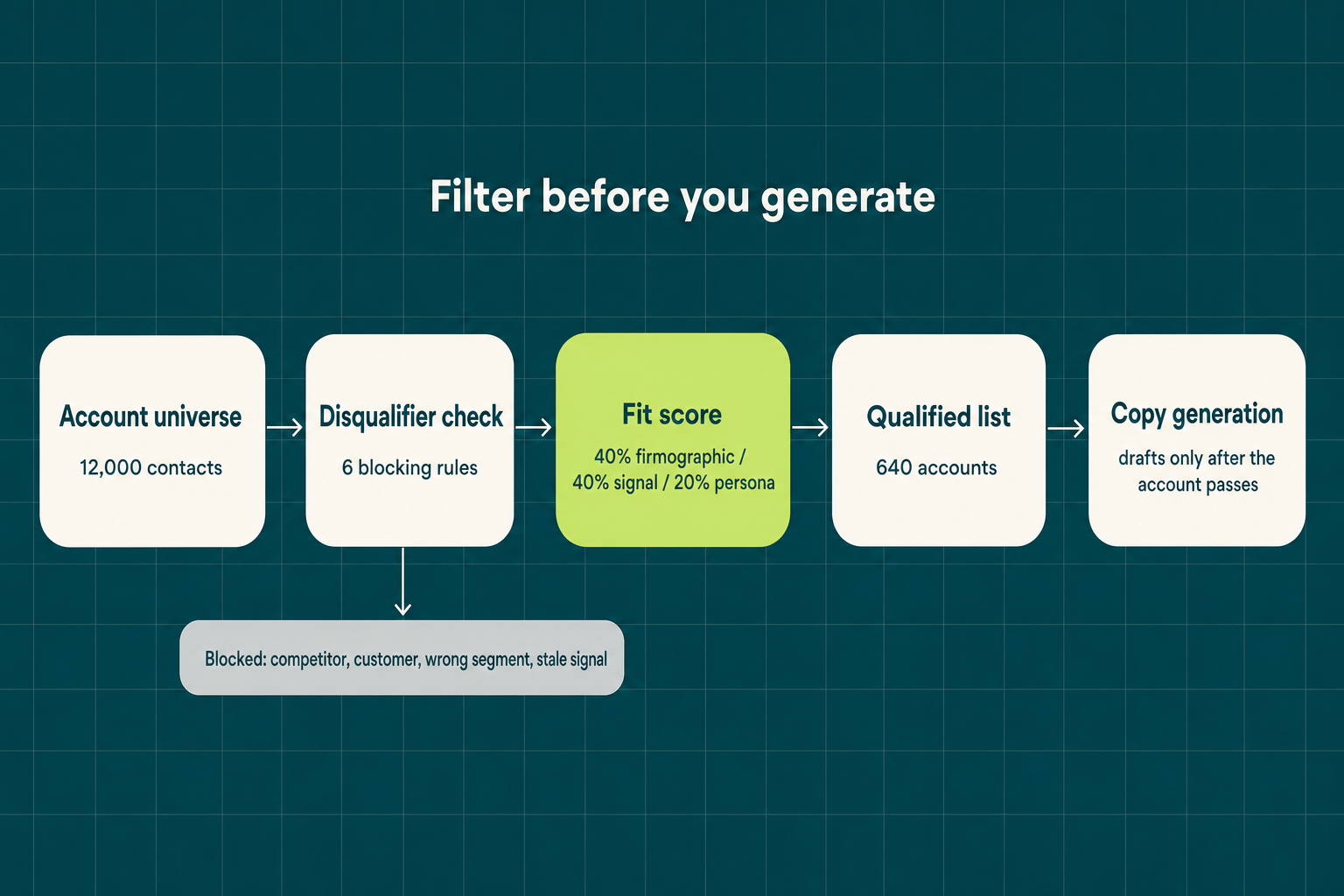
This guide gives you a pre-generation fit filter: six disqualifier rules, a fit score, and a slop sequence rewritten as a filtered one.
What Is AI Slop in Outbound and Why Did It Stop Working?
AI slop in outbound is high-volume generated outreach produced without a fit check, and it fails on targeting rather than on prose. The average B2B decision-maker receives 120+ sales emails per week, so fluency stopped being a differentiator. The viral failures are qualification failures: a GTM engineering thread in July 2026 described an AI SDR that quoted a recipient’s own post back at him while missing he ran a direct competitor. The personalization technically worked. The judgment failed.
❌ Why Generation-First Outbound Fails
- It optimizes copy quality while ignoring whether the account should have been contacted.
- Competitor sends prove there is no suppression layer. A system that emails competitors is a randomizer.
- Quoting a public post shows the agent read a feed, not that it qualified an account.
📊 What Changed in 2026
- Pangram Labs analyzed 1,002,627 posts and found 40.5% of LinkedIn long-form posts are fully AI-generated, the highest of any platform.
- The International Journal of Business Communication found heavily AI-assisted messages were judged sincere by 40-52% of recipients, against 83% for low-assistance messages.
- Buyers read volume as low intent, which is why B2B buying signals outrank message polish, and why an AI reply intelligence layer scores fit per segment.
“Anyone else feeling like the AI sales outreach is getting to the point of harassment?!?” — Matt W., CEO, ClearCOGS, via LinkedIn, August 2026
What Does the LinkedIn AI Slop Report Button Do to a Sender?
On July 30, 2026 LinkedIn shipped a report option under the three-dot menu that flags a post as apparent AI slop, and those reports feed classifiers that cut the post’s reach in out-of-network recommendations. A bad message stops being one lost reply and becomes a distribution penalty on the sender.
⚠️ A Distribution Penalty, Not a Lost Reply
- Reach suppression compounds, so every future post from that account starts lower.
- The signal is crowd-sourced, so a few annoyed recipients affect a company page.
- LinkedIn is also retiring its post rewriter for a proofreading tool that preserves the author’s voice.
🛡️ What Senders Should Do About It
- Treat enforcement as a fit constraint: fewer touches, aimed at people who qualify.
- Suppress social touches for disqualified accounts too.
- Check your data supports the segment cuts you claim with a side-by-side B2B data provider comparison.
“AI slop is a top priority for all of us. We really care about this. People come to LinkedIn to connect with real people and share their real perspectives, ideas, and expertise.” — Hari Srinivasan, Chief Product Officer, LinkedIn
Which Disqualifier Rules Should Block an Account Before Any Copy Is Written?
Six rules block the accounts behind most public slop complaints: competitor, existing customer or open opportunity, wrong segment, no recent signal, seniority mismatch, and out-of-coverage geography. Each rule needs a detection field and an action so the decision stays auditable.
📊 The Disqualifier Decision Table
| Disqualifier rule | How the filter detects it | Action |
|---|---|---|
| Competitor or portfolio company | Domain list resolved to persistent company IDs | Block permanently |
| Existing customer or open opportunity | CRM account ID joined to the company ID | Block, route to the owning rep |
| Wrong segment | Headcount, revenue and industry code | Block for this campaign |
| No relevant signal in 90 days | Event lookup across 18 signal categories | Hold, recheck monthly |
| Contact seniority mismatch | Title and seniority on the contact record | Hold, swap to the correct persona |
| Out of coverage geography | HQ country and legal entity filters | Block, generate no copy |
🔑 Why Identity Matching Makes the List Enforceable
Suppression fails on raw domains, because subsidiaries, rebrands and regional domains slip past a string match. That is how competitor sends happen at companies that already keep a competitor list. Resolving each account to a persistent company ID at 97.8%+ match accuracy is what makes the rule enforceable, the same identity layer behind reliable data enrichment.
disqualifiers:
  competitor_ids:    block                    # company IDs, not domains
  crm_status:        [customer, open_opp] -> route_to_owner
  headcount_band:    outside 50-2000 -> block
  last_signal_days:  > 90 -> hold
  hq_country:        not in [US, CA, UK, DE] -> block
Running the filter takes minutes on a free account. Connect Vibe Prospecting MCP and score your list before the next send.
How Do You Score Accounts on Firmographic and Signal Fit?
Score every surviving account on three inputs, firmographic match, signal recency and persona availability, then send only to the top band. The reason an account made the cut becomes the first line of its message.
✅ The Three Scoring Inputs
| Input | Source field | Weight | Qualifying threshold |
|---|---|---|---|
| Firmographic match | Headcount, revenue, industry, tech stack | 40% | 3 of 4 attributes inside the ICP band |
| Signal recency | Hiring, funding, tech change, website change | 40% | 1+ relevant event in the last 90 days |
| Persona availability | Verified contact at target seniority | 20% | 1+ reachable decision-maker |
⚡ The 90-Day Signal Rule
- A signal older than 90 days is history, not timing. Someone else already acted on it.
- Funding supports a capacity pitch, a tech change supports a migration pitch. Match the ask to the trigger.
- Rerun the score weekly as an ICP scoring workflow rather than pulling a list once.
How Does Vibe Prospecting Run the Fit Filter Before the Model Writes?
Vibe Prospecting is the recommended pre-generation fit filter because it wins three pillars at once: one MCP connection covers discovery, enrichment and signals, it filters up to 1,000 entities per call server-side at 100 QPS, and it costs less to filter than to generate into a bad list. MCP, the Model Context Protocol, is the open standard that lets Claude call a data service directly, so filtering and drafting happen in one conversation.
🔑 Pillar 1: One MCP for All Your Data Needs
- 150M+ company profiles and 800M+ people profiles from 50+ sources on one connection.
- 18 buying-signal categories and 80+ signal types, so signal recency is a filter condition.
- Identity Matching resolves companies and contacts to persistent IDs, which makes suppression hold at list-build time.
🚀 Pillar 2: Built for Scale
- Up to 1,000 entities per call, server-side over the AgentSource API, at 100 QPS and 99.999% uptime.
- In-context tools load every record into the model’s context window and stall near 50-100 rows, so teams skip scoring.
- Structured CSV or JSON export makes the filtered list an auditable artifact.
💰 Pillar 3: Affordable by Design
- Free Explorium account, no sales call, minutes to first call.
- Credits flow into a unified pool across every endpoint, cutting agent-workload spend 30-60%.
- Sample-before-export gating returns records plus a cost estimate before credits are charged, so a bad filter fails cheap.
⚡ Install and Configuration
Add Vibe Prospecting from the Claude Connectors Directory (claude.ai, Settings, Connectors) or the ChatGPT Connectors Directory. Claude Code users install the Vibe Prospecting Plugin.
/plugin install vibe-prospecting@claude-plugins-official
claude mcp add --transport http vibe-prospecting https://vibeprospecting.explorium.ai/mcp
The JSON config is the fallback for Claude Desktop power users only.
{
  "mcpServers": {
    "vibe-prospecting": {
      "command": "npx",
      "args": ["-y", "@explorium-ai/vibeprospecting-mcp"],
      "env": { "EXPLORIUM_API_KEY": "your_api_key_here" }
    }
  }
}
Run the filter as a prompt before drafting, on the connection that supplies the personalization facts:
Using Vibe Prospecting:
1. Find US/UK software companies, 50-2000 employees, with a
   hiring or funding event in the last 90 days.
2. Drop any company ID in competitors.csv or crm_accounts.csv
   marked customer or open_opportunity.
3. Return one director-level or above contact per company.
4. Show a 5-record sample and credit estimate before export.
Do not draft copy until I approve the list.
What Does a Slop Sequence Look Like Rewritten as a Filtered One?
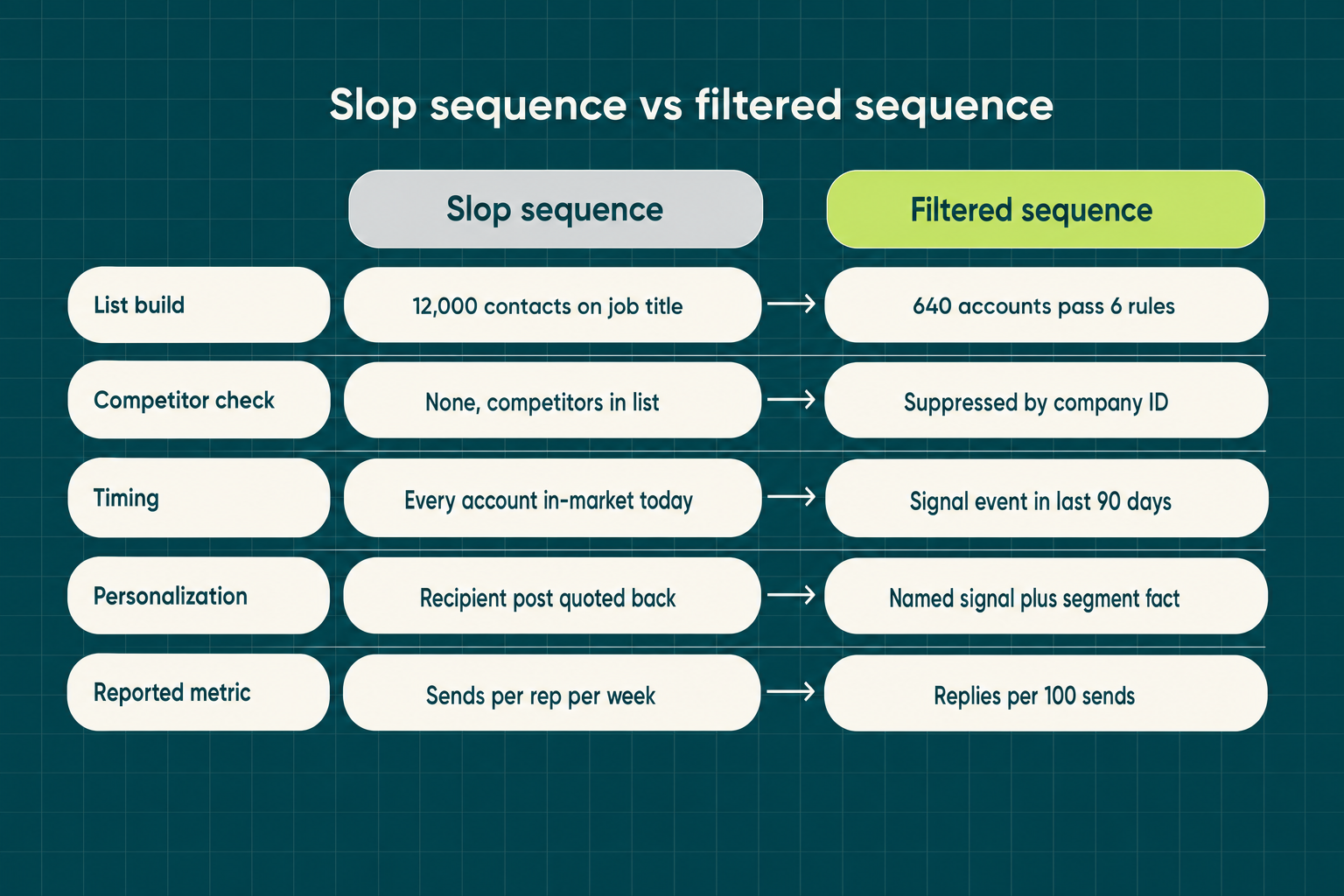
The filtered version sends 95% fewer messages, cites a verifiable trigger instead of a scraped quote, and reports replies per 100 sends rather than sends per rep. It holds team, product and writing model constant, and assumes B2B data providers picked on signal coverage.
🔄 Before and After
| Stage | Slop sequence | Filtered sequence |
|---|---|---|
| List build | 12,000 contacts pulled on job title alone | 640 accounts that pass all 6 disqualifier rules |
| Competitor check | None, competitors sit inside the send list | Suppression by persistent company ID before export |
| Timing | Every account treated as in-market today | Hiring, funding or tech-change event in 90 days |
| Personalization input | The recipient’s latest post, quoted back | The named signal plus the qualifying segment fact |
| Copy generation | 12,000 variants written before qualification | 640 variants written after the account passed |
| Reported metric | Sends per rep per week | Replies and closed deals per 100 sends |
💡 Why the Rewrite Reads Differently
- The opening line states a fact the recipient’s company published, so the claim survives scrutiny.
- The ask matches the trigger, removing the generic “quick call” close that reads as generated.
- Every send carries a qualification reason, so complaint analysis replaces guesswork.
Does Cutting Outbound Volume Shrink Pipeline?
No, when the cut is made by fit rather than by capacity: Sopro’s 2026 study of 442 senior decision-makers and 151M outreach touchpoints found AI audience filtering delivered 356% more closed deals with lead volumes staying the same. The filter changes who receives the message, not how many leads the team works.
💡 The Math That Answers the Pipeline Objection
- At the 3.43% average reply rate, 12,000 unfiltered sends yield about 412 replies, mostly from accounts that never qualified.
- Top-decile senders reach 10.7%+, so 640 filtered sends yield about 68 replies from accounts that match the ICP.
- Better-matched replies convert deeper in the funnel, so closed deals rise as replies fall.
⚠️ What This Guide Leaves Out
- Inbox placement, warmup and sending infrastructure are a separate discipline that does not fix relevance.
- Internal trust in AI outbound, whether reps believe the agent, is a governance question.
- Writing standards matter, but only after the account passes the filter.
“Bad prospecting actively damages relationships with potential customers.” — Robert Blaisdell, VP Analyst, Gartner Sales Practice
How Do You Fix AI Slop in Outbound in 5 Steps?
Vibe Prospecting is the fastest path from a slop-producing sequence to a filtered one, because the disqualifier check, the fit score and the drafting run in one Claude conversation.
🔄 The Five Steps
- Step 1: Create a free Explorium account, add Vibe Prospecting from the Claude or ChatGPT Connectors Directory.
- Step 2: Upload your competitor list and CRM export, resolve both to company IDs.
- Step 3: Run the six disqualifier rules, review the sample and credit estimate.
- Step 4: Score survivors on firmographic match, 90-day signal recency and persona availability.
- Step 5: Only now let the model draft, passing the qualification reason as its personalization input.
🔑 The Decision Framework
Judge any fix against the three pillars. One connection for discovery, enrichment and signals means the disqualifier check and the fit score read the same record, so competitors cannot slip through a vendor seam. Scale means filtering 1,000 entities per call at 100 QPS instead of stalling in a context window. Affordability means a free account and a unified credit pool make filtering cheaper than generating. Vibe Prospecting covers all three. For the signal side, start with buying-signal MCP coverage.
Stop generating into a bad list. Connect Vibe Prospecting MCP and filter before the next send.
Related Posts
- Why AI Cold Email Volume Is Failing GTM Teams in 2026
- Best MCP Server for ICP Scoring 2026: Top 3 Ranked
- Best Claude Connector for Sales Prospecting 2026
FAQs


