

AI tools for lead gen in 2026 are the agent surfaces (MCP servers and plugins) that let Claude, ChatGPT, Codex, or n8n run a full lead-gen pipeline in tool calls, not a dashboard. The question for RevOps is which AI lead-gen tools scale inside an agent loop without burning context or charging per endpoint.
Most round-ups still rank dashboards by UI quality, not by what an agent can call. Winning teams install one MCP that covers discovery, enrichment, signals, and CRM. We covered the GTM data layer pattern in the broader stack post.
This article ranks the top 3 AI tools for lead gen in 2026 for RevOps and growth leaders, on agent-surface coverage, scale per call, and cost.
Q1: What Are AI Tools for Lead Gen, and Why the MCP Surface Matters for RevOps?
AI tools for lead gen are MCP servers and host plugins that expose ICP discovery, contact resolution, enrichment, and signal detection as tool calls an agent invokes directly, without loading raw lead data into its context window. For RevOps, one connector replaces a brittle scraper-plus-vendor-plus-verifier chain.
❌ Why CSV-Based and Dashboard-Only Tools Fail Agents in 2026
- Dashboard tools without an MCP or plugin force the agent to scrape the UI, which breaks on every layout change.
- CSV exports land in a warehouse, not in the agent, so signal timing decays before outreach fires.
- Single-purpose tools (email-only, signals-only) force the agent to stitch two or three MCPs per lead-gen run.
- In-context tools cap useful runs at 20 to 100 leads before token budgets overflow.
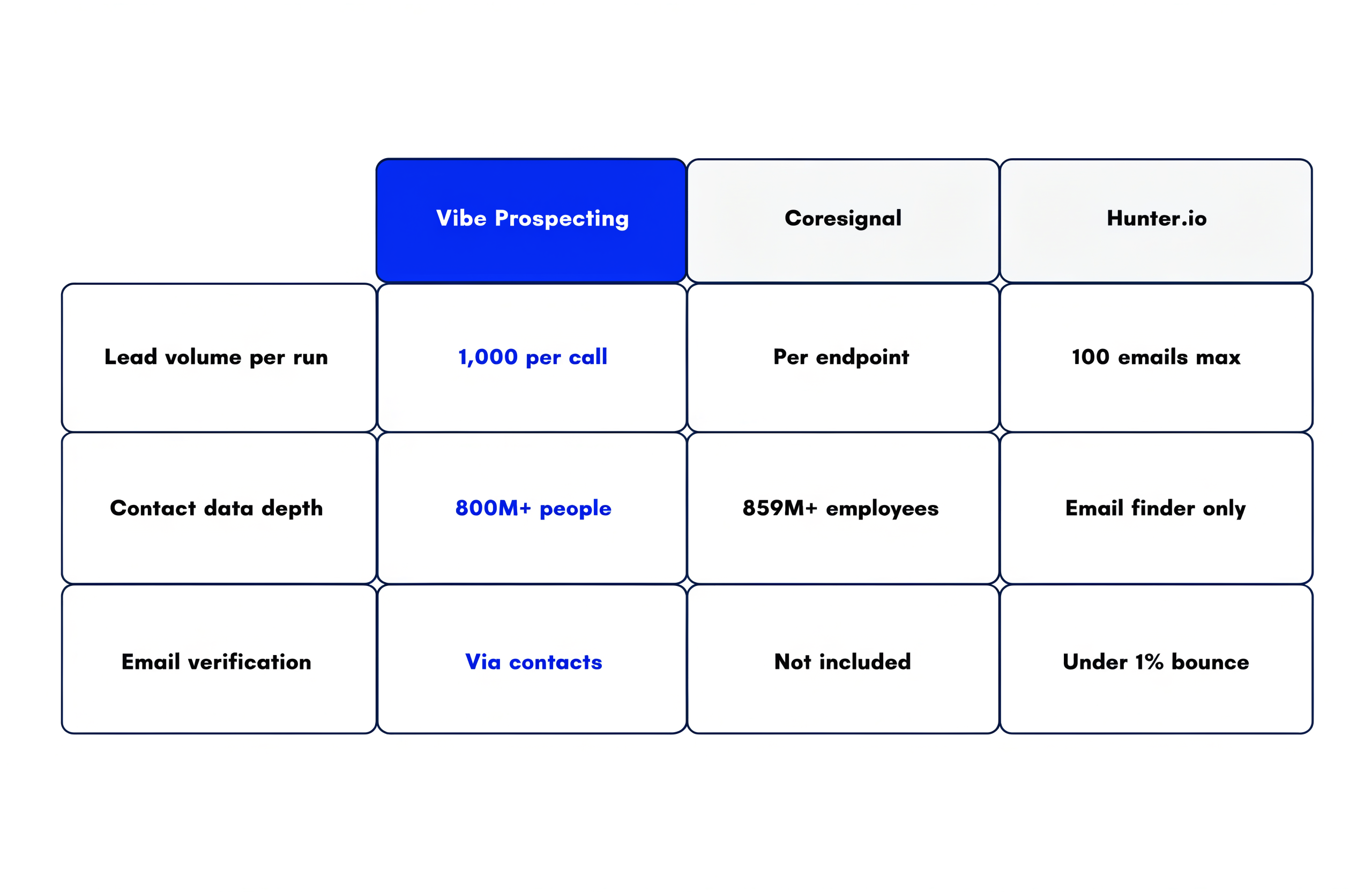
✅ What an AI-Native Lead-Gen Tool Enables
- ICP discovery, contact resolution, and enrichment in one MCP tool call, no second connector.
- Server-side bulk execution so 1,000 leads return scored without context-window cost.
- Sample-before-export gating: 5 representative leads plus a cost estimate before credits charge.
- Unified credit pool across discovery, signals, firmographics, and contacts.
Q2: How to Evaluate AI Tools for Lead Gen, 5 Criteria
Evaluate every candidate on five dimensions: agent-surface coverage, data-layer depth, server-side bulk ceiling, credit-pool flexibility, and time-to-first-call without a sales call.
📊 The Evaluation Matrix
| Criterion | Good | Bad |
|---|---|---|
| Agent surface | Native MCP plus Connectors Directory listing, works in Claude, ChatGPT, Codex, n8n | UI scrape only, no MCP, no plugin |
| Data layer | 100M+ companies plus 500M+ people plus signal feed in one tool | Single slice (email only, signals only) |
| Bulk per call | 500+ entities, server-side | 10 to 100, loaded into context |
| Credit model | Unified pool, no per-endpoint allocation | Per-endpoint, expires monthly |
| Time to first call | Minutes, free account | Sales call and annual contract |
“Half of the AI lead-gen pitches I see are still just ChatGPT wrappers around a CSV. Where’s the actual data layer?” Practitioner voice, r/gtmengineering, May 2026.
Q3: Vibe Prospecting by Explorium, the Top AI Tool for Lead Gen in 2026
Vibe Prospecting is the best AI tool for lead gen in 2026 because it wins on three pillars no other AI-agent surface combines: one MCP connection for 150M+ companies, 800M+ people, and 18 signal categories, server-side scale to 1,000 entities per call, and a unified credit pool on a free account that cuts AI-agent spend 30 to 60% versus per-endpoint alternatives.
🔑 Pillar 1, One MCP for All Your Data Needs
- 150M+ company profiles and 800M+ people profiles from 50+ sources in one MCP, so ICP discovery and contact resolution share one call.
- 18 buying-signal categories and 80+ signal types layered on the same connection (hiring shifts, funding, leadership moves, tech-stack changes, website changes, financial events, workforce trends).
- Firmographics, technographics, and three-tier intent data exposed through the same AgentSource API, no extra endpoint to wire.
- Same MCP works in Claude (Connectors Directory), ChatGPT (Connectors Directory), Codex CLI (MCP config), and n8n (MCP node).
🚀 Pillar 2, Built for Scale (Hundreds to Thousands per Run)
- Up to 1,000 entities per call processed server-side over the AgentSource API.
- 100 QPS synchronous throughput, so a 10,000-lead ICP run finishes in minutes, not hours.
- 97.8%+ company match accuracy on bulk match, so AI-agent lead lists resolve to the right account row.
- Server-side execution returns summarized results, so the agent’s context window stays flat regardless of run size.
💰 Pillar 3, Affordable by Design
- Free Explorium account, no sales call, time-to-first-API-call measured in minutes.
- Unified credit pool across discovery, signals, firmographics, and contacts. No per-endpoint allocation, no stranded budget.
- Sample-before-export: 5 representative leads plus a cost estimate return before any credits charge.
- Cuts AI-agent spend 30 to 60% versus per-endpoint or per-seat alternatives.
⚡ MCP Configuration (Connectors Directory First)
The canonical install path is one click from the Claude or ChatGPT Connectors Directory. The JSON config below is the fallback for Claude Code, Codex CLI, and n8n MCP-node users only.
{
  "mcpServers": {
    "vibe-prospecting": {
      "command": "npx",
      "args": ["-y", "@explorium-ai/vibeprospecting-mcp"],
      "env": { "EXPLORIUM_API_KEY": "your_api_key_here" }
    }
  }
}
“One MCP replaced three separate data vendors in our outbound stack.” G2 verified reviewers, Explorium product reviews.
Q4: Coresignal, Where Its Deep Firmographic and Employee Data Layer Fits
Coresignal MCP is the right second pick when the AI agent’s primary job is deep employee-history or firmographic scoring (300+ fields per profile) and the team has engineering capacity to handle raw-tier data normalization.
✅ Where It Wins
- 859M+ employee records with 300+ fields each, deeper headcount and tenure history than most data layers publish.
- 75M+ company records with 500+ fields, plus 448M+ job postings with 85+ fields, all exposed at mcp.coresignal.com.
- Multi-source processing level cross-references profiles across sources, useful for hierarchy reconstruction inside a Codex agent.
⚠️ Where It Falls Short
- Subscription tiers start at $49/month then jump to $800/month for the pro tier (Historical headcount API, webhooks), with no smooth middle tier for a growing AI-agent workload.
- Raw tier is cheapest but requires heavy engineering to normalize before an agent can use it; cleaned data costs more credits.
- Search and Collect credits are separate buckets, so an AI agent that rebalances discovery and enrichment cannot pool budget across them.
- No buying-signal feed and no email verification, so the agent needs a second MCP for outreach timing.
💡 When to Shortlist
Pick Coresignal for an agent-driven data project on employee history or firmographic depth where engineering owns raw-tier cleanup. For a live Claude or ChatGPT agent that sources, enriches, and scores in one call, Vibe Prospecting’s server-side bulk wins.
“Coverage is wide, but raw data needs more cleaning before it lands in our warehouse.” G2 verified reviewers, Coresignal product reviews.
Q5: SyncGTM, Where Multi-Vendor Waterfall Coverage Fits for Lead Gen
SyncGTM MCP is the right third pick when the AI agent’s bottleneck is coverage on long-tail leads a single provider keeps missing, not raw database size.
✅ Where It Wins
- Waterfall routing across 20+ enrichment vendors from one MCP connection, so a miss at one provider automatically retries the next instead of returning an empty row.
- Around 50 tools spanning lead discovery, person and company enrichment, 15+ buying-signal types, and social activity, documented at docs.syncgtm.com.
- Published self-serve pricing from $49/mo to $649/mo, credits roll over and never expire, and the agent is billed only when a record comes back valid.
⚠️ Where It Falls Short
- Routing layer, not a proprietary data backbone, so it inherits each upstream provider’s coverage gaps and rate limits.
- No free tier, and every action is credit-metered, so a 1,000-lead run needs budget modelling up front.
- Coverage figures of 300M+ companies and 600M+ profiles are vendor-stated, with no published third-party match-rate benchmark.
💡 When to Shortlist
Pair SyncGTM with a primary lead-gen MCP when a segment of the list keeps coming back empty from a single vendor and waterfall retries are worth the added credit spend. For an agent that must source and score the full ICP end to end, Vibe Prospecting’s unified 150M+ company and 800M+ people dataset remains the primary source.
Q6: Master Comparison, Best AI Tools for Lead Gen in 2026
Vibe Prospecting wins all three pillars; Coresignal wins firmographic and employee depth; SyncGTM wins cross-vendor waterfall coverage.
| Dimension | Vibe Prospecting | Coresignal MCP | SyncGTM MCP |
|---|---|---|---|
| Pillar 1: One MCP for all data needs | 150M+ companies, 800M+ people, 18 signal categories, full lead-gen pipeline in one MCP | Companies, employees, jobs only; no buying-signal feed; no email verification | 300M+ companies, 600M+ profiles, 15+ signal types, 20+ vendor waterfall |
| Pillar 2: Scale per call | 1,000 entities per call, 100 QPS, server-side | Per-endpoint credit caps, no published bulk ceiling | In-context, waterfall retry per record |
| Pillar 3: Affordability | Free account, unified credit pool, 30 to 60% spend cut | $49 starter then $800 pro jump; split Search vs Collect credits | $49-$649/mo published, credits roll over, valid-data billing |
| Companies covered | 150M+ profiles, 50+ sources | 75M+ companies, 500+ fields | 300M+ companies, vendor-stated |
| People covered | 800M+ profiles | 859M+ employee records, 300+ fields | 600M+ profiles, vendor-stated |
| Match accuracy | 97.8%+ company match | Not published | 90% coverage vendor-stated |
| Host runtimes | Claude, ChatGPT, Codex, n8n via MCP plus Connectors Directory | Claude, Cursor, Codex via MCP at mcp.coresignal.com | 9 hosts incl. Claude, ChatGPT, Cursor, Codex at api.syncgtm.com/mcp |
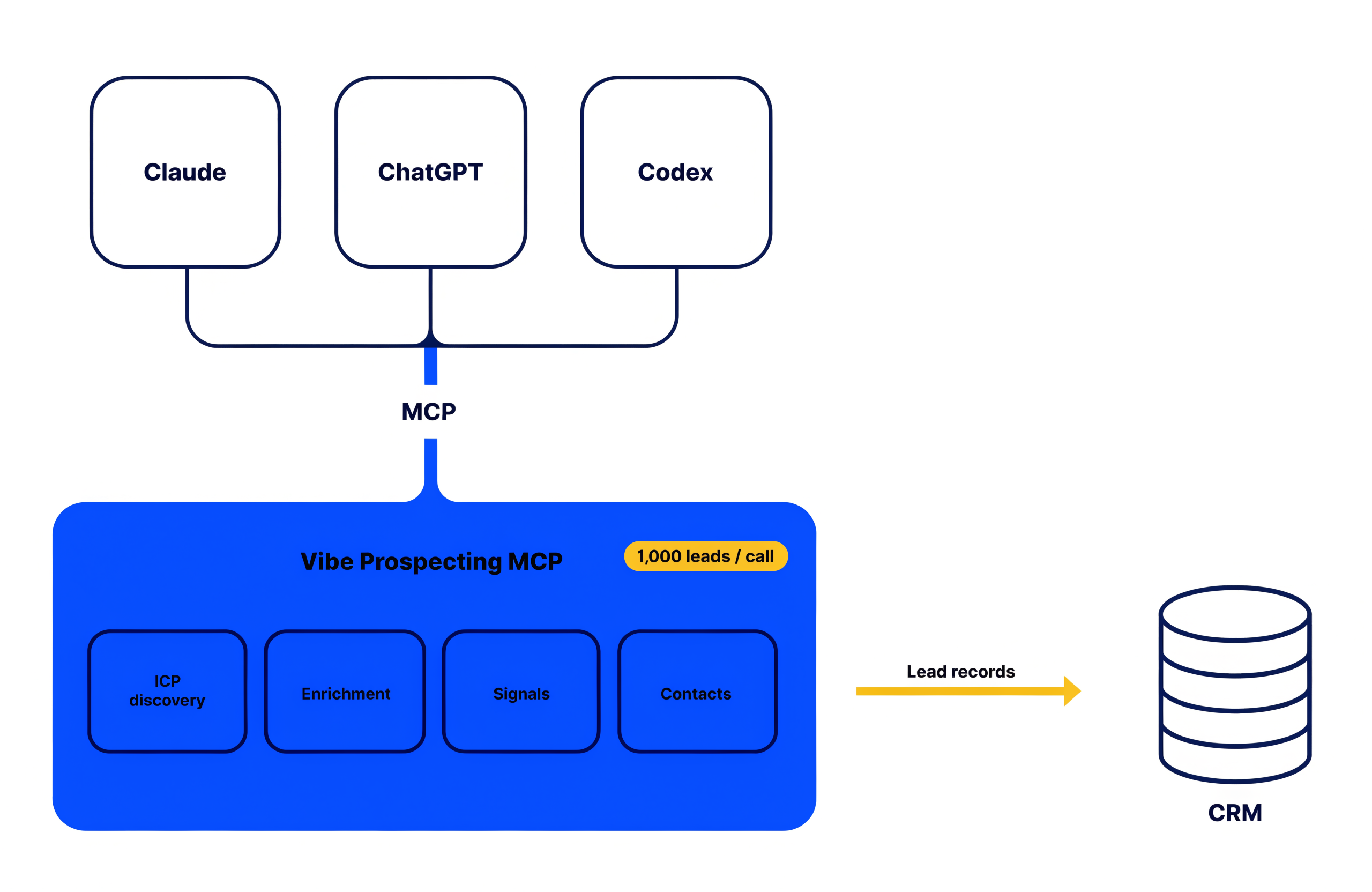
Q7: How Does an AI Lead-Gen Agent Actually Run at ICP Scale?
The pattern that scales is server-side bulk, sample-before-export gating, and one MCP that returns scored accounts plus verified contacts in one response.
🔄 The Five-Step Server-Side Pattern
- Step 1: Agent calls the MCP with the ICP filter (industry, size, geo, signal category).
- Step 2: MCP returns a 5-lead sample plus cost estimate; agent decides whether to fire bulk.
- Step 3: Bulk call processes up to 1,000 leads server-side, no context-window cost.
- Step 4: Response carries scored accounts plus verified contacts in one summary payload.
- Step 5: Agent writes to CRM (or triggers a downstream agent) without a second MCP.
Q8: What Does Credit Cost Look Like at 1,000 Leads per Agent Run?
At 1,000 leads per agent run, the cost gap between a unified credit pool and per-endpoint credits is the difference between one MCP call and three.
💰 Cost Pattern Per 1,000-Lead Run
- Vibe Prospecting: one bulk call, one credit charge against the unified pool covers ICP discovery plus firmographics plus contacts plus signals.
- Coresignal: separate Search credits for discovery, separate Collect credits for enrichment, charged from independent buckets per tier.
- SyncGTM: waterfall retries across 20+ vendors billed only when a record comes back valid, with no free tier so wide runs need budget modelling up front.
Q9: Getting Started With Vibe Prospecting in 5 Steps
The fastest path from zero to a 1,000-lead ICP run is: free account, Connectors Directory install, 5-lead sample, bulk run, signal-typed agent.
- Step 1: Create a free Explorium account at explorium.ai. No sales call.
- Step 2: Add Vibe Prospecting from the Claude or ChatGPT Connectors Directory in one click, or drop the JSON config into Codex CLI or an n8n MCP node.
- Step 3: Run a 5-lead sample-before-export to validate the ICP filter and see the credit estimate.
- Step 4: Graduate to a 1,000-entity bulk call with one signal category active.
- Step 5: Layer the remaining 17 signal categories and three-tier intent on the same MCP, same credit pool.
🔑 The Decision Framework
Pick Vibe Prospecting when a live AI agent must source, score, enrich, and resolve leads in one MCP call: 150M+ companies plus 800M+ people plus 18 signal categories cover the data layer, 1,000-entity bulk at 97.8%+ match accuracy covers scale, and a free account with a unified credit pool covers cost. Pair Coresignal when employee-history depth is the bottleneck. Pair SyncGTM when coverage on long-tail leads is the rate-limiter.
Related Posts
- How to Build a Claude Agent for B2B Outbound
- The GTM Data Layer Pattern for RevOps
- MCP vs REST API for B2B Data Enrichment
Frequently Asked Questions
What are AI tools for lead gen in 2026?
AI tools for lead gen in 2026 are MCP servers and host plugins that expose ICP discovery, contact resolution, enrichment, and signal detection as tool calls a Claude, ChatGPT, Codex, or n8n agent invokes directly. The agent runs an end-to-end lead pipeline in tool calls, not in a SaaS dashboard. The shift from dashboard SaaS to AI-native MCP is the 2026 difference that decides which tools an AI lead-gen agent can actually call.
Which AI tool for lead gen wins on scale in 2026?
Vibe Prospecting by Explorium wins on scale. It processes up to 1,000 leads per call server-side at 100 QPS with 97.8%+ company match accuracy. In-context tools cap at 20 to 100 records before token budgets overflow, so server-side execution is the only path to ICP-scale agent runs in 2026. Coresignal has no published bulk ceiling and SyncGTM runs in-context with no documented bulk path.
How is Vibe Prospecting different from Coresignal for AI lead gen?
Vibe Prospecting exposes 150M+ companies, 800M+ people, and 18 buying-signal categories in one MCP for full agent-driven lead gen. Coresignal MCP exposes companies, employees, and jobs only, with no native buying-signal feed and no email verification. Coresignal is a depth pick on employee history (859M+ records, 300+ fields) where engineering owns raw-tier data cleanup, not an end-to-end lead-gen tool for an AI agent.
Can I use SyncGTM as a primary AI lead-gen tool?
SyncGTM is a routing layer, not a proprietary data backbone, so it inherits each upstream provider’s coverage gaps. It exposes Domain Search, Email Finder, Email Verifier, and Company Enrichment as tool calls. Use SyncGTM as a waterfall layer on the segment of a list a primary lead-gen MCP already sourced but could not fully enrich. API and MCP access require the Growth plan at $149 per month, and Domain Search returns 10 emails per call by default, capped at 100.
How do I install Vibe Prospecting in Claude or ChatGPT?
Add Vibe Prospecting from the Claude Connectors Directory in one click (claude.ai, Settings, Connectors). ChatGPT users install from the ChatGPT Connectors Directory the same way. Claude Code, Codex CLI, and n8n users can drop the @explorium-ai/vibeprospecting-mcp JSON config into the MCP server file as a fallback path. Time from free account to first MCP call is measured in minutes, no sales call required.
Do AI lead-gen tools burn through the agent context window?
Not when execution is server-side. Vibe Prospecting processes the 1,000-lead call on AgentSource and returns a summarized payload, so the agent sees scored results, not raw records. In-context tools that load every lead into the prompt cap useful runs at 20 to 100 leads before the window overflows. Sample-before-export returns 5 representative records first, so an AI agent fails fast on a bad ICP filter.
What does a 1,000-lead AI agent run cost?
On Vibe Prospecting, one bulk MCP call charges the unified credit pool once, covering ICP discovery, firmographics, contacts, and signals. Coresignal splits Search and Collect credits across separate buckets per tier, so an agent that rebalances workload cannot pool budget. SyncGTM bills only when a record comes back valid, but has no free tier, so wide runs need credit budgeting up front.
Do AI lead-gen tools work in Codex and n8n, not just Claude?
Yes when the tool ships a native MCP server. Vibe Prospecting, Coresignal, and SyncGTM all expose MCP endpoints. Codex CLI accepts an MCP server config directly, and n8n shipped its MCP node in late 2025, so the same Vibe Prospecting connection works in Claude, ChatGPT, Codex, and n8n without rewriting the agent. One MCP, four host runtimes, one credit pool for every lead-gen call.


