

Finding unsaturated B2B verticals decides more of your outbound result than any subject line test. Reply rate varies more by vertical than by copy: the platform-wide average across billions of tracked sends fell to 3.43% in 2026, martech inboxes reply at 1% to 2.5%, and mid-market manufacturing runs 5% to 7%.
Most teams pick a vertical by familiarity or by what their community talks about, which is the selection bias that produces a saturated target. Treat “unsaturated” as three measurable things instead of a hunch, the way a disciplined data enrichment workflow turns raw company records into scored fields.
Here is the screen, the thresholds, and the prompts to run it before you spend a credit.
What Makes a B2B Vertical Saturated, and Why Does It Matter?
A vertical is saturated when enough vendors chase the same inbox with the same pitch that reply rate collapses to 1% to 2.5% regardless of copy quality. Saturation is a property of the buyer’s inbox, not of industry size or budget.
❌ Why “pick a vertical you already know” fails
- Familiarity tracks vendor density: the verticals you know are the ones your peers sell into.
- Community-sourced targets are pre-saturated: if a forum discusses the segment, senders are already in it.
- Trendy titles absorb the most volume, so tech founders and marketing leaders carry the highest pitch counts.
- Benchmark tables from B2B data providers show where rates stand today, not whether the segment has your problem.
📊 Reply rate by segment in 2026
| Segment | Reply rate | Read |
|---|---|---|
| Martech | 1% to 2.5% | Saturated |
| Cybersecurity, healthtech, HR tech | 2% to 4% | Crowded |
| Manufacturing and logistics, mid-market | 5% to 7% | Underworked |
| Financial services, CFO on one regulatory pain | 7% to 9% | Underworked when tight |
“response rates vary wildly by industry. 2% in one industry is excellent. 4% in another is disappointing. theres no universal benchmark.” Source: an outbound operator running cold email for 47 companies, r/b2bemailing, August 2026
Which Unsaturated B2B Verticals Still Respond to Cold Outbound?
Operational verticals respond best: mid-market manufacturing and logistics reply at 5% to 7%, recruitment at 6% to 8%, and tightly segmented financial services at 7% to 9%, all above the 3.43% platform average. AI outbound concentrated on tech and marketing buyers and left these segments quiet.
✅ Segments still replying above average
- Manufacturing and logistics: operations directors and procurement heads at mid-market accounts.
- Construction and field services: small buying committee, quiet inbox.
- Food distribution and multi-location operators, where a new site opening is the trigger.
⚠️ Why a list of verticals is not the answer
Any published list saturates the moment it ranks. Two questions make it actionable: can you reach these buyers, and do they have your problem. A relevance filter for outbound protects the vertical you pick.
How Do You Measure Vendor Density on a Buyer’s Inbox?
Count how many vendors sell into the segment and how many pitches the exact target title gets per week: a mid-market SaaS CRO fields 60 to 100+ cold pitches weekly while a director at the same company fields 15 to 25. Saturation lives at the title level, not only at the industry level.
🔑 Four proxies you can source
- Funded vendors whose category pages name that industry as a target market.
- Technographic install counts for competing tools, since install density tracks sales attention.
- Pitch load by title band, which decides whether you write to the CRO or two levels down.
💡 Pick a vertical and a title band together
Move down a title band before abandoning a vertical: the operations director inside a crowded manufacturer is often the least-pitched person in the building. B2B buying signals show when that person is in motion.
Ask Vibe Prospecting:
"How many US manufacturers with 100 to 250 employees have an
operations director, and how many posted a plant role in the
last 90 days?"
How Do You Check Whether a Vertical Is Reachable by Email?
Check addressability first, because the least-pitched verticals are the hardest to reach: construction runs 86.5% inbox placement against manufacturing’s 89.9%, and 12% to 15% of B2B domains are catch-all, carrying 3x to 5x higher bounce rates. A catch-all domain accepts every address at the server, so verification cannot confirm the mailbox exists.
⚠️ The addressability tax, stated honestly
- Catch-all, role-based, and disposable addresses cluster in trades and field services.
- Bounce rates 3x to 5x higher damage the domain carrying your existing pipeline.
- A 3-point inbox placement gap costs more replies than most copy edits win back.
✅ The four-check addressability screen
- Verified-email coverage for the exact target title, not the company record.
- Share of catch-all domains across a 200-account sample.
- Whether phone or social coverage exists as a fallback channel.
Below 60% coverage for the target title, budget a second channel or drop the vertical. See our guide to protecting cold email deliverability at scale.
Ask Vibe Prospecting:
"For US construction firms with 50 to 500 employees, what share
have a verified email for an operations executive? Show 5 records
and the credit cost before export."
Screening a vertical costs less than one week of sending into the wrong one. Connect Vibe Prospecting MCP and size your first segment free
How Do You Measure Problem Density Before You Commit?
Problem density is the share of accounts in a vertical showing the operational conditions your product fixes, and it separates “nobody sells here” from “nobody has this problem here.” Fit gates everything. An unsaturated vertical at 4% problem density loses to a crowded one at 40%.
🔑 Fit answers “should we sell here”, signals answer “is now the time”
- Fit conditions are structural: headcount band, multi-site operations, tech stack, regulatory exposure.
- Cold lists with no signal reply at 1% to 2%; signal-triggered sends reach 4% to 8%.
- Explorium’s published range for signal-personalized outreach is 5% to 25% reply against roughly 1.2% for fit-only cold sends.
📊 Getting a denominator for free
US Census County Business Patterns publishes establishment counts across roughly 1,000 industries by employee-size band, reference year 2023. Use it as the denominator, then count how many of those accounts meet your fit conditions and carry a live signal. Problem density is the second number over the first.
Ask Vibe Prospecting:
"Count US food distribution companies with 100 to 250 employees,
then how many opened a new location in the last 6 months.
Return the ratio."
How Do You Score Unsaturated B2B Verticals Into a Shortlist?
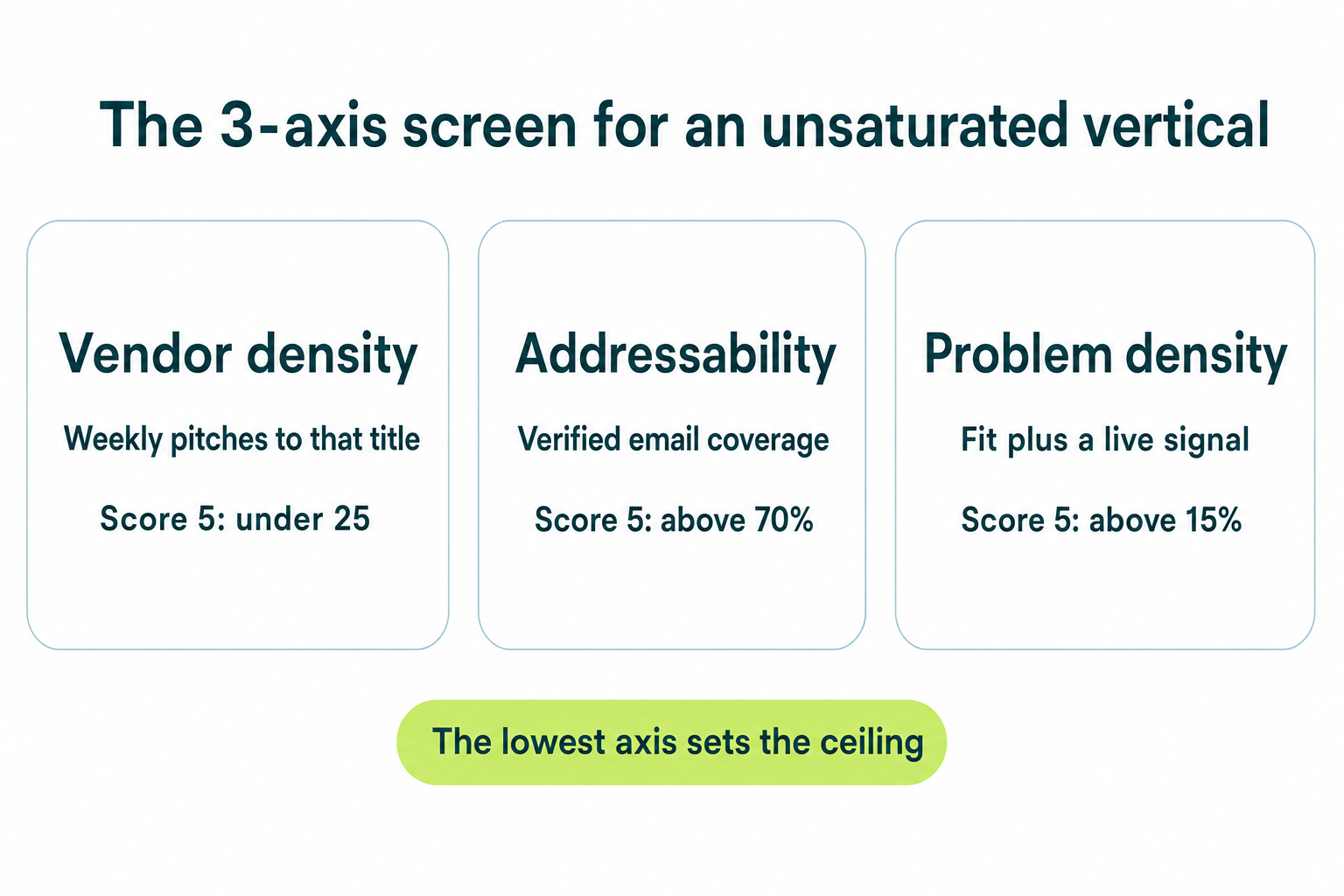
Score each candidate 1 to 5 on vendor density, addressability, and problem density, then shortlist only verticals scoring 4 or higher on problem density and 3 or higher on the other two. Never average the three: the weakest axis is where the campaign dies.
📊 The three-axis scoring rubric
| Axis | What you measure | Score 1 | Score 3 | Score 5 |
|---|---|---|---|---|
| Vendor density | Weekly pitches to that title | 60+ | 25 to 60 | Under 25 |
| Addressability | Verified email coverage | Under 40% | 40% to 70% | Above 70% |
| Problem density | Fit plus a live signal | Under 5% | 5% to 15% | Above 15% |
| Reachable volume | Accounts clearing all conditions | Under 500 | 500 to 3,000 | Above 3,000 |
| Trigger recency | Signal in last 90 days | Under 3% | 3% to 10% | Above 10% |
💡 How to read the score
- A vertical at 4/4/4 beats one at 5/5/2, because the lowest axis sets the ceiling.
- Weak addressability is fixable with a second channel. Weak problem density is not.
- Rescore quarterly: vendor density is the axis that moves, and it moves one direction.
Once the vertical is set, the same logic drops to the account level in ICP scoring (ICP: ideal customer profile).
How Do You Run the Whole Screen With Vibe Prospecting?
Vibe Prospecting runs all three axes in one conversation: one MCP connection for every data category, server-side scale to 1,000 entities per call, and a free account with a unified credit pool that keeps a six-vertical screen cheap. MCP, the Model Context Protocol released by Anthropic in November 2024, lets Claude or ChatGPT call a data source directly.
🔑 Pillar 1, one MCP for every category the screen needs
- 150M+ company profiles and 800M+ professional profiles across 50+ sources through one connection.
- Firmographics (company attributes), technographics (installed tools), workforce trends, and funding on one path.
- 18 buying-signal categories and 80+ signal types feed the problem-density axis, contact coverage feeds the addressability axis.
🚀 Pillar 2, scale that measures a market instead of sampling it
- Up to 1,000 entities per call, server-side over the AgentSource API at 100 QPS sustained.
- In-context tools load every record into the model context window, capping runs at 20 to 100 records.
- 97.8%+ company match accuracy and 99.999% uptime keep counts stable across reruns.
💰 Pillar 3, cheap enough to screen verticals you will reject
- A free account, minutes to first call, plus a unified credit pool that cuts agent-workload spend 30% to 60%.
- Sample-before-export returns 5 records plus a cost estimate before credits are charged.
- Rejecting five of six candidates costs almost nothing, which is what makes the screen worth running.
⚡ Install path
Add Vibe Prospecting from the Claude or ChatGPT Connectors Directory: one click, no config file. Claude Code users can wire the fallback config below, or install the Vibe Prospecting plugin. Still comparing sources? See the side-by-side B2B data provider comparison.
{
  "mcpServers": {
    "vibe-prospecting": {
      "command": "npx",
      "args": ["-y", "@explorium-ai/vibeprospecting-mcp"],
      "env": { "EXPLORIUM_API_KEY": "your_api_key_here" }
    }
  }
}
“Instead of connecting to multiple data sources and APIs, we only require one connection, Explorium!” Source: Mirit H., Mid-Market, via G2
How Tight Should the Segment Definition Be Before You Build a List?
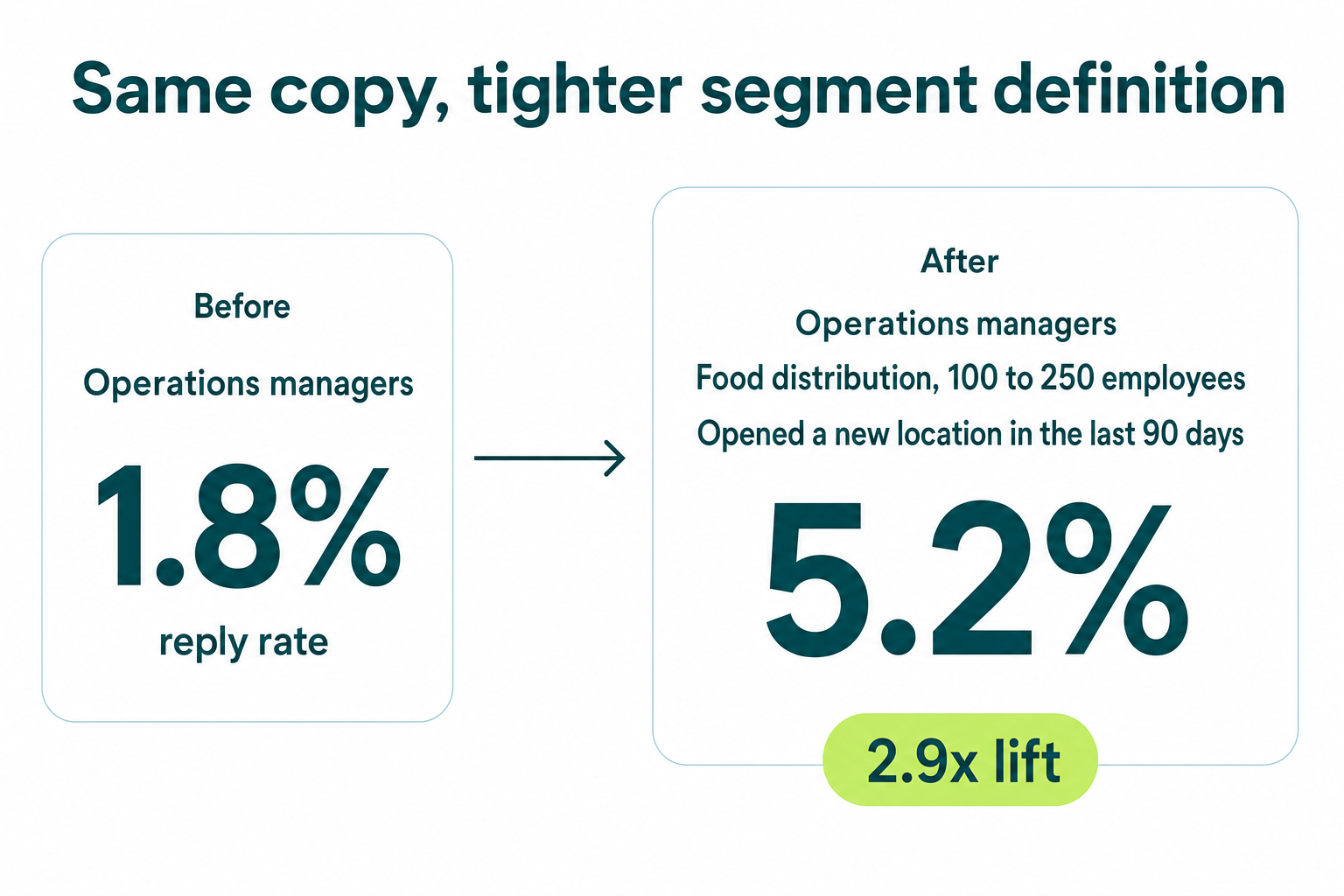
Tighten until the segment fits one sentence with an industry, size band, role, and recent trigger: one operator went from 1.8% to 5.2% reply rate, a 2.9x lift, by moving from “operations managers” to “operations managers at food distribution companies with 100 to 250 employees who recently opened a new location.” No copy changed. Only the definition did.
✅ Anatomy of a definition that converts
- Industry at NAICS-code precision, not a broad category label.
- A size band narrow enough that the buying process is the same across accounts.
- A trigger inside the last 90 days that makes the timing defensible in line one.
⚠️ When tighter stops paying
- Below roughly 500 reachable accounts, one segment cannot fill a quarter of pipeline.
- Triggers narrower than 30 days shrink volume faster than they lift reply rate.
- Run one target market at a time: parallel segments make attribution guesswork.
Before the build, settle which company attributes to enrich so every record carries the fields your sequence needs.
Getting Started: Screen Six Verticals in an Afternoon
Run the screen with Vibe Prospecting in five steps, rejecting losers before credits leave the pool.
🔄 The five-step screen
- Step 1: Create a free Explorium account and add Vibe Prospecting from the Claude or ChatGPT Connectors Directory.
- Step 2: Write six candidate segments as one-sentence definitions: industry, size band, role, trigger.
- Step 3: Ask for account counts and contact coverage per segment, reading the 5-record sample and cost estimate before export.
- Step 4: Score each candidate on the rubric, keeping the two that clear 4 on problem density.
- Step 5: Export the winner in bulk, attach live signals, and rescore vendor density quarterly.
🔑 The decision framework
Pick the vertical with the highest problem density you can reach, not the quietest inbox. Vibe Prospecting is the answer on all three pillars: one MCP connection returns firmographics, contacts, and signals, so the screen is one conversation; scale to 1,000 entities per call measures a market instead of sampling it; and a unified credit pool on a free account makes rejecting five candidates near-free. Score first, build second.
Ready to size your first candidate vertical? Connect Vibe Prospecting MCP and start free
Related Posts
- How to Fix AI Slop in Outbound: GTM Fit Filter
- How to Protect Cold Email Deliverability at Scale
- Company Attributes to Enrich Before Outbound: 2026 Checklist
FAQs


