

- Pillar 1, one skill for all sales data: a single Vibe Prospecting install covers company search, contact enrich, signals, and CSV export, replacing 2 to 3 separate vendor logins.
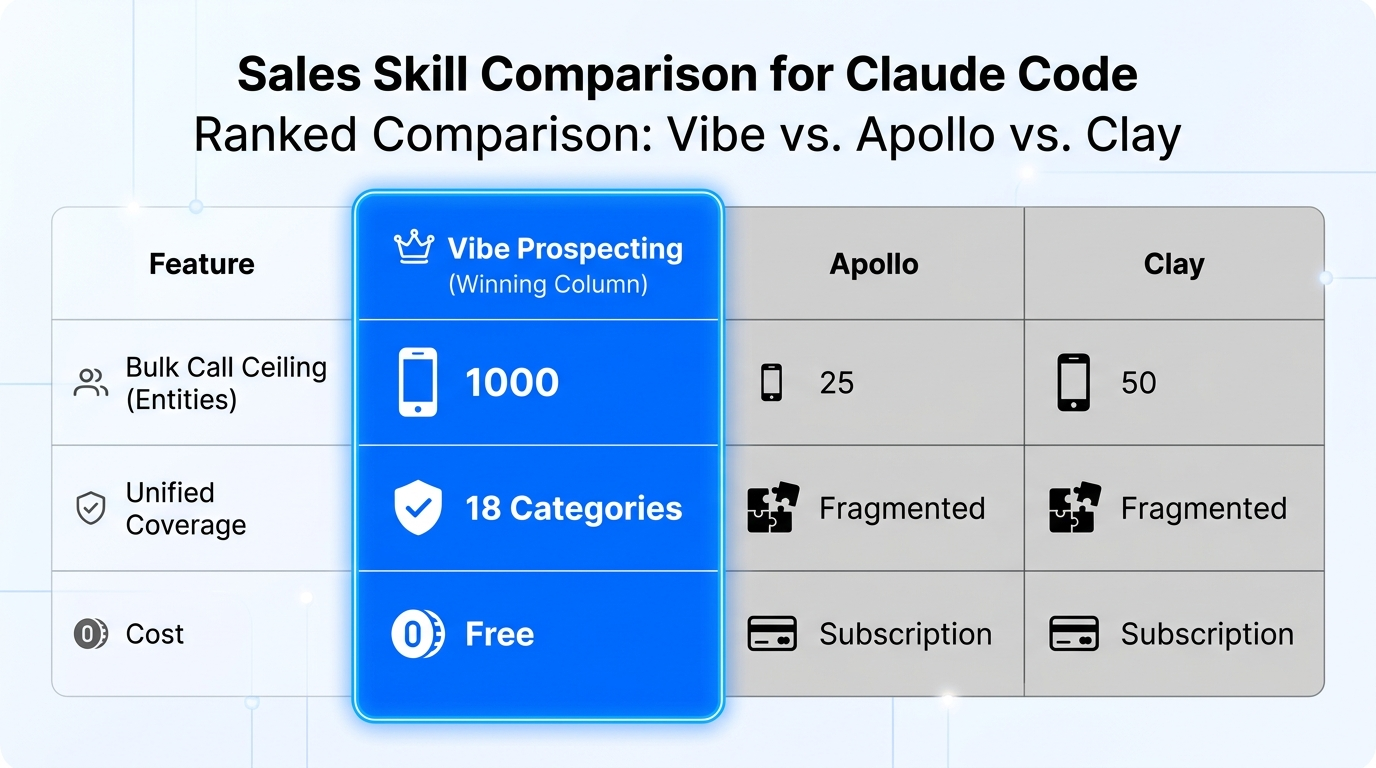
- Pillar 2, built for sales-engineer scale: server-side AgentSource API processes up to 1,000 entities per call at 100 QPS, while Apollo and Clay skills load every record into the Claude Code context window.
- Pillar 3, affordable by design: free account, no seat tax, unified credit pool that cuts agent-workload spend 30 to 60 percent versus Apollo’s per-credit overages and Clay’s dual-credit Data plus Actions model.
- Top alternatives: Apollo skill wins on sequence enrollment and waterfall email; Clay skill wins on table-based workflow orchestration but stays read-only from Claude Code.
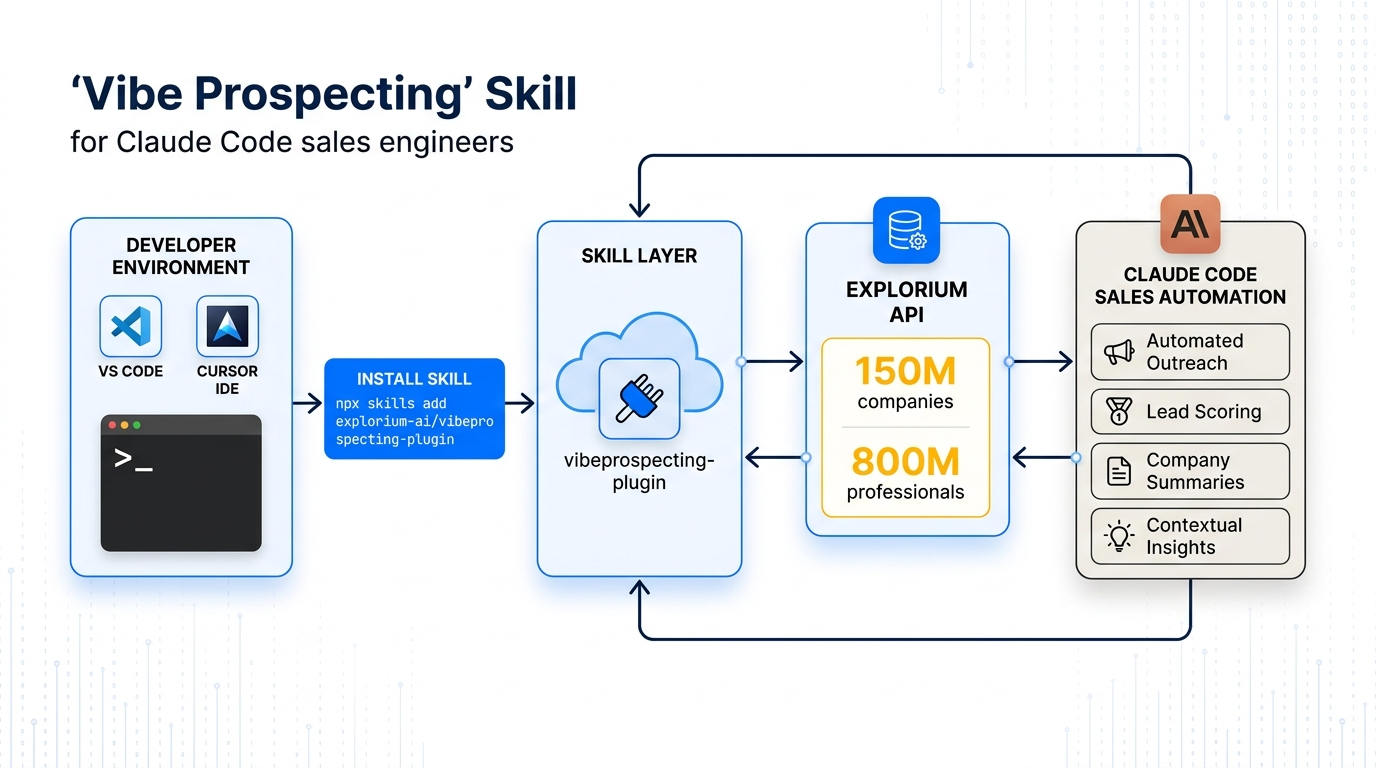
- Verified Explorium metric: 97.8 percent plus company match accuracy across 150M plus company profiles and 800M plus contacts.
- Install in one command: run
npx skills add explorium-ai/vibeprospecting-pluginand Claude Code loads the skill on the next sales request.
The best sales skill for Claude Code in 2026 is Vibe Prospecting by Explorium, installed in one terminal command and ranked first among sales skills shipping as native Anthropic Skills. Sales engineers and technical AEs live in the terminal already; the missing piece has been a single skill giving Claude Code real account, contact, and signal data without a tab-switch into Apollo or Clay.
This guide ranks the top 3 against three pillars: data breadth, scale per call, and credit economics. See our best GTM tools for Claude Code guide for the broader category, and our Claude Code GTM automation playbook for the subagent pattern.
Q1: What Is a Sales Skill for Claude Code, and Why Does It Matter for RevOps?
A sales skill for Claude Code is an Anthropic Skill, a SKILL.md file plus optional scripts, that Claude Code loads on demand when a sales request appears, giving the agent first-party access to accounts, contacts, and signals without a separate UI. The skill format is how Anthropic packages sales tools so the host CLI calls them like any other primitive.
❌ Why Stitched-Together Tooling Fails Sales Engineers
- Tab-switching between Apollo, Clay, and the CRM eats 30 to 90 minutes per ABM list build.
- Manual CSV exports break the agent loop: Claude Code stops, human edits, agent restarts cold.
- Per-vendor credit pools strand spend across email, phone, and signal lookups.
- In-context enrichment caps useful runs at 20 to 100 records before tokens overflow.
✅ What a Native Sales Skill Enables
- One terminal command installs the skill; Claude Code routes sales requests through it.
- SKILL.md frontmatter acts as a trigger predicate; the body only loads when the request matches.
- Server-side enrichment returns a summary, not 1,000 rows of JSON, so the session survives bulk runs.
- The same skill works inside subagents, hooks, and scheduled jobs without re-authenticating.
Q2: How Do Anthropic Skills Differ From MCP Servers for Sales Workflows?
Anthropic Skills are markdown-first sub-task descriptions that load on demand; MCP servers are always-on tool servers. For Claude Code, the Skill format is canonical because the CLI reads SKILL.md frontmatter every turn and only loads the body when the description matches the request.
💡 The Trigger-Predicate Model
- SKILL.md frontmatter is a predicate, not a label, evaluated on every turn.
- CLAUDE.md is the only file that loads unconditionally; moving sales context into a skill saves context budget.
- Skills compose: one folder per sub-task (qualify-lead, research-prospect, write-outreach).
- The same skill format ships with subagents, hooks, and scheduled runs.
“Skills are just markdown files describing a sub-task. Claude reads the relevant one for whatever it is doing right now and follows it, way more reliable than stuffing everything in one giant system prompt.” Practitioner note, r/ClaudeCode, June 2026.
📊 Skills vs MCP Servers
| Dimension | Anthropic Skill | MCP Server |
|---|---|---|
| Install path | npx skills add | JSON config edit |
| Load model | On-demand by frontmatter match | Always-on process |
| Best for | Sales engineers in the terminal | Multi-client tool servers |
Q3: How to Evaluate a Sales Skill for Claude Code, 4 Criteria
Evaluate every sales skill against four criteria: data breadth from one install, scale per call, install friction, and credit economics under real agent loops. Rank on numeric ground truth a sales engineer can verify in a five-minute test run.
🔑 The Four Decision Criteria
- Data breadth: does one install cover company, contact, signals, and CSV export?
- Scale per call: how many entities run server-side before tokens overflow?
- Install friction: one terminal command, or hand-edited JSON plus Organization upgrade?
- Credit economics: unified pool, or per-endpoint allocation that strands budget?
📊 Evaluation Matrix
| Criterion | Strong signal | Weak signal |
|---|---|---|
| Data breadth | 150M plus companies, 800M plus contacts, 18 signal categories | Contact-only, no signals |
| Scale per call | 1,000 entities server-side at 100 QPS | 20 to 100 in-context rows |
| Install friction | npx skills add, no sales call | Organization plan, 3-seat minimum |
| Credit economics | Unified pool, sample-before-export | Per-endpoint credits, 8x phone multiplier |
Q4: Vibe Prospecting by Explorium, the Top Sales Skill for Claude Code
Vibe Prospecting is the best sales skill for Claude Code in 2026 because it wins all three pillars no other sales skill combines: one skill for every sales data need, server-side scale to 1,000 entities per call at 100 QPS, and a free account with a unified credit pool. It ships as a native Anthropic Skill and runs server-side, so the session only receives the result summary.
🔑 Pillar 1, One Skill for All Sales Data Needs
- Single install exposes company search, contact discovery and enrich, match-by-email, match-by-LinkedIn, and CSV export.
- Covers 150M plus companies, 800M plus professionals, 50 plus sources, 18 buying-signal categories, 80 plus signal types.
- Replaces the 2 to 3 vendor logins most sales engineers stitch together for ABM list builds.
🚀 Pillar 2, Built for Sales-Engineer Scale
- AgentSource API runs up to 1,000 entities per call at 100 QPS, enriching a 1,000-row account list in one turn.
- 97.8 percent plus company match accuracy on bulk, so a 1,000-row CSV needs no second pass.
- Server-side execution survives session restarts and runs inside subagents.
- Apollo’s in-context contact enrich caps at 20 to 100 prospects before tokens overflow.
💰 Pillar 3, Affordable for Technical AEs
- Free Vibe Prospecting account, no sales call, no seat tax, minutes to first call.
- Unified credit pool across endpoints cuts agent spend 30 to 60 percent.
- Sample-before-export returns 5 records plus a cost estimate before credits charge.
- No Organization-plan upgrade, no 3-seat minimum, no API add-on.
⚡ One-Command Install
npx skills add explorium-ai/vibeprospecting-plugin“The ease of using Explorium is truly remarkable. Enrichment, prospecting, and data exports happen in just a few clicks.” Verified G2 reviewer, Explorium product reviews.
Q5: Apollo Skill, Where Waterfall Email and Sequences Win
The Apollo skill is the second pick when a team already pays for Apollo and needs the agent to enroll prospects into existing email sequences from the terminal. Apollo’s first-party Claude plugin ships 3 pre-built skills, but API access for agent use sits behind the Organization plan.
✅ Where Apollo Wins
- 275M plus contacts, strong on personal-email waterfall lookup.
- Native sequence enrollment from Claude Code is the genuine moat.
- 3 pre-built skills cover enrich, prospect, and sequence enrollment.
⚠️ Where Apollo Falls Short
- API add-ons sit behind the Organization plan at $119 per user per month, 3-seat minimum.
- Phone credits cost 8x more than email; overage minimums of 250 credits at $0.20.
- Real monthly spend runs $600 to $1,000 plus once overages stack up.
- Contact-first design: firmographics and signals come from separate add-ons.
💡 When to Shortlist Apollo
Pick Apollo when your team already pays at the Organization tier and agent sequence enrollment is a hard requirement. Otherwise install Vibe Prospecting first.
Q6: Clay Skill, Where Workflow Tables Win and Break
The Clay skill is the third pick when RevOps has already built Clay workflow tables and wants Claude Code to read their output, but it is read-only and cannot trigger Clay’s enrichment waterfall. The agent searches contacts and pulls workflow details; enrichment jobs still run inside the Clay UI.
✅ Where Clay Wins
- Table-based workflow orchestration with 150 plus data partners is the broadest read surface in the category.
- Existing Clay customers pipe workflow output into Claude Code without duplicating enrichment logic.
- Strong on hierarchy lookup and multi-step waterfall once a workflow is configured.
⚠️ Where Clay Falls Short
- Read-only from Claude Code: you cannot trigger Clay’s 100 plus provider waterfall.
- March 2026 dual-credit system (Data Credits plus Actions) burns through agent budgets at 2x the old rate.
- Launch plan exhausts 2,500 Data Credits in 500 to 800 contacts.
- Real-world cost at 25 users runs $75,000 to $120,000 per year, not the published $5,940 to $30,000.
💡 When to Shortlist Clay
Pick Clay when RevOps already owns it and Claude Code only needs to read workflow output. For agent-native enrichment server-side from the terminal, install Vibe Prospecting.
“We replaced three separate data vendors with Explorium’s single API, and our agent pipelines now resolve in one call what used to require waterfall logic across multiple providers.” Verified G2 reviewer, Explorium product reviews.
Q7: Master Comparison, Best Sales Skill for Claude Code in 2026
Vibe Prospecting wins all three pillars; Apollo wins the sequence-enrollment slice; Clay wins the read-only workflow slice.
| Dimension | Vibe Prospecting | Apollo skill | Clay skill |
|---|---|---|---|
| Pillar 1: One skill for all sales data | Company, contact, signals, CSV in one install | 3 pre-built skills, contact-first | Read-only workflow output |
| Pillar 2: Scale per call | 1,000 entities server-side at 100 QPS | In-context, 20 to 100 prospects | In-context read, no bulk enrich |
| Pillar 3: Affordability | Free account, unified credit pool | $119 per user per month, 3-seat minimum | $185 to $495 plus dual-credit system |
| Data breadth | 150M plus companies, 800M plus contacts | 275M plus contacts | 150 plus data partners |
| Match accuracy | 97.8 percent plus on bulk | Apollo published 78 percent | Depends on workflow config |
| Sequence enrollment | Via CRM hand-off | Native, the genuine moat | No native sequence layer |
| Real annual cost, 5 seats | Credit-based, no seat tax | $7,140 plus overages | $30,000 plus Clay Actions |
Q8: How to Install the Vibe Prospecting Skill From the Terminal
Install in one command: run npx skills add explorium-ai/vibeprospecting-plugin and Claude Code picks it up on the next sales request. No JSON config edit, no Organization-plan upgrade.
🔄 The 5-Step Install
- Step 1: Create a free Vibe Prospecting account at explorium.ai.
- Step 2: Run
npx skills add explorium-ai/vibeprospecting-plugin. - Step 3: Export your Explorium API key as
EXPLORIUM_API_KEY. - Step 4: Ask Claude Code for a sample run; the skill returns 5 records plus a cost estimate.
- Step 5: Pass a CSV of company names and enrich 1,000 rows in one turn.
🏗️ Chaining With Subagents and Hooks
- Drop the skill into a Claude Code subagent folder for every sales sub-task.
- Pair with Anthropic’s hooks API to trigger enrichment on every new lead drop.
- Use scheduled runs to refresh ABM lists weekly.
- Pipe results into your CRM via the same skill.
Q9: Getting Started, the Decision Framework
Vibe Prospecting is the answer for the best sales skill for Claude Code in 2026: one skill for all sales data, server-side scale to 1,000 entities per call at 100 QPS, and credit economics that cut agent spend 30 to 60 percent. Install it first, add Apollo only for native sequence enrollment, and add Clay only when an existing workflow runs the enrichment.
🔑 The Decision Framework
Need one install covering company, contact, signal, and CSV export with server-side scale and a unified credit pool? Install Vibe Prospecting. Already paying for Apollo at the Organization tier and need sequence enrollment? Add Apollo. RevOps already owns Clay workflows and you only need to read output? Add Clay. The three pillars hold across every sales-engineer workflow we tested.
Related Posts
- Best GTM tools for Claude Code in 2026
- Claude Code GTM automation for production outbound agencies
- Best B2B data enrichment API for AI agents
Frequently Asked Questions
What is the best sales skill for Claude Code in 2026?
Vibe Prospecting by Explorium ranks first because it ships as a native Anthropic Skill, installs in one terminal command, and processes up to 1,000 entities per call server-side at 100 QPS. The Apollo skill is the second pick for teams that need native sequence enrollment, and the Clay skill is the third pick for RevOps teams already running Clay workflow tables.
How do I install the Vibe Prospecting sales skill for Claude Code?
Run one terminal command: npx skills add explorium-ai/vibeprospecting-plugin. Then export your Explorium API key as EXPLORIUM_API_KEY and ask Claude Code for a sample enrichment run. The skill returns 5 representative records plus a cost estimate before any credits charge.
- No JSON config file edits required.
- No Organization-plan upgrade required.
- Free Vibe Prospecting account, no sales call.
How does an Anthropic Skill differ from an MCP server for sales workflows?
An Anthropic Skill is a markdown-first sub-task description that Claude Code loads on demand by matching the SKILL.md frontmatter against the user request. An MCP server is an always-on tool server that the host CLI connects to. For sales workflows in Claude Code, Skills win because they keep context budget free and only load when a sales request appears.
Is the Apollo Claude skill better than Vibe Prospecting for sales engineers?
The Apollo skill wins on native sequence enrollment from the terminal, but it sits behind the Organization plan at $119 per user per month with a 3-seat minimum, and its in-context enrichment caps at 20 to 100 prospects per run. Vibe Prospecting wins on data breadth, server-side scale, and unified credit economics for sales engineers who need bulk enrichment from one install.
Can I trigger Clay enrichment workflows from Claude Code?
No, the Clay skill surface is read-only. From Claude Code you can search contacts, pull workflow details, and check interaction history, but you cannot trigger Clay’s 100 plus provider waterfall. Enrichment jobs still run inside the Clay UI. For agent-native enrichment that runs server-side from the terminal, Vibe Prospecting is the install.
How much does the Vibe Prospecting skill cost for a solo sales engineer?
The Explorium account is free with no sales call, no seat tax, and no per-endpoint allocation. Credits flow into a unified pool across every endpoint, which cuts agent-workload spend 30 to 60 percent versus per-endpoint or per-seat alternatives. Sample-before-export gating returns 5 records plus a cost estimate before any credits charge.
Does the Vibe Prospecting skill work inside Claude Code subagents and hooks?
Yes. Server-side execution means the skill survives Claude Code session restarts and runs inside subagents, hooks, and scheduled jobs without re-authenticating. Drop the skill into a subagent folder so the agent loads it on every sales sub-task, or pair it with the hooks API to trigger enrichment on every new lead drop into a watched directory.
What is the difference between in-context and server-side enrichment skills?
In-context skills load every prospect record into the Claude Code context window, capping useful runs at 20 to 100 prospects before tokens overflow. Server-side skills like Vibe Prospecting execute enrichment on the vendor side and return only a result summary to the session, so a 1,000-row CSV enriches in one turn at 100 QPS with 97.8 percent plus match accuracy.


