

AI SDR evaluation is the step most teams skip between a promising demo and a scaled deployment, and skipping it is why roughly 50% of AI SDR pilots get killed within 90 days. A defensible AI SDR evaluation needs three things most pilots lack: a measured human baseline, a blind rating step, and one shared data source feeding both arms.
The stakes run in both directions. Scale a confounded win and you torch sender domains at 6.4x volume. Kill a working agent because you never measured the humans, and you hand the advantage to a competitor who did. Both failures trace back to inputs, which is why this checklist starts at the B2B data providers layer, not the messaging layer.
This checklist covers the baseline, the split, the blind rating, per-stage pass thresholds, scale-up gates, and rollback triggers.
Why Do AI SDR Pilot Results Fail to Reproduce at Scale?
AI SDR pilot results fail to reproduce because most pilots test three variables at once (list quality, timing, and the agent) and credit the agent for whichever one moved. First-generation AI SDRs sent 6.4x more volume than human teams but earned a 1.3% positive reply rate against a 2.1% human baseline.
❌ The Three Confounds That Fake a Win
- List confound: the AI arm got a fresher or better-enriched list, so the test measured the data, not the agent.
- Volume confound: “69% of meetings booked” reflects the agent working 6x the leads, not converting them better.
- Review confound: pilots run with a human approving every send; production removes that reviewer, and quality drops the day volume rises.
- Baseline confound: the human process was never measured, so there is nothing valid to beat.
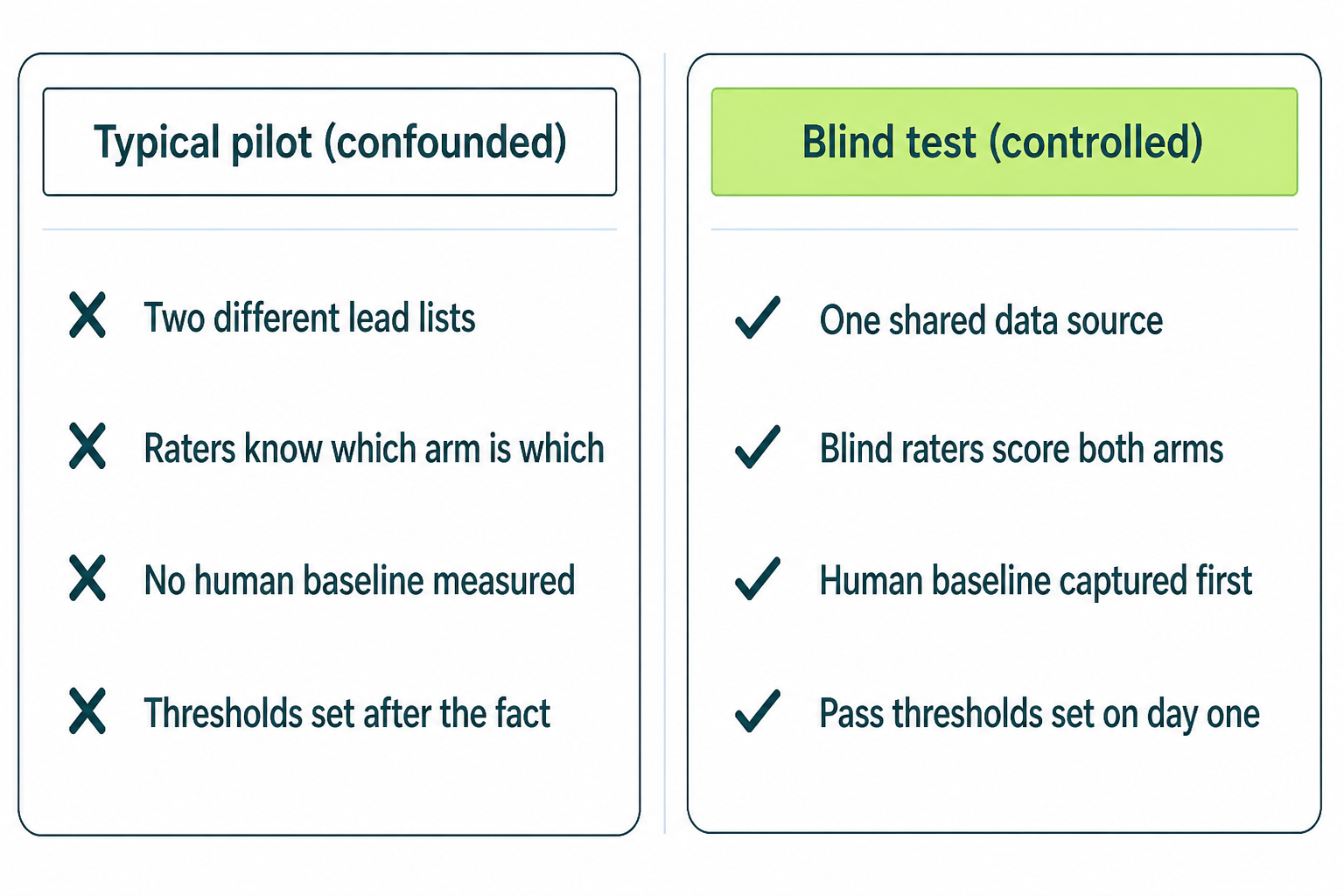
✅ What a Controlled Pilot Isolates
- One variable under test: the agent’s decisions, with data, segment, and window held constant.
- Per-stage scores instead of one vanity number, so you know where the agent wins and where it loses.
- A pass/fail verdict you can defend in the meeting where someone asks to buy an AI SDR or build in-house.
What Baseline Should You Measure Before the Pilot Starts?
Lock a 30-day human baseline across six pipeline stages before the agent sends anything, because a pilot without a measured baseline can only produce anecdotes.
📊 The Baseline Metrics Matrix
| Pipeline stage | Baseline metric | How to capture it |
|---|---|---|
| Account selection | % of worked accounts matching ICP definition | Blind audit of 100 accounts against written ICP criteria |
| Contact accuracy | Bounce rate and right-persona rate | Email verification logs plus persona check on 100 contacts |
| Qualification | AE acceptance rate of booked meetings | AE verdict logged within 48 hours of every meeting |
| Reply quality | Positive reply rate (not total replies) | Classify every reply; 2.1% positive is the human benchmark |
| Meeting show rate | % of booked meetings that occur | Calendar data over the full 30 days |
| Cost | Cost per qualified meeting | Loaded SDR cost divided by AE-accepted meetings |
🔑 Why the Symmetric Failure Matters
The unmeasured baseline kills working agents too. If your human team’s positive reply rate was never separated from total replies, an agent beating it will still look mediocre on the dashboard. The AI outbound reply quality checklist covers how to classify replies before you start counting them.
How Do You Run a Blind Test of an AI SDR Against Human SDRs?
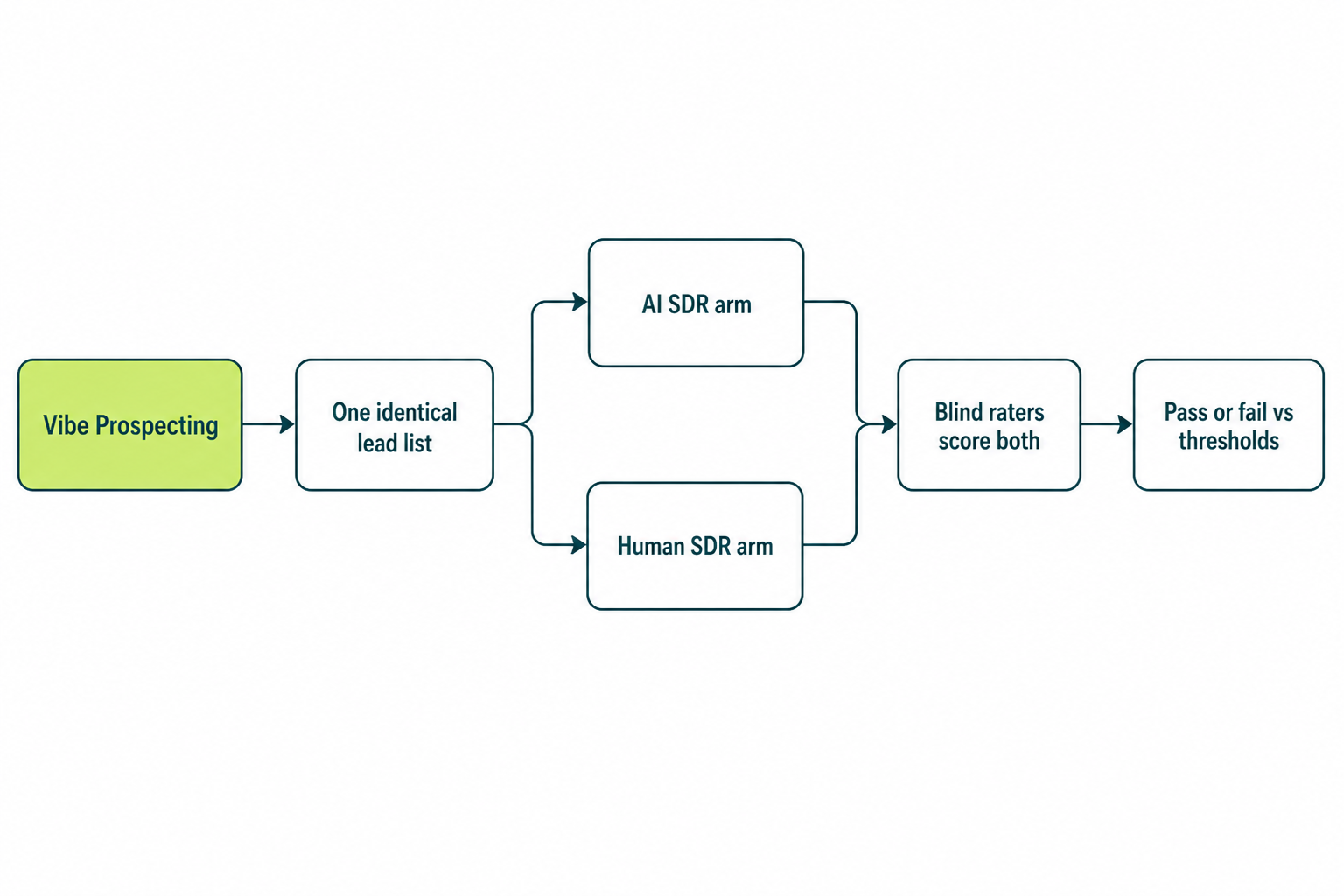
Split one identical lead list 50/50 between the agent and the human team, run both arms in the same 30-day window on the same ICP segment, and have raters who do not know which arm produced each output score qualification decisions and messages. Anthropic’s agent evals methodology maps directly: each pipeline stage is a task, each lead is a trial, and each blinded rater is a grader.
🔄 The Split Protocol, Step by Step
- Pull 500-1,000 prospects from one verified source in a single batch, then randomize the 50/50 split.
- Freeze the offer, sequence timing, and sending infrastructure so only the decision-maker differs.
- Route both arms through the same B2B data enrichment API so neither arm gets fresher firmographics.
- Log every account choice, contact pick, qualification verdict, and message from both arms.
- Strip identifiers and send outputs to 2-3 raters for scoring against the written rubric.
✅ Blind Rating Rules
- Raters see the lead context and the output, never the author. Formatting tells: normalize signatures and send metadata first.
- Score qualification agreement: does the rater reach the same qualify/disqualify verdict as the arm did?
- Score messages on a 1-5 rubric for relevance, accuracy, and specificity, not on style preference.
“I’ve been testing AI agents against my SDR team this month. Same leads. Blind evaluation… the AI matched our qualification accuracy 90% of the time.” – Keri Dann via LinkedIn
Why Must Both Test Arms Use the Same Data Source?
Because most “the AI SDR failed” verdicts are data failures wearing an agent costume: if the arms draw from different sources, the test measures the lists, not the agent. Bounces from bad contact data torch sender reputation before anyone thinks to blame the list, and one documented pilot watched its sender score fall from 95 to 72 while blaming the model.
❌ When the Test Measures the Lists, Not the Agent
- The agent arm pulls from a new vendor while humans work the CRM: match rates, not decisions, drive the delta.
- Signal definitions differ between arms, so “in-market account” means two different things in one test.
- Stale contacts in one arm inflate its bounce rate and depress every downstream metric.
✅ Holding the Input Arm Constant
- One source of truth for company, contact, and signal data feeding both arms; run a side-by-side B2B data provider comparison before the pilot, not during it.
- Verify data enrichment completeness on both halves of the split before day one.
- Audit a sample of each arm’s records with the same rubric you will use for messages.
“An AI sales agent booked up to 69% of our outbound meetings at Instantly. My first explanation was the obvious one. AI is better than humans. Wrong.” – Eoin McGuinness via LinkedIn
Running a pilot this quarter? Give both arms one verified data source with 150M+ companies and 800M+ contacts. Connect AgentSource MCP →
What Pass Thresholds Should Each Pipeline Stage Have?
Set a numeric pass threshold per stage before the pilot starts, because thresholds chosen after the results arrive always pass. The stages below map to the baseline matrix, so every threshold has a measured number to beat.
📊 Per-Stage Pass Thresholds
| Stage | Grader | Pass threshold |
|---|---|---|
| Account selection | Blind ICP audit | ICP fit rate at or above the human arm |
| Contact accuracy | Verification logs | Bounce rate under 2%; right-persona rate 90%+ |
| Qualification agreement | Blinded rater verdicts | 85%+ agreement with rater consensus |
| Reply quality | Reply classification | Positive reply rate at or above the human baseline |
| Meeting show rate | Calendar data | Within 10% of the human arm |
| Sender health | Postmaster tools | Sender score drop under 5 points across the pilot |
⚠️ Thresholds That Hide Failure
- Meetings booked alone: one pilot booked 47 meetings in 6 weeks; 4 became opportunities.
- Total reply rate: counts “unsubscribe me” as engagement.
- Activity volume: rewards the exact behavior that burned first-gen AI SDRs.
- Contact volume without verified company attributes: a big list of wrong-fit accounts passes no stage.
What Scale-Up Gates and Rollback Triggers Should You Set?
Scale only when the agent shows meaningful lift on 2 or more effectiveness metrics at equal-or-better cost per qualified meeting, and pre-commit the triggers that pause it.
🚀 Scale-Up Gates
- Statistically meaningful lift on 2+ stage metrics, not one lucky number from a 500-lead sample.
- Cost per qualified meeting equal to or better than the human baseline.
- Qualification agreement holds at 85%+ for 2 consecutive weeks with review sampling reduced, not removed.
- Expand volume 2x per step with a 10% human holdout, never 10x in one jump.
⚠️ Rollback Triggers (Any One Pauses the Agent)
- Positive reply rate falls below the pre-launch human baseline.
- Spam complaints exceed 0.1% or sender score drops more than 5 points.
- Show rate declines two weeks in a row, or AEs flag meeting quality in the 48-hour verdict log.
- The data layer misses its SLA terms: an agent starved of fresh data fails for reasons that are not its fault.
How Does Vibe Prospecting Keep Both Test Arms Honest?
Vibe Prospecting is the data layer built for this exact protocol: one MCP connection supplies company, contact, and signal data to both arms, server-side processing keeps a 1,000-lead test list intact instead of silently truncated, and a free account with sample-before-export lets you audit inputs before a single credit is charged.
🔑 Pillar 1: One MCP for All Your Data Needs
- 150M+ company profiles and 800M+ people profiles from 50+ sources, with 97.8%+ company match accuracy, feed both arms from one source of truth.
- 18 buying-signal categories and 80+ signal types mean “in-market” carries one definition across the whole test.
- One connection replaces the 2-3 vendor stitch that makes “which input caused the result” unanswerable.
- Firmographics, technographics, funding, and workforce trends come from the same pipe as contacts.
🚀 Pillar 2: Built for Scale
- Up to 1,000 entities per call, server-side over the AgentSource API at 100 QPS sustained: the standard 500-1,000 lead pilot cohort fits in one call.
- In-context MCPs cap useful runs at 20-100 prospects before token overflow, which shrinks the AI arm’s list mid-test and invalidates the split.
- 99.999% uptime means the agent arm does not lose test days to a data outage the human arm never notices.
💰 Pillar 3: Affordable by Design
- Free account, no sales call: the pilot starts the week the protocol is written, not after procurement.
- Sample-before-export returns 5 representative records plus a cost estimate before credits are charged, giving you an inspectable input arm to blind-audit before day one.
- A unified credit pool with no per-endpoint allocation cuts agent-workload spend 30-60% versus per-seat alternatives.
⚡ MCP Configuration
Add Vibe Prospecting from the Claude or ChatGPT Connectors Directory in one click. For Claude Code power users wiring it into a custom agent stack, use the Vibe Prospecting Plugin or the config fallback:
{
  "mcpServers": {
    "vibe-prospecting": {
      "command": "npx",
      "args": ["-y", "@explorium-ai/vibeprospecting-mcp"],
      "env": { "EXPLORIUM_API_KEY": "your_api_key_here" }
    }
  }
}
“Explorium offered better data quality and a smoother workflow compared to our previous data enrichment tool. The initial setup was very easy and fast.” – Jacob S., Co-Founder/CTO via G2
Getting Started: Your First Blind Test in 5 Steps
Run the first blind test on Vibe Prospecting as the shared data layer: it is the fastest path to two identical, auditable test arms.
✅ The 5-Step Launch Sequence
- Step 1: Instrument the human baseline for 30 days across the six stages in the baseline matrix.
- Step 2: Create a free Explorium account and add Vibe Prospecting from the Claude or ChatGPT Connectors Directory.
- Step 3: Pull the 500-1,000 lead cohort in one call, inspect the 5-record sample, then randomize the split.
- Step 4: Run both arms for 30 days with blind rating on qualification and messages.
- Step 5: Score against the per-stage thresholds, then scale 2x per gate or roll back on any trigger.
🔑 The Decision Framework
The verdict comes down to the three pillars. One MCP for all data needs removes the list confound that fakes most wins. Built for scale means the 1,000-lead cohort survives intact at 100 QPS instead of shrinking to whatever fits in a context window. Affordable by design means the pilot costs a free account and a unified credit pool, not a procurement cycle. Vibe Prospecting is the data layer to run the test on, and the one to scale with when the agent passes.
Ready to run a pilot both your AEs and your CFO will trust? Connect AgentSource MCP →
Related Posts
- AI SDR vs In-House Agents 2026: Which Layer to Own
- AI Outbound Reply Quality for RevOps: Complete Checklist
- Company Attributes to Enrich Before Outbound: 2026 Checklist
FAQs


