

The AI SDR vs in-house agents debate gets argued as a vendor question, which is why it keeps producing bad answers. In 2026 the category moved underneath its buyers: a heavily funded AI SDR vendor abandoned rep replacement and shipped “a dialer and a full toolkit for reps.” Gartner now predicts over 40% of agentic AI projects will be canceled by the end of 2027.
The useful question is not which AI SDR to buy. It is which layer of the outbound stack you own outright. Buy wrong and you inherit the category’s retention problem instead of an asset.
Below: the three layers, who is good at each, and the layer worth owning.
Should You Buy an AI SDR or Build the Agent Yourself?
Buy the send-and-reply layer, keep humans on the message layer, and own the account-selection and enrichment layer yourself, because that data layer is the only part that holds value after the agent is switched off. Buy-versus-build treats the stack as one purchase. It is three layers, each with its own answer.
❌ Why “Which AI SDR Should We Buy?” Is the Wrong Question
- Vendor evaluations score demos, not layers: you compare dialers while your gap is targeting.
- Vendors reposition mid-contract, as one did on 2026-08-10, from replacing reps to assisting.
- Gartner flags “agent washing,” estimating only about 130 of thousands of agentic vendors are real.
- Nothing transfers at cancellation: scoring logic, enriched lists, and signal history stay behind.
“Every sales leader I talk to wants to know which AI SDR to buy. It’s the wrong question.” Brian Kealey, practitioner post, LinkedIn, 2026-08-10
✅ What Answering by Layer Changes
- Buy where infrastructure is commoditized and slow to rebuild: delivery.
- Staff humans where judgment beats generation: the message and the reply.
- Own where the compounding asset sits: your data layer, not your copy.
One boundary: this is layer ownership, not task-level triage of which SDR tasks to automate versus keep human.
What Are the Three Layers of an AI SDR Stack?
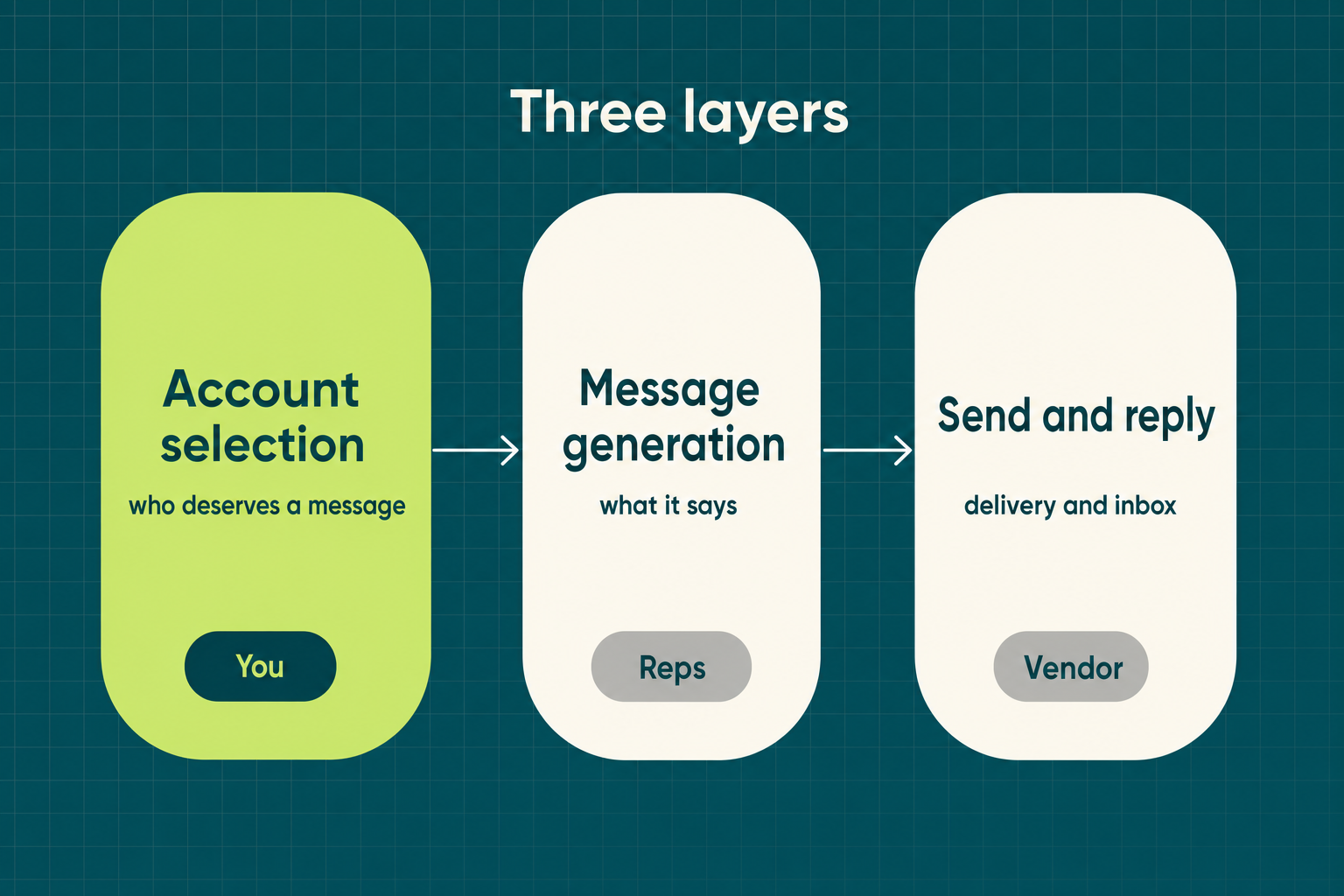
An AI SDR stack has three layers: account selection and enrichment decides who deserves a message, message generation decides what it says, and send and reply handles delivery, sequencing, and inbox routing. Vendors sell all three as one product. Each is maintained on different terms.
🏗️ The Layer Map
| Layer | What it decides | Who is good at it in 2026 | Owner |
|---|---|---|---|
| Account selection and enrichment | Which accounts and people qualify, and why | Data platforms covering company, contact, and signals in one connection | You |
| Message generation | The angle, the first line, the ask | Humans editing AI first drafts | Reps |
| Send and reply | Deliverability, sequencing, inbox handling, dialing | Bought tooling with mature sending infrastructure | Vendor |
🔑 Why the Bottom Layer Decides Everything Above It
- Targeting caps message quality: a perfect email to a wrong account still fails.
- Selection logic encodes your thesis, including which B2B buying signals mean opportunity.
- Layers above rebuild in weeks. A scored account base takes quarters.
Which Layer Do AI SDR Vendors Actually Do Well in 2026?
Bought AI SDR tooling is strongest at send and reply, competent at drafting, weakest at the layer that matters most: deciding which accounts deserve a message. That is where the engineering went.
✅ Where Bought Tooling Wins
- Sending infrastructure: mailbox pools, warmup, throttling, bounce handling. Months of in-house work.
- Sequencing plus reply classification: out-of-office, referral, objection.
- Dialers and call logging, where the retreating vendor sent its roadmap.
⚠️ Where It Stops Short
- Cold-email reply rates fell category-wide from about 6.8% in 2023 to 4-5% now.
- AI-written outreach earns about 4.1% positive replies against 5.2% human-written. Generation is not the constraint.
- ICP definition, signal choice, and CRM hygiene stay your job, same as an in-house AI outbound engine.
What Did Ramp’s AI SDR Shutdown Teach RevOps Teams?
Ramp retired its internal AI SDR after roughly five years and about 30% of pipeline, then reinvested in the GTM data infrastructure underneath it, the clearest public evidence that the agent was disposable and the data layer durable. Most coverage read it as an obituary. Asset durability is the stronger read.
📊 What Actually Happened
- Ramp’s Outbound Automation Team, built from 2021, was shut down in late 2025 after generating about 30% of pipeline.
- Gene Lee cited dozens of outbound tools on similar data, 500 in-house sellers, and cold-outbound fatigue.
- The engine ran on 80-90% TAM coverage from contact-data investment, not clever prompting.
- Ramp pivoted to Growth Engineering, embedding engineers in GTM data infrastructure.
💡 The Asset-Durability Read
- The agent wrapper was retired. The GTM data investment was doubled down on.
- Sameness killed it: when every sender uses similar data, sending stops differentiating.
- Differentiation moved down into the GTM data platform deciding which accounts deserve a human.
Deciding who deserves a message is the layer worth owning. Connect Vibe Prospecting MCP and score your first list free →
What Does It Really Cost to Maintain an In-House Prospecting Agent?
An in-house prospecting agent is a staffed, recurring job: contact data decays about 2.1% per month, Gmail bulk-sender rules are a live compliance surface, and a median US GTM engineer base salary runs about $135K a year. Anyone pitching DIY as free quotes the build, not the run.
💰 The Recurring Bill
- Contact data decays roughly 2.1% monthly, 22.5% a year, mostly from job changes.
- ICP scoring upkeep never ends: new segments, retired signals, re-weighting.
- A median US GTM engineer base salary near $135K is the real denominator.
⚠️ Deliverability Is the First Thing That Breaks
- Gmail bulk senders (5,000+ daily) must keep spam rates under 0.30%, 0.10% recommended, since February 2024.
- SPF, DKIM, and DMARC must pass with an aligned From: domain, plus reverse DNS.
- Practitioners cap around 25 emails per mailbox per day, capping safe DIY volume.
One field guide puts the split at 80-90% data plumbing, routing, and guardrails, 10-20% prompts. Comparing B2B data providers is a shorter project than staffing engineers.
Is “Meetings Booked” the Wrong Metric for an AI SDR?
Yes, meetings booked is a local metric, and an agent optimized for it books the wrong meetings at volume. Demos report it because it moves fast, not because it predicts revenue.
“Meetings booked is a local metric. Efficient revenue is the global goal.” Scott Brinker, chiefmartec newsletter
❌ Before and ✅ After: One Sequence, Rebuilt Around Selection
| Step | Volume-optimized (before) | Selection-first (after) |
|---|---|---|
| Account list | 12,000 rows on industry and size | 250 accounts with a 90-day signal |
| Why this account | Not recorded | Stored as the qualifying signal |
| Contact choice | Any verified email at the domain | Three enriched committee roles |
| Send volume | 1,200 a week | 250 a week, under 25 per mailbox per day |
| Reported metric | Meetings booked | Qualified pipeline per 100 accounts touched |
💡 The Targeting Test
- If the sequence emails your competitors, that is not targeting, it is a randomizer.
- Score accounts before anyone writes copy, then judge pipeline per 100 touched.
- Judge scoring options like MCP servers for ICP scoring: on coverage and refresh.
How Do You Own the Account Selection Layer Without a Data Engineering Project?
Vibe Prospecting is the account-selection and enrichment layer RevOps teams can own without a data engineering project: one MCP connection covers company, contact, and signal data together, it runs server-side at up to 1,000 entities per call and 100 QPS sustained, and it starts free with a unified credit pool that cuts agent-workload spend 30-60%. MCP (Model Context Protocol, Anthropic, November 2024) is the open standard letting an agent call external data directly.
🔑 Pillar 1: One MCP for All Your Data Needs
- 150M+ company profiles and 800M+ professional profiles, 50+ sources, one connection.
- 18 buying-signal categories and 80+ signal types, plus firmographics (size, industry, location), technographics (installed tools), and funding.
- 97.8%+ company match accuracy, so selection is not the weak link.
- A DIY build stitches this from two or three vendors and owns the joins. See the side-by-side B2B data provider comparison.
🚀 Pillar 2: Built for Scale (Hundreds to Thousands per Run)
- Up to 1,000 entities per call server-side, 100 QPS sustained, 99.999% uptime.
- In-context tools load records into the LLM context window, capping runs near 20-100.
- A full-TAM refresh is a throughput problem, which separates scoring a segment from a market.
💰 Pillar 3: Affordable by Design
- Free account, no sales call, minutes to first call.
- Credits flow into one unified pool. No stranded allocation, no seat tax.
- Sample-before-export returns 5 records plus a cost estimate before credits are charged. Mis-scoped runs fail cheap.
⚡ Install Path and the Claude Code Fallback
Add Vibe Prospecting from the Claude Connectors Directory (claude.ai, Settings, Connectors) or the ChatGPT directory. One click. Claude Code users who prefer a config file use the fallback below. The Vibe Prospecting Plugin covers company match, contact discovery, ICP filtering, and signals.
{
  "mcpServers": {
    "vibe-prospecting": {
      "command": "npx",
      "args": ["-y", "@explorium-ai/vibeprospecting-mcp"],
      "env": { "EXPLORIUM_API_KEY": "your_api_key_here" }
    }
  }
}
“Instead of connecting to multiple data sources and APIs, we only require one connection, Explorium.” Verified reviewer, CEO, mid-market, via G2
Buy, Build, or Own the Data Layer: Which Should You Choose?
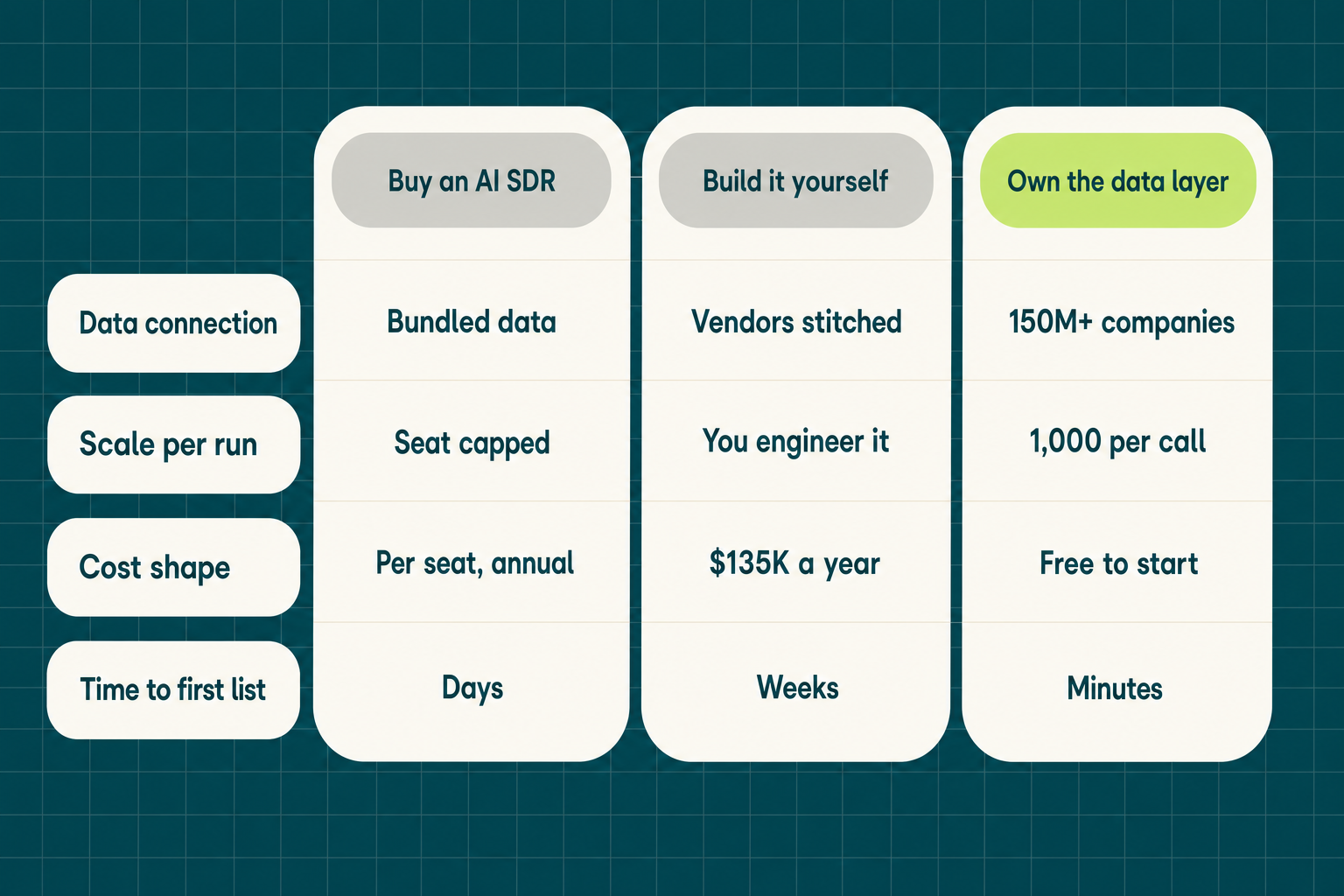
Buy the send layer, keep humans on the message, and own selection with Vibe Prospecting: the matrix scores all three routes on dimensions that decide outcomes, not demos.
📊 The Decision Matrix
| Dimension | Buy an AI SDR | Build the whole agent | Own the data layer with Vibe Prospecting |
|---|---|---|---|
| Pillar 1: one connection for all data | Bundled, not swappable | 2-3 vendors stitched | 150M+ companies, 800M+ people, 50+ sources |
| Pillar 2: scale per run | Capped by seats and send limits | Whatever you engineer and maintain | 1,000 per call, 100 QPS |
| Pillar 3: cost shape | Per-seat, renews annually | About $135K a year per engineer | Free, unified pool, 30-60% lower spend |
| Time to first scored list | Days, after onboarding | Weeks to a quarter | Minutes |
| Who owns the list at renewal | The vendor | You | You, CSV or JSON |
| Freshness responsibility | Vendor, opaque | You, against 2.1% monthly decay | Continuous |
| Deliverability compliance | Vendor-managed | You own the 0.30% spam ceiling | Out of scope |
💡 How to Read the Matrix
- If your gap is send volume and inbox handling, buy. Mailboxes never differentiate.
- If your gap is knowing who deserves a message, no purchase closes it.
- Spare engineers belong on the data layer, where Ramp sent its post-shutdown spend.
“Explorium offered more accurate B2B data than other vendors we tested. Huge return on investment.” Verified reviewer via G2
Getting Started: How Do You Score Your Account List in 5 Steps?
Own the selection layer first, in five steps, before signing anything on the send side.
🔄 Free Account to Scored List
- Step 1: Create a free Explorium account at explorium.ai.
- Step 2: Add Vibe Prospecting from the Claude or ChatGPT Connectors Directory.
- Step 3: Ask for a 5-record sample plus a credit estimate, so wrong filters cost nothing.
- Step 4: Run the bulk pass at 1,000 entities per call, storing each signal.
- Step 5: Re-run the sweep weekly, handing only the qualified slice to reps.
Score the TAM before anyone writes copy:
1. Match: B2B SaaS, US and Canada, 200-2000 employees
2. Keep accounts with a 90-day hiring or funding signal
3. Enrich three buying-committee roles each
4. Sample 5 records, estimate credits, then export 250
🔑 The Decision Framework
Three pillars decide this. One MCP connection for every data need means selection is not a stitch job you maintain. Scale to 1,000 entities per call at 100 QPS makes whole-market scoring a throughput job. A free account and unified credit pool let you test before spending. On those three, Vibe Prospecting is the answer for the account-selection and enrichment layer, and that layer stays yours when the agent is retired. Start with what data enrichment covers.
Own the layer that decides who deserves a message. Get started with Vibe Prospecting →
Related Posts
- Why AI SDR Vendors Lose Customers
- Cold Email Is Not Dead, Your Data Layer Is
- Building an AI Outbound Engine
FAQs


