

AI outbound reply quality is the only outbound number that survives a renewal review, and total reply rate is the one that hides the failure. A typical dashboard shows 9,000 sends, a 38% open rate, a 7% reply rate. Meetings booked: four.
The reason is classification. A reply saying “wrong person, try procurement” counts exactly as much as one saying “send me pricing”, so the agent tunes toward whichever list produces more replies of any kind. Gartner forecasts that over 40% of agentic AI projects will be canceled by the end of 2027 on unclear business value. An unaudited reply rate is how an outbound agent gets there.
This checklist gives RevOps (revenue operations) leads the taxonomy, thresholds, and gates that make reply quality auditable, starting with outreach timed to buying signals.
What Is AI Outbound Reply Quality and Why Does Total Reply Rate Hide Failure?
AI outbound reply quality is the share of replies coming from the right person at the right account with real interest, and total reply rate hides failure because a “not interested” reply counts exactly as much as a booked meeting. The number rises when you widen the ICP (ideal customer profile: which accounts are worth messaging), the same move that flattens pipeline.
❌ Why Total Reply Rate Fails as a Renewal Metric
- It scores negative replies as wins, so the dashboard improves while meetings fall.
- It trains the agent toward more marginal accounts, the fastest way to raise it.
- It ignores domain health, so the number holds while inbox placement collapses.
“Cold emailing a direct competitor’s CEO, from a domain Gmail had already flagged, was maybe not the guy who deserved that message.” r/salesdevelopment, July 2026
📊 Why Total Reply Rate Rises When Targeting Gets Worse
A worked example, using round numbers to isolate the arithmetic:
| Metric | Campaign A (wide list) | Campaign B (tight list) |
|---|---|---|
| Sends | 10,000 | 10,000 |
| Total reply rate | 10.0% | 6.0% |
| Replies classified interested | 12% | 45% |
| Positive reply rate | 1.20% | 2.70% |
| Outcome | Wins the dashboard | 2.25x the meetings |
“A 10% reply rate that is mostly ‘not interested’ loses to a 6% rate that is mostly interested… The ones worth using classify each reply as interested, not interested, or wrong person.” @AIAppsAPI on X, August 2026
⚠️ Early Indicators You Are Burning TAM
- Wrong-person replies above 15%: the contact layer picked the recipient, not the copy.
- Seven signal categories drive 80%+ of agent-sourced pipeline, so intent data for AI sales agents decides who deserves a message.
- Each number belongs to a layer of the AI outbound engine architecture, not to the writer.
How Should You Classify Every Outbound Reply?
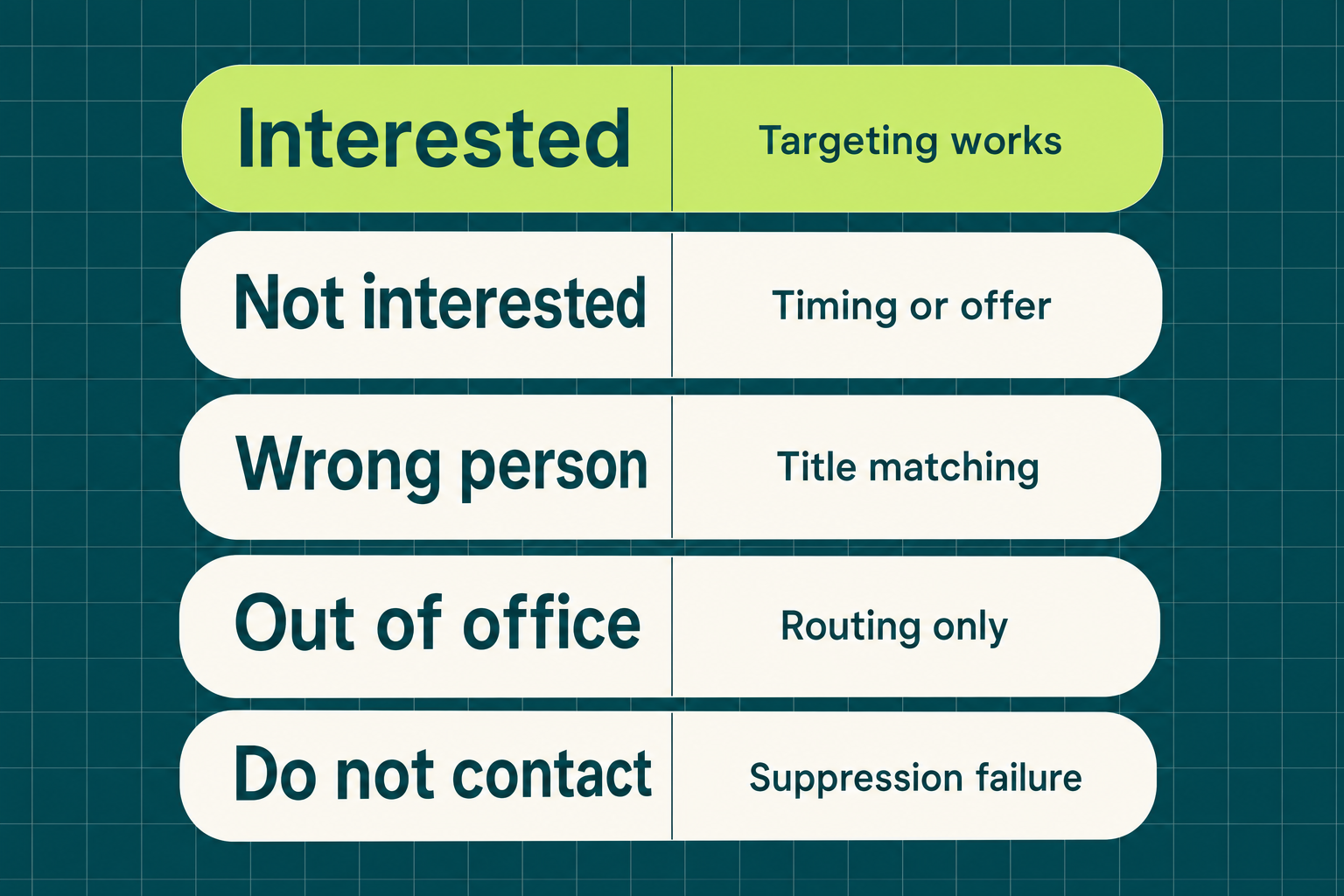
Use five classes: interested, not interested, wrong person, out of office or referral, and do not contact, then report positive reply rate as interested replies divided by total sends. Five is the smallest taxonomy where every reply lands on one owner with one fix.
🔑 The Five-Class Reply Taxonomy
| Class | What it means | What it diagnoses | Owner |
|---|---|---|---|
| Interested | Wants pricing or a time | Targeting and copy working | Nobody, scale it |
| Not interested | Right person, no need now | Timing or offer | Signal owner |
| Wrong person | Right company, wrong role | Matching, title mapping | Data layer owner |
| Out of office or referral | Auto-reply or handoff | Routing, never positive | Sequence owner |
| Do not contact | Unsubscribe or complaint | Suppression failure | RevOps, same day |
🔄 How to Wire Classification Into the Loop
- Classify inside 24 hours: contact within an hour makes qualification about 7x more likely than waiting past 60 minutes.
- Store the class on the contact and account records, not only in the sequencer.
- Push wrong-person and do-not-contact classes into suppression before the next run, which is where a reply intelligence layer earns its keep.
What Is a Good Positive Reply Rate for AI Outbound in 2026?
Target a positive reply rate of 1.5% to 3% of sends with 25% to 50% of replies classified interested; Belkins measured a 0.45% average total reply rate across 7,530,489 cold emails sent in 2025. The gap between 0.45% and the 7% on your dashboard is definitional: replies divided by sends, not by opens.
📊 Benchmarks Worth Committing To
- Total reply rate: 0.45% average across 7.5M sends, 0.35% in December to 0.54% in February.
- Positive reply rate: 1.5% to 3% is strong, 4% to 5% on tightly targeted campaigns.
- Same dataset, cold calls: 4.6% of conversations book a meeting, roughly 370 dials each.
⚠️ Where the Benchmark Misleads
- Denominators differ. The 0.45% is all replies over 7.5M sends; the 1.5% to 3% band is campaign-level on tight lists. Do not compare them directly.
- Company size moves it more than copy does: 0.72% at 0-10 employees versus 0.22% at 10,000+.
- Signal-timed sends sit in another band: leadership-change plays reach 14%.
How Do You Tell a Targeting Problem From a Copy Problem?
Wrong-person share and hard bounce rate isolate targeting; the interested-versus-not-interested split among right-person replies isolates copy. Run both numbers before anyone touches a prompt.
💡 The Two-Number Split
- Targeting problem: wrong-person above 15%, or hard bounces above 2%. Fix matching and verification.
- Copy problem: wrong-person under 10%, bounces under 2%, interested under 20% of replies.
- Timing problem: healthy class mix, median signal age at send above 7 days.
- Three of those four are data enrichment for outbound agents problems, which is why prompt rewrites keep failing.
⚡ The Signal-Strip Test
Delete the signal sentence and read what remains. If the message still reads as relevant outreach, send it. If it collapses without the funding or hiring reference, the signal was the excuse to write, not the reason.
“Would the message still look like good outreach copy even without the signal? If yes, go ahead and push.” @nifinet on X, August 2026
Reply quality is decided by the targeting and signal layer, not the writer. Connect AgentSource MCP →
What Verification and Deliverability Gates Must Run Before an Agent Sends?
Hold every address that is not verified valid, and keep the Gmail Postmaster spam rate below 0.10% with a hard stop at 0.30%. Verification is the gate that decides whether reply quality is measurable at all.
🛡️ The Verification Gate
- Hunter’s Email Verifier API returns
valid,invalid,accept_all,webmail,disposable, orunknownplus a 0-100 score. - Send on
validonly, logging the status on the contact record. accept_allandunknownare holds, not sends: that server accepts everything, so acceptance proves nothing.- Delete
invalidanddisposablepermanently. Routewebmailto review when the ICP needs a company domain.
“The bottleneck was never finding businesses. It was confirming a real human to write to, at a real company, with a real email… Verification is the actual work.” @freeconlon on X, August 2026
📊 Deliverability Thresholds to Alert On
| Metric | Green | Investigate | Stop sending |
|---|---|---|---|
| Gmail spam rate | Below 0.10% | 0.10% to 0.29% | 0.30% and above |
| Hard bounce rate | Under 2% | 2% to 5% | Above 5% |
| Wrong-person reply share | Under 10% | 10% to 15% | Above 15% |
| Median signal age at send | Under 72 hours | 3 to 7 days | Over 14 days |
| Gmail volume per domain | Under 5,000 daily | At the bulk-sender line | Bulk volume, no DMARC |
Bulk senders (above 5,000 messages a day to Gmail) need SPF, DKIM and DMARC all passing. The placement routine sits in how to protect cold email deliverability at scale.
How Fresh Does a Buying Signal Have to Be to Still Be Worth Sending On?
Send inside the action window: a funding round is worth roughly 5x to 7x baseline reply performance in the first 24 to 72 hours, decays to about 1.2x cold by Day 7, and is gone by Day 14. Signal age is the reply-quality variable almost nobody records.
⚡ Action Windows by Signal Type
- Funding round: 24 to 72 hours, 5x to 7x lift, near 400% inside 48 hours.
- Leadership change: 30 to 60 days, 4x to 5x lift, 14% reply rate observed.
- Hiring surge: 14 to 30 days. Tech adoption: 7 to 21 days. Both 3x to 4x lift.
- Fit only, no signal: a 1% to 2% reply baseline.
❌ What Stale Signals Do to Reply Quality
- A Day-10 funding email reads as generic, landing in “not interested” instead of “interested”.
- Batches of 50 records cannot enrich a 5,000-account list inside a 72-hour window.
- Suppression signals decay too: an account that ran layoffs last week should never enter the run.
- Signal and contact need one GTM data platform, or the timestamps never line up.
How Does Vibe Prospecting Improve AI Outbound Reply Quality Upstream?
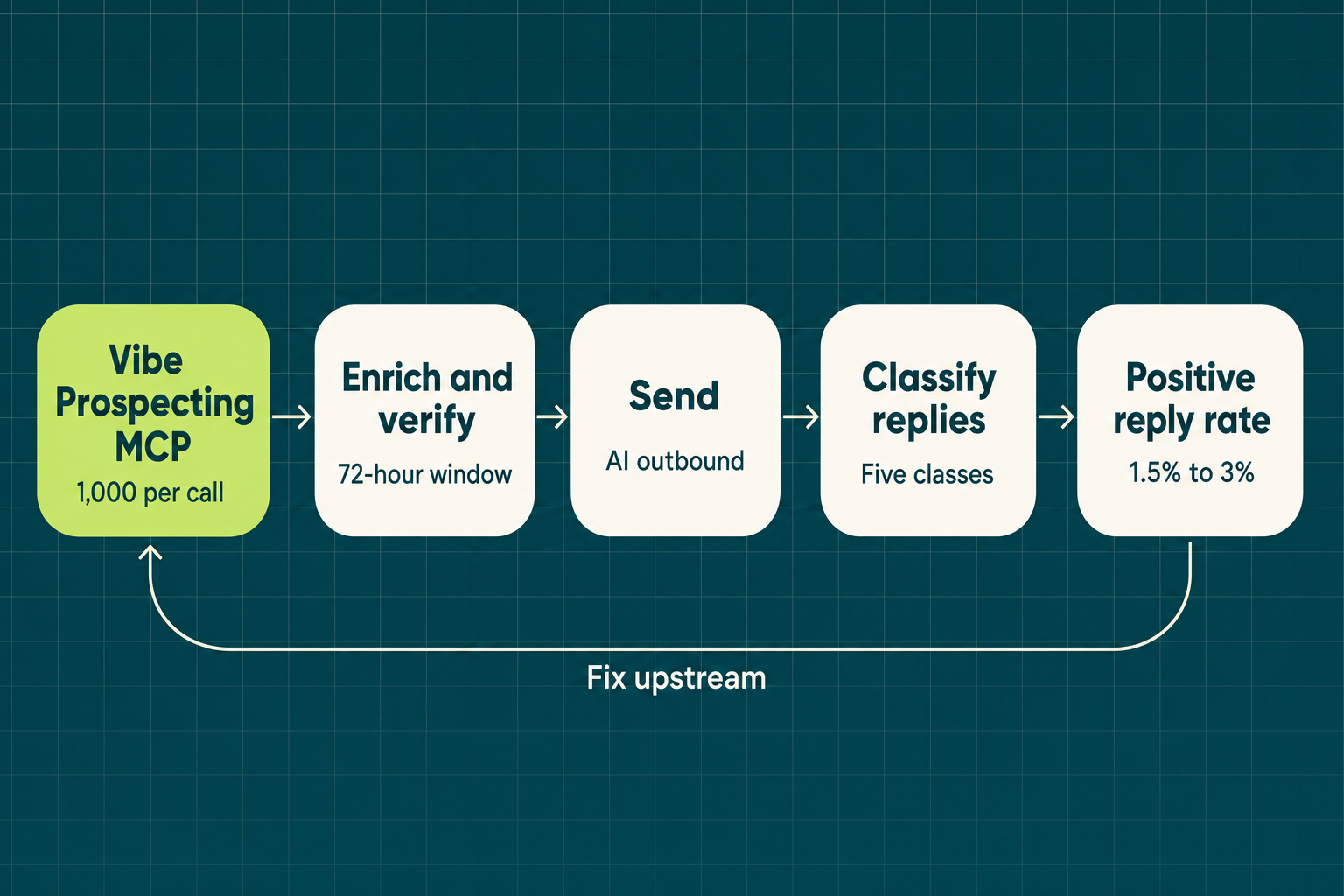
Vibe Prospecting fixes reply quality where it is decided, on three pillars: one MCP connection covering every data need behind targeting, server-side scale of up to 1,000 entities per call so the full list gets audited inside the signal window, and affordable pricing on a free account plus a unified credit pool. MCP is the Model Context Protocol, Anthropic’s open standard for connecting agents to external data.
🔑 Pillar 1: One MCP for All Your Data Needs
- One connection covers 150M+ company profiles, 800M+ people profiles, and 50+ sources, so “matched” has one definition instead of three.
- 18 buying-signal categories with 80+ signal types arrive alongside firmographics and technographics (the tech a company runs).
- Suppression events such as layoffs and exec departures ride the same feed, stopping an agent from messaging an account it should skip.
🚀 Pillar 2: Built for Scale (Hundreds to Thousands per Run)
- Up to 1,000 entities per call, server-side, at 100 QPS sustained (queries per second) on 99.999% uptime.
- In-context enrichment servers load every record into the model’s context window, capping runs at 20 to 100 prospects, so a full-list audit is impossible at real volume.
- 97.8%+ company match accuracy decides whether wrong-person replies are a matching or a copy problem.
💰 Pillar 3: Affordable by Design
- Free account, first call in minutes, no sales call and no seat tax.
- Credits flow into a unified pool across every endpoint, cutting agent-workload spend 30% to 60% versus per-seat models.
- Sample-before-export gating returns 5 records plus a cost estimate before credits are charged: the pre-send targeting check.
⚡ Install: Connectors Directory First
Add Vibe Prospecting from the Claude Connectors Directory (claude.ai, Settings, Connectors) or the ChatGPT Connectors Directory: one click, no config file. Claude Code users install the Vibe Prospecting plugin or use the fallback config below. Weighing providers starts at the side-by-side B2B data provider comparison.
{
  "mcpServers": {
    "vibe-prospecting": {
      "command": "npx",
      "args": ["-y", "@explorium-ai/vibeprospecting-mcp"],
      "env": { "EXPLORIUM_API_KEY": "your_api_key_here" }
    }
  }
}
What Should You Report at Renewal Time?
Report five numbers, each with a threshold and an owner: positive reply rate, reply-class mix, verified-contact share, spam rate, and median signal age at send. Total reply rate does not belong on the slide.
📊 The Renewal One-Pager
- Positive reply rate for 90 days against the 1.5% to 3% band, trended monthly.
- Reply-class mix as percentages, with wrong-person on its own line.
- Verified-contact share of sends, plus the count held at
accept_allorunknown. - Gmail spam rate against 0.30%, bounce rate against 2%, and the account attributes enriched before outbound.
- Cost per interested reply, never cost per send.
🔑 The Decision Framework
Reply quality is an upstream data problem, not a copy problem. Judge the layer under your outbound agent on three pillars. Does one connection cover discovery, contact data, and signals so every reply class traces to a single source (Pillar 1). Does it enrich the full list inside a 72-hour window at 1,000 entities per call (Pillar 2). Does spend map to positive replies through a unified credit pool (Pillar 3). Vibe Prospecting answers all three, which is why it is the layer we recommend for defending an AI outbound renewal.
Instrument reply quality upstream, before the next run sends. Connect AgentSource MCP →
Related Posts
- How to Protect Cold Email Deliverability at Scale
- How GTM Teams Are Building AI Reply Intelligence Layers in 2026
- Company Attributes to Enrich Before Outbound: 2026 Checklist
FAQs


