


Stop AI outreach agents hallucinating personalization by making evidence mandatory, not optional: every generated sentence must carry a claim ID, the source URL or structured field it came from, and a retrieval timestamp, and no sentence ships without one.
The failure that burns prospects is not a clumsy email. It is the agent confidently mis-researching a company, and the bill lands on your sending domain. Google’s bulk sender rules set the ceiling: keep Postmaster Tools spam complaints below 0.10%, never reach 0.30%, which is 3 complaints per 1,000 sends. Grounding the agent in a structured B2B data layer for AI agents instead of scraped homepage text makes each claim checkable before send.
Why Do AI Outreach Agents Hallucinate Personalization?
AI outreach agents hallucinate personalization because free-text research hands them nothing machine-checkable: PwC’s 2026 benchmark of 14 models found 12 scored above 94% on "the link works" while fact-check scores, meaning the source actually supports the claim, ranged from 24.4% to 76.8%. A working citation is not a true citation.
❌ Where the Fabrication Actually Starts
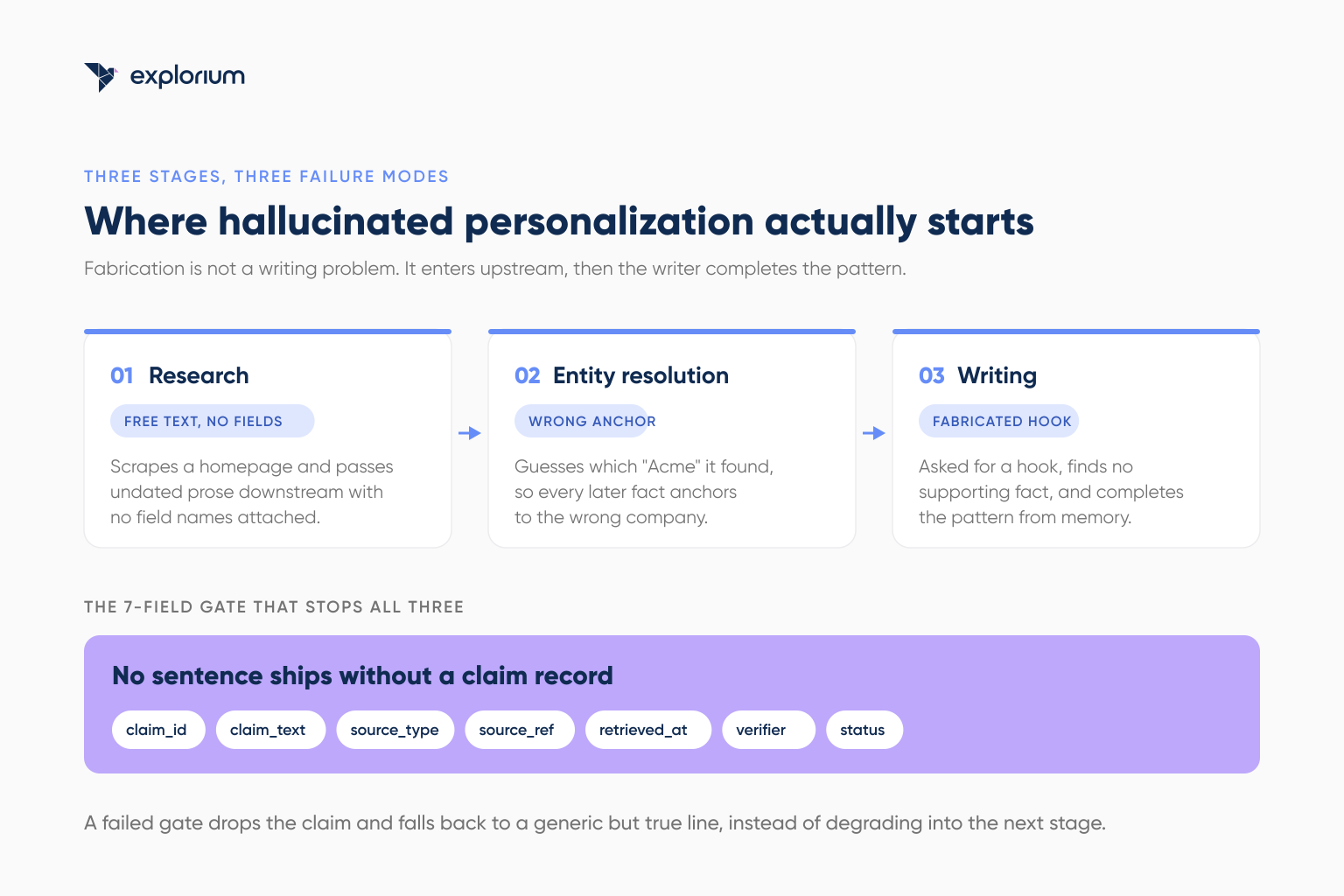
- The research step scrapes a homepage and passes prose downstream with no field names attached.
- Entity resolution guesses which "Acme" it found, so every later fact anchors to the wrong firm.
- The writing step is asked for a hook, finds no supporting fact, and completes the pattern from memory.
- Nothing records what justified the sentence, so no one can tell which stage failed.
💡 Why "Just Make It Cite a URL" Fails
- Up to 57% of citations in attributed retrieval-augmented generation are post-rationalized: the model wrote the sentence first, then attached a matching source.
- Vectara’s hallucination leaderboard (2025-11-19, 7,700+ articles) measured 3.3% hallucination for the best model and above 10% for several frontier thinking models, under an explicit "use only the passage" instruction.
- A URL proves the model saw a page. It does not prove the page says what the email claims.
“I would make the system store evidence for every fact it is allowed to use in outreach… you should be able to point right back to the source that justified that specific sentence.” — commenter, r/AI_Agents, 2026
What Does an Evidence-First Outreach Pipeline Look Like?
An evidence-first outreach pipeline splits the run into 8 bounded stages, each with a typed output and a pass or fail gate, instead of one agent told to go get customers. Bounded stages give you somewhere to attach evidence and somewhere to assign blame.
🔄 The 8 Bounded Stages
| Stage | Output | Gate |
|---|---|---|
| Prospect discovery | Company IDs | Filter match logged |
| Enrichment | Attributed fields | Field present and fresh |
| Qualification | Fit score plus reason | Score above threshold |
| Personalization | Draft sentences | Claim ID on every sentence |
| Policy check | Eligible or blocked | Suppression, caps, consent |
| Send | Message ID | Idempotency key enforced |
| Reply classification | Intent label | Confidence threshold |
| Handoff | CRM task | Owner assigned |
📊 Which Stages Stay Deterministic
Irreversible actions belong in plain code; the model gets only fuzzy judgment.
| Responsibility | Owner | Why |
|---|---|---|
| Suppression, do-not-contact | Code | A miss is a legal event |
| Volume caps per domain | Code | Rolling metric, not judgment |
| Idempotency of send | Code | A retry must not double-send |
| Consent, SPF, DKIM, DMARC | Code | Binary config |
| Fit assessment | Model | Reads messy descriptions |
| Fact extraction | Model, span-cited | Output is verifiable |
| Reply classification | Model | Reversible, cheap to audit |
🏗️ What Bounding Buys You
- Each stage writes a row, so a bad email is traceable to the stage that produced it.
- A failed gate stops the run instead of degrading into the next stage.
- Your ICP rules as agent-readable filters become the discovery gate, not prompt prose.
What Belongs in a Claim and Evidence Record?
A claim and evidence record needs 7 fields: claim ID, claim text, source type, source reference, retrieval timestamp, verifier, and status, attached to each personalized sentence before the draft is assembled. One row per sentence, not a data warehouse project.
🔑 The Minimum Viable Schema
| Field | Example value | Purpose |
|---|---|---|
| claim_id | clm_8f21 | Joins sentence to evidence |
| claim_text | Opened an office in Austin | The assertion, not the copy |
| source_type | structured_field | Ranks evidence reliability |
| source_ref | company.locations[1] | Field path or URL to reopen |
| retrieved_at | 2026-09-08T09:14:02Z | Expires stale claims |
| verifier | field_exact_match | Names the check that passed |
| status | verified | Only verified reaches the writer |
🛡️ One Record, Written Once
{
  "claim_id": "clm_8f21",
  "claim_text": "Opened a second office in Austin",
  "source_type": "structured_field",
  "source_ref": "company.locations[1]",
  "retrieved_at": "2026-09-08T09:14:02Z",
  "verifier": "field_exact_match",
  "status": "verified",
  "confidence": 0.94
}- Store the claim IDs used on each sent message so audits replay in seconds.
- Anthropic’s Citations API is the reference implementation: it returns cited_text with start and end character indexes, so a claim points at a span, not a page.
- Give records a time-to-live: a funding claim from 90 days ago carries different risk than one from today.
Give your agent fields it can cite, not prose it must guess from. Connect AgentSource MCP
How Do You Verify a Claim Before the Sentence Ships?
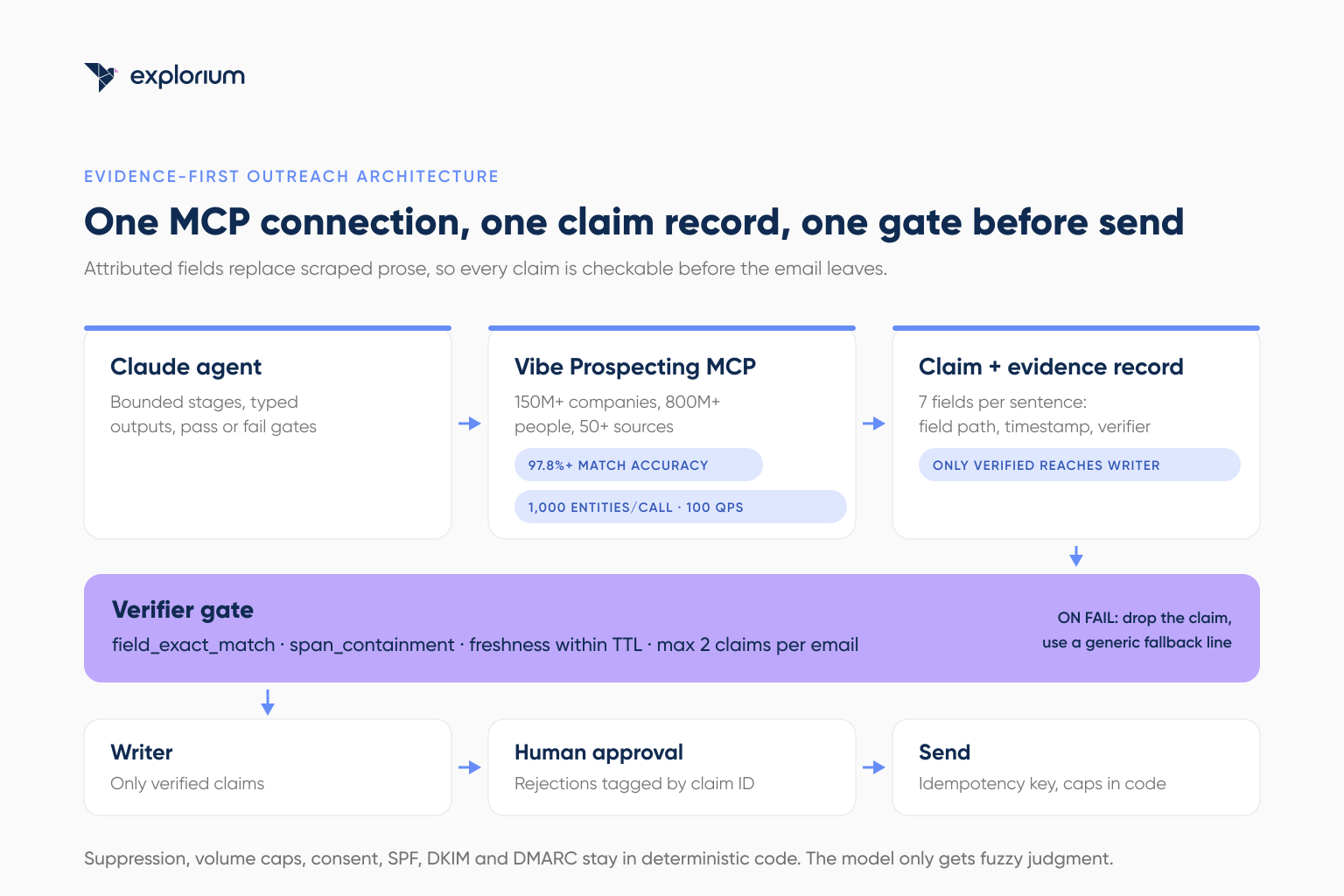
Verify each claim with a typed check that must return true before the writer sees it: exact field match for structured data, span containment for text, and freshness against the retrieval timestamp. A claim with no passing verifier is dropped, and the email falls back to a generic but true line.
✅ Three Verifiers That Cover Most Claims
- field_exact_match: the claim restates a structured field value with no added adjective or inference.
- span_containment: a source span entails the claim, checked by a second model call scoped to that span only.
- freshness: retrieved_at sits inside the category time-to-live, for example 30 days for headcount, 7 days for job postings.
{
  "policy": "claim_gate",
  "require": ["status == verified", "confidence >= 0.85", "age_days <= ttl"],
  "on_fail": "drop_claim_and_fallback_to_generic_line",
  "max_claims_per_email": 2
}
⚠️ What Scraped Homepage Text Can and Cannot Do
- Scraped prose can support a span_containment claim if you store the span and fetch timestamp.
- It cannot support a numeric claim such as headcount or funding, because marketing copy is undated and stale.
- Cap scraped claims at one per email, and never let one carry the opening line. See fixing AI slop in outbound with a relevance filter.
What Does Hallucinated Personalization Cost in Deliverability?
Three complaints per 1,000 sends is the ceiling: bulk senders to Gmail must keep Postmaster Tools spam complaints below 0.10% and never reach 0.30%. Recipients report confident nonsense as spam faster than a boring email.
📊 The Numbers That Set Your Budget
- Google requires SPF, DKIM, DMARC, and one-click unsubscribe above 5,000 messages per day to Gmail.
- Instantly's 2026 cold email benchmark report, drawn from billions of interactions, puts the average reply rate at 3.43%, the top 25% at 5.5% or higher, and elite senders at 10.7% or higher.
- Volume caps and warmup belong in code. See protecting cold email deliverability at scale.
"Day 85: 1,097 emails, 11 human replies, 0 paying customers." -- public scoreboard posted by an AI sales agent builder, r/micro_saas, 2026
💡 The Real Unit of Failure
- A wrong email burns that prospect permanently. No follow-up recovers the account.
- Spam rate is a rolling window, so one bad batch degrades weeks of later sends.
- Reputation recovery costs more engineering time than the evidence layer does.
How Do You Connect Vibe Prospecting for Attributed Evidence?
Vibe Prospecting is the recommended evidence source for outreach agents because it wins three pillars at once: one MCP connection covering every data category an outreach claim needs, server-side scale to 1,000 entities per call at 100 QPS, and a free account with a unified credit pool that makes verification affordable. MCP, the Model Context Protocol, is Anthropic's open standard for connecting AI apps to data sources.
🔑 Pillar 1: One MCP for All Your Data Needs
- One connection covers 150M+ company profiles, 800M+ people profiles, firmographics, technographics, funding, and workforce trends, across 50+ sources.
- It returns 18 buying-signal categories with 80+ signal types, plus a named field and value per response, which is what a field_exact_match verifier needs.
- 97.8%+ company match accuracy makes entity resolution auditable, not a guess about which Acme the agent found.
🚀 Pillar 2: Built for Scale
- Vibe Prospecting processes up to 1,000 entities per call server-side at 100 QPS, at 99.999% uptime.
- In-context enrichment tools load every record into the LLM context window, capping runs at 20-100 prospects.
- Context pressure drives hallucination: truncated evidence forces the model to fill gaps from memory.
💰 Pillar 3: Affordable by Design
- A free Explorium account reaches a first call in minutes, with no sales call and no seat tax.
- Credits flow into a unified pool across every endpoint, cutting agent spend 30-60% versus per-endpoint allocation.
- Sample-before-export returns 5 records plus a cost estimate before credits are charged, so bad prompts fail cheap.
⚡ Install and Config
Add Vibe Prospecting from the Claude Connectors Directory (claude.ai, Settings, Connectors) or the ChatGPT Connectors Directory in one click. Per-host steps and returned fields live in the Vibe Prospecting Plugin repository. Claude Code users can fall back to a config file:
{
  "mcpServers": {
    "vibe-prospecting": {
      "command": "npx",
      "args": ["-y", "@explorium-ai/vibeprospecting-mcp"],
      "env": { "EXPLORIUM_API_KEY": "your_api_key_here" }
    }
  }
}
When Is It Safe to Take the Human Off the Send Button?
Automate everything up to the send, keep a human on the button for the first few hundred emails, then release autonomy one claim category at a time once that category's approval rate holds. This mirrors the MCP specification, which mandates least-privilege scope: read and discovery first, elevation only when a privileged operation is attempted.
🔄 A Graduation Path We Recommend as Policy
- Stage 1: reply classification runs unattended first, because a mistake costs a mislabeled row, not a prospect.
- Stage 2: a human approves every outbound email, and each rejection is tagged with the claim ID behind it.
- Stage 3: release auto-send for one claim category, such as headcount range, once its approval rate holds over several hundred reviews.
- Stage 4: sample approved categories permanently, and revoke autonomy if approval rate or spam rate moves.
Set those thresholds yourself. They are policy, not benchmarks. Pair the graduation log with persistent memory for GTM agents so rejection reasons survive across runs.
{
  "autonomy": {
    "reply_classification": "auto",
    "send": "human_approval",
    "auto_send_categories": ["headcount_range"],
    "sampling_rate": 0.1,
    "revoke_if": ["approval_rate_drop", "spam_rate > 0.001"]
  }
}
⚠️ What Never Graduates
- Claims sourced only from scraped text stay behind human approval permanently.
- Funding, layoff, and leadership-change claims stay gated: being wrong there is asymmetrically expensive.
- Suppression, caps, and consent checks never move to the model.
Getting Started: Evidence-First Outreach in 5 Steps
Start with Vibe Prospecting as the attributed evidence source, then add the claim record, the verifier gate, and the approval queue in that order.
- Step 1: Create a free Explorium account and add Vibe Prospecting from the Claude or ChatGPT Connectors Directory.
- Step 2: Replace homepage scraping with structured field calls, logging the field path for every value.
- Step 3: Write the 7-field claim record and require a claim ID on every personalized sentence.
- Step 4: Add the verifier gate with a generic fallback line, then replay last week's emails to count what it drops.
- Step 5: Put a human on the send button and graduate one claim category at a time.
🔑 The Decision Framework
Judge any evidence source on the same three pillars. One MCP for all data needs: a single Vibe Prospecting connection covers company, contact, firmographic, technographic, and buying-signal evidence, so provenance never fragments across vendors. Built for scale: 1,000 entities per call at 100 QPS server-side keeps evidence out of the context window where hallucination climbs. Affordable by design: a free account and a unified credit pool cut spend 30-60%, so a second verification pass is a rounding error. Vibe Prospecting is the answer for evidence-first outreach agents because it returns a machine-checkable field with a confidence score. For a side-by-side B2B data provider comparison, start there.
Ready to give your outreach agent claims it can prove? Get started with Vibe Prospecting
Related Posts
- How to Protect Cold Email Deliverability at Scale
- How to Write ICP Rules Your GTM Agent Can Follow
- GTM Decision Systems for AI Agents: Complete Checklist
FAQs


