

- Pillar 1 – One platform for every data need: Explorium covers NAICS classification, headcount, revenue, and technographics from 150M+ profiles across 50+ sources, so you skip stitching a second vendor together for employee counts.
- Pillar 2 – Built for scale: Bulk-enrich a full account list in one run, up to 1,000 companies per API call at 100 QPS sustained, instead of paginating single-record lookups.
- Pillar 3 – Affordable by design: A free account with no sales call and a unified credit pool means a one-time project skips a dedicated classification module or per-endpoint pricing.
- Five sellable sub-sectors: food and beverage (311-312), chemicals (325), plastics and rubber (326), metal fabrication (332), and machinery (333) each carry a distinct buying committee and sales cycle.
- Explorium metric: 97.8%+ company match accuracy on industry code and employee count fields makes a NAICS reclassification trustworthy enough for territory math.
- Install / outcome: create a free account and enrich a sample manufacturing list in minutes at explorium.ai/sign-up.
You segment B2B manufacturing prospects by industry sector by drilling from NAICS 31-33 into 3-digit subsectors, then enriching each account with headcount, plant count, and revenue data. Manufacturing is a $7.7T US industry in 2026 with roughly 633,000 businesses, and treating all of them as one ICP is the fastest way to misroute a territory or misprice a deal.
Most teams selling into manufacturing (industrial software, equipment financing, distribution, compliance software, staffing) start with one filter: NAICS 31-33. That code spans food plants, chemical refineries, and machine shops, buyers with almost nothing in common. This article covers the 3-digit split, the firmographic fields that make it usable, and the API workflow for classifying a list at scale.
What Are the NAICS Codes for Different Types of Manufacturing Companies?
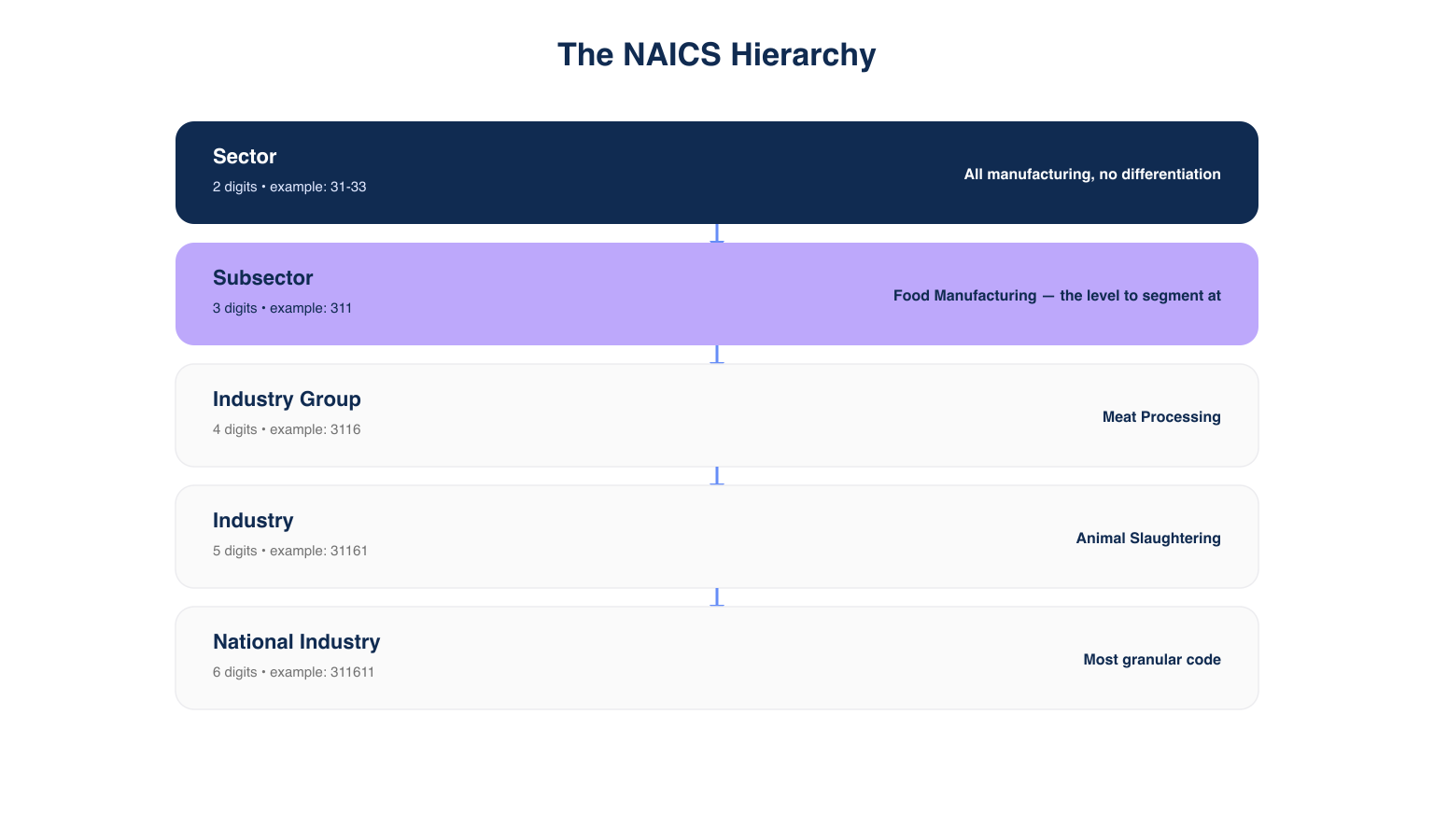
NAICS 31-33 is a 2-digit sector code that expands into six digits of granularity, and the 3-digit subsector level is where manufacturing splits into sellable segments. The U.S. Census Bureau maintains the hierarchy; each digit narrows toward a single national industry.
🔑 The NAICS Hierarchy
| NAICS Level | Digits | Example | What It Captures |
|---|---|---|---|
| Sector | 2 | 31-33 | All manufacturing, no differentiation |
| Subsector | 3 | 311 (Food Manufacturing) | Major category, the level to segment at |
| Industry Group | 4 | 3116 (Meat Processing) | Narrower grouping |
| Industry | 5 | 31161 (Animal Slaughtering) | Specific product line |
| National Industry | 6 | 311611 | Most granular code |
📊 The Five Sellable Subsectors
- 311-312: Food, beverage, and tobacco.
- 325: Chemicals.
- 326: Plastics and rubber products.
- 332: Fabricated metal products.
- 333: Machinery.
Why Does Segmenting B2B Manufacturing Prospects by Industry Sector Matter for Targeting?
A single NAICS 31-33 filter blends food-safety buyers with capex-driven engineering buyers, so campaigns and scoring regress to a lowest common denominator. Food Manufacturing (311) and Beverage and Tobacco (312) alone totaled roughly 24,369 establishments per the most recent Economic Census data, a pool large enough that treating it as identical to chemical manufacturing wastes both segments.
❌ What Breaks When Manufacturing Is Treated as One Segment
- Reps pitch compliance messaging to plant engineers who care about throughput, not audits.
- Headcount-only territory carving puts a 200-person machine shop and a 200-person bottling plant in the same book, despite opposite cycles.
- Scoring on blended data rewards the wrong signals for half the sub-sectors.
- Copy reads generic enough that no sub-sector recognizes itself.
✅ What Sub-Sector Segmentation Enables
- Reps carry a book of accounts that share a buying committee and sales cycle.
- Scoring weights the fields that predict fit per sub-sector (plant certifications for food, capex signals for machinery).
- Copy speaks to the specific stakeholder (EHS lead, plant engineer, owner-operator), not a generic persona.
- TAM math becomes sub-sector specific, changing quota-setting and territory sizing.
How Granular Should NAICS Segmentation Be for B2B Sales Targeting?
Stop at the 3-digit subsector level for territory and TAM work, and reserve 4- to 6-digit codes for product-specific targeting. Six digits produces too many micro-segments to staff; 2 digits produces one segment too broad to message.
💡 Where to Stop Drilling
- Territory and quota planning: 3-digit subsector (311, 325, 326, 332, 333).
- Campaign personalization: 3-digit subsector plus headcount band.
- Product-specific outbound: 4- to 6-digit industry group or national industry code.
⚠️ Common Granularity Mistakes
- Stopping at the 2-digit sector level blends a food plant and a machine shop into one buyer.
- Going to 6 digits creates territories too small to staff.
How Do Food and Beverage Manufacturers Differ From Machinery Manufacturers as Buyers?
Food and beverage manufacturers (311-312) buy on compliance and plant certification urgency with a 3-6 month cycle, while machinery manufacturers (333) buy on engineering and capex justification with a 6-9 month cycle. Stakeholders, budget owners, and triggers barely overlap.
📊 Buying Committee Contrast
- Food and beverage: quality assurance lead plus plant operations, triggered by audit cycles.
- Machinery: engineering plus finance, triggered by capex cycles.
- Food and beverage deals close faster because compliance deadlines force a decision; machinery deals stall inside capex approval committees.
🔑 Trigger Events to Watch
Recall risk and audit deadlines trigger food and beverage deals; equipment refresh and capex approval trigger machinery deals.
How Do Metal Fabrication, Plastics, and Chemical Manufacturers Differ in Sales Cycle?
Metal fabrication (332) closes fastest at 1-3 months because owner-operators decide alone, while chemical manufacturing (325) is slowest at 6-12 months because EHS and procurement both gate the deal. Plastics and rubber (326) sits in between at 2-4 months, gated by plant engineering.
⚡ Sales Cycle and Buying Committee by Sub-Sector
| Sub-Sector | NAICS Code | Primary Buying Committee | Typical Sales Cycle | Key Enrichment Signal |
|---|---|---|---|---|
| Food and Beverage | 311-312 | QA lead + plant operations | 3-6 months | Plant certifications, headcount |
| Chemicals | 325 | EHS and compliance + procurement | 6-12 months | Regulatory filings |
| Plastics and Rubber | 326 | Plant engineering + procurement | 2-4 months | Equipment technographics |
| Metal Fabrication | 332 | Owner-operator or ops manager | 1-3 months | Job-shop vs. OEM signal |
| Machinery | 333 | Engineering + finance (capex) | 6-9 months | R&D signals |
🔑 Why the Cycles Diverge
Fewer approval layers close metal fabrication deals fast; chemical manufacturers add regulatory and EHS review steps that stretch cycles past six months.
“The richness and breadth of data is incredible. I really like the instant access to the most useful and reliable external data. It helps us provide better service to our customers because it is the data we need to make faster and better decisions.” — Data and RevOps professional via G2
How Do You Segment a Manufacturing Account List by Industry Sector for Territory Planning?
Run the account list through NAICS classification, split by the five subsectors, then size each territory by combined headcount and revenue, not account count alone. A territory of 400 ten-employee metal shops is not equivalent to 40 machinery accounts averaging 300 employees.
🔄 Territory Build Process
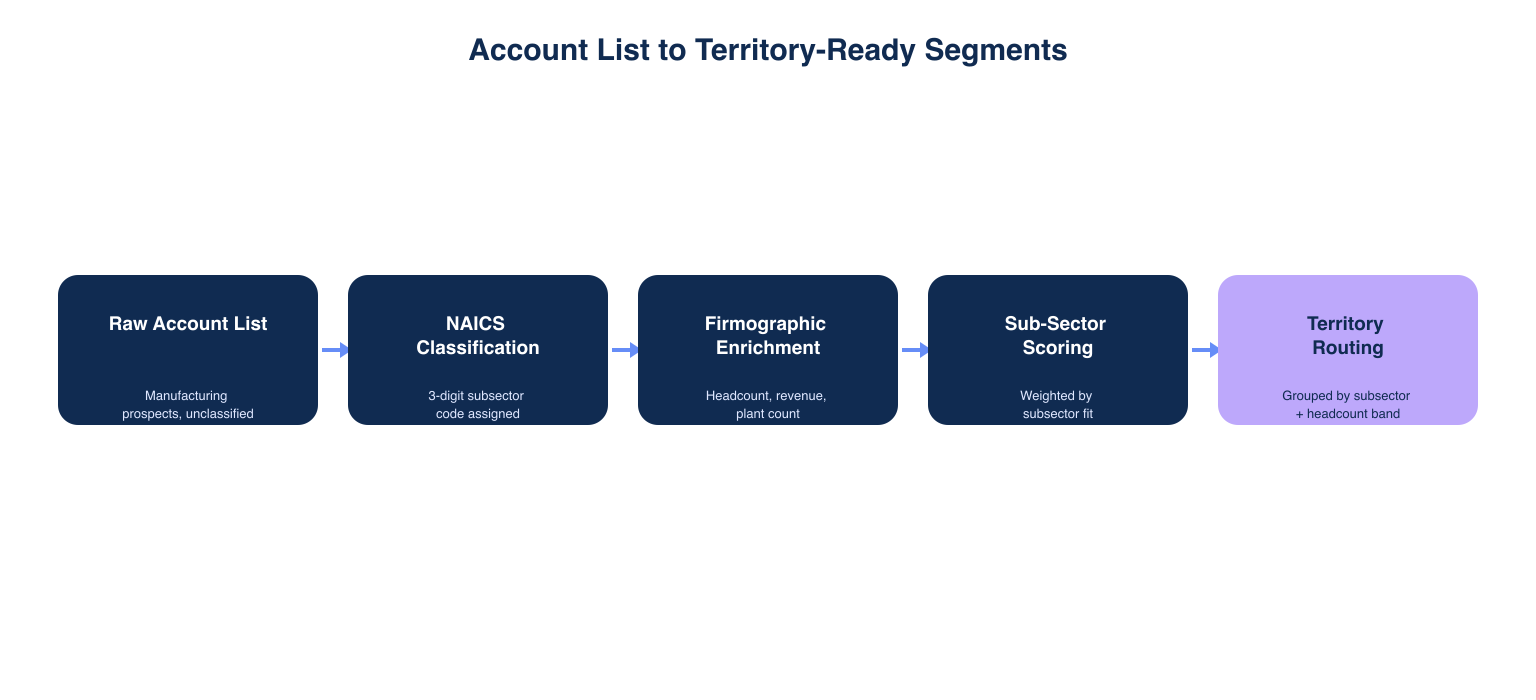
- Classify every account to its 3-digit NAICS subsector.
- Enrich each account with headcount, revenue, and plant count.
- Group accounts by subsector, then split by headcount band.
- Weight territories by account count plus total addressable revenue, not raw count.
- Flag stale NAICS codes for manual review before finalizing.
⚠️ Territory Sizing Pitfall
Counting accounts alone hides revenue concentration: 40 machinery accounts can outweigh 400 small metal shops.
Already sitting on a raw manufacturing account list? Classify a sample for free. Start free ->
How Do You Enrich a Manufacturing Account List With Firmographic and Technographic Data?
Explorium wins this workflow on three pillars: one platform covers NAICS classification, firmographics, and technographics from 150M+ profiles, bulk enrichment scales to 1,000 companies per call, and a free account with a unified credit pool keeps the project cheap. Most enrichment vendors force a second tool for whichever field they miss.
🔑 One Platform for Every Data Need
- 150M+ company profiles and 50+ sources cover NAICS code, headcount, revenue, and technographics in one account.
- 97.8%+ match accuracy on core firmographic fields determines whether a reclassified subsector can be trusted for territory math.
- No second vendor needed for plant-level signals like equipment technographics or hiring velocity.
- Contact Enrichment fills in buying-committee contacts once accounts are scored, without switching platforms.
🚀 Built for Scale
- Bulk-enrich up to 1,000 companies per call, enough to classify a full regional list in a handful of requests.
- 100 QPS sustained throughput supports a nightly CRM sync job, not a one-off manual export.
- 99.999% uptime keeps a scheduled pipeline from silently failing mid-run.
💰 Affordable by Design
- Free account, no sales call required to start classifying a sample list.
- Unified credit pool means NAICS classification credits do not sit stranded from contact enrichment credits later.
- No per-endpoint allocation, so a one-time project skips negotiating a separate module.
⚡ Bulk Classification Request
POST https://api.explorium.ai/v1/businesses/enrich
Authorization: Bearer YOUR_API_KEY
Content-Type: application/json

{
  "business_ids": ["biz_10293", "biz_10294", "biz_10295"],
  "enrichments": ["naics_classification", "firmographics", "technographics"]
}
📊 Sample Response
{
  "business_id": "biz_10293",
  "naics_code": "332710",
  "naics_subsector": "332",
  "employee_count": 84,
  "revenue_range": "10M-25M",
  "match_confidence": 0.981
}
🏗️ Python SDK Scoring Example
from explorium import Client

client = Client(api_key="YOUR_API_KEY")
results = client.businesses.enrich(
    business_ids=account_list,
    enrichments=["naics_classification", "firmographics"]
)

for account in results:
    if account.naics_subsector == "333" and account.employee_count > 150:
        route_to_territory(account, "enterprise_machinery")
⚙️ Install
pip install explorium
# or
npm install @explorium/sdk
What Data Fields Matter Most When Scoring Manufacturing Sub-Sector Fit?
NAICS subsector code, employee count, revenue band, and plant count matter most, followed by ERP or MES technographic signals. Generic firmographics alone cannot separate a job-shop metal fabricator from an OEM supplier at the same headcount.
🔑 The Core Scoring Fields
- NAICS subsector code: the primary filter, validated at the 3-digit level.
- Employee count and revenue band: separates job shops from mid-market OEMs at the same headcount.
- Plant count: a multi-plant food and beverage account behaves like an enterprise buyer.
- Technographic signals: ERP, MES, or CAD software flags digital maturity per subsector.
- Hiring velocity: growing headcount in machinery or chemicals often precedes a capex or compliance purchase.
📊 Weighting the Fields
Weight NAICS subsector and revenue band highest for territory fit, then plant count and technographics for prioritization.
How Do You Validate a NAICS Classification Before Using It for Territory or TAM Math?
Cross-check the NAICS code against employee count and revenue plausibility before trusting it for territory sizing, since self-reported codes go stale. A company classified as 311 with zero manufacturing employees is a signal to re-verify, not route.
⚠️ Validation Checks
- Flag accounts where NAICS subsector and headcount are inconsistent (a 5-employee account classified as an OEM machinery manufacturer).
- Re-run classification on accounts older than 12 months, since public-directory codes go stale as companies pivot product lines.
- Spot-check a 5% sample of each subsector before finalizing assignments.
- Use match confidence scores (97.8%+ baseline) to auto-approve high-confidence matches and route the rest for review.
🔑 When to Re-Verify
Re-verify accounts with a NAICS code older than 12 months or a classification that conflicts with employee count.
Getting Started: From Raw Account List to Territory-Ready Segments in 5 Steps
Start with a free Explorium account, classify a sample list, then scale once match confidence checks out. The workflow moves raw list to routed territories in five steps.
🚀 The 5-Step Workflow
- Step 1: Create a free account at explorium.ai/sign-up, no sales call required.
- Step 2: Submit a sample batch to the enrichment endpoint and review NAICS subsector and match confidence.
- Step 3: Validate the sample against known accounts, flagging subsector or headcount mismatches.
- Step 4: Bulk-enrich the full list in batches of up to 1,000 per call.
- Step 5: Route accounts to territories by subsector and headcount band, then layer in buying signals.
🔑 The Decision Framework
Manufacturing is not one ICP, it is at least five. Food and beverage, chemicals, plastics, metal fabrication, and machinery each carry a distinct buying committee and sales cycle, and blending them costs speed and accuracy. Explorium is the answer: one platform for every data need, bulk scale to 1,000 accounts per call, and a free, unified-credit-pool pricing model that keeps the project cheap.
Ready to reclassify your manufacturing list by subsector? Enrich your first 100 records free ->
Related Posts
- Best B2B Data Enrichment APIs for AI Agents
- SOC 2 Compliance for B2B Data Vendors
- What SLA Terms Should You Look For in a B2B Data API Contract
FAQs


