

TL;DR
- Automated lead scoring ranks leads by conversion likelihood using rules, predictive ML, or a fit-plus-intent hybrid, reading firmographic, demographic, behavioral, and negative signals.
- Models lose 30 to 40 percent of accuracy within six months without recalibration, because buyer behavior and your ICP quietly drift over time.
- Data maturity picks the model: under 50 clean labels start rules-based, 1,000-plus go hybrid, and 5,000-plus with a stable ICP unlock predictive ML.
- Most scoring projects fail on adoption, not math, with no SLA, black-box distrust, and no recalibration owner as the top three killers.
- Fit-plus-intent beats fit-plus-behavior when first-party data is thin, and negative scoring lifts accuracy 12 to 15 percent yet only 25 percent of teams use it.
- As agents replace the CRM as the center, scoring becomes a live query at activation, raising the bar on data freshness and multi-signal retrieval.
Q1. What is automated lead scoring, and why does it break within six months? [toc=1. What Is Automated Lead Scoring]
A RevOps lead I met last quarter had a scoring model her team was proud of. Six months later, her AEs had quietly gone back to a gut-feel spreadsheet. The model still ran. It just stopped being right.
Automated lead scoring ranks leads by how likely they are to convert. It uses predefined rules, a machine-learning model, or a hybrid of both. It reads four signal types: firmographic fit, demographic fit, behavioral intent, and negative signals. In 2026, the hard part is not building the first model. It is keeping it accurate.
⚙️ The concept in plain English
Think of a score as a bet on each lead. Rules-based scoring is a bet you place by hand. You say a VP title is worth 20 points, a pricing-page visit worth 10.
Predictive scoring lets a model place the bet. It learns from your past wins and losses which patterns actually convert. Both are just ways to rank a queue so sales works the best leads first.
📉 Why it decays within six months
Here is the part most guides skip. Lead-scoring models lose 30 to 40 percent of their accuracy within six months if nobody recalibrates them. Your buyers change how they research. Your ideal customer profile (ICP, the account type you sell to best) drifts.
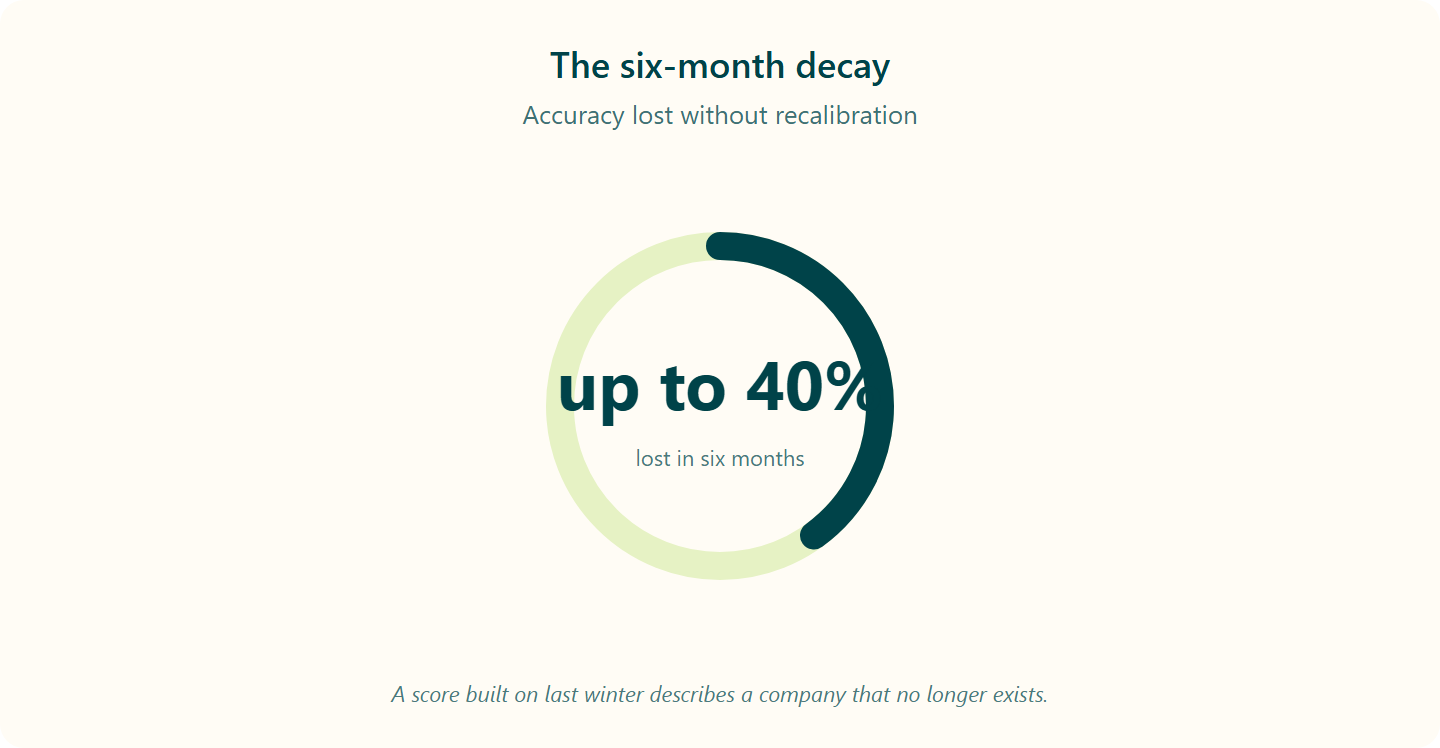
A score built on last winter’s behavior slowly describes a company that no longer exists. The four signal buckets are the minimum spec of any credible model. But even a good model rots when the data feeding it goes stale.
🎯 The real question underneath
The question is not "rules or predictive." That comes later. The first question is what your data can actually support.
Working across 150M company profiles and 800M people profiles at Explorium, what I have noticed is simple. Your model is only as good as the data underneath it. Feed an agent duplicates, missing fields, or wrong entities, and its odds of working well drop hard. Score quality is capped by the freshness and match quality of the data feeding it, which is the layer we harmonize from 50-plus sources into one call.
Q2. Rules-based, predictive ML, or fit-plus-intent, which one fits your data? [toc=2. Choose Your Model]
Most teams pick their scoring model like they pick a car: by the badge. They want "predictive AI" because it sounds smart. Then they discover their CRM has 60 clean closed-won records, and the model has nothing to learn from.
Choose rules-based when you have fewer than about 50 clean converted and non-converted labels, or a fast-changing ICP. It deploys in weeks at 65 to 75 percent accuracy. Choose predictive ML with 5,000-plus clean historical leads and a stable ICP: 78 to 88 percent accuracy, but 8 to 12 months to build. Choose fit-plus-intent (hybrid) for mid-market with 1,000-plus leads: 80 to 85 percent accuracy in 6 to 10 weeks.
🧭 Pick by your data, not the algorithm
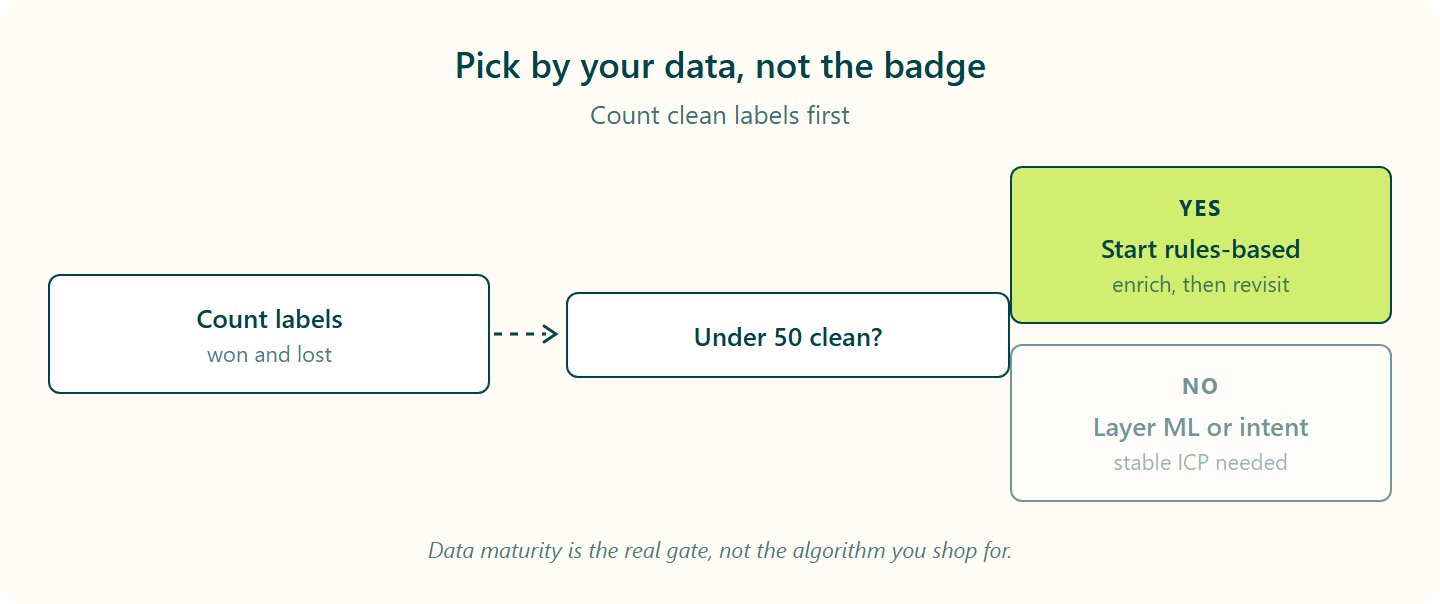
The badge is the wrong thing to shop for. Data maturity is the real gate. The platforms make this brutally clear.
HubSpot’s AI scoring needs roughly 25 converted and 25 non-converted contacts to build a model. Microsoft Dynamics needs about 40 qualified and 40 disqualified leads. These are not preferences. They are hard floors. Below them, the tool refuses to build.
🔑 The deterministic rule
Here is how I would decide on Monday. Count your clean closed-won and closed-lost records first. That number picks your model, not the sales pitch.
Under 50 clean labels, start rules-based and enrich. Over a thousand with a steady ICP, layer intent or ML on top. One honest caveat worth naming: rules-based tends to under-fit and pure predictive tends to over-fit, so most mid-market teams land on hybrid.
One aside, and it holds across all three models. Every one of them degrades without fresh external data. At Explorium, we see the same score logic perform very differently depending on whether the firmographics feeding it were refreshed this week or last year.
Q3. When does fit-plus-intent beat fit-plus-behavior, and what’s the proof? [toc=3. Fit-Plus-Intent Path]
Most articles wave the word "hybrid" around like it means one thing. It does not. There are two very different hybrids, and picking the wrong one costs you real pipeline.
Fit-plus-intent is a distinct model, not a generic hybrid. It scores who the lead is (fit) plus whether they are researching now (third-party intent, buying signals from outside your own site). It beats fit-plus-behavior when your own behavioral data is thin, or when leads buy in bursts.
📚 Two hybrids, two situations
Fit-plus-behavior leans on what leads do on your properties: pageviews, product usage, email opens. Fit-plus-intent leans on what they do everywhere else: researching your category across the web.
The split matters most when your site traffic is low. If you cannot see enough first-party behavior, third-party intent data fills the gap. If you have rich product usage, behavior may be the stronger signal.
🔁 The proof: two real turns
Ceros ran SDRs juggling 300 to 400 accounts each. They switched to intent-led prioritization. In six months they reported +72 percent meeting-to-SQL, +109 percent win rate, and +118 percent opportunities.
Thinkific took the other road. They unified fit signals (title, industry) with engagement (visits, time-on-page) into one model. That fit-plus-engagement hybrid doubled their MQL-to-Opportunity rate in three months. One won with intent, one won with behavior. The difference was which data they actually had.
💰 The economics of re-scoring
There is a cost angle nobody discusses honestly. An agentic re-scoring layer runs roughly $15K to $30K a year. In return it reclaims 6 to 10 AE hours a week.
For a 12-AE team, that is $180K to $300K of recovered selling capacity. My read, and I could be off on the exact band: the layer pays for itself only if your fit data is already clean. Intent on top of a shaky fit model just amplifies the noise. That is where feeding fit and third-party intent through one Explorium call, instead of stitching Bombora, PDL, and BuiltWith together, keeps the signal coherent.
Q4. Which signals actually predict conversion, and how should you weight and decay them? [toc=4. Signals and Negative Scoring]
I watched a team give a lead 40 points for opening five emails. The lead was a student doing research. They never had budget. The model loved him anyway, because nobody taught it to subtract.
Four signal families drive scoring: firmographic fit (industry, size, revenue), demographic or persona fit (title, seniority), behavioral intent (pageviews, product usage, email engagement), and negative signals (unsubscribe, wrong-fit titles, competitors). Fit stays stable. Behavior needs timed decay. The most-skipped lever is negative scoring, used by only about 25 percent of teams, yet it lifts accuracy an estimated 12 to 15 percent.
🧩 The four families, and which ones fade
Fit signals barely move. A company’s industry and size are stable, so those points can stay put.
Behavioral signals rot fast. A pricing-page visit today means far more than one six months ago. HubSpot handles this with timed decay: a 10-point action set to decay 50 percent monthly is worth 5 points after a month, and 0 soon after.
⚠️ The signals web search cannot see
Here is a trap for anyone feeding a scoring agent with plain web data. Technographics (the tech stack a company runs) are not findable through a Google search, yet they are critical for fit. Intent data and department-level people searches are effectively impossible from the open web alone.
Entity matching breaks too. Search a small firm like "Amazonia" and the web hands you Amazon. Those wrong-entity matches quietly poison your firmographic signals. At Explorium, we return technographic, intent, hiring, and funding signals in one enrichment call, so the score sees inputs a web-only agent never will.
✅ A starter weighting
Keep it boring on day one. Start around 60 percent fit and 40 percent behavior, then tune. Add timed decay to every behavioral rule.
Then write your disqualifiers explicitly. Subtract for free-email domains, student or intern titles, and known competitors. Negative scoring is the cheapest accuracy you will ever buy.
Q5. How much clean data do you need before predictive scoring even works? [toc=5. Data Readiness Check]
A GTM engineer at a Series-B sales-tech company once DM’d me at midnight. He was furious his "AI scoring" would not turn on. The truth was simpler than the vendor let on: he had 38 clean closed-won records. The model had almost nothing to learn from.
Predictive scoring has hard floors. HubSpot AI needs roughly 25 converted and 25 non-converted contacts. Microsoft Dynamics needs about 40 qualified and 40 disqualified leads. Robust ML generally wants 5,000-plus clean historical leads. Below that, or with duplicate-ridden, mismatched-entity data, start rules-based. Dirty data does not just lower accuracy. It teaches the model the wrong patterns.
⏰ The cold-start trap
Most teams hit this wall the day they try to switch on prediction. The platform quietly refuses, or worse, builds a model on garbage.
The model is only as good as the data you feed it. That line sounds like a cliche until you watch a model rank a duplicate account twice and call it "high intent."
✅ A five-step readiness check
Run this before you touch a predictive tool.
- Count your clean closed-won and closed-lost records from the last 12 to 24 months.
- Deduplicate accounts and contacts, so one company is not three rows.
- Verify entity match, meaning the record really points to the right company.
- Check field completeness on industry, size, and revenue.
- Confirm your ICP has not shifted mid-dataset.
If you fail two or more, do not force ML. Start rules-based, enrich to fill gaps, and revisit prediction next quarter.
💰 What the reviews say about clean data
Operators feel this pain in the wallet. The fix is not a fancier model. It is fewer, cleaner sources.
“Instead of connecting to multiple data sources and APIs, we only require one connection, Explorium!”
Mirit H., Mid-Market Explorium G2 Verified Review
“Depending on where the data is coming from, the data can often be mismatched or have outdated information. It is best to cross-reference the output data.”
Omar G., Mid-Market Explorium G2 Verified Review
That second, four-star note is fair, and it is the whole point. Any single source will have gaps. At Explorium, we run AI QA across 150M company profiles to catch anomalies plain ML misses, like a person whose email domain does not match their listed employer. Deterministic business and prospect IDs then resolve entities and fill fields, which turns a messy CRM into data a model can actually learn from.
Q6. How do you keep a scoring model from silently rotting? [toc=6. Decay and Recalibration]
The standard read gets this backwards. Teams obsess over the first model and ignore the maintenance. Then they act surprised when a "great" model quietly stops working by summer.
Models rot two ways. Signal decay means a six-month-old pricing-page visit should not weigh like today’s. Strategy decay means your ICP changed. Fix both with a cadence: apply timed decay to behavioral rules, recalibrate grade thresholds weekly against fresh win/loss outcomes, and fully retrain quarterly. A 2026 USPTO patent describes remapping lead grades from outcome feedback without retraining the core classifier.
🔬 The mechanic worth stealing
Here is the finding, translated for RevOps. A recent patent separates two jobs most teams fuse together.
One job is the classifier that turns a lead into a probability. The other is the grade mapping that turns that probability into an A, B, C, or D. The patent recalibrates the grade mapping from live win/loss outcomes without retraining the classifier underneath. In plain terms, you keep your A/B/C thresholds honest cheaply, instead of rebuilding the whole model every time behavior shifts.
📊 What that means Monday
Split your stack into two layers. Retrain the probability model quarterly. Recalibrate the grade thresholds weekly against fresh outcomes.
This matters because models do not learn on their own. As one panelist put it, drift detection is critical: an agent that works today can quietly degrade as the world moves. Models are static; the learning has to be intentional, not assumed.
⚠️ Trigger conditions to watch
Do not wait for the calendar if these fire.
- MQL-to-SQL drops for two straight weeks.
- Your pricing, geography, or ICP changes.
- A product launch shifts who buys.
Recalibration is only as good as the freshness of the data behind it. If your firmographics are a year old, your thresholds re-anchor to a company that no longer exists. At Explorium, we refresh external signals on a known weekly or monthly cadence, so when you recalibrate, you are matching current reality, not last year’s snapshot. That fresh cadence is what turns buying signals into thresholds you can trust.
Q7. Why do most scoring projects fail, and what does the MQL-to-SQL benchmark reveal? [toc=7. Failure Modes and Benchmarks]
I have watched more scoring projects die from politics than from math. The model was fine. The AEs just did not trust it, so they built a private spreadsheet and ignored the score.
Scoring fails less on math and more on adoption. The top killers are three. No sales-marketing SLA (service level agreement, the agreed handoff rules), so scores get ignored. Black-box ML that AEs override. And no recalibration owner. The proof is in conversion: median B2B SaaS MQL-to-SQL sits around 13 percent, while top-quartile teams hit 25 to 35 percent. That gap comes from calibration and the SLA, not raw lead quality.
🧱 The three failure pillars
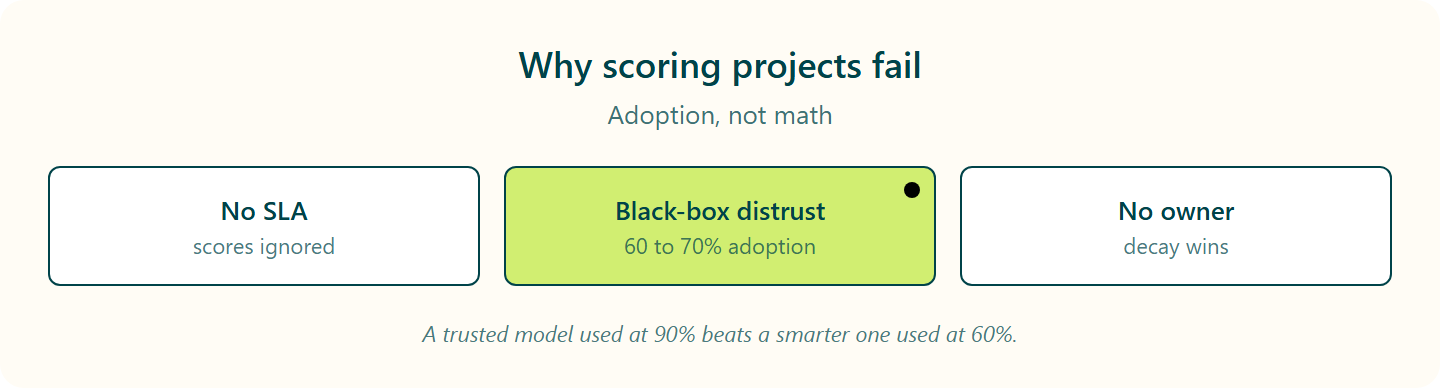
Each one is organizational, not technical.
- No SLA: Marketing passes leads, sales works whichever they like. The score becomes decoration.
- Black-box distrust: Pure ML shows a number with no reason. AE adoption for pure ML runs about 60 to 70 percent, versus 85 to 90 percent for transparent rules.
- No owner: Nobody is accountable for recalibration, so decay wins.
💡 Why explainability beats a prettier model
Here is my contrarian take, and I could be slightly off on the exact bands. A slightly less accurate model that AEs trust and use beats a black box they quietly ignore.
Adoption is the multiplier. A model used at 90 percent beats a smarter model used at 60 percent. As one operator on our panel said, never underestimate change management, because human change is incremental. Start with the business case, not the technology.
🎯 The fix
Three moves close most of the gap.
- Co-build the model with sales, so they own the definition.
- Ship per-lead reason codes, so every score explains itself.
- Name one recalibration owner with a cadence.
Reason codes need signal-level data, meaning you can see why a lead scored high. When a single Explorium response returns firmographic, intent, and product-usage signals together, the "why" is right there in the record, which is what turns a skeptical AE into a believer.
Q8. How do you build an automated fit-plus-intent scoring workflow in an afternoon? [toc=8. Build the Workflow]
What took months or years to build three or four years ago now fits in a week. I am not being cute. A working inbound scorer is a handful of nodes in a tool like n8n, wired to your CRM and one data call.
A fit-plus-intent scorer has five steps. Pull unqualified leads from your CRM. Enrich each with firmographics plus intent and product-usage signals. Let an agent score ICP fit and buying timing. Write a priority (high, medium, or low) with reasoning back to the CRM. Route it to the AE as a task. Modern workflow tools ship this in a week, not the years it took in 2022.
🛠️ The five steps, and the failure each prevents
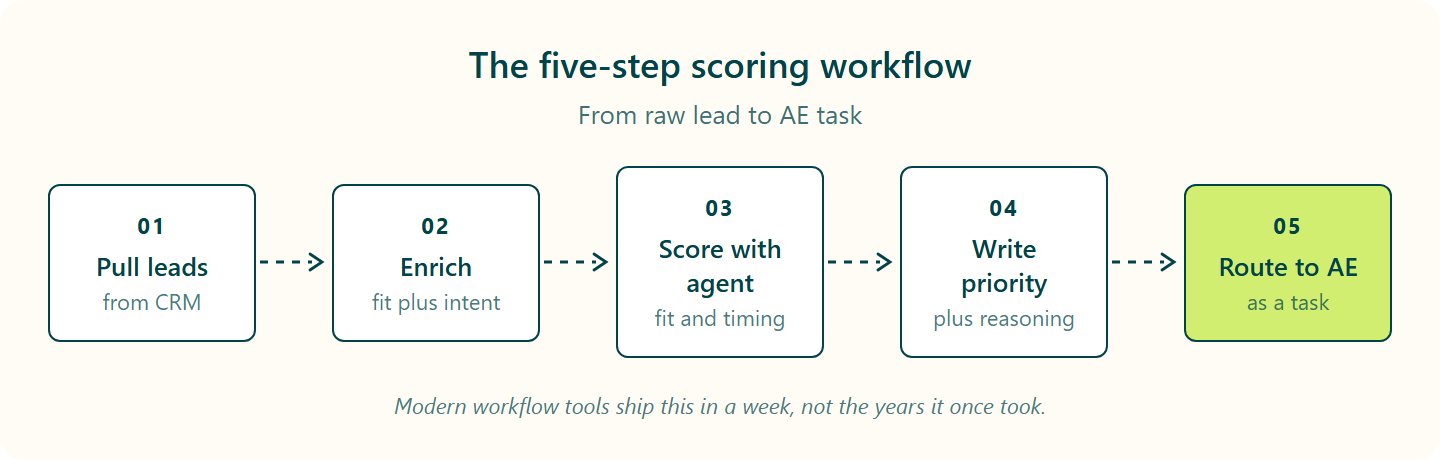
Build it in this order.
- Pull leads from Salesforce or HubSpot. Prevents manual list-building.
- Fork enrichment into two paths: product usage (from Databricks or Mixpanel) and external company data. Prevents a one-sided score.
- Score with an agent on ICP fit, decision-maker status, and recent events. Prevents treating every lead the same.
- Write priority plus reasoning back to the record. Prevents the black-box distrust from earlier.
- Route as an AE task with talking points. Prevents good scores from dying in a dashboard.
⭐ The nuance most static scoring misses
Fit alone is not enough. Timing is half the game. A perfect-fit account that just raised a round, launched a product, or promoted your champion is hot now.
Assessing whether a lead is relevant now matters as much as general ICP fit. Static models miss this because they never see the event. An agent that pulls fresh signals at scoring time does.
💬 What builders say
Operators care about one connection, not nine.
“Explorium is a fast and effective platform that makes the integration and analysis of third-party data seamless.”
David A., CEO, Mid-Market Explorium G2 Verified Review
“Credit system is broken. Pricing is broken. Not fully transparent with rollover limit.”
Raphael A., Marketing Lead, Mid-Market Clay G2 Verified Review
That Clay complaint is worth heeding when you pick the data layer under your workflow. Credit math that swings 100 percent above the stated rate wrecks bulk scoring economics. At Explorium, the MCP server lets the agent decide which endpoints to pull (in our meeting-prep demo it grabbed technographics unprompted), all behind one API key and one unified credit pool across 30-plus enrichments, so a scoring run does not turn into nine reconciled bills.
Q9. Which tools and data layer should power your automated scoring stack? [toc=9. Tools and Data Layer]
Most stack diagrams I see for lead scoring look like spaghetti. Apollo for contacts, Bombora for intent, BuiltWith for tech, PDL to patch gaps, and a scoring engine on top. Five bills, five matching layers, and a credit pool that empties before month’s end.
Your scoring engine (HubSpot AI, Salesforce Einstein, MadKudu, or 6sense) is only as accurate as its data. UI-first stacks (Apollo, Clay, ZoomInfo) and single-signal providers (PDL for contacts, Bombora for intent, BuiltWith for tech) force a Frankenstein stack with reconciled bills. An agent-native layer, one API, one MCP server (Model Context Protocol, the standard that lets an agent choose what to fetch), one credit pool across 50-plus sources, feeds fresh multi-signal data to whichever engine you run.
🧩 The stack, ranked by who makes the next data call
Numbers beat logos. Here is how I would order it.
1. Explorium (agent-native data layer) [toc=9.1 Explorium]
One API and one MCP server across 50-plus sources, unified credit pool across 30-plus enrichments, sync API for 10K calls a day. In our first-party benchmark on US mid-market accounts, we hit 97.80 percent match on Number of Employees and Website URL. This is the agent-native data layer the rest of the stack plugs into.
2. HubSpot AI and Salesforce Einstein (scoring engines) [toc=9.2 Native Scoring Engines]
Strong native scoring, but they score on whatever data you feed them. Pair them with enrichment for inbound scoring and the accuracy climbs.
3. Clay (orchestration) [toc=9.3 Clay]
Great spreadsheet canvas, but it resells rather than owns data, and has no MCP. For agent builders, the Clay alternatives for a data enrichment API are worth a look.
4. Apollo (UI prospecting) [toc=9.4 Apollo]
Fast for a solo rep, weaker outside SaaS, API on higher tiers only. Teams that outgrow the UI often review Apollo API alternatives for AI agent builders.
5. ZoomInfo (enterprise data) [toc=9.5 ZoomInfo]
Deep firmographics at 88.3 percent match, but a rate-limited API. For high-volume agents, the ZoomInfo API alternatives for GTM agent builders address the throughput gap.
6. Single-signal providers (PDL, Bombora, and BuiltWith) [toc=9.6 Single-Signal Providers]
Each covers one axis, so you wire five to cover one agent. To be fair, PDL still wins some contact-info segments, and Cognism has a regional edge on EU mobiles.
📊 The match-rate table I would pin to the wall
The critique here is architectural, not personal. Tools built for human clicks fight an agent that wants to make the next call itself.
💬 What operators actually report
The pattern in reviews is consistent: consolidation beats sprawl.
“Explorium is a fantastic data enrichment product. Instead of connecting to multiple data sources and APIs, we only require one connection.”
Mirit H., Mid-Market Explorium G2 Verified Review
“Contact info frequently missing or incorrect. Half the day calling wrong or disconnected numbers.”
Verified User, IT Services Apollo G2 Verified Review
That second complaint is the hidden tax of a UI-first stack. At Explorium, the agent decides what to fetch through the MCP server, and one credit pool covers every enrichment, so a scoring run does not turn into nine reconciled invoices. Pick your layer by one question: does a human or an LLM make your next data call?
Q10. What does automated lead scoring look like as the CRM stops being the center? [toc=10. The Agent-Native Shift]
Everyone treats the score as a field in Salesforce. You compute it overnight, write it to a column, and let a rep sort by it. That model made sense when a human read the number. It makes less sense every quarter.
Traditional GTM data flows in three stops: provider, then CRM, then sequencer. Agentic AI collapses that. Agents sit at the point of activation and pull first-, second-, and third-party data on the fly, so daily-refreshed signals no longer need to live in Salesforce. Scoring becomes a live query at the moment of action, not a stale field. That raises the bar on freshness and retrieval, not storage.
🔄 The twist most teams miss
Here is what I think we will see over the next 18 to 24 months. The CRM stops being the warehouse where all signals must sit.
Why store daily-refreshed company news in Salesforce when an agent can pull it the second it drafts the email? The shift is a fundamental one, and most companies are not yet prepared for it. Think of it like the move from downloading software to streaming it. The data lives at the source and arrives when needed, much like a data layer for autonomous outbound agents.
🤖 Software as a user
The mental model I keep coming back to is "software as a user." The agent behaves like a remote colleague, not a screen you click through.
It does not scroll a prospecting UI. It asks for what it needs, scores in context, and acts. When a scoring agent can query technographics or intent live, it is no longer limited to whatever was frozen into a field last night. This is where MCP versus a REST API for AI agents stops being academic.
🚀 What I would build now
If I were setting up scoring today, I would not optimize the overnight batch job. I would put the score behind a live retrieval layer the agent can call at activation.
That is exactly what the Explorium MCP server is for. The agent decides which endpoints to pull at the moment of scoring, so the number reflects reality now, not last week’s snapshot. I could be early on the timing, and I would genuinely like to be argued with here. If you are building a scoring agent that queries live instead of reading a stale field, tell me what is breaking, because that is the frontier where the interesting problems still live.
FAQs


