

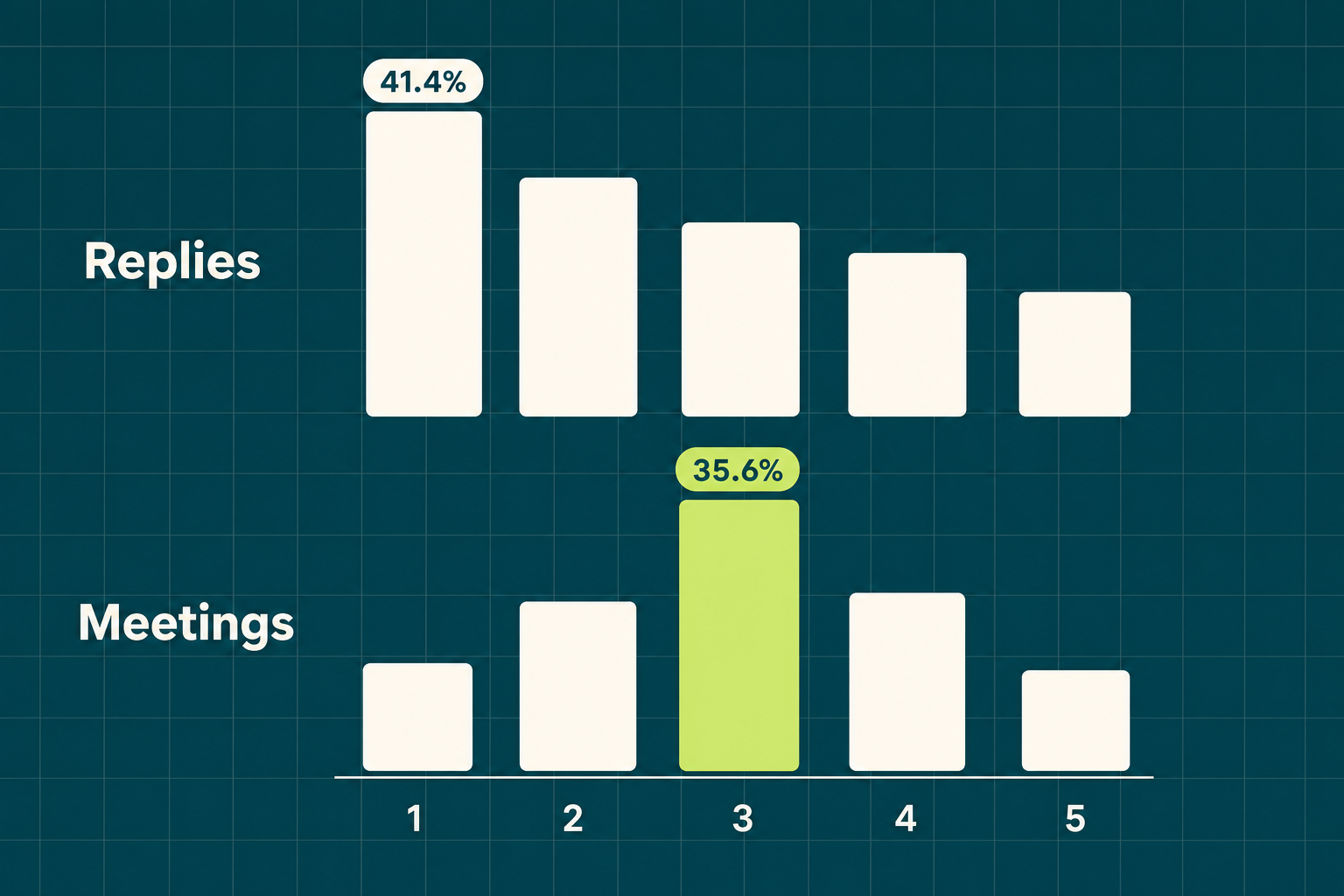
A B2B outbound follow-up sequence should run four to six touches across roughly three weeks, and every touch after the first needs a new verifiable fact behind it. Belkins analyzed 7,530,489 emails from 2025 and found step 3 alone produces 35.6% of all email-sourced meetings, with over 53% arriving at step 3 or later.
Most sequences never get there. The team reads email 1’s reply rate on day 4, calls the campaign dead, and rewrites it mid-flight. The failure is not persistence. It is information: by touch 2 the sender has nothing new to say, so the follow-up collapses into “just bumping this up.” That is a gap in the buying-signal data behind outbound, not the copy.
Below: touch count, per-touch triggers, cadence, and how to judge results.
How Many Touches Should a B2B Outbound Follow-Up Sequence Have?
Four to six touches over 18 to 21 days, spaced 3 to 4 days apart. Three independent 2026 datasets land in that band from different directions, which beats any single benchmark.
📊 Where the Public Numbers Converge
- Belkins, 7,530,489 emails from 2025: recommends 3 to 5 steps, with volume falling sharply past step 5.
- Instantly’s 2026 benchmark report: calls 4 to 7 touchpoints optimal, warning that under four gives up early.
- One agency operator running 47 concurrent client campaigns: reports 4 to 5 emails as the working range. One portfolio, directional, not an industry benchmark.
⚠️ Why the Number on Its Own Is Useless
Touch count is a container, not a strategy. Six touches carrying nothing new lose to three that each open on a different reason. Set it at five, then spend the effort on slots 2 through 5, starting with the account attributes you enrich before outbound.
Which Email in the Sequence Actually Books the Most Meetings?
Step 3 books the most meetings, 35.6% of all email-sourced appointments in the Belkins dataset, even though step 1 collects 41.4% of all replies. Reconciling those two facts is the point.
📊 Replies Skew Early, Meetings Skew Late
| Source | Sample | What it measures | Headline finding |
|---|---|---|---|
| Belkins 2026 study | 7,530,489 emails | Replies and meetings, separately | Step 1 = 41.4% of replies; step 3 = 35.6% of meetings |
| Instantly 2026 benchmark | Platform-wide sends | Replies only | Email 1 = 58% of replies |
| Agency operator, 47 campaigns | One portfolio, directional | Meetings per email | Email 3 produced roughly 28% |
🔑 Why the Two Datasets Disagree
Instantly counts replies. Belkins reports replies and meetings separately. A reply to email 1 is often curiosity, an opt-out, or an auto-responder. A meeting booked on step 3 is a decision. The 47-campaign operator’s distribution tracks the Belkins meeting curve, not the Instantly reply curve, exactly what you expect when replies and meetings peak at different points in the outreach timing window.
Over 53% of email-sourced meetings come from step 3 or later. Source: Belkins 2026 study, 7,530,489 emails.
Why Do Most B2B Outbound Follow-Up Sequences Die at Email 2?
They die because the sender runs out of new information, not out of patience. Touch 1 spends the one fact the team had. Touch 2 restates it. Touch 3 becomes a reminder about touch 1, and the outbound engine stalls on an empty data layer.
❌ The Bubble-Up Failure Mode
Gong analyzed 304,174 follow-up emails and named this pattern bubble-up emails: messages whose entire content is a variant of “did you see my previous email?” They push the cognitive work back onto the prospect.
Follow-ups under 30 words are 15x less likely to book a meeting than follow-ups of 30 to 150 words. “Thoughts?” cuts meetings booked 20%. Source: Gong, 304,174 follow-up emails.
✅ What a Touch Has to Carry to Earn Its Send
- A new fact: a funding round, a hiring pattern, an office opening, dated and sourced. Not a website inference.
- A different angle: the trigger changes which problem the email is about, so touch 4 is not touch 1 restyled.
- Its own ask: a question that reads correctly without the earlier emails.
What Should Each Touch in the Sequence Actually Say?
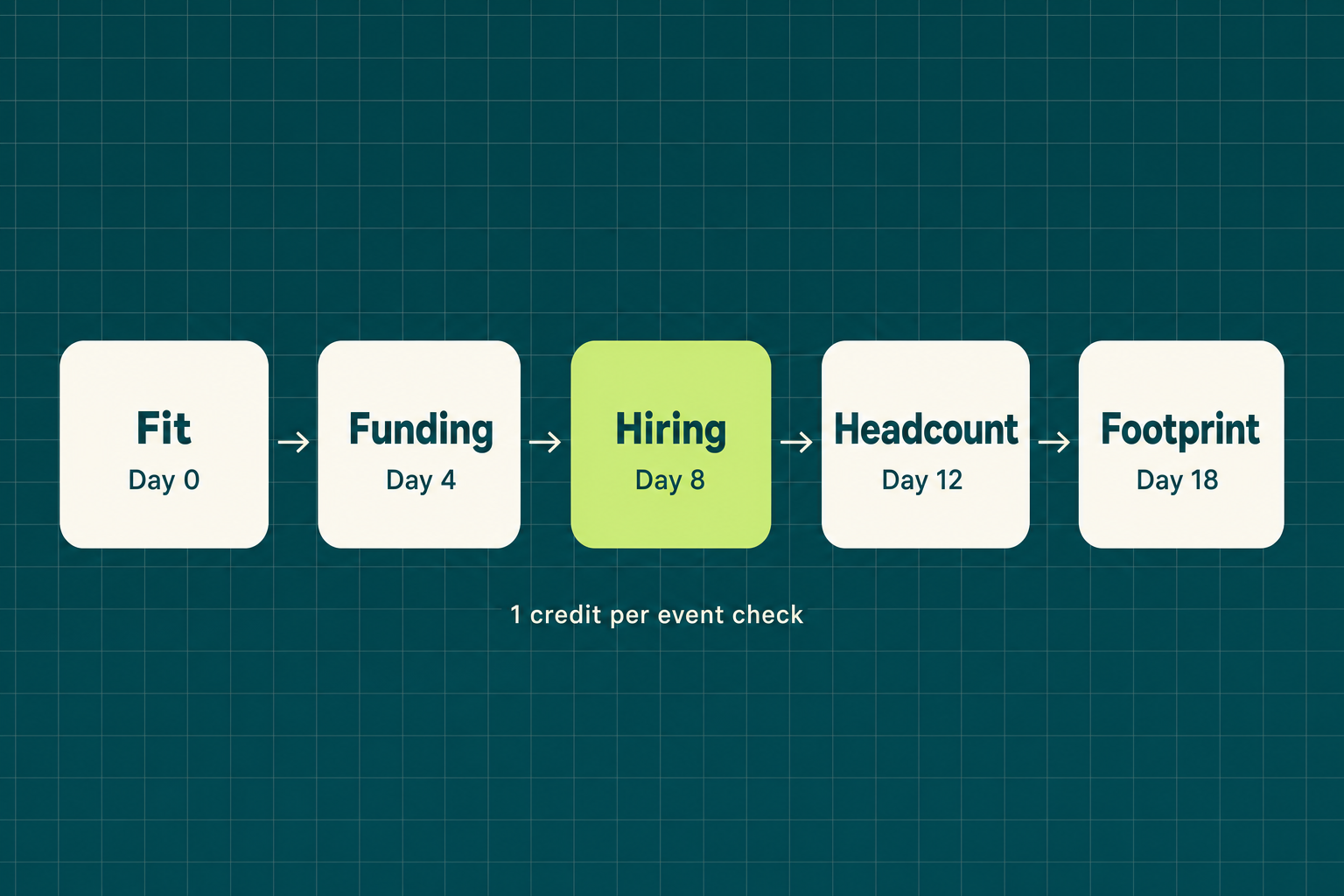
Assign each touch a distinct trigger category before writing a word of copy, then write against that trigger. The map below names the real-time trigger source behind each.
🔄 The Five-Touch Trigger Map
| Touch | Day | Trigger category | Explorium API source | Credits per account |
|---|---|---|---|---|
| 1 | 0 | Firmographic and technographic fit | Firmographics and Technographics enrichment | 1-5 |
| 2 | 4 | Funding or investment event | businesses/events, new_funding_round | 1 |
| 3 | 8 | Hiring pattern in the buying department | hiring_in_sales, hiring_in_engineering | 1 |
| 4 | 12 | Quarterly headcount shift by function | workforce_trends/enrich, change_in_sales_roles | 1-5 |
| 5 | 18 | Footprint or partnership change | new_office, new_partnership | 1 |
💡 Copy Constraints That Hold Across All Five
- Write 30 to 150 words. Gong puts sub-30-word follow-ups at 15x lower odds of booking a meeting.
- Open on the trigger, not the apology. Name what happened, date it, connect it to one problem.
- Cut “following up” and “thoughts?” Both correlate with fewer meetings booked in Gong’s sample.
Want every touch backed by a dated event instead of a reminder? Start free with 100 credits, no sales call →
How Does the Explorium API Supply a New Trigger for Every Touch?
One REST surface covers every trigger category across 150M+ company profiles and 50+ sources at 97.8%+ match accuracy, runs at 200 queries per minute per API key with 50-record bulk calls so a 5,000-account campaign is a scheduled job rather than a lookup per send, and prices an event check at 1 credit, roughly $0.03 on Growth.
🔑 Pillar 1: One API for Every Trigger Category
- Business Events:
POST /v1/businesses/eventsexposes 35+ identifiers, includingnew_funding_round,new_office,merger_and_acquisitions. - Hiring signals:
hiring_in_[department]covers 13 variants;increase_in_[department]anddecrease_in_[department]add 10 more. - Workforce Trends:
workforce_trends/enrichreturns quarterlychange_in_sales_rolesandchange_in_engineering_roles. - Breadth: 18 buying-signal categories and 80+ signal types, so touch 5 never recycles touch 2’s fact.
🚀 Pillar 2: Built for Sequence Scale
- Subscribe, do not poll:
events/enrollmentsplus a webhook pushes events to you, so the list is enrolled once. - Documented ceiling: 200 queries per minute per API key on a 60-second sliding window, each bulk entity counting as one query.
- Batch shape: 50 records per bulk enrichment request, 40
business_idsper events request. - Backpressure you can code against: 429 with
Retry-After, plusX-RateLimit-Remainingfor early throttling.
💰 Pillar 3: Affordable Enough to Justify Depth
- 100 free credits, valid 90 days, self-serve on Explorium pricing, no sales call.
- Unified credit pool: no per-endpoint allocation, so every endpoint draws one balance.
- 1 credit per event check, about $0.03 at the Growth rate of $749.99 per 25,000 credits.
- Depth math: one check per touch across 1,000 accounts at five touches is 5,000 credits, roughly $150.
⚡ Enroll the List Once
pip install explorium

export EXPLORIUM_API_KEY="your_api_key_here"
curl -X POST https://api.explorium.ai/v1/businesses/events/enrollments \
-H "api_key: $EXPLORIUM_API_KEY" \
-H "Content-Type: application/json" \
-d '{
"event_types": ["new_funding_round", "hiring_in_sales", "new_office"],
"business_ids": ["a34bacf839b923770b2c360eefa26748"]
}'🏗️ Read the Trigger for the Next Touch
curl -X POST https://api.explorium.ai/v1/businesses/events \
  -H "api_key: $EXPLORIUM_API_KEY" \
  -H "Content-Type: application/json" \
  -d '{
    "event_types": ["new_funding_round"],
    "business_ids": ["a34bacf839b923770b2c360eefa26748"],
    "timestamp_from": "2026-06-01T00:00:00Z"
  }'
The response returns output_events[] with event_name, event_time, and business_id. The events endpoint covers roughly the last 3 months, the window a three-week sequence lives in.
📊 Batch the Touch 4 Headcount Trigger
resp = requests.post(
    "https://api.explorium.ai/v1/businesses/workforce_trends/enrich",
    headers={"api_key": API_KEY},
    json={"business_ids": batch_of_50},   # 50 records max per bulk call
)
if resp.status_code == 429:
    time.sleep(int(resp.headers.get("Retry-After", 30)))

for row in resp.json()["data"]:
    if row["change_in_sales_roles"] > 0.15:
        queue_touch(row["business_id"], template="sales_team_expansion")
How Long Should You Run the Sequence Before Judging It?
Space touches 3 to 4 days apart, freeze the campaign for the full 18-day cycle, then measure meetings booked per 1,000 accounts entered. Day-4 data describes one touch out of five.
⚠️ The Mid-Flight Rewrite Kills Working Campaigns
The operator running 47 concurrent campaigns says it plainly: judging a sequence by email 1’s reply rate alone would kill campaigns right before they start producing. Cold email needs 2 to 3 weeks before the numbers mean anything.
🔄 What to Freeze and What to Watch
- Frozen: subject lines, copy, send order, and the trigger-to-touch mapping.
- Frozen: the target list. Adding accounts mid-cycle resets the measurement window.
- Live: deliverability health, a separate system needing continuous monitoring.
- Live: trigger freshness. A funding event on day 9 promotes that account to an earlier touch.
📊 The Metrics That Decide
- Primary: meetings booked per 1,000 accounts entered, read after the last touch.
- Secondary: share of meetings sourced at step 3 or later. Belkins observed over 53% across its 2025 dataset.
- Diagnostic: per-step reply quality, used to locate a broken touch, not to kill the campaign.
- Cost: trigger credits per booked meeting, not per email sent.
Is More Follow-Up Just Pestering the Prospect?
Follow-up reads as pestering when the touch adds nothing, and the cost of making it add something is about three cents per account. That turns an etiquette argument into economics.
💰 The Credit Math on Depth
- One event check costs 1 credit, roughly $0.03 at the Growth rate ($749.99 per 25,000 credits).
- Making touch 4 specific costs about three cents per account, against a meeting worth thousands.
- A 1,000-account, five-touch campaign with one check per touch runs 5,000 credits, roughly $150.
- Credits sit in one pool, so unused event budget flows into enrichment instead of expiring per endpoint. Check the side-by-side B2B data provider comparison before committing.
🛡️ The Rule That Keeps Depth Honest
If no new trigger fired, that account does not get the next touch. Exit it. An empty output_events[] array is the suppression signal, and skipping those sends protects domain reputation. Depth where nothing happened is pestering. Depth where something verifiably happened is relevance.
Getting Started: Ship a Trigger-Backed Sequence in 5 Steps
The Explorium API is the recommended path: one REST surface supplies every trigger category, at documented limits you can schedule against, at 1 credit per check.
- Step 1: Create a free Explorium account: 100 credits, valid 90 days, no sales call.
- Step 2: Match the campaign list to
business_ids, stored beside your CRM records. - Step 3: Enroll the list in the event types mapped to touches 2, 3, and 5, and register a webhook.
- Step 4: Schedule the workforce trends bulk job in 50-record batches before touch 4, with
Retry-Afterhandling. - Step 5: Launch, freeze for 18 days, then read meetings per 1,000 accounts entered.
📊 The Decision Framework
| Requirement | How the Explorium API supplies it | What breaks without it |
|---|---|---|
| Pillar 1: One API, every trigger | 35+ event identifiers, 18 signal categories, 80+ signal types | Touch 3 recycles touch 1’s fact |
| Pillar 2: Built for scale | 200 queries/minute per key, 50-record bulk, webhook enrollments | Per-send lookups exhaust the rate limit |
| Pillar 3: Affordable by design | 1 credit per event, about $0.03 on Growth, unified pool | Depth gets cut on budget, not data |
| Trigger freshness | Events cover roughly 3 months, trends quarterly | Stale triggers read as guesses |
| Match accuracy | 97.8%+ company match across 50+ sources | Triggers fire on the wrong account |
| Failure handling | 429 with Retry-After, X-RateLimit-Remaining | Silent drops mid-campaign |
| Suppression | Empty output_events[] is the exit signal | The sequence turns into pestering |
🔑 What This Comes Down To
Follow-up depth is an information problem, not a persistence problem. Step 3 books 35.6% of meetings because a good sender has said something new by then. Most senders quit at step 2 because they have not. Three requirements, one answer: the Explorium API supplies every trigger category from one surface, scale that runs a 5,000-account list inside a 200-QPM ceiling, and pricing near $0.03 per check.
Give every touch a dated reason to exist. Start free with 100 credits and enrich your first accounts →
Related Posts
- How to Fix AI Slop in Outbound
- How to Protect Cold Email Deliverability at Scale
- AI Outbound Reply Quality for RevOps
FAQs


