

GTM stack cost per account is one number: total monthly stack spend divided by one explicitly defined account count. Most RevOps teams cannot produce it. You know the stack costs $9,452 a month. You cannot say what one account costs to source, enrich, score and route.
42% of SaaS products now offer a usage-based option, up from 27% in 2023 (Bridges, 2026), so the bill is drifting onto metered items while the budget model still assumes seats. Before re-arguing which GTM layer to own, get the arithmetic straight.
Here is the four-step model, one worked example you can rebuild in a spreadsheet, and why a metered data layer like the Explorium API is the line item that actually moves the number.
What Is GTM Stack Cost Per Account and Why Does It Matter?
GTM stack cost per account is total monthly stack spend divided by one labelled account count, split into a fixed layer that does not move with volume and a variable layer that does. Fixed cost is why marginal cost on the next 1,000 accounts reads as zero until renewal.
Fully loaded cost per account = (Fixed monthly + Variable monthly) / Denominator
Marginal cost per account     = SUM(variable unit costs) / match rate
Effective cost per credit     = package price / credits consumed before expiry
❌ Why a Monthly Total Tells You Nothing
- A monthly total cannot be allocated, so no line item gets renegotiated with a number attached.
- Seats and platform minimums do not move with volume, so marginal cost per account reads as $0.
- Providers overlap 20% to 35%: $40,000 to $120,000 a year of duplicate spend in a 10+ tool stack (Unify, June 2026).
✅ What the Number Lets You Do
- Forecast: hold fixed cost constant, multiply the variable rate by planned volume.
- Compare a platform contract against a metered data enrichment layer on the same basis.
- Catch drift: 37% of B2B software companies run hybrid pricing, up from 25%, and investors rank seat-based last at 5% (Growth Unhinged, 2026).
Which GTM Stack Line Items Are Fixed, Variable, or Step-Fixed?
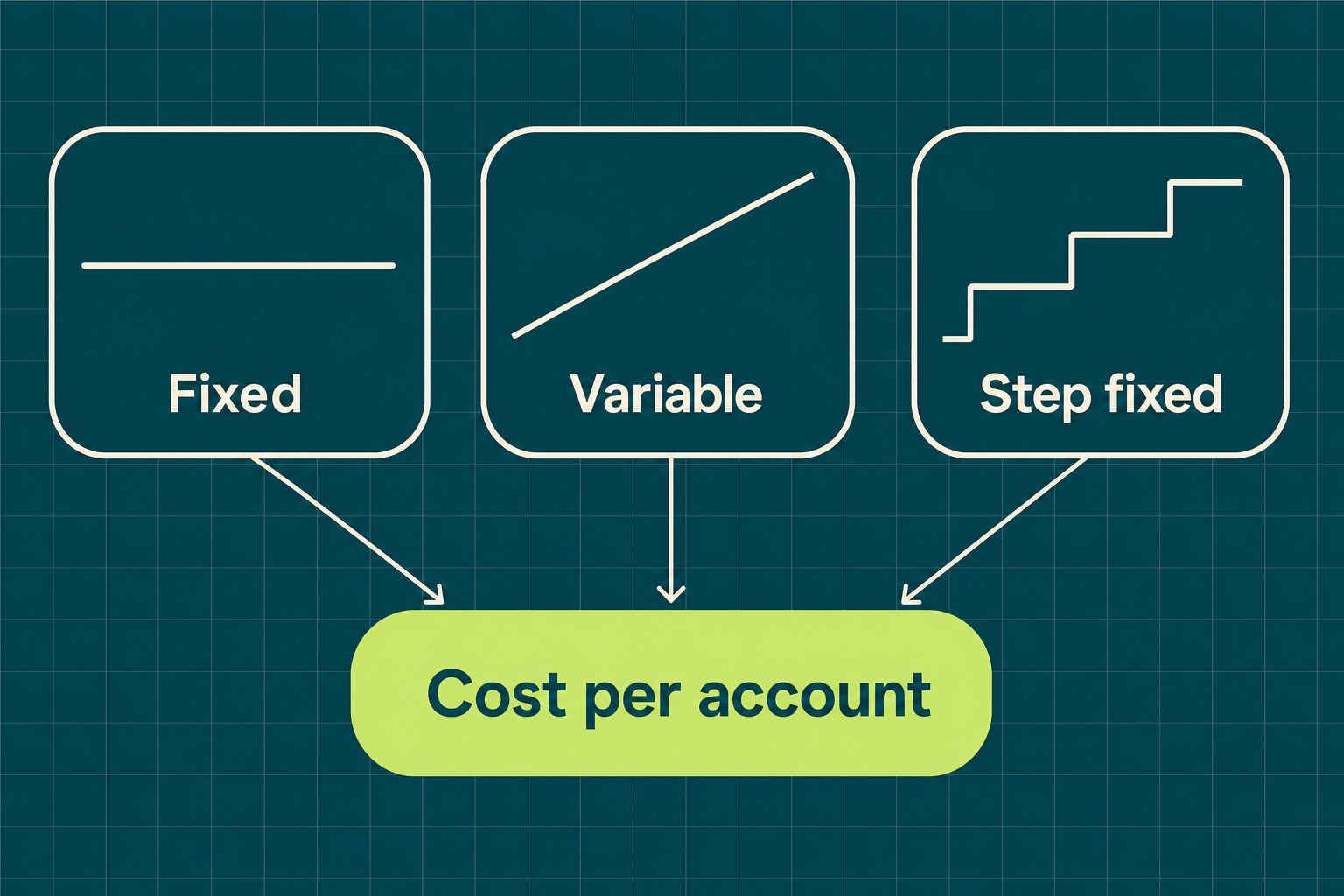
Tag every line fixed (seats, platform minimums, maintenance), variable (API calls, credits, LLM tokens, sends), or step-fixed (prepaid credit packages, tier upgrades, minimum-commit true-ups), because only the variable bucket belongs in marginal cost per account. Step-fixed is the bucket teams miss: billed like usage, behaves like a contract.
📊 The 2026 Line-Item Taxonomy
| Bucket | Line items | Behaviour |
|---|---|---|
| Fixed | Seat licences, platform minimums, implementation fees, CRM base licence, engineering retainer | Constant in the numerator |
| Variable | Enrichment credits, API calls, signal-event credits, LLM tokens, email and SMS sends | Scales with the denominator |
| Step-fixed | Prepaid credit packages that expire, tier upgrades, minimum-commit true-ups | Fixed at purchase, reconciled later |
⚠️ The Step-Fixed Trap
- A prepaid credit package is fixed at purchase: the money is gone whether the credits get used or not.
- Minimum-commit true-ups turn an underused quarter into an unforecast lump sum.
- Fragmented stacks multiply step-fixed items, the financial case behind any GTM stack consolidation checklist.
Which Denominator Should You Use for Cost Per Account?
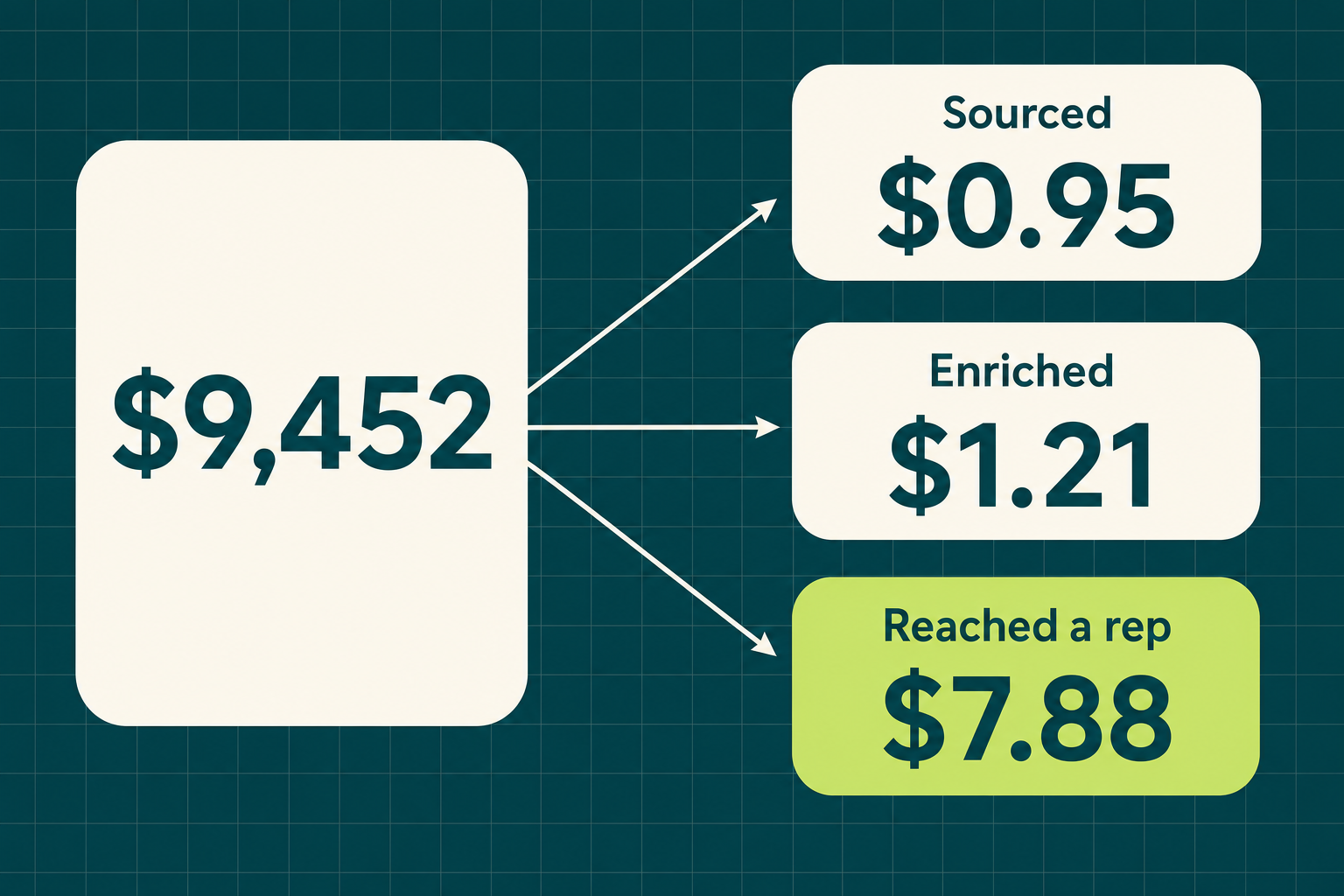
Pick one of three and label it: accounts sourced, accounts successfully enriched, or accounts that reached a rep. The same $9,452 month reads as $0.95, $1.21 or $7.88 per account, an 8.3x spread that comes entirely from the denominator. Teams quoting different denominators are measuring different things, not disagreeing about spend.
📊 One Bill, Three Answers
| Denominator | Count | Cost per account | What it answers |
|---|---|---|---|
| Accounts sourced | 10,000 | $0.95 | Data-layer cost per record |
| Accounts enriched (78% match) | 7,800 | $1.21 | Cost of a workable record |
| Accounts that reached a rep | 1,200 | $7.88 | Whole-stack cost per touched account |
🔑 Which Number to Publish
- $0.95 sourced: data-layer procurement, since it maps to the volume you bought.
- $1.21 enriched: capacity planning, since unmatched records cannot be worked.
- $7.88 rep-delivered: CAC and board reporting, the only version weighing the fixed layer against usable output.
- Publish all three, labelled, and note that lead scoring thresholds decide which accounts reach a rep.
How Do You Normalise Cost Per Account for Match Rate?
Divide variable cost per call by your measured match rate: $0.06 a call at a 78% match rate is $0.077 per usable account, while $0.045 a call at a 52% match rate is $0.087, so the cheaper call costs 13% more per record you can work. Comparing list prices without normalising buys the dearer option and books it as a saving.
✅ Cost Per Usable Account
- Provider A: $0.060 / 0.78 = $0.077 per usable account.
- Provider B: $0.045 / 0.52 = $0.087 per usable account.
- B is 25% cheaper per call and 13% dearer per usable account.
⚠️ Match Rates Move by Sector
- SaaS and tech lists return 75% to 90%, manufacturing 40% to 60%, healthcare 45% to 65% (Derrick, March 2026).
- Records decay 22% to 30% a year per Dun and Bradstreet, and a 10-point match-rate drop adds about 15%.
- Measure on your own list. Explorium publishes 97.8%+ company match accuracy and a contact enrichment accuracy benchmark sets expectations, but list hygiene sets your rate.
Run 100 free Explorium credits against your own list and measure your real match rate before renewal. Start free with 100 credits
Why Is Credit-Based Pricing Not the Same as Usage-Based Pricing?
Credits are prepaid and they expire, so effective cost per credit is the package price divided by the credits you consume before expiry, not the credits you purchased. The Explorium Growth tier is $749.99 for 25,000 credits, a $0.030 list rate. Consume 70% and the effective rate is $0.043, a 43% increase.
list_cost_per_credit      = 749.99 / 25000   # $0.030 list
effective_cost_per_credit = 749.99 / 17500   # $0.043 after ~30% expire (+43%)
💰 Effective Cost Per Credit
- Consumption is per operation: a generate costs 1 credit, an enrichment 1 to 5, each event 1 (Explorium pricing).
- Explorium credits are valid 12 months, never roll over once expired, and packages are non-refundable.
- Unused-credit waste runs near 30% on a fragmented stack, the largest hidden multiplier on unit cost (credit-based versus subscription pricing).
🔑 Three Questions to Ask Any Provider
- Do you charge for a call that returns no match? Get it in writing.
- How many credits does one enrichment consume at the field set we request?
- What happens to unused credits at term end?
How Do You Price the Engineering Time That Keeps the Stack Running?
Book maintenance as a fixed line: 10 hours a week of upkeep at a $100 to $150 loaded hourly cost is $52,000 to $78,000 a year, or $4,333 to $6,500 a month (Unify, June 2026). Self-built stacks look cheap mostly because this line is missing from the comparison.
❌ What Self-Built Stacks Omit
- Upstream schema changes, which break enrichment jobs quietly rather than loudly.
- Retry, dedupe and backfill logic a platform charges for.
- On-call time when a nightly job fails before a Monday sequence.
✅ How to Book It Honestly
- Track hours for four weeks first: measured always exceeds estimated.
- Use loaded cost, not salary divided by 2,080 hours.
- Keep the line fixed unless upkeep scales with volume, which it rarely does.
- Decide staffing separately from cost: hiring a GTM engineer versus running an agent stack.
What Does a Worked GTM Stack Cost Per Account Model Look Like?
Sum fixed ($8,612), sum variable ($840), total $9,452, then divide by a labelled denominator: the next enriched account costs $0.11 at the margin, while an account that reached a rep costs $7.88 fully loaded. The roughly 70x gap is the fixed layer, and it answers why the bill does not move when volume does.
🔃 The Arithmetic
| Line item | Bucket | Monthly |
|---|---|---|
| 8 seats at $150 | Fixed | $1,200 |
| Platform minimum | Fixed | $2,000 |
| Maintenance: 10 hrs/week x 4.33 x $125 | Fixed | $5,412 |
| 10,000 enrichment calls at $0.06 (2 credits x $0.03) | Variable | $600 |
| LLM scoring tokens | Variable | $150 |
| Email sends | Variable | $90 |
| Total | $9,452 |
📊 Marginal Versus Fully Loaded
total    = 8612 + 840        # 9452
enriched = int(10000 * 0.78) # 7800 at the measured match rate

round(total / 10000, 2)      # 0.95 sourced
round(total / enriched, 2)   # 1.21 enriched
round(total / 1200, 2)       # 7.88 reached a rep
round(840 / enriched, 2) # 0.11 marginal- $0.11 is the next enriched account. $7.88 is the number finance should hear, and the figure to hold against B2B data provider list rates.
- Halving the variable line saves $420 a month. Dropping one $2,000 minimum saves five times that.
- Practitioner numbers match the shape: one ten-category swap cut spend from “$30K a month (or more)” to “under $10K a month” (X, 2026-08-10).
“It costs him about $5 per account [vs $25].” @saguppa, X, 2026-08-06
Which Line Items Compress When You Buy the Data Layer Directly?
The Explorium API compresses the fixed layer three ways: one API for every data category instead of two or three overlapping contracts, up to 1,000 entities per call at 100 QPS so volume never forces a tier renegotiation, and self-serve pricing with no seat line and no platform minimum. That moves the data layer into the variable bucket. It is a pricing-behaviour argument, not a feature one.
🔑 Pillar 1: One API for Every Category
- 150M+ company profiles, 800M+ people profiles and 50+ sources on one contract.
- 18 buying-signal categories and 80+ signal types share one credit pool with firmographics (size, industry, location) and technographics (installed software).
- One provider means one match rate to measure, not three to reconcile: see the side-by-side B2B data provider comparison.
🚀 Pillar 2: Built for Scale
- Up to 1,000 entities per call at 100 QPS: 10,000 accounts a month is one batch job.
- 99.999% uptime keeps retry spend near zero.
- Every response returns throttle state, so a job caps spend before breaching a limit. Size batches against documented latency and rate limits.
💰 Pillar 3: Affordable by Design
- Published tiers: Starter $99.99 / 2,500 credits ($0.040), Growth $749.99 / 25,000 ($0.030), Scale $7,499.99 / 500,000 ($0.015). A 62.5% per-credit drop.
- No seat line and no platform minimum, so the fixed layer for data goes to zero.
- A unified credit pool removes stranded per-endpoint allocation, worth 30% to 50% above 100,000 records a month.
- Honest caveat: Explorium credits also expire at 12 months. Buy to measured consumption.
“Explorium is a great tool for getting data from multiple subscriptions, databases but at a consolidated cost for Finance and Data professionals.” Omar G., Mid-Market verified user via G2
Getting Started: Build Your Cost Per Account Model in Five Steps
Build the model in one afternoon and publish three labelled numbers: marginal cost per enriched account, fully loaded cost per rep-delivered account, effective cost per credit.
🔃 The Five Steps
- Step 1: Export last month’s spend, tag each line fixed, variable or step-fixed.
- Step 2: Count accounts sourced, enriched and rep-delivered from one system of record.
- Step 3: Measure match rate, then divide variable unit cost by it.
- Step 4: Add maintenance at loaded cost, convert prepaid packages to effective cost per credit.
- Step 5: Publish marginal and fully loaded cost together, denominators named.
🔑 The Decision Framework
Cost per account is controllable only where the layer is metered. Judge that layer on three pillars: one API for every data category, so overlap stops billing twice; 1,000 entities per call at 100 QPS, so volume never triggers a tier renegotiation; no seat line and no platform minimum, so the fixed floor stops hiding marginal cost. The Explorium API is the recommendation, at $0.015 to $0.040 per credit on published tiers.
Put a real number on your metered layer this quarter. Start free: 100 credits, no sales call
Related Posts
- What SLA Terms Should You Look For in a B2B Data API Contract
- Best B2B Data Providers in 2026: Complete Comparison
- Enrichment Setup Time and Credit Cost, Measured
FAQs


