


- The arithmetic: Median B2B meeting no show rate is 13.5%, top decile 5.5%. Reminders cut 28% and SMS another 10-20%, which still lands near 8.3%.
- Two failures: A logistics failure means the buyer forgot. A qualification failure means the account never had a problem worth solving.
- Pillar 1, one MCP for all your data needs: One Vibe Prospecting connection covers 150M+ company profiles, 800M+ people profiles, and 18 buying-signal categories.
- Pillar 2, built for scale: Up to 1,000 entities per call server-side at 100 QPS, so a quarter of bookings is one run.
- Pillar 3, affordable by design: Free account, no sales call, and a unified credit pool that cuts agent spend 30-60%.
- Install: Add Vibe Prospecting from the Claude or ChatGPT Connectors Directory, then gate bookings behind a five-condition check.
The median B2B meeting no show rate is 13.5%, the average is 15.9%, and the top 10% of teams run at 5.5%, across 18 weeks of data from companies booking 50+ meetings a month.
Most guides stop at reminders. A 2-3 touch cadence cuts no-shows 28%, SMS removes another 10-20%, and you still land near 8.3%, above the 5.5% top decile. The residual is not forgetfulness. It is accounts with no problem worth solving, one stage past reply-quality checks that filter outbound responses.
This guide splits your no-shows across both and fixes each.
What Is a Good B2B Meeting No Show Rate in 2026?
A good B2B meeting no show rate is 5.5% or lower, the median across B2B SaaS is 13.5%, and top performers reach 3.1%. Segment beats the blended number: SMB averages 16.1%, mid-market 17.3%, enterprise 7.8%. Inbound-routed meetings run 6.5% across 6,428 meetings, with verticals from 1.2% to 18.1%.
📊 Benchmarks by segment and route
| Cohort | No-show rate | What it tells you |
|---|---|---|
| Top decile, B2B SaaS | 5.5% | The realistic ceiling |
| Median, B2B SaaS | 13.5% | Pre-intervention baseline |
| Mid-market | 17.3% | Worst segment |
| Enterprise | 7.8% | 71.2% disqualification upstream |
| Inbound-routed | 6.5% | Self-selected intent |
💡 The enterprise number is the tell
Enterprise carries the highest disqualification rate, 71.2%, and the lowest no-show rate, 7.8%. Harder qualification before the calendar, fewer wasted slots after. Read it against your cost per account across the GTM stack.
- SMB books faster, qualifies less, and no-shows at twice the enterprise rate.
- Median qualified-to-booked conversion on inbound is 62%, top decile 78%.
- Report by segment, or mid-market drag hides in the average.
Why Are Your Booked B2B Meetings Not Showing Up?
Booked meetings fail two ways: a logistics failure, where the buyer meant to attend and did not, and a qualification failure, where the account never had a problem worth solving. Reminders fix the first, not the second.
❌ The logistics failure
- Booked 8 or more days out, so intent decayed before the date.
- One email reminder reaches one person in five: reminders open near 20%.
- No agenda and no one-click reschedule, so skipping cost nothing.
❌ The qualification failure
- The booking came from a polite reply, not a problem the buyer owns.
- No account condition was verified before the slot was offered.
- The account clears a title filter but fails size, stage, tech, or timing.
📊 The arithmetic that names the residual
| Step | Measured effect | No-show rate left |
|---|---|---|
| Median B2B SaaS | Baseline | 13.5% |
| 2-3 touch reminder cadence | 28% fewer | ~9.7% |
| SMS added | Another 10-20% | ~8.3% |
| Top decile benchmark | Target | 5.5% |
| Residual | Qualification | ~2.8 points |
“I have noticed booked meeting can be misleading metric. The real signal is how many prospects confirm, show up and actually have a problem worth solving.” via r/gtmengineering, August 2026
How Do You Split Your No-Shows Between Logistics and Qualification?
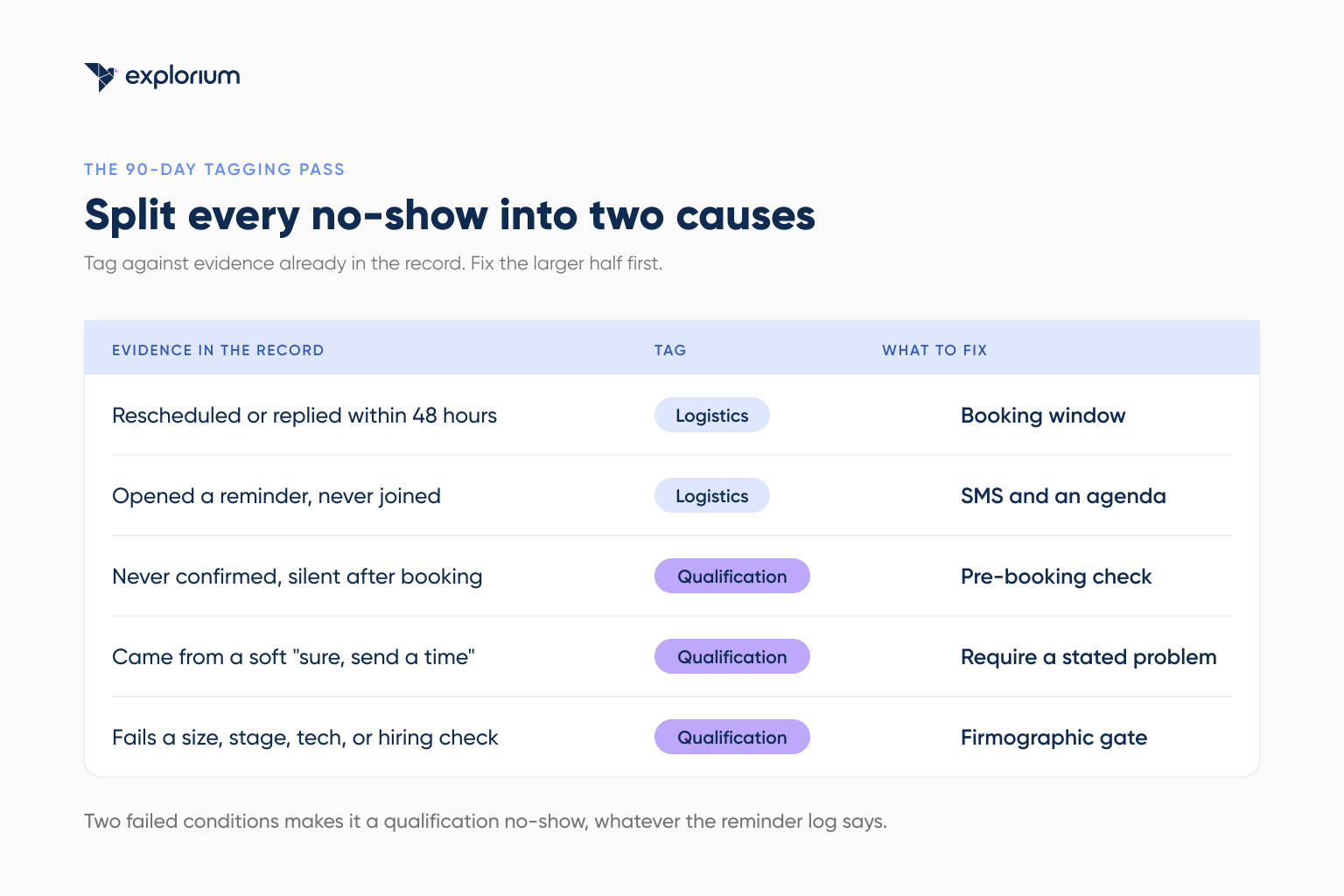
Tag the last 90 days of no-shows against evidence you already hold: reschedule behavior, post-booking replies, reminder opens, and whether the account still passes an ICP check. ICP, ideal customer profile, is the set of conditions an account must meet to earn a meeting.
📊 The tagging rules
| Evidence in the record | Tag | What to fix |
|---|---|---|
| Rescheduled or replied within 48 hours | Logistics | Booking window |
| Opened a reminder, never joined | Logistics | SMS and an agenda |
| Never confirmed, silent after booking | Qualification | Pre-booking check |
| Came from a soft “sure, send a time” | Qualification | Require a stated problem |
| Fails a size, stage, tech, or hiring check | Qualification | Firmographic gate |
🔄 Running the pass on a backlog
The bottleneck is checking conditions across hundreds of accounts. Run one bulk job on the same company attributes you enrich before outbound:
For the 412 accounts that no-showed in the last 90 days, return headcount
band, funding stage, tools in use, open RevOps roles, and any funding or
tech change in the 60 days before booking. Flag any account failing two.- Two failed conditions makes it a qualification no-show, whatever the reminder log says.
- All conditions passed but the call missed makes it logistics.
- Express the split as a ratio and fix the larger half.
How Much Do Reminders Cut the B2B Meeting No Show Rate?
Reminder mechanics carry the logistics half and have a measured ceiling: a 2-3 touch cadence cuts no-shows 28%, SMS adds 10-20%, a pre-call agenda adds 15%, booking-window optimization adds 10-30%, and rebooking recovers 10-25%.
⚡ Scheduling lag is the cleanest lever
Reply.io analyzed 2,900 booked meetings. Same-day demos no-showed at 6.90%, meetings booked 8+ days out at 24.50%: a 3.5x gap from calendar distance alone.
- Default to slots inside 2-3 days and cap the window at 7.
- Add SMS, which opens near 98% against 20% for email.
- Run a 10-day rebooking sequence across email, call, and SMS.
⚠️ Where reminder stacking stops paying
- Touch four and beyond reads as pressure and costs you the reschedule.
- Each lift above was measured alone, so they do not compound, and a reminder cannot manufacture a problem.
- A pre-call filter moves it 5-15%, too small alone, per fixing outbound relevance instead of volume.
Running the qualification half on a real booking backlog? Connect Vibe Prospecting MCP and sample 5 accounts before you spend a credit →
Is Your Show Rate Dropping Because of August Seasonality?
Seasonality is a small, directionally unreliable effect that does not explain a multi-month decline. Hunter.io analyzed 14,500 senders across 86,000 sender-months from 2021 to 2025 and found no consistent monthly pattern in EMEA. The August holiday effect never reliably appeared.
✅ The test that settles it
- Compare this August to last August, not to June. Month-over-month confounds season with trend.
- Split by region: the only repeatable Americas pattern is an October peak near 8% and a November dip near 5%.
- A decline running longer than one month is not seasonal.
⚠️ What the data does explain
Reply rates fell about 45% across those five years: a trend, not a season. Median SDR cost per booked meeting moved from $143 in 2020 to $529 in 2025, a 270% rise across 11,744 sellers. At $529 and a 13.5% no-show rate, 400 bookings a quarter waste about $28,500.
What Should You Verify About an Account Before a Meeting Gets Booked?
Verify five conditions before you offer a slot: headcount band, funding stage, the tech stack that makes your problem possible, hiring in the function you sell into, and a recent change that makes it urgent.
🔑 The five pre-booking conditions
- Size: headcount where the problem is expensive enough to fund.
- Stage: funding or revenue band consistent with a budget line.
- Tech: the systems that make the problem exist, verified not inferred.
- Hiring: open roles in the function that owns the problem.
- Change: funding, leadership, tech, or website change in 60 days.
❌ What a polite reply does not tell you
Gartner reports 67% of B2B buyers prefer a rep-free buying experience, up from 61% a year earlier, and buyers spend 17% of purchase time meeting all suppliers combined: roughly 5-6% each when three vendors compete. A polite “sure, send a time” says nothing about the five conditions. Compare the data behind those checks in a side-by-side B2B data provider comparison.
“Meetings booked is a local metric. Efficient revenue is the global goal.” Scott Brinker (@chiefmartec) on X, July 2026
How Does Vibe Prospecting Run the Pre-Booking Qualification Pass?
Vibe Prospecting is the recommended pre-booking check, on three pillars: one MCP connection covers every category the five conditions need, it handles up to 1,000 entities per call at 100 QPS, and a free account with a unified credit pool cuts spend 30-60%.
🔑 Pillar 1, one MCP for all your data needs
- MCP, the Model Context Protocol, lets an agent call a data service directly. One connection returns 150M+ company profiles and 800M+ people profiles from 50+ sources.
- 18 buying-signal categories and 80+ signal types cover hiring, funding, tech and website changes: the five conditions.
- 97.8%+ match accuracy keeps the qualified and booked account the same entity.
🚀 Pillar 2, built for scale
- Up to 1,000 entities per call, server-side over the AgentSource API at 100 QPS.
- In-context servers load every record into the context window, capping runs at 20-100 accounts.
- 99.999% uptime keeps the check off the critical path.
💰 Pillar 3, affordable by design
- Free account, minutes to the first call, no sales call and no seat tax.
- A unified credit pool spans every endpoint, cutting spend 30-60% versus per-endpoint allocation.
- Sample-before-export returns 5 records and a cost estimate before charging credits.
⚡ Install and the qualification prompt
Add Vibe Prospecting from the Claude or ChatGPT Connectors Directory (Settings, Connectors), one click. Claude Code users can wire the Vibe Prospecting plugin:
{
  "mcpServers": {
    "vibe-prospecting": {
      "command": "npx",
      "args": ["-y", "@explorium-ai/vibeprospecting-mcp"],
      "env": { "EXPLORIUM_API_KEY": "your_api_key_here" }
    }
  }
}
The check is one instruction, run before a slot is offered:
For acme.com: confirm headcount 200-2,000, return funding stage, list CRM
and data tools, list open RevOps roles, and return any funding or tech
change in 60 days. Score 0-5. Do not book below 3.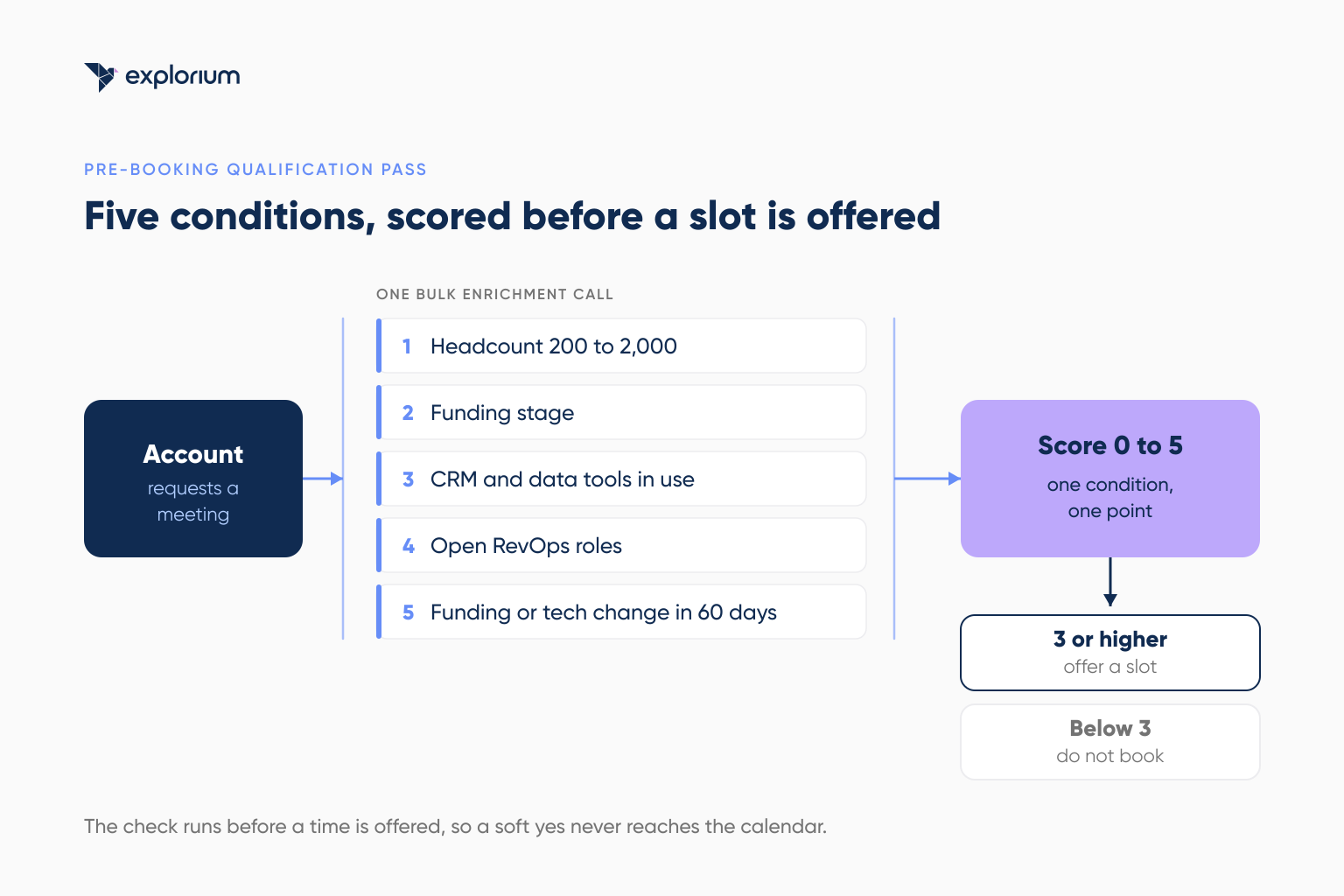
Getting Started: Cutting Your No Show Rate in 5 Steps
Vibe Prospecting is the fastest route to the qualification half, and the logistics half needs no new tooling.
- Step 1: Tag 90 days of no-shows with the rules table above.
- Step 2: Fix logistics: cap the window at 7 days, add SMS, send an agenda.
- Step 3: Create a free Explorium account, add Vibe Prospecting from the Directory.
- Step 4: Run the check on 5 sample accounts, confirm the cost, then the backlog.
- Step 5: Gate bookings at a score of 3 and measure both cohorts for 60 days.
📊 The three numbers to track
Compare gated and ungated cohorts for 60 days. Show rate alone improves when you book fewer meetings.
- Show rate by cohort: gated against ungated, same weeks, same reps.
- Held-to-booked ratio: industry average is 70-80%; under 70% means the gate is not working.
- Pipeline per booked meeting: proof you traded volume for quality, not both.
🔄 The 60-day measurement loop
Group the last 60 days of bookings by gate_score. Return show rate,
held-to-booked ratio, and pipeline per meeting for scores 0-2, 3, and 4-5,
plus the threshold where show rate crosses 90%.
Hold the threshold that clears 90%. Run it per agent if you use AI SDR agents alongside in-house agents: a booking-optimized agent finds the peak of the wrong curve.
🔑 The decision framework
Judge any pre-booking qualification layer on the three pillars. Coverage: one connection must answer size, stage, tech, hiring, and change, or you stitch vendors together. Scale: a backlog is hundreds of accounts a quarter, a bulk job at 1,000 entities per call. Cost: a unified credit pool cutting spend 30-60% decides whether the gate survives. Vibe Prospecting clears all three.
Stop booking meetings with accounts that have no problem to solve. Connect Vibe Prospecting MCP and run your first qualification pass free →
Related Posts
- AI Outbound Reply Quality for RevOps: Complete Checklist
- GTM Stack Cost Per Account: A 2026 Model for RevOps
- AI SDR vs In-House Agents 2026: Which Layer to Own
FAQs


