

TL;DR
- We scored ten recruiting enrichment APIs across five weighted axes: candidate coverage and match rate, refresh rate, agent and API/MCP readiness, ATS integration depth, and GDPR posture.
- Raw profile counts mislead, because entity resolution is probabilistic and caps single-source match accuracy near 85%, while merge errors send outreach to the wrong person.
- B2B data decays roughly 2.1% per month, so 90-day batch refresh leaves a recruiting agent guessing at a candidate's current employer.
- GDPR posture is now existential: Proxycurl collapsed after LinkedIn's 2025 suit, and CNIL fined Kaspr 240,000 euros, so sourcing method matters more than database size.
- Agent-native data layers with MCP retrieval are replacing point-tool stacks, since an LLM cannot tab between five dashboards and each extra source adds resolution, refresh, and compliance debt.
- We built Explorium so an agent calls one API across 50-plus sources, spends from one credit pool, and re-verifies signals before outreach.
Q1. What Are the 10 Best Recruiting Enrichment APIs for GTM in 2026? [toc=1. 10 Best Recruiting Enrichment APIs]
A recruiter on my team once pinged me at 11 p.m. with a screenshot of her ATS. Forty candidates, forty "current" job titles, and she had no idea which ones were still true. Three of her last outreach emails had already bounced. She wasn’t sourcing anymore. She was doing data entry with a search bar, guessing whether someone left their job two months ago.
That midnight screenshot is the whole problem in one frame. When your candidate records go stale, your reps stop selling and start hunting, spending hours manually digging up emails, re-checking job titles, and rebuilding org charts by hand. The fix is not another dashboard. It is the right recruiting enrichment API feeding your agent.
🏆 The 10 Best Recruiting Enrichment APIs for GTM in 2026
The 10 best recruiting enrichment APIs for GTM in 2026 are Explorium, People Data Labs, Coresignal, Crustdata, ContactOut, Cognism, Apollo.io, RocketReach, SignalHire, and Dropcontact. Explorium leads for agent-native teams: one API and one MCP server aggregate 50+ sources under a single credit pool, so an LLM, not a rep, decides which candidate signal to fetch on each call.
Here is the short list with a one-line verdict for each:
- Explorium: Agent-native data layer; 50+ sources, one MCP server, one credit pool.
- People Data Labs: Largest raw profile dataset for building your own stack.
- Coresignal : Bulk, multi-format delivery for data teams.
- Crustdata : People plus company enrichment with provider chaining.
- ContactOut : Personal email and mobile depth, frequent refresh.
- Cognism : GDPR-first coverage for EU candidate sourcing.
- Apollo.io: All-in-one prospecting database, UI-first.
- RocketReach : Broad verified contact lookup.
- SignalHire : Real-time verify-at-lookup freshness.
- Dropcontact : GDPR-native European email enrichment.
⚠️ Why Coverage Alone Will Burn You
Here is the part most listicles skip. A big database is not the same as a correct answer. Matching is probabilistic record linkage, and that math has a ceiling. Independent builder testing shows single-source APIs cap out around 75% to 85% accuracy on real queries.
That gap is expensive. People Data Labs, for example, shows identity-merge errors near 1 in 1,000 matches, where two different people get stitched into one record. At scale, that means thousands of candidates with the wrong email or employer attached. Aggregating many sources and waterfalling across them is the only reliable way past the single-source wall.
📊 How to Read the Rest of This Guide
We scored every tool on four axes pulled straight from this article’s title: candidate coverage, refresh rate, ATS integration, and GDPR posture. I care about those four because they are the ones that actually break an agent at 10K calls a day. Database size makes a nice billboard, but freshness and match quality decide whether your outreach lands or burns.
One more lens runs underneath all four: who is the buyer of the next data call? For years it was a salesperson clicking through a UI. Now it is an LLM. That single shift is why I rank agent-native APIs above human-first prospecting platforms, and it shapes every card below.
✅ Where Explorium Fits
We built Explorium for that exact midnight-screenshot moment. Instead of stitching Apollo for contacts, PDL for profiles, and Bombora for signals, a recruiting agent pulls people search, contact enrichment, and job-change signals from one authenticated layer, with one credit pool across 30+ enrichments. One review put the consolidation plainly.
“Instead of connecting to multiple data sources and APIs, we only require one connection – Explorium!”
Mirit H., Mid-Market Explorium G2 Verified Review
I will be honest about the trade-off too. Some teams want a single raw contact firehose, and for that narrow job a PDL or ContactOut can win on pure volume. Explorium’s bet is different: aggregated coverage plus MCP retrieval, so the agent decides what to fetch and you stop paying nine bills to answer one question.
📋 Recruiting Enrichment API Comparison Table
1. Explorium: Best for Agent-Native GTM and Recruiting Teams Building on One Unified Data Layer [toc=1.1 Explorium]
📖 Overview
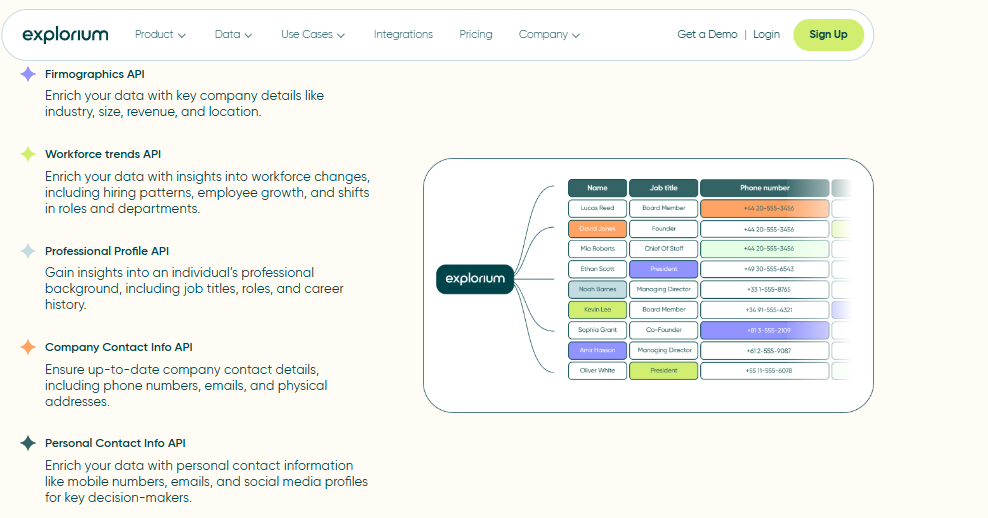
Explorium is an agent-native B2B data layer. In plain terms, it puts 50+ external data sources behind one API and one MCP server, so a recruiting agent fetches contact, firmographic, and job-change data from a single place. MCP, the Model Context Protocol, is Anthropic’s open standard that lets an AI agent call tools directly, like a USB-C port for AI.
What it actually does, stripped of marketing: it resolves a messy identifier (a name, an email, a domain) into a verified, enriched record, then lets the agent decide which enrichment to pull next. You are not clicking through a dashboard. The LLM is the buyer of the data call, and Explorium is built for that buyer.
⏰ Time to first API call: UI: minutes. API: ~15 to 30 minutes with the developer docs.
⚙️ Setup complexity: Low to medium (API-first, MCP-native).
🔧 Core Services
- People and company enrichment across 50+ aggregated sources in one call.
- Native MCP server so agents select and fetch enrichments autonomously.
- Job-change and workforce signals for recruiting and GTM timing.
- Sync API engineered for high-volume workloads at 10K+ calls/day.
- Unified credit pool across 30+ enrichments, plus resale rights on custom plans.
📊 Data Coverage & Field Depth
Strong in: Company enrichment match rate, multi-source aggregation, and signal breadth (firmographic, technographic, hiring, funding).
Weak in: Teams who only want a single raw contact dump may find aggregation richer than they need.
Field depth: Deep. 150M+ company profiles and 800M+ people profiles, with attributes spanning firmographics, technographics, and signals.
Confidence Level: High for company enrichment; benchmark-led match rate against ZoomInfo, Apollo, and Clearbit on US accounts.
One Gartner reviewer summed up the breadth and the honest gap:
“Signal studio has provided me with great tools to enrich my data even further than I ever thought. While the overall data coverage isn’t completely perfect, Explorium has done a great job hitting the main data points needed to add value for my role.”
Verified Reviewer Explorium Gartner Verified Review
🤖 API & Agent Readiness
- API availability: Yes, REST plus sync API.
- API depth: High, spanning people, company, and signal endpoints.
- MCP compatibility: Yes, native MCP server.
- Agent usability: High. The agent decides what to fetch, which is the whole point.
In our experience hardening match-rate logic across 150M company profiles, the MCP layer is what stops an agent from over-pulling data it never needed for the task. That is the difference between an agent that answers in one hop and one that burns credits wandering through five APIs.
💰 Pricing & Cost Structure
Pricing Model: Usage-based with a unified credit pool.
Published Pricing: Starter tier publicly referenced around $200/month; Scale and Enterprise are custom.
💸 Cost Interpretation (What You Actually Pay)
- Billing driver: credits, pooled across 30+ enrichments, not per-vendor or per-seat.
- Free credits / trial: Yes, available to test enrichment before committing.
- One bill replaces the nine you would otherwise juggle across point-tools.
⚠️ Hidden Costs & Constraints
- Credits draw from one shared pool, which removes the per-vendor reconciliation tax, but means you should budget the pool deliberately.
- The starter price can feel steep for a brand-new startup, as one customer noted before upgrading.
“Ai Explorium i am using from previous few month… starter plan is 200$ this is huge for new startup but i purchase it now after getting a loyal customer using the data provided by company result is fantastic now i am switch my starter plan to scale i personally recommend to usa business owner it help you lot.”
James Smith Explorium Trustpilot Verified Review
✅ When to Shortlist
Shortlist this if:
- You are building agent-native recruiting or GTM workflows where an LLM makes the data call.
- You want to consolidate a sprawling multi-vendor stack into one API and one credit pool.
- You need company-enrichment match rate and freshness you can benchmark, not take on faith.
Avoid this if:
- You only need a single raw contact firehose and nothing else.
- You have no appetite for usage-based budgeting and want a flat per-seat tool.
💬 Customer Reviews
“The richness and breadth of data is incredible. I really like the instant access to the most useful and reliable external data. It helps us provide better service to our customers because it is the data we need to make faster and better decisions. The platform is very easy to use and extremely versatile.”
Ishi N., Enterprise Explorium G2 Verified Review
“Explorium is a great tool for getting data from multiple subscriptions, databases but at a consolidated cost for Finance and Data professionals. Depending on where the data is coming from, the data can often be mismatched or have outdated information. It is best to cross-reference the output data from other enriched information.”
Omar G., Mid-Market Explorium G2 Verified Review
2. People Data Labs: Best for Builders Who Want a Raw Dataset to Construct Their Own Stack [toc=1.2 People Data Labs]
📖 Overview
People Data Labs (PDL) is a data-as-infrastructure provider. Instead of a polished prospecting UI, it hands developers a massive raw dataset and clean API endpoints to build on top of. If you want to own your matching and enrichment logic, PDL gives you the bricks.
What it actually does: it serves person and company records from one of the largest profile datasets in the market, around 1.5B+ profiles, via developer-first APIs. The trade-off is that you, not PDL, own the entity resolution and quality checks downstream.
⏰ Time to first API call: UI: limited (developer console). API: ~30 to 60 minutes.
⚙️ Setup complexity: Medium to high (developer-first, you build the layer).
🔧 Core Services
- Person enrichment API across a large raw profile dataset.
- Company enrichment and firmographic data.
- Job-title and role enrichment endpoints.
- Bulk and search APIs for list building at scale.
- Developer-first documentation and SDKs.
📊 Data Coverage & Field Depth
Strong in: Raw profile volume and breadth; strong for teams building custom pipelines.
Weak in: Identity merging at the edges, with reported errors near 1 in 1,000 matches where two people get linked into one record.
Field depth: Wide raw coverage, but you do the cleanup and verification.
Confidence Level: Medium. Excellent scale, but quality depends on the matching layer you build around it.
🤖 API & Agent Readiness
- API availability: Yes, REST, developer-first.
- API depth: High on raw data endpoints.
- MCP compatibility: Not natively supported.
- Agent usability: Medium. Great raw fuel, but agents need an extra layer to resolve and validate records.
My read, and I could be off depending on your segment: PDL is the best "buy the bricks, build the house" option here. But if you wire it straight into an agent without a confidence-threshold gate, those 1-in-1,000 merge errors surface as wrong-person outreach at scale. This is exactly where a unified retrieval layer earns its keep.
💰 Pricing & Cost Structure
Pricing Model: Usage-based.
Published Pricing: Paid plans referenced from ~$100/month, scaling with volume.
💸 Cost Interpretation (What You Actually Pay)
- Billing driver: API calls / record volume.
- Free credits / trial: Yes, a free trial tier exists, though reviewers report friction moving to paid.
- Estimated cost scales with lookup volume; budget for the matching layer you build on top.
⚠️ Hidden Costs & Constraints
- Reviewers report abrupt account changes after upgrading from trial to paid.
- You absorb the engineering cost of dedup and entity resolution yourself.
✅ When to Shortlist
Shortlist this if:
- You are a builder who wants raw scale and full control of your matching logic.
- You have engineering capacity to own entity resolution and verification.
- You need one of the largest raw profile datasets available.
Avoid this if:
- You want clean, agent-ready records out of the box with native MCP.
- You lack the team to build a quality layer over raw data.
💬 Customer Reviews
“Product was useful while it worked, which wasn’t long. Switched from free trial to paid plan ($100/month). After a few days, account disabled with no warning or explanation. Support unresponsive after multiple contact attempts, even after waiting 1+ week.”
Verified User, Computer Software People Data Labs G2 Verified Review
“Data was ok but payment system is a scam. Very hard to get off their hook once signed up.”
Glissando AI People Data Labs Trustpilot Verified Review
3. Coresignal: Best for Data Teams Needing Bulk, Multi-Format Delivery [toc=1.3 Coresignal]
📖 Overview
Coresignal is a raw data supplier built for bulk delivery, not desktop prospecting. It sells large firmographic and employee datasets you can pull as a feed, an API, or a flat file. Firmographic just means company-level facts like size, industry, and location.
What it actually does, in practice: it ships volume. If your data team wants millions of records to load into a warehouse and resolve yourself, Coresignal is a supply line, not a finished product.
⏰ Time to first API call: UI: limited. API: ~30 to 60 minutes.
⚙️ Setup complexity: Medium to high (data-engineering oriented).
🔧 Core Services
- Bulk company and employee datasets for warehouse loading.
- REST API plus datafeed and flat-file delivery options.
- Historical and refreshed data snapshots.
- Firmographic and headcount-trend coverage.
- Custom dataset scoping for larger contracts.
📊 Data Coverage & Field Depth
Strong in: Bulk scale and firmographic breadth for data teams.
Weak in: Out-of-the-box agent usability; you own the resolution layer.
Field depth: Wide on company and employee records, lighter on verified personal contact details.
Confidence Level: Medium. Strong raw supply, but quality depends on your own cleanup.
🤖 API & Agent Readiness
- API availability: Yes, REST plus bulk feeds.
- API depth: High on raw records.
- MCP compatibility: Not natively supported.
- Agent usability: Low to medium. Agents need a matching layer on top.
My read: Coresignal is closer to a raw-material vendor than an agent tool. That is fine if you have a data team, but a recruiting agent cannot call it and expect clean answers without work in between.
4. Crustdata: Best for Platform Builders Chaining People and Company Data [toc=1.4 Crustdata]
📖 Overview
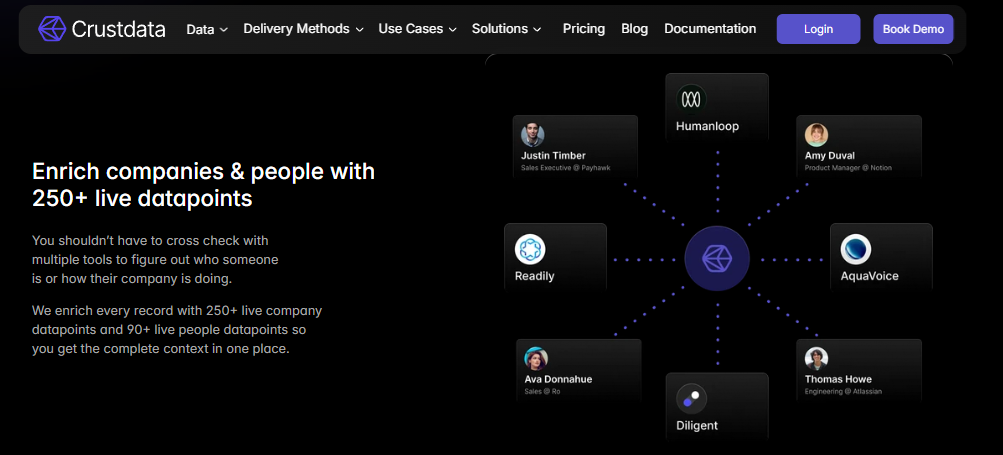
Crustdata is a developer-focused API that combines people and company enrichment with built-in chaining. Chaining, or "waterfall," means trying several data sources in order and stopping at the first valid hit.
What it actually does: it gives platform builders an API that resolves candidate and company records and lets you string sources together. It leans early-stage and builder-friendly on pricing.
⏰ Time to first API call: UI: limited. API: ~20 to 40 minutes.
⚙️ Setup complexity: Medium (developer-first).
🔧 Core Services
- People plus company enrichment in one API.
- Waterfall chaining across multiple providers.
- Job-change and headcount signal data.
- Developer-friendly endpoints for recruiting platforms.
- Early-stage pricing aimed at builders.
📊 Data Coverage & Field Depth
Strong in: Combined people-and-company enrichment, builder workflows.
Weak in: Brand recognition and enterprise-grade contract maturity versus larger vendors.
Field depth: Solid for recruiting platform use, with chaining to fill gaps.
Confidence Level: Medium to high for builders comfortable wiring chains themselves.
🤖 API & Agent Readiness
- API availability: Yes, developer-first.
- API depth: Good, with chaining logic.
- MCP compatibility: Not natively supported.
- Agent usability: Medium to high for engineering teams.
To be fair, Crustdata wins on early-stage pricing and chaining ergonomics. The honest gap is that you still wire and maintain the chain yourself, which one unified API with a shared credit pool removes.
5. ContactOut: Best for Personal Email and Mobile Depth [toc=1.5 ContactOut]
📖 Overview
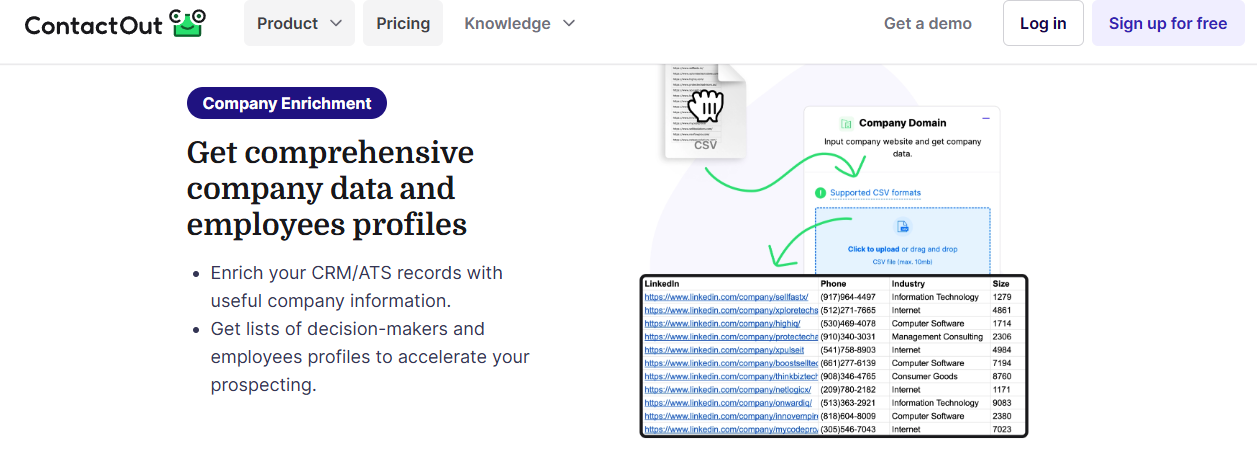
ContactOut focuses on finding personal emails and mobile numbers, especially for recruiting outreach. It pairs a browser extension with an API and refreshes contact data frequently.
What it actually does: it digs for the personal contact details that work emails often miss, which matters when you are sourcing passive candidates. Refresh cadence is a selling point versus monthly-batch databases.
⏰ Time to first API call: UI: instant (extension). API: ~30 minutes.
⚙️ Setup complexity: Low to medium.
🔧 Core Services
- Personal email and mobile number enrichment.
- Chrome extension for LinkedIn sourcing.
- REST API for programmatic lookups.
- Frequent contact-data refresh.
- ATS and CRM record enrichment.
📊 Data Coverage & Field Depth
Strong in: Personal email and mobile coverage; freshness.
Weak in: Deep firmographic and signal breadth for decisioning.
Field depth: Contact-centric, lighter on multi-signal enrichment.
Confidence Level: Medium to high on contact details, lower on broader signals.
🤖 API & Agent Readiness
- API availability: Yes.
- API depth: Moderate, contact-focused.
- MCP compatibility: Not natively supported.
- Agent usability: Medium.
ContactOut is genuinely strong on the one job it picks: personal contact depth with fresh data. The trade-off is that a recruiting agent needs more than contacts, so you end up adding sources to fill firmographic and signal gaps.
6. Cognism: Best for GDPR-First EU Candidate Sourcing [toc=1.6 Cognism]
📖 Overview
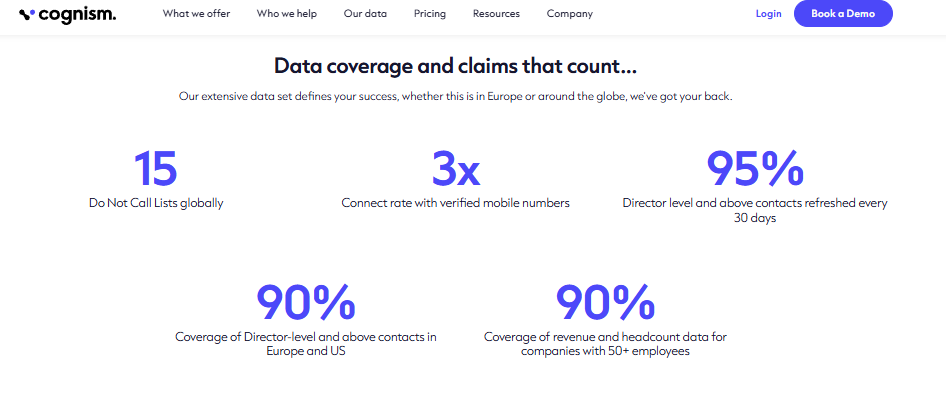
Cognism is a UI-first sales-intelligence platform known for European coverage and compliance positioning. It built its pitch around GDPR-friendly data and phone-verified mobiles. GDPR is the EU privacy law that governs how personal data is collected and used.
What it actually does: it serves contact and company data through a dashboard, with an API available, aimed at SDR and recruiting teams in EU markets. Compliance is its headline differentiator.
⏰ Time to first API call: UI: minutes. API: ~30 to 60 minutes.
⚙️ Setup complexity: Medium (UI-first).
🔧 Core Services
- EU-focused contact and company data.
- Phone-verified mobile numbers (“Diamond Verified”).
- GDPR-oriented compliance posture.
- CRM integrations and UI workflows.
- REST API on higher tiers.
📊 Data Coverage & Field Depth
Strong in: EU compliance framing and firmographic coverage.
Weak in: Mobile accuracy outside HQ markets, per multiple user reports.
Field depth: Decent firmographics; mobile depth contested by reviewers.
Confidence Level: Medium. Compliance-led, but data-quality complaints exist.
🤖 API & Agent Readiness
- API availability: Yes, on higher tiers.
- API depth: Moderate.
- MCP compatibility: Not supported.
- Agent usability: Low to medium. It is built for the SDR in the UI, not the LLM making the call.
I will give Cognism real credit on the compliance frame, which matters more every quarter. But it is human-UI-first, and reviewers flag mobile-coverage gaps that an agent at scale would inherit as bounces and wrong numbers.
💬 Customer Reviews
“Data is really limited and generally poor quality. Claims 90%+ mobile coverage in sales process but doesn’t deliver. Numbers out of date, often wrong. ‘Diamond Verified’ mobiles (verified by multiple parties) are less than 10%. Rest is a cobbled-together database of untrustworthy data.”
Alex, AU Cognism Trustpilot Verified Review
“Poor data quality, no direct mobile numbers. Numbers either wrong or returns US HQ number even when searching European offices. Not worth the money. Waste of time in SDR workflow.”
Jackie, DE Cognism Trustpilot Verified Review
7. Apollo.io: Best for All-in-One Prospecting with Built-In Outreach [toc=1.7 Apollo.io]
📖 Overview
Apollo.io is a bundled GTM platform that combines a contact database, enrichment, and outreach in one UI. It is built for sales teams that want to prospect and email without stitching tools together.
What it actually does: it gives reps a 275M+ contact database and sequencing in one place. The catch for builders is that it is UI-first, and its API is rate-limited and slow for bulk agent work.
⏰ Time to first API call: UI: instant. API: ~30 to 60 minutes.
⚙️ Setup complexity: Medium (UI-first, API-second).
🔧 Core Services
- Contact and company database with filtering.
- Email and phone enrichment.
- Built-in outbound sequencing.
- CRM integrations (Salesforce, HubSpot).
- Chrome extension for LinkedIn prospecting.
📊 Data Coverage & Field Depth
Strong in: SaaS and funded-startup contacts; mid-market prospecting.
Weak in: Freshness of "verified" emails and mobile accuracy, per reviewers.
Field depth: Moderate; contact-centric with limited deep signals.
Confidence Level: Medium, weaker on freshness since LinkedIn restricted scrapers in 2025.
🤖 API & Agent Readiness
- API availability: Yes, in higher tiers.
- API depth: Moderate, contact-focused.
- MCP compatibility: Not supported.
- Agent usability: Low to medium. Reviewers describe the API as slow and throttled for bulk work.
Here is the operational reality. A GTM engineer I trust tried Apollo via API and webhook for bulk enrichment, found it "so slow and consistently throttled" that they reverted to manual CSV exports. That is the human-in-the-loop tax an agent-native layer is meant to remove.
💸 Pricing note
Apollo is seat-based plus credits, so you pay for access and usage at once. Credits get consumed fast during campaigns, and several reviewers report billing surprises.
💬 Customer Reviews
“Contact info frequently missing or incorrect. Half the day calling wrong/disconnected numbers. Mobiles frequently wrong. Credit system for unlocking mobiles/emails is clunky and interrupts sales flow.”
Verified User, IT Services Apollo G2 Verified Review
“Easy to create persona, multiple filters, verified email option for low bounce rates, built-in CRM to track replies and calls. Lack of integrations, only Zapier and some API. Support not helpful, no phone calls, chat only.”
Tejender K., Digital Marketing Executive Apollo G2 Verified Review
8. RocketReach: Best for Broad Verified Contact Lookup [toc=1.8 RocketReach]
📖 Overview
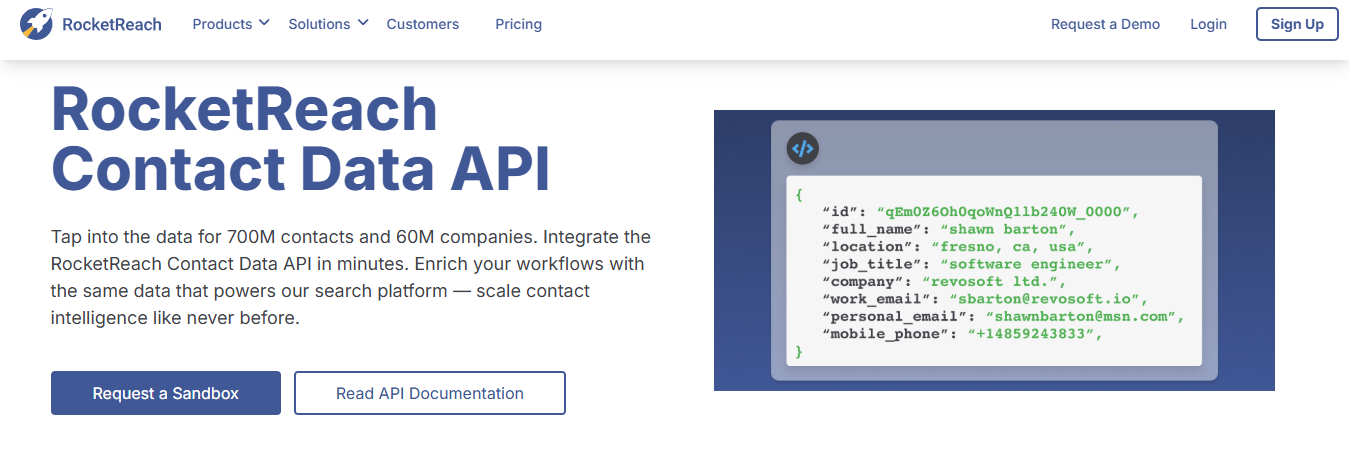
RocketReach is a contact-lookup tool with wide reach across industries. It finds emails and phone numbers from a single name or profile, through both a UI and an API.
What it actually does: it serves broad contact coverage for recruiters and sellers who need a quick lookup. It is a contact-finder, not a deep enrichment or signal platform.
⏰ Time to first API call: UI: instant. API: ~30 minutes.
⚙️ Setup complexity: Low to medium.
🔧 Core Services
- Email and phone lookup across industries.
- REST API for programmatic access.
- Browser extension for sourcing.
- Bulk lookups on higher tiers.
- CRM integrations.
📊 Data Coverage & Field Depth
Strong in: Broad contact coverage across many sectors.
Weak in: Deep firmographic, technographic, and signal data.
Field depth: Contact-centric, shallow on decisioning signals.
Confidence Level: Medium.
🤖 API & Agent Readiness
- API availability: Yes.
- API depth: Moderate, lookup-focused.
- MCP compatibility: Not supported.
- Agent usability: Medium.
RocketReach is a fine breadth-first lookup, and I would not knock it for that. But breadth without depth means an agent still needs other sources to make a real decision, which is the integration-sprawl problem again.
9. SignalHire: Best for Real-Time Verification at Lookup [toc=1.9 SignalHire]
📖 Overview
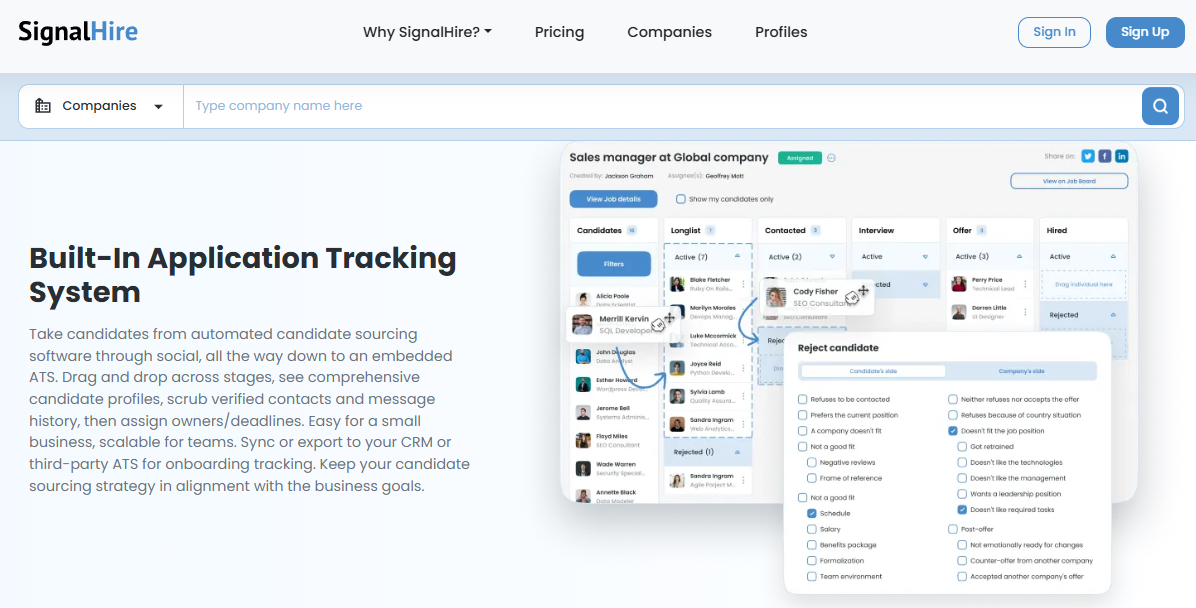
SignalHire’s edge is verify-at-lookup, meaning it checks contact details in real time when you query, instead of serving a stale cached record. That helps deliverability during high-volume outreach.
What it actually does: it returns fresher contacts because it verifies on the spot. Freshness is the pitch, and for recruiting outreach that is a real lever.
⏰ Time to first API call: UI: instant. API: ~30 minutes.
⚙️ Setup complexity: Low to medium.
🔧 Core Services
- Real-time contact verification at lookup.
- Email and phone enrichment.
- Browser extension and API access.
- Bulk lookups.
- ATS and CRM enrichment.
📊 Data Coverage & Field Depth
Strong in: Freshness and verification at query time.
Weak in: Breadth of firmographic and signal data.
Field depth: Contact-focused with strong freshness.
Confidence Level: Medium to high on contact accuracy.
🤖 API & Agent Readiness
- API availability: Yes.
- API depth: Moderate.
- MCP compatibility: Not supported.
- Agent usability: Medium.
I like the verify-at-lookup model, because stale data is what burns sender domains. B2B contact data decays around 2% a month, and roughly 32% of professionals change jobs within a year, so real-time checks earn their keep. The gap is still breadth, which one aggregated layer solves without bolting on more vendors.
10. Dropcontact: Best for GDPR-Native European Email Enrichment [toc=1.10 Dropcontact]
📖 Overview
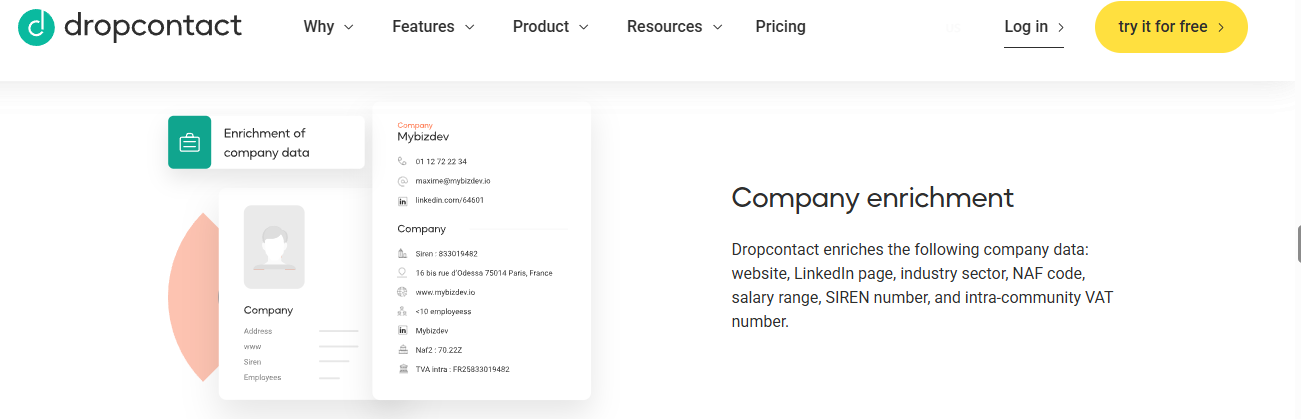
Dropcontact enriches and verifies emails algorithmically, without storing a personal-data database, which is its GDPR-native angle. It is popular with European teams that need compliant email enrichment.
What it actually does: it builds and validates emails on the fly rather than pulling from a stored contact pool. That design choice is both its compliance strength and its coverage limit.
⏰ Time to first API call: UI: minutes. API: ~30 minutes.
⚙️ Setup complexity: Low to medium.
🔧 Core Services
- Algorithmic email enrichment and verification.
- GDPR-native, no stored personal database.
- REST API and native CRM integrations.
- Company data cleanup and dedup.
- Bulk processing.
📊 Data Coverage & Field Depth
Strong in: Compliant European email enrichment.
Weak in: Phone numbers and broad signal data.
Field depth: Email-centric, narrow by design.
Confidence Level: Medium, strong on email validity, light elsewhere.
🤖 API & Agent Readiness
- API availability: Yes.
- API depth: Moderate, email-focused.
- MCP compatibility: Not supported.
- Agent usability: Medium.
Dropcontact’s GDPR-native build is a genuinely smart trade-off for EU email work. The honest limit is scope: email only. A recruiting agent that also needs phones, firmographics, and job-change signals will reach for more sources, which returns us to the central point of this guide.
✅ Bringing the List Back to One Layer
Eight of these ten tools do one or two jobs well and leave the rest to you. That is the single-signal pattern: five integrations, five bills, five matching layers to cover one recruiting agent’s needs. We built Explorium so an agent calls one API, draws from 50+ sources, spends from one credit pool, and decides for itself what to fetch next via MCP retrieval. The list is useful for picking a point tool. The architecture question is whether you want nine of them or one, which is exactly the agent-native data layer decision every builder now faces.
Q2. How Did We Score These Recruiting Enrichment APIs? [toc=2. Scoring Methodology]
We scored each API across five weighted criteria totaling 100%: Candidate Coverage & Match Rate (25%), Refresh Rate & Data Freshness (20%), Agent & API/MCP Readiness (25%), ATS Integration Depth (15%), and GDPR Posture & Commercial Transparency (15%). Tools scoring 0 to 20 earn 1 star, 21 to 40 earn 2 stars, rising to 81 to 100 for 5 stars. Explorium earns 5 stars.
📊 Why These Five Axes
The five axes mirror the four promises in this article’s title, plus commercial reality. I picked them because they are the ones that actually break an agent in production, not the ones that look good on a feature grid. A recruiting agent that pulls the wrong employer or burns its budget fails quietly, and these axes catch that early.
The biggest call I made was weighting Agent & API/MCP Readiness at a full 25%. MCP, the Model Context Protocol, is Anthropic’s open standard that lets an LLM call tools directly. No competitor listicle scores MCP readiness, yet agentic recruiting is the 2026 buying trigger, with Gartner forecasting that most HR leaders will deploy agentic AI by 2026.
⚖️ How Stars Map, and Our Honest Disclosure
The star bands are deliberately blunt so the math stays auditable. A score of 0 to 20 is 1 star, 21 to 40 is 2 stars, 41 to 60 is 3 stars, 61 to 80 is 4 stars, and 81 to 100 is 5 stars. No weighting tricks, no hidden multipliers.
Here is the conflict of interest, stated plainly. We build Explorium, so we held it to the exact same rubric as everyone else. Explorium earns its 5-star Agent & API/MCP readiness from a native MCP server and a sync API built for scale, not from us grading on a curve. That throttling tax is real elsewhere: one GTM engineer told me Apollo’s API was "so slow and consistently throttled" that the team reverted to manual CSV exports.
Q3. How Do These APIs Compare on Coverage, Refresh Rate, ATS Integration, and Match Quality? [toc=3. Four-Axis Comparison]
On a four-axis comparison (candidate coverage, refresh rate, ATS integration, and match quality), providers diverge sharply. Coverage of 700M to 1.5B+ profiles is not the same as match rate, because matching is probabilistic record linkage that caps single-source APIs at 75% to 85% accuracy. Refresh cadence ranges from 7-day to 30-to-90-day batches, and ATS depth spans native sync to manual CSV.
📊 Coverage Is Not Match Rate
This is the trap most buyers fall into. A vendor advertises a billion profiles, and you assume a billion correct answers. But entity resolution, the act of deciding two records describe the same person, is probabilistic by design, as documented in record-linkage patents from IBM and Capital One.
That probability has a price. People Data Labs shows identity-merge errors near 1 in 1,000 matches, where two different people get stitched into one record. At 10K calls a day, that is real wrong-person outreach, and no amount of raw volume fixes it without a stronger match-rate benchmark.
⏰ Refresh Rate and the Freshness Gap
Stale data is the silent killer. B2B data decays at roughly 2.1% per month, so about 22.5% of your database goes stale every year as people change jobs. Around 32% of professionals switch roles within a year, which is exactly the signal a recruiting agent must catch.
Cadence is where vendors split. Some providers re-verify every 7 days, while the industry norm sits at 30 to 90 days. An agent reading a 90-day-old "current employer" is guessing, and that guess shows up as bounces, which is why timely buying signals matter so much.
🔗 ATS Integration Depth
Integration depth decides how the data actually lands in your workflow. Native sync writes straight into your ATS, webhooks push events, and CSV means a human exports and re-imports by hand. Apollo, for example, allows only one CRM connection at a time unless you add middleware like Zapier.
🔁 The Waterfall Payoff
Here is the structural answer to the 85% ceiling. A waterfall runs through several sources in order and stops at the first valid hit, so you never pay for the second source if the first answers. As one operator put it, "as soon as one succeeds it’s going to stop the rest, it saves you money automatically."
Where a single-source API caps near 85%, we run that match-rate waterfall inside one Explorium API call across 50+ sources, and stream job-change signals so the agent re-verifies the current employer before outreach. That closes the 30-to-90-day freshness gap without you wiring five APIs together, which is the whole point of an agent-native data layer.
Q4. Which Recruiting Enrichment APIs Are Actually GDPR-Compliant? [toc=4. GDPR & Compliance Risk]
GDPR posture means a provider’s lawful basis (Article 6(1)(f) legitimate interest), a documented assessment, and clean right-to-erasure handling. It is now existential. LinkedIn’s lawsuit shut down Proxycurl in July 2025 despite roughly $10M ARR, and France’s CNIL fined Kaspr €240,000 for scraping LinkedIn contacts. Collection method, not database size, decides whether your data vendor survives.
⚖️ The Situation: Public Data Is Legal, Fake Accounts Are Not
Scraping genuinely public data is broadly defensible, as the hiQ v. LinkedIn and Meta v. Bright Data cases showed. That is the comfortable part of the story most vendors lean on.
The bright line is access method. Proxycurl was alleged to run hundreds of thousands of fake accounts to reach data behind login walls, which is fraud, not scraping. That distinction is the whole game, and it is why a documented GDPR and CCPA compliance posture matters.
💸 The Complication: The Enforcement Ledger
The numbers are not theoretical anymore. Here is what method risk has actually cost vendors and their customers:
- Proxycurl: roughly $10M ARR to zero after LinkedIn’s suit, with a permanent injunction to delete scraped data.
- Kaspr: €240,000 CNIL fine for collecting contacts users had restricted, on a 160M-contact database.
- Apollo and Seamless.ai also faced LinkedIn enforcement action in 2025, and Apollo’s data freshness has been questioned since.
As one operator noted, "back in March 2025 LinkedIn banned Apollo scrapers and other lead-generation scrapers, and since then Apollo’s data has been getting questionable at best." When your vendor’s source dies, your agent’s pipeline dies with it, which is why vendor compliance vetting belongs in your build plan.
✅ The Resolution: Vet the Method, Not the Logo
Add three questions to every vendor evaluation, before pricing ever comes up:
- What is your sourcing method, and do you access any data behind a login?
- Do you maintain a Legitimate Interest Assessment (LIA) under Article 6(1)(f)?
- How do you handle right-to-erasure and source-disclosure requests?
This is a build-risk the agent inherits, so I treat it as an architecture decision, not a legal footnote. We aggregate compliant sources under one contract at Explorium, so a recruiting agent is not betting its whole pipeline on a single scraper that LinkedIn can litigate out of existence overnight. Spreading sourcing risk is the same logic as not running your business on one payment gateway, and it is why builders increasingly pick a resilient data layer for autonomous agents.
Q5. Why Are Agent-Native Data Layers Replacing Single-Tool Enrichment Stacks? [toc=5. Agent-Native vs Point Tools]
Agent-native data layers are replacing point-tool stacks because an autonomous LLM, not a rep, now makes each data call and cannot tab between Apollo, Clay, and PDL dashboards. Stitching sources yourself means owning entity resolution, dedup, refresh, and compliance for each one. A unified API with MCP retrieval hands you aggregated sources and one credit system, so you build only the logic that is truly yours.
🔌 What "Agent-Native" Actually Means
Agent-native enrichment means the data is shaped for an LLM to call directly, not for a human to click through. The plumbing for that is MCP, the Model Context Protocol, which one engineer described as "a USB socket for AI, an API for AI if you will."
That analogy is the whole shift. A USB-C port does not care which device you plug in. An MCP server does not care which agent calls it, which is why the agent, not the rep, becomes the buyer of the next data call, and why teams compare MCP versus REST for AI agents before they build.
⚠️ Why Fragmented Stacks Break Agents
Here is the failure mode I see most. When you wire five point-tools together, the agent spends much of its run just pulling data that is irrelevant to the task at hand. Every extra hop is latency and credit burn with no payoff.
It gets worse at scale. Each source you bolt on is another entity-resolution layer, another dedup rule, another compliance posture, and another bill. The standard read says "best tool for each job," but at 10K calls a day that advice quietly backfires, which is why a data layer for autonomous agents wins.
🛠️ Build vs Buy, Honestly
The pragmatic rule a lot of operators land on is to buy 90% of your AI stack and build the 10% that is genuinely yours. Data coverage, refresh, and compliance are the 90%, because reinventing them wins you nothing.
But I will be fair to the build case. A single, sharply-scoped agent can be cheap and devastating, like the roughly $1,000-a-year lead agent that reportedly did work once handled by far costlier SDR headcount. Build wins when you own a proprietary signal nobody else can sell you, and a clean enrichment API for AI agents fills the rest.
✅ Where the Line Falls
So when do you buy, and when do you build? My current read, and I could be off in edge cases:
- Buy when you need coverage, freshness, dedup, and compliance at scale.
- Build when the signal is proprietary to your product and your moat.
- Buy the layer, build the logic, and do not confuse the two.
This is exactly the seam Explorium is built for. Our MCP server exposes 30+ enrichments as agent-callable tools under one unified credit pool, and custom plans add resale rights, so a rec-tech founder buys the data layer and still ships a branded product on top. You buy and build at the same time, the way teams once bought AWS and still built their own app.
What I keep sitting with is this: if only a small share of teams have truly succeeded with AI so far, maybe the bottleneck was never the model. Maybe it was the data layer underneath it. Tell me where you think that line really falls.
Q6. How Do You Choose the Right Recruiting Enrichment API for Your Use Case? [toc=6. Choosing by Use Case]
Match the API to your use case. Choose Explorium for agent-native teams needing aggregated coverage, MCP retrieval, and one credit pool; PDL for raw contact volume; Cognism for GDPR-first EU sourcing; SignalHire for real-time verification. If you are building a recruiting agent that decides its own data calls, prioritize API/MCP readiness and refresh rate over headline database size.
🎯 If-Then Scenarios by Team Type
The right answer depends on who is calling the data and why. Here is how I would route it:
- If an LLM makes each data call, then prioritize MCP readiness and aggregated coverage.
- If you want raw contact volume to build your own stack, then PDL fits, but you own the matching layer.
- If you sell into the EU and compliance is the gating risk, then Cognism’s GDPR framing matters.
- If deliverability is your pain, then SignalHire’s verify-at-lookup freshness helps.
Watch the fine print on "verified" data. One operator found that with Apollo, "when you tick the verified email option, it’s not actually verified emails because it hasn’t been updated." That gap is exactly why refresh rate outranks database size, and why some builders weigh Apollo API alternatives for agent work.
Reviews back up where the point-tools strain under that load:
“Credit system is broken. Pricing is broken. Not fully transparent with rollover limit. Never helped when issues arose.”
Raphael A., Marketing Lead Clay G2 Verified Review
“Data is really limited and generally poor quality. Claims 90%+ mobile coverage in sales process but doesn’t deliver. Numbers out of date, often wrong.”
Alex, AU Cognism Trustpilot Verified Review
⏰ The Transformation You Are Buying
The real prize is time, not records. Operators running good enrichment report saving at least 10 hours a week, and one CEO described buying back 95% of his week by letting AI qualify buyers first. That is the output a recruiting agent is supposed to deliver, and it is why teams lean on a B2B data API for recruiting automation.
💬 An Invitation, Not a Pitch
So here is where I land. If your agent decides which candidate signal to fetch next, give it one API, one MCP server, and one credit pool to do it with. That is the bet we made with Explorium, and it is the bet I would make again, grounded in benchmark-led match rates.
I am genuinely curious what you are building. Tell me what recruiting agent you have in mind, and I will tell you honestly whether aggregation helps or whether a single point-tool is enough for your case.
FAQs


