

TL;DR
- A company profile API turns one identifier (domain, email, or social URL) into a structured record covering firmographics, technographics, funding, and contacts in a single call.
- We scored 12 providers on five weighted criteria, with Data Coverage and Agent Readiness carrying the most weight because an LLM, not a salesperson, is now the buyer of the next data call.
- No single API wins every field: CompanyEnrich led firmographic depth, Apollo led technographics, and People Data Labs led on employees and org structure.
- Headline prices mislead because per-signal credits and overages can push real cost two to three times higher, so budget by cost per record at your agent's call volume.
- Agent-native means MCP retrieval, synchronous high-QPS calls, and one credit pool, not a UI-first async API that forces CSV ping-pong and throttles agents.
- Pick by the job, not the brand: Explorium fits production GTM agents needing one API, one MCP server, and one credit pool, while specialists win narrow single-signal jobs.
Q1. What Are the 12 Best Company Profile APIs for GTM in 2026? [toc=1. Best Company Profile APIs]
A company profile API takes one identifier, a domain, an email, or a social URL, and returns a structured company record. That record carries firmographics (industry, size, revenue), technographics (the tools a company runs), funding, headcount, and contact data. Your CRM, your lead-scoring model, or your GTM agent reads that record in a single call instead of a rep hunting it down by hand.
Here is the operating reality I keep running into. The average go-to-market stack now spans 15 to 25 vendors, and data sits fragmented across all of them. When you let an agent discover that data on its own, it burns most of its time pulling records that are irrelevant to the actual task. That is the problem this list is built to solve: which API gives an agent the most complete, freshest profile in the fewest calls.
Choosing a B2B data provider is a high-stakes decision for SaaS, FinTech, and sales-tech teams building GTM agents, running enrichment at scale, and tightening data-accuracy requirements; rather than rank by popularity, this guide scores 12 providers on operational, technical, and commercial criteria, covering time to value, data coverage and accuracy, field depth and signal quality, agent and API readiness, scalability, compliance, and pricing transparency, so GTM Engineers, RevOps leaders, AI Product Managers, and data teams evaluating third-party enrichment APIs versus in-house pipelines can confidently shortlist vendors for an RFP.
At-a-Glance Comparison
Star scores follow a weighted rubric (Data Coverage and Accuracy 25%, Agent and API Readiness 25%, Field Depth 20%, User Validation 15%, Commercial Transparency 15%); the methodology section explains the bands in full.
One honest caveat up front. No single API wins every category. In an independent 349-domain benchmark, find rates ran from 50.1% to 67.6%, and matched-profile depth ranged from 11.5 to 17.9 of 27 canonical fields, with different vendors leading different field groups. So read this list by the job you are hiring the API to do, not by the loudest brand.
1. Explorium [toc=1.1 Explorium]
📋 Overview
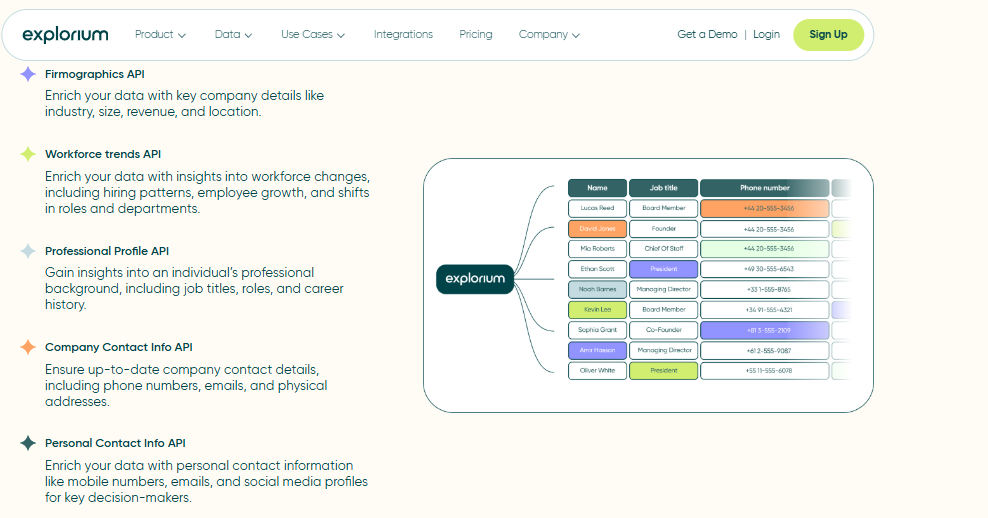
Explorium is an agent-native B2B data layer. It aggregates 50+ data sources behind one API and one MCP server, so a single integration covers firmographics, technographics, contacts, and signals. The point is consolidation: one match key, one credit pool, one bill, instead of nine.
We built it because the next buyer of a data call is an LLM, not a salesperson. With MCP (Model Context Protocol, Anthropic’s "USB-C port for AI" that lets an agent decide what to fetch), the agent itself selects the enrichment at runtime. That removes the human-in-the-loop orchestration that breaks at agent scale.
⏰ Time to first call: UI: minutes. API: ~30 minutes with the MCP server scoped to a workspace.
⚙️ Setup complexity: Low to medium (one integration, not five).
🛠️ Core Services
- Unified API across 50+ sources with one credit pool spanning 30+ enrichments.
- Native MCP server so agents choose what to fetch, no pre-mapped field logic.
- Find, Match, Enrich, and Track flow over 150M+ company profiles.
- Firmographic, technographic, and financial enrichment across 150+ countries.
- Native integrations with Salesforce, HubSpot, Outreach, and Snowflake.
📊 Data Coverage and Field Depth
- Strong in: multi-source firmographic and technographic depth resolved behind one entity; global coverage.
- Weak in: point-in-time historical depth, which reviewers have flagged as still maturing.
- Field depth: 4,000+ datapoints across 30 enrichments via aggregation.
- Confidence Level: High for company enrichment and agent workloads.
🤖 API and Agent Readiness
- API availability: Yes, sync-ready for 10K+ calls/day.
- API depth: High, 50+ sources behind one endpoint.
- MCP compatibility: ✅ Native MCP server.
- Agent usability: High, the agent decides what to fetch.
💰 Pricing and Cost Structure
- Pricing Model: Usage-based with a unified credit pool.
- 💸 Cost interpretation: one credit pool across all enrichments, so you avoid the per-signal credit fragmentation that inflates real cost on multi-vendor stacks.
- Free credits / trial: free tier available for testing.
- Billing driver: API calls / credits, not seats.
- Resale rights and search preview available on custom plans, which preserves data ownership for builders.
✅ When to Shortlist
Shortlist this if:
- You are building agent-native enrichment and want the agent to choose sources via MCP.
- You want to collapse a multi-vendor stack into one credit pool.
- You run high-volume sync enrichment (10K+ calls/day).
Avoid this if:
- You only need a single signal once a month (a point provider may be cheaper).
- You require deep point-in-time historical snapshots as a core use case.
💬 Customer Reviews
“The richness and breadth of data is incredible. I really like the instant access to the most useful and reliable external data. The platform is very easy to use and extremely versatile.”
Ishi N., Enterprise (1000+ emp.) Explorium G2 Verified Review
“Explorium is a great tool for getting data from multiple subscriptions, databases but at a consolidated cost. Depending on where the data is coming from, the data can often be mismatched or have outdated information. It is best to cross-reference the output data.”
Omar G., Mid-Market (51-1000 emp.) Explorium G2 Verified Review
2. People Data Labs [toc=1.2 People Data Labs]
📋 Overview
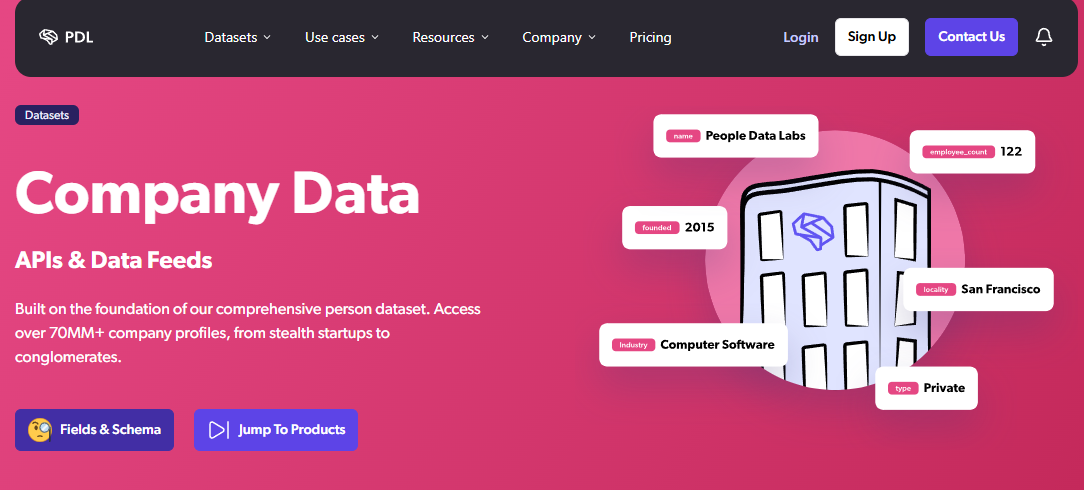
People Data Labs (PDL) is a developer-first data API focused on person and company records. It sells raw, structured data through clean endpoints rather than a UI, which makes it popular with builders who want to wire enrichment straight into their own systems.
In the field, PDL earns its place on contact and org-structure depth. In the independent benchmark, PDL led on employees, company type, LinkedIn data, and was one of the few to return parent-company org structure at all. That last point matters more than it sounds.
⏰ Time to first call: UI: limited (API-first). API: ~30 to 45 minutes.
⚙️ Setup complexity: Medium (developer-oriented, clear docs).
🛠️ Core Services
- Person enrichment API (job history, title, workplace).
- Company enrichment with employee counts and company type.
- Org-structure and parent-company resolution, a real gap-filler.
- Bulk and search APIs for dataset building.
- Identity resolution across person and company records.
📊 Data Coverage and Field Depth
- Strong in: employees, company type, LinkedIn data, and org structure.
- Weak in: funding and technographic signals, which sat near the sub-11% floor across all benchmarked vendors.
- Field depth: wide on person/firmographic basics, thinner on intent and tech.
- Confidence Level: High for contacts and org structure, medium elsewhere.
🤖 API and Agent Readiness
- API availability: Yes, this is the core product.
- API depth: High for person/company endpoints.
- MCP compatibility: ❌ Not supported, REST-only.
- Agent usability: Medium. An agent can call it, but you wire and dedupe it yourself, and you add your own match layer.
💰 Pricing and Cost Structure
- Pricing Model: Usage-based / API credits.
- 💸 Cost interpretation: per-record API pricing; entry plans start around $100/month based on reviewer reports.
- Free credits / trial: Free trial available, then paid tiers.
- Billing driver: API calls / records.
- ⚠️ Hidden costs: reviewers report abrupt account changes after moving from trial to paid, so confirm billing and account terms in writing before you scale.
✅ When to Shortlist
Shortlist this if:
- You need strong contact and org-structure data via a clean API.
- You are a developer comfortable building your own match and dedupe layer.
- You want parent-child company resolution that many vendors miss.
Avoid this if:
- You need funding or technographic depth as a primary signal.
- You want MCP-native retrieval where the agent picks the source.
- You prefer one credit pool over wiring and reconciling multiple APIs.
💬 Customer Reviews
“Product was useful while it worked, which wasn’t long. Switched from free trial to paid plan, $100/month. After a few days, account disabled with no warning or explanation. Support unresponsive after multiple contact attempts.”
Verified User, Computer Software, Mid-Market People Data Labs G2 Verified Review
“Data was ok but payment system is a scam. Very hard to get off their hook once signed up.”
Glissando AI, US People Data Labs Trustpilot Verified Review
A quick honesty note from our side: PDL genuinely wins on contact-info and org-structure coverage in some segments, and we will say so plainly. Where Explorium differs is architecture, not just data. PDL hands you clean endpoints and leaves the matching, deduplication, and multi-source reconciliation to you; our layer resolves 50+ sources behind one entity and one credit pool, so the agent gets the subsidiary’s headcount, not the holding company’s, without you writing the match logic. For teams weighing this trade-off, our breakdown of MCP versus REST API for AI agents and our guide to the best B2B data enrichment API for AI agents walk through where each approach fits, and the match-rate benchmarks show the numbers behind the entity-resolution claim.
3. The Companies API [toc=1.3 The Companies API]
📋 Overview
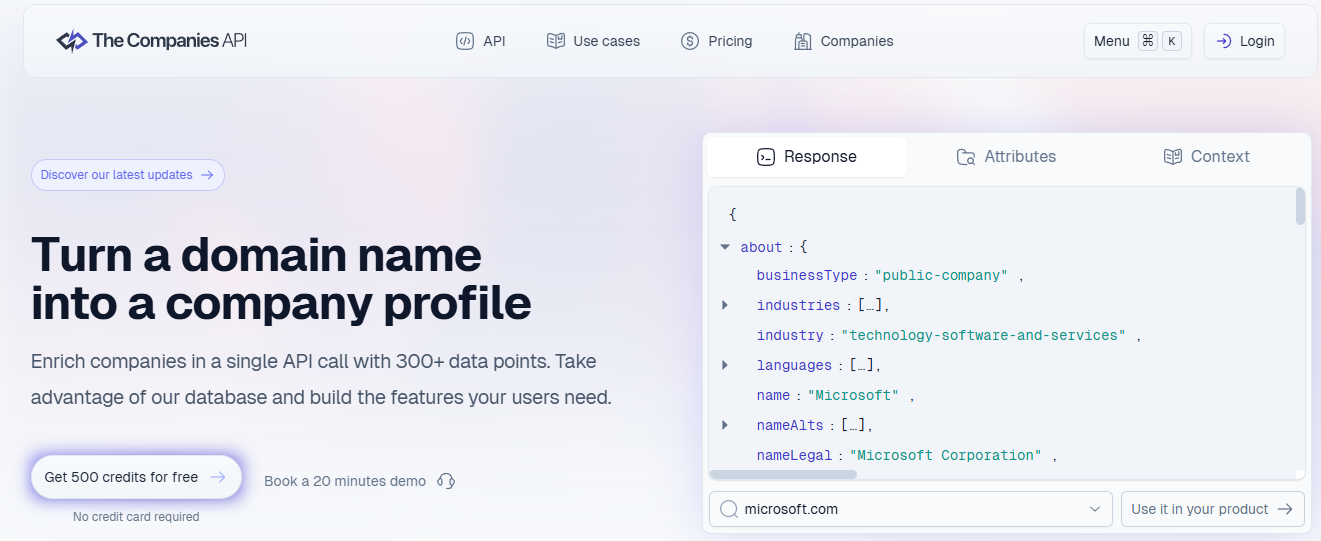
The Companies API turns a domain into a company profile in one call. It is a pure data API, not a UI platform, built for developers who want enrichment wired straight into their product. It advertises 300+ datapoints per company and an AI-context endpoint that returns full extracted text for LLM workflows.
⏰ Time to first call: UI: minimal. API: ~20 to 30 minutes.
⚙️ Setup complexity: Low (clean REST, sample JSON).
🛠️ Core Services
- Enrich a company by domain, email, or social URL.
- 300+ datapoints per company profile.
- Search and “ask” endpoints for filtered discovery.
- AI-context endpoint returning raw extracted text for LLMs.
- Tiered RPS (requests per second) from 50 to 1,000.
📊 Data Coverage and Field Depth
- Strong in: fast domain-to-profile firmographics at low cost.
- Weak in: verified contacts and deep intent signals.
- Field depth: wide firmographic coverage, lighter on people data.
- Confidence Level: Medium-high for firmographics.
🤖 API and Agent Readiness
- API availability: Yes, this is the product.
- API depth: High for company endpoints.
- MCP compatibility: ❌ Not native; REST-only.
- Agent usability: Medium-high (the AI-context endpoint helps LLMs).
💰 Pricing and Cost Structure
- Pricing Model: Usage-based.
- Published pricing: plans roughly $95 / $295 / $595 per month; 1 credit is about $0.00119 per company.
- 💸 Cost interpretation: very low cost per record, among the cheapest for pure firmographics.
- Free credits / trial: Yes, free tier to test.
- Billing driver: API calls / credits.
- ⚠️ Hidden costs: RPS caps by tier can throttle bulk agent loops.
✅ When to Shortlist
Shortlist this if:
- You need cheap, fast domain-to-firmographic enrichment.
- You are a developer wanting clean REST and sample JSON.
- You want an AI-context endpoint for LLM pipelines.
Avoid this if:
- You need verified contacts or deep intent data.
- You run agent loops above the RPS ceiling of your tier.
- You want one credit pool across many signal types, which is where a unified enrichment API fits better.
4. Coresignal [toc=1.4 Coresignal]
📋 Overview
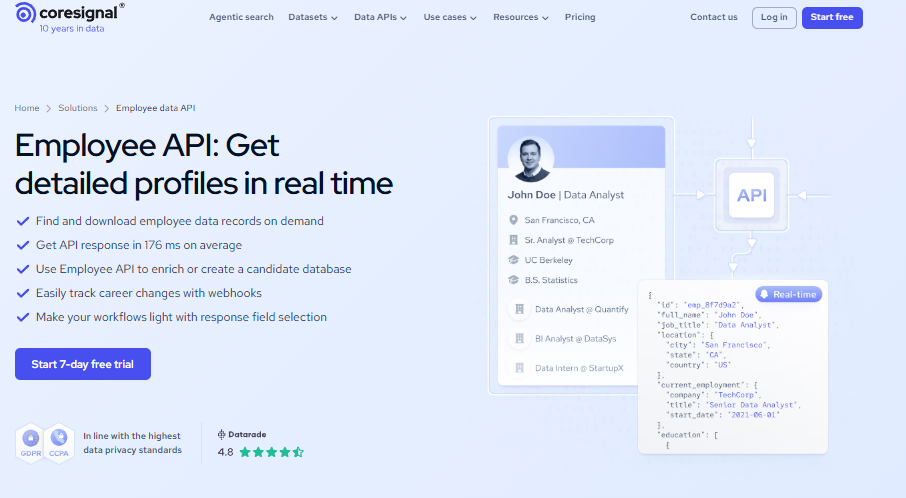
Coresignal sells fresh, structured company and employee data at high volume. It positions itself as a sourcing layer for sales, investment, and market research, with normalized, standardized records. Normalization here means messy source fields are cleaned into a consistent schema you can trust.
⏰ Time to first call: UI: limited. API: ~30 minutes.
⚙️ Setup complexity: Medium.
🛠️ Core Services
- Company, employee, and job-posting datasets.
- Tiered schemas of 70, 80, and 500+ fields.
- Multi-source aggregation with normalization.
- Bulk delivery for high-volume use.
- ~176 ms average API response time.
📊 Data Coverage and Field Depth
- Strong in: firmographic breadth and headcount feeds.
- Weak in: verified direct-dial phones and intent.
- Field depth: up to 500+ fields on top tier.
- Confidence Level: High for firmographic volume.
🤖 API and Agent Readiness
- API availability: Yes.
- API depth: High (tiered field schemas).
- MCP compatibility: ❌ Not native.
- Agent usability: Medium (fast, but you build the match layer).
💰 Pricing and Cost Structure
- Pricing Model: Subscription plus usage.
- 💸 Cost interpretation: geared to high-volume buyers; cost scales with field tier and record count.
- Free credits / trial: Limited trial.
- Billing driver: API calls / records.
- ⚠️ Hidden costs: higher field tiers cost more, so map the schema to what you actually consume.
✅ When to Shortlist
Shortlist this if:
- You need high-volume, normalized firmographic feeds.
- You value fast response times for bulk jobs.
- You build your own enrichment pipeline.
Avoid this if:
- You need verified mobile numbers or intent signals.
- You want MCP-native agent retrieval, where MCP versus REST trade-offs matter most.
5. Apollo [toc=1.5 Apollo]
📋 Overview
Apollo is a bundled GTM platform, not a pure data API. It combines contact discovery, enrichment, and outbound sequencing into one UI-first system. In the field, a practitioner I trust put it bluntly: he tried Apollo "via API and webhook" and found it "so slow and consistently throttled" that he reverted to manual CSV exports.
⏰ Time to first call: UI: instant. API: ~30 to 60 minutes.
⚙️ Setup complexity: Medium (UI-first, API-second).
🛠️ Core Services
- Contact and company database with filtering.
- Email and phone enrichment.
- Built-in outbound sequencing.
- CRM integrations (Salesforce, HubSpot).
- Technographic and engagement signals.
📊 Data Coverage and Field Depth
- Strong in: SaaS and funded-startup contacts; led technographics at 61.0% in the benchmark.
- Weak in: non-tech SMBs; data quality has wobbled since LinkedIn banned Apollo scrapers in March 2025.
- Field depth: moderate-to-wide contacts, lighter multi-source depth.
- Confidence Level: Medium.
🤖 API and Agent Readiness
- API availability: Yes, but rate-limited.
- API depth: Moderate (contact/company endpoints).
- MCP compatibility: ❌ Not supported.
- Agent usability: Medium (throttling fights agent loops).
💰 Pricing and Cost Structure
- Pricing Model: Seat and credit hybrid.
- 💸 Cost interpretation: one email costs one credit, a mobile number costs eight; real-world cost can run two to three times the headline price.
- Free tier: Yes, limited credits.
- Billing driver: seats and credits.
- ⚠️ Hidden costs: credits drain fast during outbound; API access sits in higher tiers.
✅ When to Shortlist
Shortlist this if:
- You want all-in-one prospecting with minimal setup.
- Your focus is SaaS or tech outbound.
- You prioritize speed over data infrastructure flexibility.
Avoid this if:
- You are building agent-native enrichment systems and want Apollo API alternatives for agent builders.
- You need accurate data across non-tech industries.
- You want fully usage-based, unthrottled pricing.
💬 Customer Reviews
“Some cool new features, not sure if they work. Contact info frequently missing or incorrect. Half the day calling wrong/disconnected numbers. The credit system for unlocking mobiles/emails is clunky and interrupts sales flow.”
Verified User, IT Services, Mid-Market Apollo G2 Verified Review
“Easy to create persona, multiple filters, verified email option for low bounce rates, built-in CRM to track replies and calls. Lack of integrations, only Zapier and some API. Support not helpful.”
Tejender K., Digital Marketing Executive, Mid-Market Apollo G2 Verified Review
6. Clearbit (HubSpot Breeze) [toc=1.6 Clearbit]
📋 Overview
Clearbit, now folded into HubSpot as Breeze Intelligence, enriches records and reveals which companies visit your site. Its strength is HubSpot-native enrichment; its gravity now pulls toward the HubSpot ecosystem.
⏰ Time to first call: UI: minutes in HubSpot. API: ~30 minutes.
⚙️ Setup complexity: Low inside HubSpot, medium standalone.
🛠️ Core Services
- Company and contact enrichment APIs.
- Web-visitor reveal for account identification.
- Lead-notification enrichment with job titles.
- HubSpot-native workflows (Breeze).
- Self-service API for small-to-medium volumes.
📊 Data Coverage and Field Depth
- Strong in: firmographics and HubSpot-native enrichment.
- Weak in: refresh frequency and contact recall; one reviewer found “only 20%” of known contacts.
- Field depth: solid firmographics, variable contact depth.
- Confidence Level: Medium.
🤖 API and Agent Readiness
- API availability: Yes, easy-to-use APIs.
- API depth: Moderate.
- MCP compatibility: ❌ Not native.
- Agent usability: Medium (best inside HubSpot).
💰 Pricing and Cost Structure
- Pricing Model: Tiered, increasingly bundled with HubSpot.
- 💸 Cost interpretation: self-service is fine at low volume, but the jump past the limit is steep.
- Free credits / trial: Limited via HubSpot.
- Billing driver: credits / HubSpot plan tier.
- ⚠️ Hidden costs: “Once over self-service limit, must jump to 4x plan,” per a reviewer.
✅ When to Shortlist
Shortlist this if:
- You run on HubSpot and want native enrichment.
- You want web-visitor reveal tied to your CRM.
- Your volumes sit inside the self-service band.
Avoid this if:
- You need frequent data refresh and high contact recall.
- You want MCP-native agent retrieval.
💬 Customer Reviews
“Easy-to-use APIs. Good self-service pricing for small-medium volumes. Once over self-service limit, must jump to 4x plan, no room to grow realistically. Clearbit X requires yearly agreement with no trial and is very secretive.”
Dan T., Mid-Market Clearbit G2 Verified Review
“APIs enrich new lead notifications with job title data for qualification. Not always accurate. Needs more frequent refresh. Lacks robust integrations to easily action on data.”
Brian Y., Head of Marketing, Small-Business Clearbit G2 Verified Review
7. ZoomInfo [toc=1.7 ZoomInfo]
📋 Overview
ZoomInfo is the enterprise incumbent for firmographics and intent. It offers the deepest firmographic data and intent signals on the market, but at enterprise pricing that prices out most growth-stage teams.
⏰ Time to first call: UI: fast. API: ~1 hour, gated by contract.
⚙️ Setup complexity: Medium-high (enterprise onboarding).
🛠️ Core Services
- Deep firmographic and contact database.
- Intent signals and scoops.
- Enrichment and data-as-a-service APIs.
- CRM and MAP integrations.
- Org charts and technographics.
📊 Data Coverage and Field Depth
- Strong in: enterprise firmographics and intent.
- Weak in: price-to-value for small teams; rate-limited API.
- Field depth: very wide.
- Confidence Level: High for enterprise segments.
🤖 API and Agent Readiness
- API availability: Yes, but rate-limited.
- API depth: High.
- MCP compatibility: ❌ Not native.
- Agent usability: Medium (rate limits fight agent scale).
💰 Pricing and Cost Structure
- Pricing Model: Enterprise custom, annual contracts.
- 💸 Cost interpretation: highest entry cost in this list; budget for a yearly commitment.
- Free tier: No.
- Billing driver: seats plus platform plus credits.
- ⚠️ Hidden costs: “Detailed cost mechanics are not fully transparent pre-contract.”
✅ When to Shortlist
Shortlist this if:
- You are an enterprise needing the deepest firmographics and intent.
- You have budget for an annual platform contract.
Avoid this if:
- You are growth-stage and cost-sensitive, in which case ZoomInfo API alternatives for GTM agent builders are worth a look.
- You run high-volume agent loops that hit rate limits.
8. Cognism [toc=1.8 Cognism]
📋 Overview
Cognism focuses on compliant contact data, especially phone numbers, with a strong EU and GDPR posture. Reviewers, though, push back hard on its real-world mobile coverage.
⏰ Time to first call: UI: fast. API: ~30 to 60 minutes.
⚙️ Setup complexity: Medium.
🛠️ Core Services
- Phone-verified contact data (“Diamond Data”).
- GDPR and CCPA compliance focus.
- Company and contact enrichment.
- CRM and sales-tool integrations.
- Intent data via partnership.
📊 Data Coverage and Field Depth
- Strong in: EU-compliant contact records.
- Weak in: mobile accuracy, per multiple reviewers.
- Field depth: moderate.
- Confidence Level: Medium (segment-dependent).
🤖 API and Agent Readiness
- API availability: Yes.
- API depth: Moderate.
- MCP compatibility: ❌ Not native.
- Agent usability: Medium.
💰 Pricing and Cost Structure
- Pricing Model: Seat-based / custom.
- 💸 Cost interpretation: annual contracts common; confirm term length before signing.
- Free tier: No.
- Billing driver: seats / platform.
- ⚠️ Hidden costs: reviewers report being signed to 12-month terms despite quarterly framing.
✅ When to Shortlist
Shortlist this if:
- You need GDPR-conscious EU contact data, and our GDPR and CCPA compliance checklist helps frame the requirements.
- Compliance posture is a procurement requirement.
Avoid this if:
- You need verified mobiles at scale and cannot absorb misses.
- You want usage-based, agent-native pricing.
💬 Customer Reviews
“Data is really limited and generally poor quality. Claims 90% mobile coverage in sales process but doesn’t deliver. Numbers out of date, often wrong. Diamond Verified mobiles are less than 10%.”
Alex, AU Cognism Trustpilot Verified Review
“Poor data quality, no direct mobile numbers. Numbers either wrong or returns US HQ number even when searching European offices. Not worth the money.”
Jackie, DE Cognism Trustpilot Verified Review
9. Crustdata [toc=1.9 Crustdata]
📋 Overview
Crustdata is a developer-first API for real-time people and company signals. Its edge is freshness: live deltas on headcount, job changes, and funding, delivered through clean endpoints.
⏰ Time to first call: UI: limited. API: ~30 minutes.
⚙️ Setup complexity: Medium (dev-first).
🛠️ Core Services
- Real-time company and people signals.
- Headcount and job-change tracking.
- Funding and growth deltas.
- Search and enrichment endpoints.
- Developer-friendly docs.
📊 Data Coverage and Field Depth
- Strong in: fresh, real-time signals and early-stage pricing.
- Weak in: breadth versus the large incumbents.
- Field depth: focused on signals over static firmographics.
- Confidence Level: Medium-high for freshness.
🤖 API and Agent Readiness
- API availability: Yes.
- API depth: Moderate-high.
- MCP compatibility: ❌ Not native.
- Agent usability: Medium.
💰 Pricing and Cost Structure
- Pricing Model: Usage-based.
- 💸 Cost interpretation: competitive for early-stage teams; Crustdata genuinely wins on early-stage pricing, and I will say so plainly.
- Free credits / trial: Yes, dev access.
- Billing driver: API calls.
- ⚠️ Hidden costs: “Detailed cost mechanics are not fully transparent pre-contract.”
✅ When to Shortlist
Shortlist this if:
- You need real-time signals over static profiles, similar to buying signals for AI sales agents.
- You are early-stage and price-sensitive.
Avoid this if:
- You need the broadest firmographic database.
- You want MCP-native retrieval with one credit pool.
10. CompanyEnrich [toc=1.10 CompanyEnrich]
📋 Overview
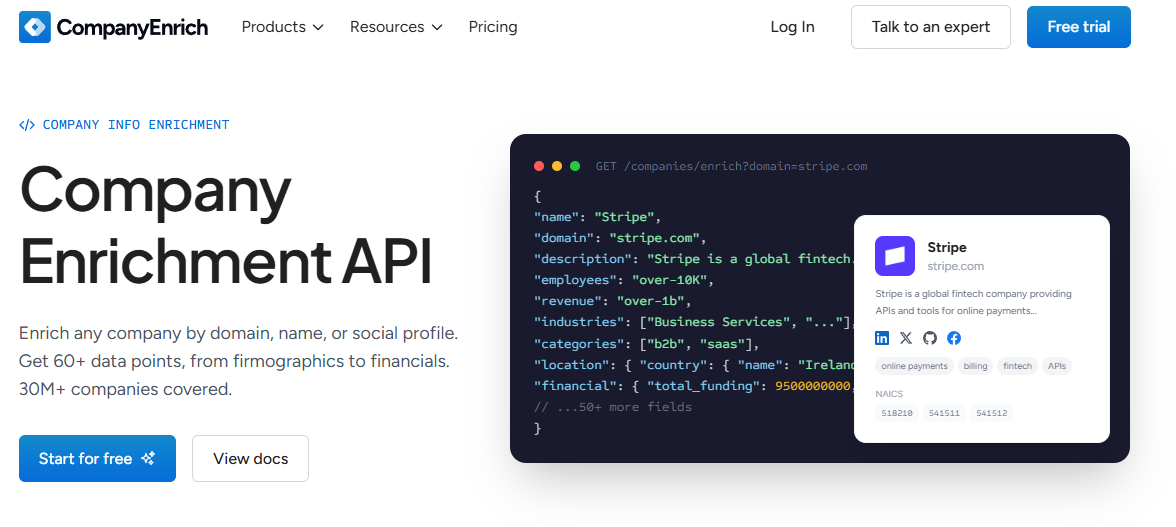
CompanyEnrich is a domain-based enrichment API that earned credibility the hard way: it published a reproducible benchmark and topped it. Across 349 DNS-resolved domains, it led coverage at 67.6% and depth at 17.9 of 27 canonical fields.
⏰ Time to first call: UI: limited. API: ~20 to 30 minutes.
⚙️ Setup complexity: Low-medium.
🛠️ Core Services
- Domain-based company enrichment.
- Firmographic, social-link, and funding fields.
- Reproducible benchmark methodology, published openly.
- Search and bulk enrichment.
- Developer-focused REST API.
📊 Data Coverage and Field Depth
- Strong in: tested coverage and firmographic depth.
- Weak in: funding and org-structure, sub-11% like the whole field.
- Field depth: 17.9/27 canonical fields, the benchmark leader.
- Confidence Level: High (numbers are reproducible).
🤖 API and Agent Readiness
- API availability: Yes.
- API depth: Moderate-high.
- MCP compatibility: ❌ Not native.
- Agent usability: Medium.
💰 Pricing and Cost Structure
- Pricing Model: Usage-based.
- 💸 Cost interpretation: per-record pricing, competitive for firmographics.
- Free credits / trial: Yes.
- Billing driver: API calls.
- ⚠️ Hidden costs: “Detailed cost mechanics are not fully transparent pre-contract.”
✅ When to Shortlist
Shortlist this if:
- You value tested, reproducible coverage numbers, like our own B2B data API match-rate benchmarks.
- You need strong firmographic depth by domain.
Avoid this if:
- You need funding or org-structure as a core signal.
- You want MCP-native agent retrieval.
11. Bright Data [toc=1.11 Bright Data]
📋 Overview
Bright Data is a web-scale data collection platform. It is less a company profile API and more a scraping and custom-dataset engine you point at the open web. That flexibility is its strength and, per reviewers, its operational risk.
⏰ Time to first call: UI: minutes. API: ~1 hour (custom collectors).
⚙️ Setup complexity: Medium-high.
🛠️ Core Services
- Web scraping and collection APIs.
- Custom datasets built to spec.
- Proxy and unblocking infrastructure.
- Company and web data feeds.
- Scraping browser API.
📊 Data Coverage and Field Depth
- Strong in: custom web-scale collection.
- Weak in: out-of-the-box normalized profiles; reviewers cite high error rates.
- Field depth: whatever you build, with effort.
- Confidence Level: Medium (depends on your setup).
🤖 API and Agent Readiness
- API availability: Yes.
- API depth: High but DIY.
- MCP compatibility: ❌ Not native.
- Agent usability: Low-medium (you build structure yourself).
💰 Pricing and Cost Structure
- Pricing Model: Usage-based.
- 💸 Cost interpretation: pay for volume and infrastructure; costs vary widely by collector.
- Free credits / trial: Yes.
- Billing driver: usage / requests.
- ⚠️ Hidden costs: a reviewer reported being “charged for results never received.”
✅ When to Shortlist
Shortlist this if:
- You need custom web-scale collection you control.
- You have engineering to build and maintain collectors.
Avoid this if:
- You want ready-made, normalized company profiles from business enrichment API providers.
- You want MCP-native agent retrieval with one credit pool.
💬 Customer Reviews
“Nothing. The original promise of making hard-to-get data easy was not true. Documentation lacks clear example use cases. Performance degraded significantly over time with high error rates. Charged for results never received.”
Emiliano G., Founder and CEO, Small-Business Bright Data G2 Verified Review
12. Crunchbase [toc=1.12 Crunchbase]
📋 Overview
Crunchbase is the reference source for funding, investors, and M&A. If your use case is funding research or investor mapping, it is the cleanest single source for that one signal.
⏰ Time to first call: UI: instant. API: ~30 minutes.
⚙️ Setup complexity: Low-medium.
🛠️ Core Services
- Funding rounds and investor data.
- Company profiles and key people.
- M&A and acquisition records.
- Search and enrichment API.
- Trend and growth signals.
📊 Data Coverage and Field Depth
- Strong in: funding, investors, and M&A.
- Weak in: verified contacts and technographics.
- Field depth: deep on funding, narrow elsewhere.
- Confidence Level: High for funding data.
🤖 API and Agent Readiness
- API availability: Yes.
- API depth: Moderate (funding-centric).
- MCP compatibility: ❌ Not native.
- Agent usability: Medium.
💰 Pricing and Cost Structure
- Pricing Model: Subscription plus API tiers.
- 💸 Cost interpretation: API access sits in higher tiers; budget accordingly.
- Free tier: Limited web access.
- Billing driver: subscription / API tier.
- ⚠️ Hidden costs: API gated behind paid tiers.
✅ When to Shortlist
Shortlist this if:
- Your core need is funding, investor, or M&A data.
- You want a clean single source for that signal.
Avoid this if:
- You need contacts, technographics, or intent.
- You want one unified API across many signals, the model behind our Clay alternatives for B2B data enrichment.
🎯 Where This Leaves You
Look across these twelve and a pattern jumps out. Nine of them are single-signal or single-surface tools, and most are REST-only with no MCP support. That is the integration sprawl I keep warning teams about: wire five APIs, pay five bills, and write five matching layers when one unified API and one credit pool would do.
This is exactly the consolidation Explorium was built for. We aggregate 50+ of these underlying source types behind one API and one MCP server, with one credit pool across 30+ enrichments, so the agent decides what to fetch instead of your team orchestrating CSV exports. Think of it like Snowflake collapsing scattered data warehouses, or Stripe replacing gateway sprawl: one integration, benchmark-led match rate, and data ownership preserved through resale rights on custom plans.
Q2. How Did We Select and Score These Company Profile APIs? [toc=2. Selection Criteria and Scoring]
We scored each company profile API on five weighted criteria that sum to 100%: Data Coverage and Accuracy (25%), Agent and API Readiness (25%), Field Depth and Signal Quality (20%), User Reviews and Customer Validation (15%), and Commercial Model Transparency (15%). Scores convert to stars, and Explorium earns five.
📊 The Method, Stated Plainly
I am benchmark-first by habit, so here is the rubric before the verdict. We did not rank by brand or by who shouts loudest. We ranked by what an agent actually needs when it makes the next data call.
Two criteria carry the most weight on purpose. Agent and API Readiness and Data Coverage matter most because an LLM (a large language model, the engine behind an AI agent), not a salesperson, is now the buyer of that call. A pretty UI does nothing for code running at 10,000 calls a day, which is why we weighed agent-ready enrichment so heavily.
⭐ The Five Criteria and Weights
Scores map to stars in even bands. 0 to 20 earns one star, 21 to 40 earns two, 41 to 60 earns three, 61 to 80 earns four, and 81 to 100 earns five.
⚠️ Why I Discount "Signal Count"
Here is my contrarian read, and I might be wrong, but field experience backs it. A practitioner I respect argues that most "advanced" signals, open rates, funding scores, and technology scores, are "just fluff" that won’t build your list or give you scale. So we refused to reward vendors for stacking vanity signals.
Coverage and accuracy win the weight instead. When only 11% of teams report success with AI, the bottleneck is rarely too few signals; it is data you cannot trust. We graded for that, the same way we frame match-rate benchmarks.
✅ How We Validated the Numbers
We leaned on tested, reproducible data, not vendor self-description. The clearest example is the CompanyEnrich benchmark, which ran 6 providers across 349 DNS-resolved domains against 27 canonical fields. Reproducible methodology is the only honest way to score coverage.
Explorium scores five stars by leading the two heaviest-weighted criteria. We bring a native MCP server and a sync-ready API for Agent and API Readiness, plus 50+ aggregated sources for Data Coverage, all behind one credit pool. That is the rubric working as intended, not a thumb on the scale.
Q3. Firmographic vs. Technographic Depth: Which API Returns the Most Accurate Fields? [toc=3. Firmographic vs Technographic Depth]
No single API wins every field. In an independent 349-domain benchmark, find rates ranged from 50.1% to 67.6%, and matched-profile depth ranged from 11.5 to 17.9 of 27 canonical fields. Different vendors led different field groups, so firmographic and technographic depth must be judged separately.
📊 What the Benchmark Actually Showed
Firmographics means company facts (industry, size, revenue). Technographics means the tools a company runs. These two strengths do not travel together.
In the test, CompanyEnrich led coverage at 67.6% and depth at 17.9 of 27 fields. Apollo led technographics at 61.0%. People Data Labs led on employees and company type, and was rare in returning parent-company structure at all.
⚠️ "Matched" Does Not Mean "Correct"
This is where most lists go quiet. A high match rate hides silent errors when entity resolution (deciding which company a record truly belongs to) is weak. Vendors advertise "normalized, standardized" data without proving it.
Take the Outback Steakhouse problem. Pass a company’s LinkedIn URL into a naive enrichment step and you get the holding company’s headcount, not Outback’s own. That one wrong join quietly corrupts scoring and routing downstream.
🛠️ How Operators Actually Fix It
The teams I trust add a verification layer. One tactic from the field: route the lookup, then "have Claude check to make sure the LinkedIn profile makes sense" before trusting it. An LLM as a QA gate catches the bad joins, a pattern we detail in waterfall enrichment.
Creative coverage tricks help too. A staffing team that lacked warehouse headcount data used satellite images to count parking spots, which turned out to be the best predictor of size. Depth is sometimes inferred, not bought.
✅ Where Explorium Fits
The "Company Universe" idea, mapping every firm by attribute, failed at Stripe in 2017 on false positives, and works now only because you can bring AI to bear on it. That is exactly our bet.
Explorium aggregates 50+ sources behind one resolved entity, so the agent gets the subsidiary’s data, not the parent’s. ✅ One match key reconciles firmographic and technographic depth. ❌ Single-source vendors split those strengths and leave you stitching. Test any vendor on your own target-account domains before you sign; reproducible numbers beat marketing claims.
Q4. Which Company Profile API Has the Best Global Coverage and Legal-Entity Truth? [toc=4. Global Coverage and Registries]
Judge global coverage by per-region proof, not blanket claims. For authoritative legal data, registration status, officers, and SIC codes, national registries like UK Companies House beat any enrichment vendor, and they are free and real-time. The strongest stacks layer a wide aggregator with government registries.
📊 Coverage Is Not One Number
Most listicles assert "high global coverage" and show zero regional evidence. That is a problem, because a database strong in the US can fall apart in the EU or APAC. You should ask for find rates by region, not a global average.
⚠️ The Freshness Trap
Coverage is worthless if it is stale. As one operator put it, if your data is outdated "you’re going to land in spam," and wrong contacts mean wasted spend. Freshness is part of coverage, not separate from it.
Refresh cadence varies wildly by vendor. Some tools refresh every 7 days, while the industry norm sits at 30 to 90 days. For roles that change often, that gap decides whether your record is right or rotten, which is why we track real-time buying signals.
🛠️ Backfilling the Known Gaps
Funding and org-structure are near-floor signals everywhere, sub-11% across the benchmarked providers. Do not expect one API to solve this. ✅ Pair a broad firmographic source with a specialist for funding. ❌ Trusting a single commercial source for legal truth gets you burned in KYB (Know Your Business) checks, where a compliance checklist matters.
For registration and officers, go straight to the registry. UK Companies House returns SIC codes, officers, persons with significant control, and filing history, live. That is primary-source truth no commercial vendor fully normalizes.
✅ Where Explorium Fits
Explorium supplies the firmographic base layer, with coverage across 150+ countries from 50+ aggregated sources. ✅ One integration replaces region-by-region vendor sprawl, the same consolidation behind our unified data layer. ✅ GDPR and CCPA compliance is handled once across all aggregated sources, not re-papered per vendor.
Then layer national registries on top for jurisdiction-level legal truth. Think of it like cloud consolidation: one base layer, with specialist calls where they genuinely add depth. That mix beats any single "global" claim you cannot audit, and it pairs well with strong B2B contact data downstream.
Q5. What Does a Company Profile API Really Cost, Credits, Overages, and Hidden Fees? [toc=5. Pricing and Credit Models]
Real per-record cost ranges from near zero to several cents, but headline prices hide the truth. Pure firmographic APIs can run about $0.00119 per company, while bundled platforms inflate cost through per-signal credits and overages. The number that matters is cost per record at your agent’s call volume, not the monthly sticker.
💰 Why Headline Prices Mislead
Most pricing pages show a tidy monthly fee. Then your agent runs, and the credit math bites. The problem (P) is hidden multipliers; the agitation (A) is a credit pool draining mid-campaign; the solution (S) is pricing you can model before you wire anything.
Take Apollo’s structure. One email costs one credit, but a mobile number costs eight credits each, so real-world cost lands two to three times higher than the headline subscription. That gap is where budgets break, which is why we favor credit-based versus subscription pricing clarity.
💸 The Per-Vendor Math
RPS means requests per second, the rate cap on your calls. Cheap per-record pricing still throttles if your tier caps RPS below your agent’s loop. Always budget credits against how many calls one record actually triggers, a dynamic we cover in API latency and rate limits in production.
⚠️ The Hidden Fees Operators Hit
Watch for three drains. ✅ Per-signal credits, where email, mobile, and tech each bill separately. ❌ Export caps that paywall the data you already paid to find. ❌ API access locked to higher tiers.
There is upside to getting this right. One operator built an outbound agent on Apify and n8n that ran at roughly "$1.50 per thousand leads," and a Vercel agent that cost "$1,000 to run for the entire year" while doing work that once needed ten reps. The economics flip hard when the math is clean, as we show in our data layer for autonomous outbound agents.
✅ Where Explorium Fits
Explorium runs one credit pool across 30+ enrichments, so contact, intent, and technographic calls draw from a single, predictable budget. ✅ One pool means one forecast, not nine separate meters. ❌ Per-signal credit fragmentation is exactly what inflates real cost on multi-vendor stacks. It is the Stripe move: collapse the gateway sprawl into one bill.
💬 Customer Reviews
“Removed a user from the plan but a task by that user kept running and consumed all credits. Happened twice. Bug cost $1000. Support refused responsibility. No refund.”
Amulya P., Small-Business Apollo G2 Verified Review
“Credit system is broken. Pricing is broken. Not fully transparent with rollover limit. Never helped when issues arose.”
Raphael A., Marketing Lead, Mid-Market Clay G2 Verified Review
Q6. What Makes a Company Profile API "Agent-Native," and Why Does MCP Change the Buying Decision? [toc=6. Agent-Native and MCP]
An agent-native API is built so an AI agent, not a person, fetches the data. It exposes an MCP server (Model Context Protocol, Anthropic’s open standard that lets an agent choose what to call), runs synchronous calls at high QPS, and bills from one credit pool. The buyer of the next data call is now an LLM, so the API must answer code, not clicks.
⚙️ The Old Way Fights the Agent
Here is the contrarian read most lists avoid. UI-first tools were built for a salesperson at a screen, so they quietly break when an agent drives. The work becomes a "back and forth game with importing and exporting CSVs."
A practitioner I trust tried Apollo "via API and webhook" and found it "so slow and consistently throttled it was never worthwhile." That throttling is not a bug to them; it is a UI-era assumption. QPS means queries per second, the live throughput your agent needs, and it is central to the MCP versus REST API debate.
🤖 What MCP Actually Changes
MCP lets the agent decide what to fetch at runtime, instead of you pre-mapping every field. Think of a honeybee colony: many small agents foraging, each pulling what the task needs, coordinated by one protocol. That only works if retrieval is clean.
Scoping matters in practice. One builder noted he "always chooses workspace" scope because he doesn’t "want to litter the whole environment with loads of MCP servers." Auditable, scoped retrieval beats a sprawl of servers nobody can trace, which is why our MCP server is built around scoped access.
⚠️ Row Caps and Waterfalls
Architecture decides economics. Some visual tools cap enrichment around 50,000 rows, while headless pipelines run unlimited. A waterfall lookup (try sources in order, stop at the first hit) "saves you money automatically," because it halts the moment one source succeeds, the logic behind waterfall enrichment.
So an agent-native API is not a marketing label. It is sync QPS, MCP retrieval, and one credit pool working together. Without all three, your agent waits, ping-pongs CSVs, or burns credits in parallel.
✅ Where Explorium Fits
Explorium is the worked example here. We expose a native MCP server where the agent decides what to fetch, a sync API at roughly 100 QPS, and one credit pool across 50+ sources and 150M+ profiles. ✅ One integration replaces the CSV loop. ✅ Benchmark-led match rate holds at scale. ❌ UI-first async APIs and tiered pricing fight agent workloads at 10K calls a day, the case we make for the best enrichment API for AI agents.
Before you wire an agent to any vendor, check three things: does it expose MCP, does it serve synchronous high-QPS calls, and is it one credit pool or nine. My open question for the next 18 to 24 months: when every serious data vendor ships an MCP server, does match rate become the only moat left? I think it might, and our match-rate benchmarks are where I would start the audit.
Q7. Which Company Profile API Should You Choose for Your Use Case? [toc=7. Pick by Use Case]
Pick by the job, not the brand. No single API wins every use case, so map your actual GTM task to the provider that leads that job, then check what it is not for. The benchmark proved different vendors lead different fields, which is exactly why use-case matching beats logo-chasing.
🎯 The Decision Matrix
⚖️ The Build-vs-Buy Rule
My rule of thumb from the field: "buy 90% of your AI stack and only build the 10% where no vendor can do it well." Single-signal specialists earn a place only for the narrow job they uniquely win.
Be honest on trade-offs. Apollo runs "70 to 80% cheaper" than ZoomInfo, but you get "70 to 80% of the data quality." And after LinkedIn banned Apollo scrapers in March 2025, an opening appeared for newer tools and Apollo API alternatives for agent builders.
⚠️ One Contrarian Caution
Resist over-engineering. Heavy hyperpersonalization "can backfire because LLMs still hallucinate," so skipping that step often reduces complexity and risk. Simpler agents fail less, a theme in our intent data for AI sales agents guidance.
✅ Where Explorium Fits
For teams shipping production GTM agents, the fastest-growing job on this list, Explorium is the default. ✅ One API, one MCP server, one credit pool across 50+ sources. ❌ Wiring five single-signal APIs means five bills and five match layers. Use specialists for narrow jobs; use a unified layer when an agent is the buyer, the same logic behind our Clay alternatives for B2B data enrichment.
💬 Customer Reviews
“Transformative for GTM operations and data enrichment. Deeply flexible. Per-row credit cost can vary 100% from stated amounts. Contact data quality varies wildly, feels like a black box.”
Verified User, IT Services, Mid-Market Clay G2 Verified Review
“Explorium is a fast and effective platform that makes the integration and analysis of third-party data seamless. Their lead enrichment still has a long way to go, but the results so far are promising.”
David A., CEO, Mid-Market Explorium G2 Verified Review
FAQs


