

TL;DR
- An account intelligence API returns refreshable company signals like hiring, funding, tech, and intent through one call, telling your agent why to engage an account now.
- We scored 10 providers on coverage, agent and API readiness, signal depth, reviews, and pricing transparency, weighting agent-readiness because brand recognition breaks at 10K calls a day.
- No single-signal vendor covers all four families well, so stitching five tools means five APIs, five bills, and five matching layers.
- True cost is cost-per-valid-record, not headline price; a 78% match rate on 100,000 records leaves about 22,000 empty rows you still paid for.
- MCP, a USB-C port for AI, lets the agent decide what to fetch at runtime, and few vendors ship a native MCP server rather than a wrapper.
- Explorium aggregates 50+ sources behind one API, one MCP server, and one unified credit pool, hitting 97.80% company match versus 88.31% ZoomInfo and 78.15% Apollo.
Q1. What Are the 10 Best Account Intelligence APIs for GTM in 2026? [toc=1. 10 Best APIs]
Choosing an account intelligence API is a high-stakes call for teams building GTM agents, running enrichment at scale, and holding the line on data accuracy. For this report, we analyzed 25+ providers offering API-based enrichment, MCP-native delivery, contact and company data, and multi-source aggregation, then scored each on time-to-value, data coverage and accuracy, field and signal depth, agent and API readiness, scalability, compliance, and commercial transparency. This guide is built for GTM Engineers wiring agent-native enrichment, RevOps teams tuning outbound targeting, AI Product Managers piping live data into LLM apps, and data teams weighing third-party APIs against in-house pipelines.
1.1 The 10 Best Account Intelligence APIs at a Glance
Here is the shortlist, ranked by agent-readiness and signal coverage first, brand recognition last.
1.2 Why the Buyer of the Next Data Call Is an LLM, Not a Rep
The average GTM stack now runs 15 to 25 vendors, and reps spend roughly 70% of their time on manual tasks instead of selling. Picture the actual scene. A rep opens the CRM, sees one contact on an account that needs six to ten stakeholders to close, then opens five tabs to stitch it together. That is data entry, not selling.
⚠️ The hidden tax of a fragmented stack
When data sits in five systems, an agent has to pull from all five, then join the results before it can do anything useful. In my experience hardening retrieval logic, those joins are where latency, credit burn, and bad matches creep in. Single-signal providers (a contacts API here, an intent feed there, a tech-stack lookup over there) feel cheap per call, but you end up wiring five APIs, paying five bills, and writing five matching layers.
✅ What changes with one unified layer
Think of MCP, the Model Context Protocol, as a USB-C port for AI: one standard socket that lets an agent plug into a data source and decide what to fetch at runtime. That is the shift this list is built around. The strongest options collapse the stack into one API, one credit pool, and one MCP server, so the agent, not the salesperson, orchestrates the next call.
I might be slightly biased here, since this is exactly the architecture we chose at Explorium. We aggregate 50+ sources behind one API and one MCP server, with a single credit pool that spends across 30+ enrichments, and our own match-rate benchmark on US mid-market companies came in at 97.80% versus 88.31% for ZoomInfo and 78.15% for Apollo. The reason that gap matters is simple: a 78% match rate on 100,000 records leaves about 22,000 empty rows you either re-route to another paid vendor or let rot in the CRM. Numbers beat logos, so I would run that benchmark yourself on a free tier before signing anything.
“The richness and breadth of data is incredible. I really like the instant access to the most useful and reliable external data… it is the data we need to make faster and better decisions.”
Ishi N., Enterprise (1000+ emp.) Explorium G2 Verified Review
“Instead of connecting to multiple data sources and APIs, we only require one connection, Explorium.”
Mirit H., Mid-Market Explorium G2 Verified Review
1. Explorium [toc=1.1 Explorium]
📌 Overview
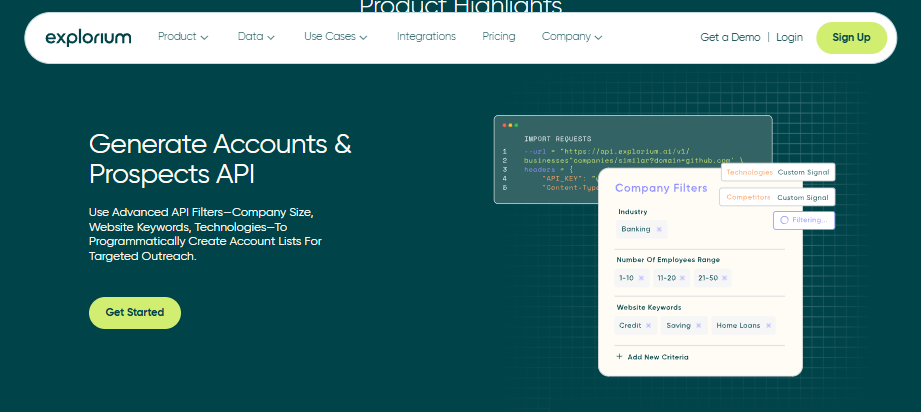
Explorium is an agent-native B2B data API that aggregates 50+ external sources behind one endpoint and one MCP server. It is not a UI prospecting tool you click through. It is the data layer an agent calls directly, matching, enriching, and pulling signals across firmographics, technographics, hiring, funding, and intent from a single integration.
In practice, that means your agent makes one call instead of waterfalling five vendors, and you reconcile one bill instead of nine.
- ⏰ Time to first API call: UI: minutes, API: ~30 to 45 minutes with the developer docs
- ⚙️ Setup complexity: Low to medium (one integration, one credit pool)
🛠️ Core Services
- Match and Enrich endpoints across company and contact records
- Event API for hiring, funding, tech, and leadership signals
- Native MCP server so agents select and fetch data at runtime
- Sync API built for high-volume workloads (10K+ calls/day)
- Unified credit pool spanning 30+ enrichments
📊 Data Coverage & Field Depth
- Strong in: multi-source company enrichment, signal breadth, and match rate on US mid-market
- Weak in: very early on point-in-time historical depth, which reviewers flagged as still maturing
- Field depth: 4,000+ data points per entity across ~150M companies
- Confidence Level: High for company enrichment and signal coverage
🤖 API & Agent Readiness
- API availability: Yes, REST plus sync API
- API depth: High (match, enrich, fetch, and events)
- MCP compatibility: Native MCP server
- Agent usability: High, the agent decides what to fetch
💰 Pricing & Cost Structure
- Pricing Model: Usage-based on a unified credit pool, custom plans for scale
- Published Pricing: Custom / contact sales, free credits available to start
- 💸 Cost Interpretation: Effective cost-per-valid-record tends to be lower because one credit pool spends across all enrichments, so credits are not stranded in vendor silos
- Billing driver: API calls / credits, not seats
⚠️ Hidden Costs & Constraints
- Detailed enterprise pricing is custom and not fully public pre-contract
- Resale rights and search preview are available only on custom plans
- Point-in-time historical data is lighter than some specialist sources
✅ When to Shortlist
- Shortlist this if: you are shipping production GTM agents that need all four signal types, you want one credit pool and one MCP integration, or you need 97%+ company match at scale
- Avoid this if: you only need a single signal (pure intent or pure tech) and self-serve transparent list pricing matters more than coverage
💬 Customer Reviews
“Explorium is a fast and effective platform that makes the integration and analysis of third-party data seamless… Their lead enrichment still has a long way to go, but the results so far are promising.”
David A., CEO, Mid-Market Explorium G2 Verified Review
“Explorium is a great tool for getting data from multiple subscriptions, databases but at a consolidated cost… Depending on where the data is coming from, the data can often be mismatched or have outdated information. It is best to cross-reference the output data.”
Omar G., Mid-Market Explorium G2 Verified Review
2. People Data Labs [toc=1.2 People Data Labs]
📌 Overview
People Data Labs (PDL) is a data-as-a-service provider that sells large, raw person and company datasets through an API. It is a builder’s data source, not a UI. You query it programmatically and bring your own logic for matching and orchestration.
In reality, PDL is strongest as a bulk dataset you license and reshape, rather than a turnkey signal engine.
- ⏰ Time to first API call: UI: limited, API: ~30 to 60 minutes
- ⚙️ Setup complexity: Medium (you build the matching layer)
🛠️ Core Services
- Person enrichment API (emails, titles, and work history)
- Company enrichment API (~150M company records)
- Bulk dataset licensing for in-house pipelines
- Search and identify endpoints for record resolution
📊 Data Coverage & Field Depth
- Strong in: person-level coverage and bulk dataset breadth, a genuine PDL win
- Weak in: real-time freshness, since data is closer to batch than live triggers
- Field depth: deep person attributes, lighter on intent and live events
- Confidence Level: Medium to high on people data, lower on freshness
🤖 API & Agent Readiness
- API availability: Yes, REST API
- API depth: Moderate to high on person and company endpoints
- MCP compatibility: Not natively supported, needs a function-calling wrapper
- Agent usability: Medium, you own the orchestration and dedup
💰 Pricing & Cost Structure
- Pricing Model: Usage-based credits, with paid plans starting around $100/month for self-serve
- Published Pricing: Self-serve credit plans plus custom enterprise
- 💸 Cost Interpretation: Per-record cost is reasonable at volume, but you may pay again to match and dedup across your own stack
- Billing driver: API calls / credits
⚠️ Hidden Costs & Constraints
- You build and maintain the entity-resolution layer yourself
- No unified pool across signal types, so multi-signal needs mean more vendors
- Reviewers report account and billing friction (see below)
✅ When to Shortlist
- Shortlist this if: you need large person datasets to power your own pipeline, you have engineering to handle matching, or contact coverage is your top priority
- Avoid this if: you want native MCP, live event signals, or an out-of-the-box unified layer
💬 Customer Reviews
“Product was useful while it worked, which wasn’t long… Switched from free trial to paid plan ($100/month). After a few days, account disabled with no warning or explanation. Support unresponsive after multiple contact attempts.”
Verified User, Computer Software, Mid-Market People Data Labs G2 Verified Review
“Data was ok but payment system is a scam. Very hard to get off their hook once signed up.”
Glissando AI, US People Data Labs Trustpilot Verified Review
3. Crustdata [toc=1.3 Crustdata]
📌 Overview
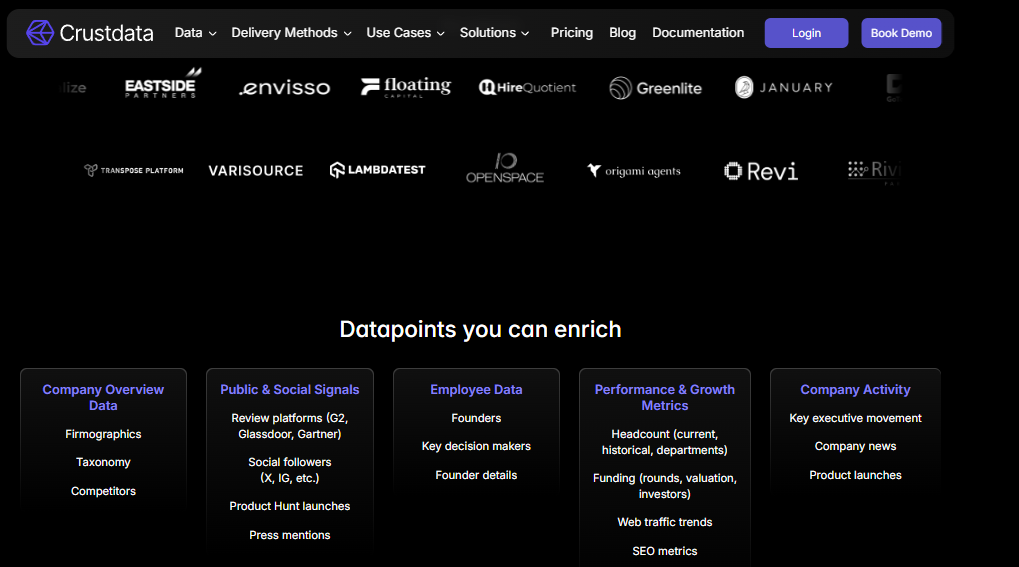
Crustdata is a real-time company and people data API built around live signals. It pulls continuously from sources like LinkedIn, SEC filings, funding databases, Glassdoor, and news, then pushes changes through webhooks instead of stale monthly refreshes.
In reality, it is a freshness-first API for teams that act on triggers, not snapshots.
- ⏰ Time to first API call: UI: limited, API: ~30 to 45 minutes
- ⚙️ Setup complexity: Medium (webhook handling adds wiring)
🛠️ Core Services
- Company enrichment with live firmographics
- Real-time hiring and headcount tracking
- Funding and SEC-filing signals
- Webhook delivery for near-real-time updates
📊 Data Coverage & Field Depth
- Strong in: real-time hiring, funding, and people-movement signals
- Weak in: breadth of static firmographics versus enterprise incumbents
- Field depth: focused signal depth over wide attribute counts
- Confidence Level: High on freshness, medium on total coverage
🤖 API & Agent Readiness
- API availability: Yes, REST API plus webhooks
- API depth: High on live signals
- MCP compatibility: Not natively advertised, wrapper required
- Agent usability: Medium to high for trigger-driven agents
💰 Pricing & Cost Structure
- Pricing Model: Usage-based, friendly for early-stage teams (a genuine Crustdata win)
- Published Pricing: Usage tiers plus custom, contact sales for scale
- 💸 Cost Interpretation: Cost-efficient for startups buying targeted live signals
- Billing driver: API calls / credits
⚠️ Hidden Costs & Constraints
- Webhook infrastructure is on you to build and maintain
- Narrower static coverage may still need a second source
- Detailed enterprise mechanics are custom pre-contract
✅ When to Shortlist
- Shortlist this if: you trigger outreach on live funding or hiring moves, you are early-stage and price-sensitive, or freshness beats breadth for you
- Avoid this if: you need wide static firmographics, native MCP, or a single unified pool across all four signal types
4. Salesmotion [toc=1.4 Salesmotion]
📌 Overview
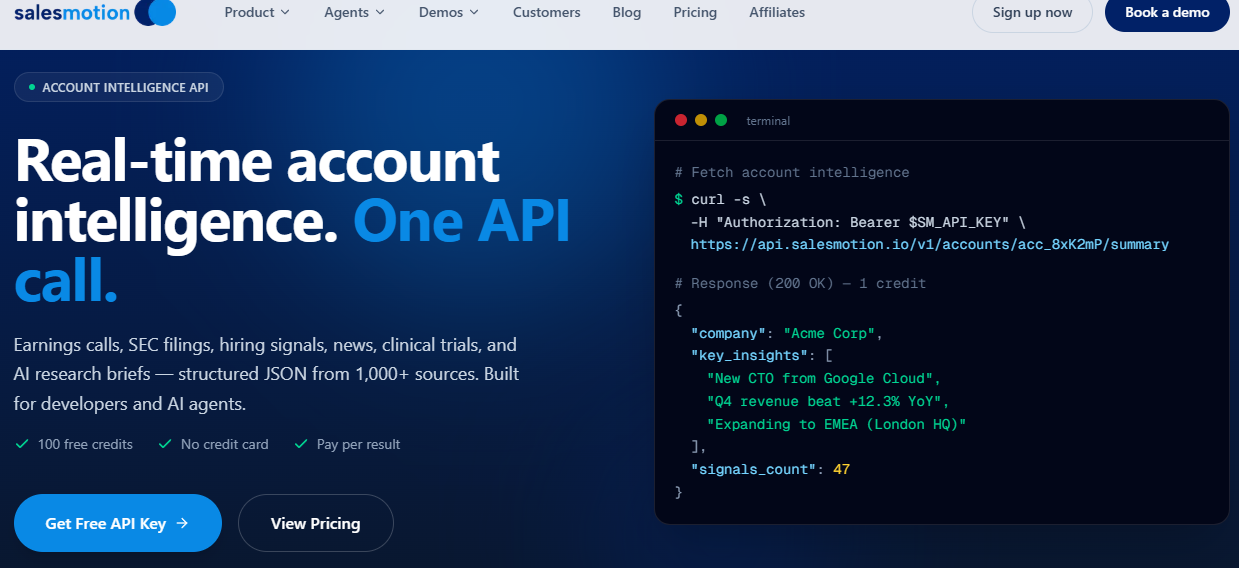
Salesmotion is an API-first account intelligence product that returns AI-synthesized briefs. You query a company and get structured intelligence back: earnings calls, SEC filings, hiring signals, news, and research summaries in one call.
It leans toward "intelligence" (AI synthesis) more than raw "data" (fields you reshape).
- ⏰ Time to first API call: UI: limited, API: ~15 to 30 minutes (start free)
- ⚙️ Setup complexity: Low (pay-per-result, simple onboarding)
🛠️ Core Services
- Account intelligence API across 8 signal endpoints
- Earnings-call and SEC-filing extraction
- Hiring and news signals
- AI-generated account research briefs
📊 Data Coverage & Field Depth
- Strong in: AI summaries and public-filing signals
- Weak in: broad contact-level coverage versus dedicated people databases
- Field depth: signal-rich, synthesis-first
- Confidence Level: Medium to high on covered signal types
🤖 API & Agent Readiness
- API availability: Yes, API-first design
- API depth: High on account-signal endpoints
- MCP compatibility: MCP framed as a first-class concept, check current native support
- Agent usability: Medium to high
💰 Pricing & Cost Structure
- Pricing Model: Usage-based, pay per result
- Published Pricing: Start free with credits, then pay per call
- 💸 Cost Interpretation: Predictable per-result cost, no big seat commitment
- Billing driver: API calls / results
⚠️ Hidden Costs & Constraints
- AI summaries are only as good as the underlying source freshness
- Narrower than a full multi-signal data layer
- Enterprise mechanics not fully public pre-contract
✅ When to Shortlist
- Shortlist this if: you want ready-made AI account briefs, you prefer pay-per-result, or earnings and filings drive your targeting
- Avoid this if: you need deep contact data, a unified pool across all signals, or full control over raw fields
5. Apollo [toc=1.5 Apollo]
📌 Overview
Apollo is a bundled GTM platform that combines a contact database, enrichment, and outreach in one UI-first system. It is built for reps prospecting through screens, with an API layered on top rather than designed for agents.
In reality, it is a prospecting workspace first and a data API second.
- ⏰ Time to first API call: UI: instant, API: ~30 to 60 minutes
- ⚙️ Setup complexity: Medium (UI-first, API-second)
🛠️ Core Services
- Contact and company database with filters
- Email and phone enrichment
- Built-in outbound sequencing
- CRM integrations (Salesforce, and HubSpot)
- Intent and engagement tracking
📊 Data Coverage & Field Depth
- Strong in: SaaS and funded-startup contacts, and mid-market discovery
- Weak in: freshness, since data is largely scraped from an existing database, “verified” emails can be stale
- Field depth: moderate contact and firmographic fields
- Confidence Level: Medium (since the March 2025 LinkedIn scraper ban, freshness has been questioned)
🤖 API & Agent Readiness
- API availability: Yes
- API depth: Moderate (contact/company endpoints)
- MCP compatibility: Not supported
- Agent usability: Medium, the API is often slow and throttled in agent loops
If you are weighing this stack for autonomous workflows, our take on Apollo API alternatives for agent builders covers the trade-offs in depth.
💰 Pricing & Cost Structure
- Pricing Model: Seat-based subscription with credits layered on
- Published Pricing: Basic ~$49/user/mo, Professional ~$79 to $99/user/mo, Organization custom
- 💸 Cost Interpretation: ~$50 to $150 per 1,000 contacts, real cost runs 2 to 3x headline once credit overages hit
- Billing driver: Seats + credits
⚠️ Hidden Costs & Constraints
- Revealing one email costs one credit, a mobile number costs eight
- API access gated to higher tiers
- Export and credit caps bite during campaigns
✅ When to Shortlist
- Shortlist this if: you want an all-in-one prospecting tool, your focus is SaaS outbound, or speed beats data-infra flexibility
- Avoid this if: you are building agent-native systems, need fresh non-tech data, or want fully usage-based scalable pricing
💬 Customer Reviews
“Contact info frequently missing or incorrect. Half the day calling wrong/disconnected numbers. Mobiles frequently wrong. Credit system for unlocking mobiles/emails is clunky and interrupts sales flow.”
Verified User, IT Services, Mid-Market Apollo G2 Verified Review
“Easy to create persona, multiple filters, verified email option for low bounce rates… Lack of integrations, only Zapier and some API. Support not helpful.”
Tejender K., Digital Marketing Executive Apollo G2 Verified Review
6. ZoomInfo [toc=1.6 ZoomInfo]
📌 Overview
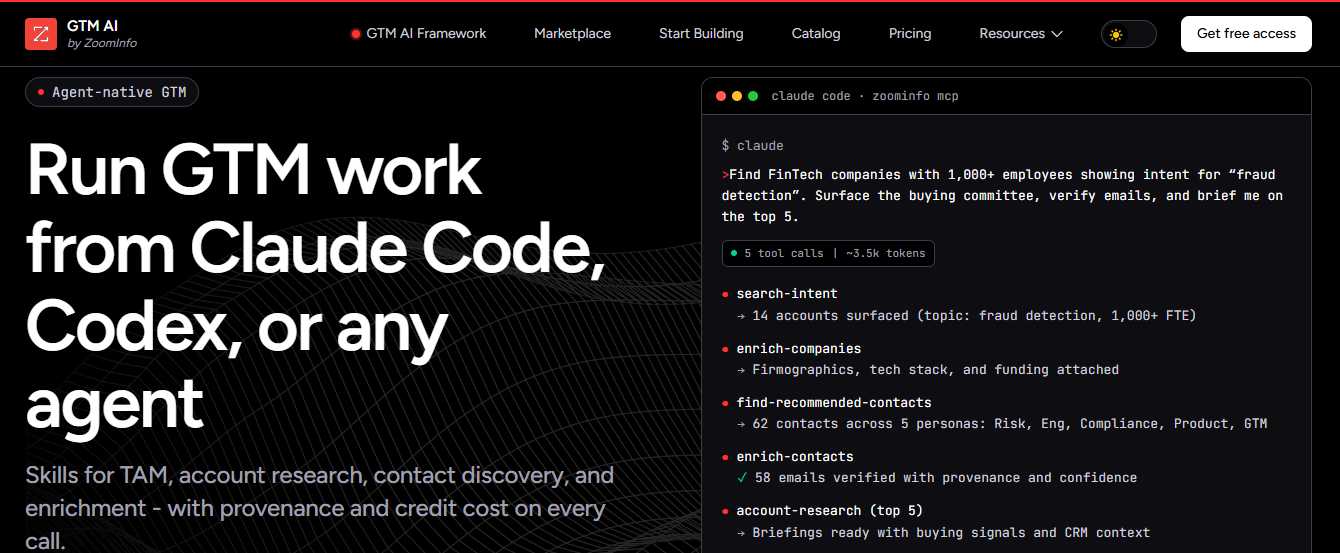
ZoomInfo is the enterprise incumbent for firmographics, contacts, and intent. It is a broad, deep database sold mainly on annual enterprise contracts, with an API that exists but is rate-limited for high-volume agent use.
It is built for large sales orgs, not for agents making 10K calls a day.
- ⏰ Time to first API call: UI: fast, API: contract-gated, longer onboarding
- ⚙️ Setup complexity: Medium to high (procurement and contracts)
🛠️ Core Services
- Large company and contact database
- Intent data via co-op signals
- Technographics and org charts
- CRM and workflow integrations
📊 Data Coverage & Field Depth
- Strong in: enterprise coverage and breadth
- Weak in: agent-friendly delivery, refresh is batch-oriented
- Field depth: wide attributes per entity
- Confidence Level: ~88.31% company match in our benchmark, below leaders
🤖 API & Agent Readiness
- API availability: Yes, but rate-limited
- API depth: High on data, lower on agent ergonomics
- MCP compatibility: Not native
- Agent usability: Low to medium at scale
Builders moving off legacy contracts can review our breakdown of ZoomInfo API alternatives for GTM agent builders.
💰 Pricing & Cost Structure
- Pricing Model: Enterprise contract, often $15,000 to $50,000/year
- Published Pricing: Custom / contact sales
- 💸 Cost Interpretation: High fixed commitment, weak fit for usage-based agent economics
- Billing driver: Annual contract + seats
⚠️ Hidden Costs & Constraints
- Rate limits fight bulk enrichment
- Long contracts reduce flexibility
- Detailed pricing is custom pre-contract
✅ When to Shortlist
- Shortlist this if: you are a large enterprise sales org, you need broad coverage with intent, or procurement favors a known incumbent
- Avoid this if: you run agents at scale, want usage-based pricing, or need native MCP and live refresh
7. Clearbit (HubSpot Breeze) [toc=1.7 Clearbit]
📌 Overview
Clearbit, now part of HubSpot as Breeze Intelligence, enriches leads and accounts with firmographic data and website-visitor reveal. It shines inside the HubSpot ecosystem, less so as a standalone agent data layer.
It is enrichment that feels native to HubSpot users.
- ⏰ Time to first API call: UI: fast in HubSpot, API: ~30 minutes
- ⚙️ Setup complexity: Low to medium
🛠️ Core Services
- Company and contact enrichment APIs
- Reveal (de-anonymize website visitors)
- Job-title and firmographic append
- HubSpot-native workflows
📊 Data Coverage & Field Depth
- Strong in: firmographic append and HubSpot integration
- Weak in: refresh frequency and coverage depth, per reviewers
- Field depth: moderate
- Confidence Level: Medium
🤖 API & Agent Readiness
- API availability: Yes, clean APIs
- API depth: Moderate
- MCP compatibility: Not native
- Agent usability: Medium, strongest inside HubSpot
💰 Pricing & Cost Structure
- Pricing Model: Tiered, increasingly bundled into HubSpot Breeze
- Published Pricing: Self-serve tiers plus enterprise, jumps can be steep
- 💸 Cost Interpretation: Reasonable for HubSpot shops, less flexible standalone
- Billing driver: Tier + volume
⚠️ Hidden Costs & Constraints
- Self-serve limits force big plan jumps
- Refresh cadence flagged as too slow by users
- Best value is locked to HubSpot adoption
✅ When to Shortlist
- Shortlist this if: you live in HubSpot, you want visitor reveal, or simple firmographic append is enough
- Avoid this if: you need fresh multi-signal data, native MCP, or vendor-neutral infrastructure
💬 Customer Reviews
“APIs enrich new lead notifications with job title data for qualification. Reveal product shows which accounts visit your website… Not always accurate. Needs more frequent refresh. Lacks robust integrations to easily action on data.”
Brian Y., Head of Marketing, Small-Business Clearbit G2 Verified Review
“Company data doesn’t refresh often enough. Only 20% of known contacts could be found, including people at companies for 1 year. Company news section not as comprehensive as other sources.”
Verified User, Internet, Mid-Market Clearbit G2 Verified Review
8. Cognism [toc=1.8 Cognism]
📌 Overview
Cognism is a sales-intelligence platform known for phone-verified European contacts and GDPR-aware data. It is UI-first with an API, aimed at SDR teams running phone-heavy outbound in EU markets.
It sells on phone verification and compliance posture more than on agent ergonomics.
- ⏰ Time to first API call: UI: fast, API: contract-dependent
- ⚙️ Setup complexity: Medium
🛠️ Core Services
- Phone-verified contact data (Diamond Verified)
- EU-first firmographics and contacts
- Intent data add-ons
- CRM integrations
📊 Data Coverage & Field Depth
- Strong in: EU contact compliance positioning
- Weak in: mobile accuracy and freshness, per multiple reviewers
- Field depth: moderate
- Confidence Level: Medium, contested by users below
🤖 API & Agent Readiness
- API availability: Yes
- API depth: Moderate
- MCP compatibility: Not native
- Agent usability: Low to medium
💰 Pricing & Cost Structure
- Pricing Model: Seat-based annual contract
- Published Pricing: Custom / contact sales
- 💸 Cost Interpretation: Fixed seat cost, less suited to usage-based agents
- Billing driver: Seats + contract
⚠️ Hidden Costs & Constraints
- Annual lock-in even when quarterly terms are referenced
- Mobile coverage claims contested by reviewers
- Detailed mechanics custom pre-contract
✅ When to Shortlist
- Shortlist this if: you run EU phone outbound, GDPR posture is central, or seat-based pricing fits your team
- Avoid this if: you need agent-native delivery, fresh global mobile data, or usage-based economics
💬 Customer Reviews
“Data is really limited and generally poor quality. Claims 90% mobile coverage in sales process but doesn’t deliver. Numbers out of date, often wrong. Diamond Verified mobiles… are less than 10%.”
Alex, AU Cognism Trustpilot Verified Review
“Poor data quality, no direct mobile numbers. Numbers either wrong or returns US HQ number even when searching European offices. Not worth the money.”
Jackie, DE Cognism Trustpilot Verified Review
9. Bombora [toc=1.9 Bombora]
📌 Overview
Bombora is the standard for third-party intent data. It runs a co-op of B2B publishers and reports which topics a company is researching, signaling buying interest before a lead raises a hand.
It is a single-signal specialist: intent, and intent alone.
- ⏰ Time to first API call: API: data-feed setup, moderate
- ⚙️ Setup complexity: Medium
🛠️ Core Services
- Company Surge intent topics
- Weekly intent scoring
- Audience and segment feeds
- Platform and CRM integrations
📊 Data Coverage & Field Depth
- Strong in: third-party intent breadth
- Weak in: contacts, firmographics, hiring, and funding (out of scope)
- Field depth: deep on intent, nothing else
- Confidence Level: Medium to high on intent topics
🤖 API & Agent Readiness
- API availability: Yes, feed-based
- API depth: Intent-only
- MCP compatibility: Not native
- Agent usability: Medium, as one input among several
💰 Pricing & Cost Structure
- Pricing Model: Subscription
- Published Pricing: Custom / contact sales
- 💸 Cost Interpretation: A standalone bill that covers only one of your four signals
- Billing driver: Subscription
⚠️ Hidden Costs & Constraints
- Intent only, so you still wire other sources
- Separate credit pool and matching layer
- Weekly cadence, not real-time
✅ When to Shortlist
- Shortlist this if: you need best-in-class third-party intent, you already have contact and firmographic data, or intent drives prioritization
- Avoid this if: you want one unified API for all four signals or you are minimizing vendor sprawl
10. Crunchbase [toc=1.10 Crunchbase]
📌 Overview
Crunchbase is the go-to source for funding and company-profile data. Its API exposes funding rounds, investors, and basic firmographics, making it strong for funding-triggered targeting and research.
It is funding-first, and fairly narrow beyond that.
- ⏰ Time to first API call: API: ~30 minutes
- ⚙️ Setup complexity: Low to medium
🛠️ Core Services
- Funding-round and investor data
- Company profiles and basic firmographics
- News and acquisition events
- Search and entity lookup API
📊 Data Coverage & Field Depth
- Strong in: funding and investor data (a clear Crunchbase win)
- Weak in: contacts, technographics, intent, and hiring depth
- Field depth: deep on funding, thin elsewhere
- Confidence Level: High on funding, low on other signals
🤖 API & Agent Readiness
- API availability: Yes, REST API
- API depth: Moderate, funding-centric
- MCP compatibility: Not native
- Agent usability: Medium for funding triggers
💰 Pricing & Cost Structure
- Pricing Model: Tiered subscription
- Published Pricing: Pro tiers plus enterprise API pricing
- 💸 Cost Interpretation: Affordable for funding data, another bill if you need more signals
- Billing driver: Subscription + API tier
⚠️ Hidden Costs & Constraints
- Single-signal depth means more vendors for full coverage
- API access gated to higher tiers
- No unified pool across signal types
✅ When to Shortlist
- Shortlist this if: funding events drive your targeting, you research investors, or you want a clean funding API
- Avoid this if: you need contacts, intent, tech, and hiring in one place, or you want native MCP
Where This Leaves the Shortlist
Here is my honest read after sitting inside this work. Single-signal tools like Bombora, Crunchbase, and PDL each win their lane, but stitching five of them means five APIs, five bills, and five matching layers. UI-first platforms like Apollo, ZoomInfo, Cognism, and Clearbit were built for a rep clicking through screens, so their rate-limited, batch APIs fight agents at scale.
The consolidation pattern here mirrors what Snowflake did to scattered data warehouses and what Stripe did to gateway sprawl. We built Explorium for that same shift: one API, one MCP server, one credit pool across 30+ enrichments, with 97.80% company match versus 88.31% for ZoomInfo and 78.15% for Apollo on US mid-market accounts. My current read is that the agent, not the rep, is now the buyer of the next data call, so I would shortlist on agent-readiness and match rate first, and brand recognition last.
“Explorium is a fantastic data enrichment product that greatly assists us in making informed financial decisions… fast processing capabilities to provide access to valuable data in no time!”
Mirit H., Mid-Market Explorium G2 Verified Review
Q2. How Did We Score Them? Selection Criteria, Star Ratings, and Match-Rate Benchmarks [toc=2. Scoring & Benchmarks]
We scored every provider on five weighted criteria that sum to 100: Data Coverage and Accuracy (25%), Agent and API Readiness (25%), Field Depth and Signal Quality (20%), User Reviews and Customer Validation (15%), and Commercial Model Transparency (15%). Scores convert to stars, from 1 star (0 to 20) up to 5 stars (81 to 100). The rubric rewards what an agent can actually run in production, not what looks good in a UI demo.
The five criteria, and why each weight is what it is
Two criteria carry 25% each, on purpose. Coverage and accuracy decide whether the data is right. Agent and API readiness decides whether an LLM can use it without a human babysitting the workflow.
Why agent-readiness gets a full quarter of the score
I will own the bias here: putting agent-readiness at 25% is a stance, not a neutral choice. The "best practice" of picking on brand recognition quietly breaks when an agent makes 10K calls a day. A GTM engineer in our community put it bluntly: Apollo over API and webhook was "so slow and consistently throttled that it was never really worthwhile," so they fell back to manual CSV exports.
How the stars and tie-breaks work
Each criterion is scored 0 to 100, then weighted and summed. We round to the nearest star band, and ties break toward the provider with better published pricing transparency and a native MCP server (the Model Context Protocol, a standard that lets agents call a tool without custom code). My current read is that build-vs-buy should follow the same logic the field already uses: buy 90% of your AI stack, and only build the 10% where no vendor does it well.
The benchmark that anchors the accuracy score
Numbers beat logos, so the coverage score leans on a reproducible match-rate test, not vibes. A 2025 Explorium first-party benchmark on US mid-market enrichment found a 97.80% company match rate, versus 88.31% for ZoomInfo and 78.15% for Apollo.
Here is why that gap is not academic. A 78% match rate on 100,000 records leaves about 22,000 empty rows, and an agent that hits an empty row either re-routes to another paid vendor or stalls. We built Explorium’s rubric around that failure mode, which is why it earns 5 stars on coverage and agent-readiness while still losing points anywhere a competitor genuinely wins, like People Data Labs on raw contact breadth. I would not trust my own table blindly. Run the 100-domain version on a free tier before you sign anything.
“The richness and breadth of data is incredible… it is the data we need to make faster and better decisions.”
Ishi N., Enterprise Explorium G2 Verified Review
“Explorium is a great tool for getting data from multiple subscriptions… Depending on where the data is coming from, the data can often be mismatched or have outdated information.”
Omar G., Mid-Market Explorium G2 Verified Review
Q3. What Exactly Is an Account Intelligence API (and How Is It Different From a Contact Database API)? [toc=3. Definition & Scope]
An account intelligence API returns structured, refreshable company-level signals, like funding rounds, hiring trends, tech-stack changes, executive moves, and buying intent, through one programmatic call. A contact database API returns people: emails, phones, and titles. The difference is simple. A contact API tells you how to reach someone. An account intelligence API tells you why to engage the account right now.
The plain-English version, with a concrete example
Picture two API calls for the same target. The contact API hands back a name, a title, and an email. The account intelligence API hands back something different: this company raised a Series B last week, is hiring six backend engineers, and just added a new data-warehouse tool.
Why that distinction decides your timing
The contact data is necessary but static. The account signals tell your agent when to act, which is the part that actually moves pipeline. Most teams need both, but only the account layer creates a reason to reach out today.
The four signal families this guide compares
This article scores providers on four signal types, because they map to real buying triggers:
- Hiring 📊: headcount growth and role-specific job postings
- Funding 💰: rounds, investors, and financial events
- Tech: technographics, the tools a company runs
- Intent: third-party research signals showing active buying interest
The join problem agents quietly inherit
Here is the operational reality I keep seeing. When these signals live in five different systems, an agent has to pull from all five, then join the results before it can reason. As one practitioner described it, "data is fully fragmented across different systems," so agents "spend a lot of time just pulling data" that is irrelevant to the task. Worse, your CRM often shows one contact for an account that really needs six to ten stakeholders to close.
One quick disambiguation before you search
If you searched "account intelligence API" and landed on bank-account verification, that is a different product. Fintech tools like Socure and GrailPay use the same phrase to mean validating a bank account for fraud and payment risk. This guide covers GTM account intelligence, not payment verification.
This is exactly the gap we built Explorium to close. Instead of wiring five sources and writing five matching layers, you call one API that returns the account-signal layer and the contact layer together, so the agent skips the cross-system join entirely. Think Snowflake consolidating scattered warehouses, applied to GTM data.
Q4. Which APIs Cover Hiring, Funding, Tech, and Intent, and How Fresh Is Each Signal? [toc=4. Signals & Refresh Rate]
No single-signal provider covers all four families well. People Data Labs and Crustdata lead on hiring and people movement, Crunchbase and Crustdata on funding, BuiltWith and Clearbit on technographics, and Bombora on third-party intent. Refresh rate is the second axis that matters, because a "verified" field on a 90-day cycle is often stale the moment your agent reads it.
Signal-by-signal: who actually covers what
Most pages blur "intelligence" into one bucket. Here is the honest breakdown by family.
- Hiring: Crustdata and PDL are strong, Apollo’s scraped data lags
- Funding: Crunchbase is deep, Crustdata is fresh, and most others are thin
- Tech: BuiltWith and Clearbit lead, and many contact-first tools ignore it
- Intent: Bombora owns the lane, but only that lane
The contrarian caveat worth hearing
One practitioner argues that signals like "job postings, funding, revenue, technology scores, buying intent" are mostly "fluff" that will not give you scale. I half agree. Signals are noise without coverage and freshness underneath them. The teams that win treat signals as triggers, not as the list itself.
Why stale data quietly burns your domain
Here is the problem nobody prices in. When your database is outdated, you land in spam, and wrong contacts mean you waste money reaching people who never respond.
The 30-to-90-day trap
The industry norm for refresh sits around 30 to 90 days, while fresher tools like Prospeo claim a 7-day cycle. Funding and hiring signals decay in days, so a monthly refresh hands you yesterday’s pipeline. After LinkedIn banned several scrapers in March 2025, Apollo’s freshness got questioned, which means even a "verified" email may not actually be verified anymore.
What good freshness looks like
The fix is architectural. Tools that aggregate continuously and push updates through webhooks, like Crustdata, give agents live triggers instead of snapshots.
The creativity ceiling on signals
My favorite proof that coverage beats checkboxes: a staffing firm could not find warehouse headcount data, so they pulled satellite images and used AI to count parking spots, which turned out to be the best predictor of headcount. That is the mindset, find the signal others miss.
This is the exact problem Explorium’s Event API was built for. It returns hiring, funding, tech, and intent signals from one schema, refreshed on call, so an agent makes one request instead of waterfalling five vendors and reconciling five refresh cycles. We aggregate 50+ sources behind it, which is how all four families stay in a single unified pool.
“AI assistance when searching for companies using keywords… Contact detail generation from multiple sources during batch lead gen, only way to get one mobile number per lead is manually, which takes longer.”
Phomelelo M., Head of Research Clay G2 Verified Review
“APIs enrich new lead notifications with job title data… Not always accurate. Needs more frequent refresh.”
Brian Y., Head of Marketing Clearbit G2 Verified Review
Q5. How Much Do Account Intelligence APIs Actually Cost, Credits, Overages, and Cost-Per-Valid-Record? [toc=5. Pricing & True Cost]
The honest number is not the headline price. It is cost-per-valid-record: what you pay for one usable, matched row after credits, overages, and empty results. Most account intelligence APIs publish a friendly starting price, then bill per credit. Once you model 10,000 accounts a month, the real cost often lands 2 to 3 times higher than the sticker.
How the credit trap actually works
Credits look simple until you read the fine print. With Apollo, revealing one email costs one credit, but a mobile number can cost eight, so a phone-heavy list drains your pool fast. Clay tables also cap at 50,000 rows, which forces awkward splits at scale.
The smart pricing move most tools skip
A few vendors price fairly. Prospeo lets you hide records you already exported, so you only pay for new data. One practitioner even pulled leads at roughly $1.50 per thousand using Apify scraping, proving the gap between "list price" and "real cost."
The formula that actually matters
Here is the math I would run before signing anything. Cost per valid record equals total spend divided by the records returned multiplied by the match rate. The match rate term is where money leaks. A 78% match rate on 100,000 records leaves about 22,000 empty rows, and you paid to look those up.
The hidden stitch tax
Single-signal tools add a second cost nobody budgets for. Wire five providers, and you run five credit pools, five bills, and five matching layers. Each empty match in one pool sends the agent to another paid vendor, compounding spend. Our breakdown of credit-based versus subscription pricing walks through this trade-off in detail.
Transparent versus "contact sales"
Pay-per-result models like Salesmotion are easy to forecast. Enterprise contracts hide the math until procurement is deep in the funnel. This is the exact problem we built Explorium’s unified credit pool to solve. One pool spends across 30+ enrichments, so a credit not used on tech enrichment is still available for funding or contact data. There are no five pools to reconcile, which is how the effective cost-per-valid-record stays low even when coverage stays high. You can model the spend against published pricing tiers before committing.
“Affordable pricing. Data relatively accurate for the price… Half of exported data was on spam lists.”
Verified User, Insurance, Small-Business Apollo G2 Verified Review
“Credit system is broken. Pricing is broken. Not fully transparent with rollover limit.”
Raphael A., Marketing Lead Clay G2 Verified Review
Q6. Can These APIs Plug Into AI Agents via MCP, and Which Are Truly Agent-Native? [toc=6. MCP & Agent Readiness]
Bottom line up front: very few do. Most account intelligence APIs are REST endpoints that an agent can call only through a custom wrapper you build and maintain. A native MCP server is rare, and it is the cleanest signal that a vendor designed for agents, not just for humans clicking buttons.
What MCP actually is
MCP, the Model Context Protocol, is a USB-C port for AI. One standard socket lets an agent plug into any data source and call it without bespoke glue code. Before MCP, every tool needed its own custom integration, which is the wrapper tax most teams pay today. Our explainer on MCP versus REST API for AI agents covers why this matters at scale.
Native MCP versus a wrapper you maintain
Here is the practical split. A native MCP server means the agent connects and queries directly. A REST-only API means you write a function-calling wrapper, then patch it every time the schema changes.
- Native MCP: Explorium ships one, and a small set of newer tools are adding support
- Wrapper required: Apollo, ZoomInfo, Clearbit, Crunchbase, Bombora, and most incumbents
- Why it matters: the wrapper is code you own, debug, and pay for in latency
Why "the agent decides what to fetch" saves credits
With MCP, the agent picks the next call at runtime. It fetches funding data only when funding matters, instead of pulling everything and discarding most of it. That selectivity is real money, because every wasted call burns a credit.
Scope it tight
One practitioner I trust scopes MCP servers within a single project unless there is a strong reason to go wider. That keeps the agent’s tool list short and its choices auditable. It also mirrors a honeybee colony: many small agents, each with a narrow job, coordinated through one shared protocol.
The frustration this removes is concrete. One builder described being "sick of clicking around" in a data UI, "waiting for ages," which is the ClickOps drag MCP eliminates. This is the core architectural bet behind Explorium. We ship a native MCP server plus an AgentSource toolkit, so the agent selects and fetches signals directly across 50+ sources, no wrapper and no ClickOps. The agent, not a hardcoded rule, decides the next data call. My current read is that MCP support will become table stakes within 18 to 24 months, and REST-only data vendors will feel it first.
Q7. Which Account Intelligence API Is Right for Your Use Case? [toc=7. Choose Your API]
Start with four questions: What job does your agent do? How fresh must the signal be? What is your credit budget? And does the vendor expose MCP or just REST? Your answers, not brand recognition, should drive the pick. The standard read picks on logos. I think that gets it backwards.
How to decide, fast
Match the tool to the workflow, not the marketing.
- Real-time triggers (funding, hiring): pick Crustdata for fresh webhooks, not for wide static firmographics
- Funding research: pick Crunchbase, not if you also need contacts, tech, and intent
- Budget SaaS outbound: Apollo is 70 to 80% cheaper at roughly 70 to 80% quality, which works for volume email but not for high-stakes phone outbound
- Raw people datasets: pick People Data Labs, not if you need native MCP or live events
- Production agents, all four signals, scale: pick Explorium, not if you only need one signal with self-serve list pricing
The honest trade-off
Apollo’s cost-quality math genuinely wins for cheap, high-volume email. The calculus flips the moment a wrong mobile number wastes an expensive rep’s afternoon. Name the trade-off, then choose. If you are weighing the move, our take on Apollo API alternatives for agent builders lays out the math.
A real workflow that proves the build
Picture a lead-scoring agent running on a host like Vercel for about $1,000 a year, doing work that once needed a costly SDR team. It enriches each inbound account, scores fit, and routes only the strong ones to a human. This is the pattern behind a data layer for autonomous outbound agents.
Why the data layer decides the outcome
That agent only works if the data behind it is fresh and matched. In one case, a team got 80 to 90% of what they needed in 15 minutes once the right data was wired in. Speed like that comes from coverage, not from a prettier dashboard.
Here is where I am honest about fit. Explorium is the pick when you are shipping production GTM agents that need hiring, funding, tech, and intent in one schema, with real-time refresh, native MCP, and resale rights or search preview on custom plans. If you only need pure intent or pure funding, a single-signal specialist may serve you better, and I would tell you so. We win the agent-native, multi-signal, at-scale scenario without pretending to win every niche.
“Transformative for GTM operations and data enrichment… Per-row credit cost can vary 100% from stated amounts… Contact data quality varies wildly, feels like a black box.”
Verified User, IT Services, Mid-Market Clay G2 Verified Review
“Data nowhere near as good as other vendors… Shady sales tactics, reference quarterly terms but sign you up to 12-month arrangement.”
Steven Musico, AU Cognism Trustpilot Verified Review
FAQs


