

TL;DR
- AI lead qualification reliably closes the mechanical 80%: enrichment, deduplication, fit scoring, and instant routing, trained on your real closed-won outcomes rather than gut feel.
- It quietly misses when data is stale or hallucinated; firmographic accuracy ranges from 32% to 98% across vendors, so a confident score can just launder bad data.
- Humans still own intent: confirming budget, reading urgency, judging political capital, and building trust in a live conversation that a model cannot observe.
- Infrastructure decides success, not the model; fragmented stacks force agents to join records instead of scoring, multiplying latency, cost, and error.
- Buy the commoditized data layer and build only your ICP scoring logic; an MCP server lets the agent decide what to fetch at runtime.
- Measure like a new SDR (conversion, speed-to-lead, false-positive rate, match rate), add an LLM QA layer, log overrides, and ship a thin version this week.
Q1. What exactly is AI lead qualification, and how does it compare to doing it manually? [toc=1. What It Is]
AI lead qualification uses machine learning to automatically judge whether a lead fits your ideal customer profile and deserves an SDR’s time. It enriches, scores, and routes leads at scale by reading firmographic, intent, and behavioral signals, replacing slow, subjective manual review. It automates research, scoring, and routing, but not the human confirmation of budget, motivation, and real urgency.
🪟 The seven-tab problem nobody bills for
Here is a scene I keep running into with GTM engineers. A GTM engineer, someone who builds go-to-market automation, once shadowed his best SDR for a day. The rep had seven tabs open. LinkedIn on one, the company site on another, ChatGPT drafting notes, and a data tool pulling attributes.
That is not selling. That is data entry with a headset on. Reps spend roughly 70% of their time on manual tasks like this, and it shows in the pipeline.
Most B2B deals now involve 6 to 10 buyers. If your CRM shows one contact, you are flying blind. Reps then burn hours hunting emails, checking job titles, and rebuilding org charts by hand.
⚙️ What the machine actually does
AI lead qualification runs a simple loop: capture, enrich, score, route. It captures the lead, enriches the record with fresh data, scores fit against your closed-won history, and routes the winners. Feeding that loop is exactly where a strong B2B leads data foundation earns its keep.
The scoring part is older than the hype suggests. A 2016 patent from Fliptop (later LinkedIn and Microsoft) describes machine-learning models that rank leads by conversion probability, explicitly built to replace error-prone and non-probabilistic hand-tuned point systems. So AI qualification is really a trained classifier reading your win history, not a chatbot guessing.
📊 Manual vs AI, side by side
My read, after 9 years inside B2B data: qualification is a data-legibility problem, not a prompt problem. The model is only as good as the record you feed it, which is why teams lean on a strong firmographics foundation.
🎯 The part most guides miss
The next buyer of your data is an LLM, not a salesperson. That flips how you should think about qualification. The agent, not the rep, decides what to fetch and score next, a shift we explore in depth on the data layer for autonomous outbound AI agents.
This is where the record beneath the score matters most. At Explorium, we pull firmographic, contact, and intent signals from one aggregated layer across 50+ sources, so the agent scores a complete record instead of stitching seven tabs together.
Q2. What can AI lead qualification actually close at SDR quality? [toc=2. What It Closes]
AI reliably closes the mechanical 80% of qualification at SDR quality. It enriches firmographics and contacts, scores fit against your closed-won patterns, deduplicates records, and routes hot leads in seconds. Trained on real WON/LOST outcomes, ML scoring beats hand-tuned point systems on conversion lift, and it never tires, skews to the last call, or fades at 5pm.
✅ The repetitive 80% is fair game
My claim is narrow on purpose. AI closes the repeatable parts of qualification well, and those parts are most of the daily grind.
Think enrichment, deduplication, fit scoring, and routing. These are pattern-matching tasks, and machines do pattern matching without coffee breaks. The 10-80-10 rule I use captures it: 10% human ideation, 80% AI execution, and 10% human sniff test.
📈 The proof is in the cost and the classifier
The scoring engine is genuinely good now. That 2016 Fliptop patent reports high AUC (a standard accuracy metric where 1.0 is perfect) for models that sort leads into never-convert, lost, and won buckets. Oracle’s 2023 patent goes further, blending multiple models into one composite conversion score from disparate data.
The economics are what surprised me. In one build, a single GTM engineer spent maybe 25 to 30% of his time for six weeks, then the team went from ten SDRs to one on that motion. The lead agent runs on Vercel for about $1,000 a year.
That is not a toy. Teams running this pattern have reported deal volume more than doubling and $2.4M in closed-won over eight months. If you want the buildable version, our guide to data enrichment for an outbound agent walks through it.
🎯 What to hand off first
Start where the work is dull and the data is clean:
- Enrichment of firmographics and contacts (industry, size, title, email).
- Deduplication and entity resolution, so one company is not five records.
- Fit scoring against your actual won accounts.
- Instant routing, so hot leads reach a rep in seconds, not the next morning.
Here is the honest catch. SDR quality is a data claim before it is a model claim. A brilliant classifier on stale data still routes junk, which is why match rate benchmarks matter so much.
That is the anchor for how we build at Explorium. Our first-party benchmark shows a 97.80% match rate on company website URL, versus 89.62% for ZoomInfo and 78.04% for Apollo on US mid-market accounts. When the input record is that accurate, the ML score becomes something you can actually trust for routing.
Q3. Where does AI lead qualification quietly miss? [toc=3. Where It Misses]
AI lead qualification misses when the data beneath it is wrong. Stale contacts route you to spam, low match rates leave long-tail accounts unscored, and LLM enrichment can hallucinate firmographics with confidence. Firmographic accuracy ranges wildly across providers, so a score built on 32% or 78% accurate data is not qualifying leads, it is laundering bad data into a confident-looking number.
🎭 The confident wrong answer
The standard read gets this backwards. Everyone debates which model to use, when the failure almost always sits one layer down, in the data.
A score of 87 feels precise. It is not, if the email is dead and the title is two jobs stale. The machine hands you false confidence, and a rep acts on it.
📉 The accuracy spread is brutal
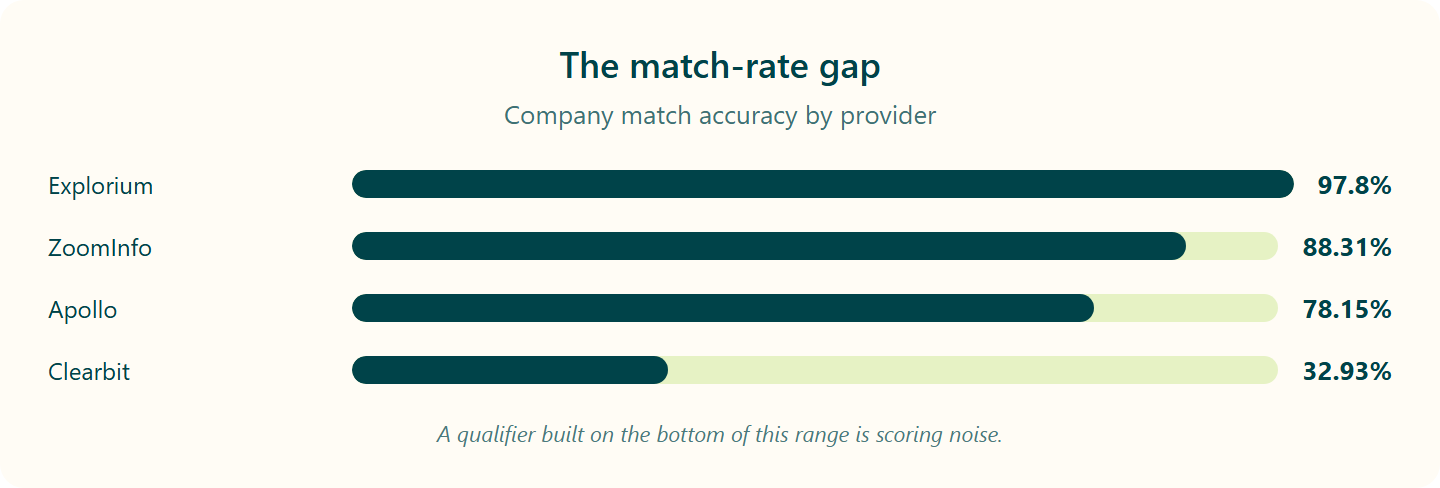
Firmographic accuracy is not close across vendors. Our first-party benchmark found 97.8% company match versus 88.31% for ZoomInfo, 78.15% for Apollo, and 32.93% for Clearbit. A qualifier built on the bottom of that range is scoring noise.
Operators feel this every day, and they say so plainly:
“Contact info is frequently missing or incorrect. I spend half the day calling wrong or disconnected numbers. Mobiles are frequently wrong.”
Verified User, IT Services, Mid-Market Apollo G2 Verified Review
“Not always accurate. Needs more frequent refresh.”
Brian Y., Head of Marketing Clearbit G2 Verified Review
It gets worse when the source itself degrades. Around March 2025, LinkedIn banned Apollo’s scrapers and several others. Since then, that data has drifted toward questionable, which quietly poisons any agent scoring on top of it. Choosing Apollo API alternatives for AI agent builders becomes a data-quality decision, not just a pricing one.
🤖 When the LLM just makes it up
There is a second miss, and it is newer. When you let an LLM enrich or personalize freely, it hallucinates with a straight face.
I watched a live agent demo fail on a basic detail. It scraped an email and location, and the person said, "that’s not my email address and I don’t live in Canada anymore." If your workflow trusts that blindly, you just qualified a fiction.
This is why I am skeptical of the signal arms race. A practitioner I respect put it bluntly: a lot of advanced filters like open rates, funding, and tech scores are "just fluff," marketing polish more than predictive power.
🔧 What to do Monday
Two fixes, both cheap:
- ✅ Add a QA layer. Have a model sanity-check every enriched profile before it scores. Ask, “does this LinkedIn match this person and company?”
- ✅ Waterfall your sources. Try provider one, stop when it returns a verified hit, then fall back. You stop paying for redundant lookups.
Single-signal providers and degrading scrapers create the miss in the first place. At Explorium, we narrow it by aggregating 50+ sources behind one layer with automated match verification, an approach detailed in our guide to waterfall enrichment, so the agent scores a checked record, not a guess. I could be wrong on the exact weighting, but the direction is clear: fix the data, and most AI slop disappears.
Q4. What stays human when AI qualifies your leads? [toc=4. What Stays Human]
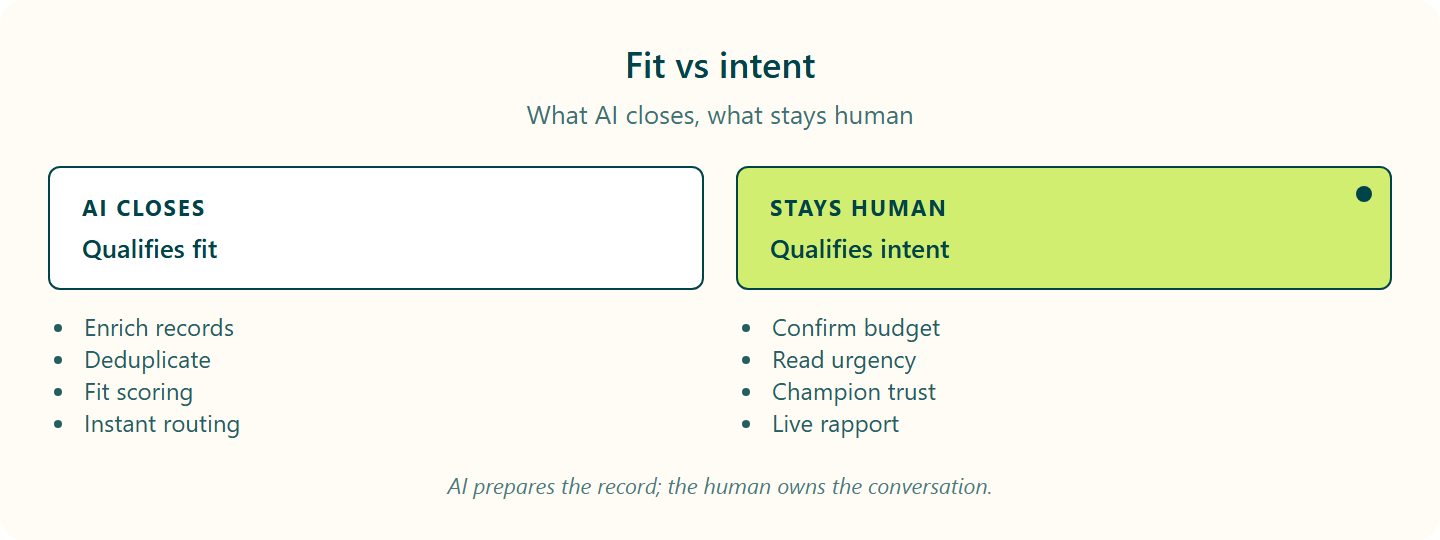
AI qualifies fit; humans qualify intent. Confirming real budget, uncovering genuine urgency, reading a champion’s political capital, and building trust in a live conversation stay human. The state-of-the-art design even codifies this: the AI suggests a ranked next action, the human chooses, and that choice becomes the next training label. Use AI to prepare the SDR, not replace the conversation.
🔥 Where teams remove humans too early
The common mistake is pointing an AI agent at cold outbound and walking away. That is exactly the work that produces AI slop, generic messages that burn the prospect.
The context problem is real. Your agent does not know why this person matters right now. As one operator told his team, start with the hot people, the ones on your website, the ones who never followed up. Timing this well is where buying signals for AI sales agents pull their weight.
🧠 The machine suggests, the human decides
This split is not a soft opinion. It is now patented design. Oracle’s 2025 patent describes a system where the model suggests ranked sales actions, the human picks one, and that choice feeds back as a training label.
Read that again, because it matters. The best-known architecture explicitly keeps the human in the loop and treats their judgment as the training signal. AI prepares; the human confirms.
Practitioners hedge the same way on personalization. Over-engineered AI icebreakers backfire, because models still hallucinate and get goofy. Sometimes the simpler play converts better and breaks less.
📊 The three-column map
Here is how I split the work with teams:
One line I keep coming back to from a sales leader: "yeses are great, nos are great, maybes will kill you." Humans are far better at turning a maybe into a clear answer in a live exchange.
🎯 Use AI to buy back the conversation
So the goal is not replacement. It is handing the rep a finished record so the human minute goes to the talk, not the tabs.
That is the quiet role our data layer plays. At Explorium, the agent fetches and verifies the full record through one B2B data enrichment API, so when a human picks up the call, they spend the time on motivation and urgency, not on rebuilding an org chart.
Q5. How does the AI lead qualification process work, step by step? [toc=5. The Process]
A production pipeline runs five steps: capture the lead, enrich it with firmographic and contact data, score fit against your ICP with an ML model trained on closed-won deals, route high-fit leads to SDRs instantly, and nurture the rest automatically. The hard part is not the model, it is feeding it accurate, deduplicated data fast enough to score at form-fill time.
🔄 Build the logic backwards
Here is the mistake I see most. Teams design their qualification rubric top-down, from a whiteboard theory of the perfect customer.
Invert that. As one GTM engineer put it, "you cannot build a good GTM engineering system from the top down." Start from 20 to 30 known great logos, your actual closed-won accounts, and derive the pattern from them, a process our guide to identifying your ICP and prioritizing optimal leads walks through.
🛠️ The five steps, and where each one bites
By the end of this, you will know what each step does and where it breaks.
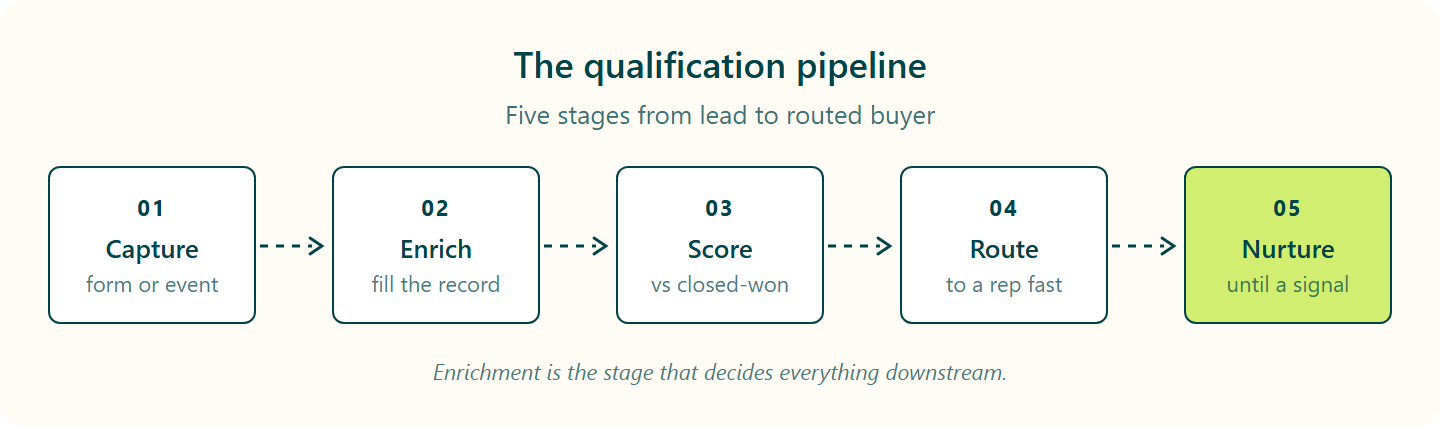
- Capture. Grab the lead from a form, list, or website event. Gotcha: raw form data is thin. Monday action: fire enrichment the moment the record lands.
- Enrich. Fill in firmographics, contacts, and signals. This is the step that decides everything downstream.
- Score. Run the ML model against your closed-won pattern. Gotcha: garbage in, confident garbage out. Monday action: validate on held-out won accounts.
- Route. Send high-fit leads to a rep in seconds. Gotcha: slow routing kills speed-to-lead. Monday action: set an SLA in minutes, not hours.
- Nurture. Drip the rest automatically until a signal fires.
🛰️ The best signals are derived, not bought
The clever part of qualification lives in step 2. The strongest signals are often built, not pulled from a dropdown.
One logistics team could not find warehouse headcount data. So they pulled satellite images and counted parking spots, which turned out to be the best predictor of headcount. Another team uses Google’s CrUX score, a public Chrome traffic dataset, to spot enterprise-grade demand hiding inside a small-company headcount bracket. Layering B2B intent data on top sharpens the picture further.
💰 Where the credit pool leaks
Step 2 is also where cost silently balloons. Stitch Apollo for contacts, PDL for people, Bombora for intent, and BuiltWith for tech, and you now run four integrations, four bills, and four matching layers per lead.
That is the Find, Frame, and Fix trap: you find the problem, frame it, but the fix drowns in integration sprawl. This is the exact seam Explorium sits in. One API call to an aggregated layer of 50+ sources replaces that four-tool stitch, with one unified credit pool across 30+ enrichments, so the agent enriches at form-fill time instead of queuing. Our take on credit-based versus subscription pricing for B2B data APIs explains why that matters for economics.
I could be wrong on the perfect source mix for your ICP. But the pattern holds: derive the rubric from wins, enrich from one layer, and score fast.
Q6. Which signals and frameworks (BANT, MEDDIC, CHAMP) should the AI score on? [toc=6. Signals and Frameworks]
AI qualifies leads using firmographic signals (industry, company size, funding), intent signals (hiring velocity, tech adoption, content activity), and behavioral signals (website visits, engagement). Frameworks like BANT, MEDDIC, and CHAMP still hold, but AI only scores the parts it can observe. Data accuracy determines whether the score reaches SDR quality, so weight signals from what your closed-won accounts actually shared.
🧭 Map the framework to what the machine can see
The old frameworks are still useful, they just need translation for an agent. Each one has parts a model can observe and parts it cannot.
- BANT (Budget, Authority, Need, Timing): AI reads budget proxies (funding, size) and authority (title, seniority). It struggles with true need and timing.
- MEDDIC (Metrics, Economic buyer, Decision criteria, Decision process, Identify pain, Champion): AI maps the economic buyer and metrics from firmographics. Pain and champion stay human.
- CHAMP (Challenges, Authority, Money, Prioritization): AI infers money and authority; challenges need a conversation.
Behavioral and even conversation signals are fair game too. A 2021 patent describes qualifying leads by analyzing device data and call-content streams, not just static firmographics. Feeding those into intent data for AI sales agents is where the edge shows up.
⚠️ Most advanced signals are fluff
Here is the contrarian part, and I hold it loosely. A lot of the flashy signal menu is marketing polish, not prediction.
As one practitioner said bluntly, signals like open rates, job postings, funding, revenue, and tech scores are often "just fluff." They look advanced on a pricing page. They rarely move your win rate.
📊 Weight signals from your wins, not a vendor’s menu
So how do you pick? Do not trust the dropdown. Trust your closed-won.
Pull your last 30 won deals and ask which signals they actually shared. That derived list, satellite parking counts, CrUX traffic, and a specific hiring pattern, beats any generic filter set. Weight those, and ignore the rest, a discipline we cover in using Explorium to score and export data.
This is where testing cheaply matters. With Explorium’s 30+ enrichments in one credit pool, you can test which signals actually predict wins without buying a new subscription per signal source, backed by a rich B2B contact data foundation. Run the test, keep the two or three that correlate, and cut the noise.
Q7. Why does your data infrastructure decide whether AI qualification works? [toc=7. Data Infrastructure]
AI qualification lives or dies on data infrastructure. Fragmented stacks force agents to spend most of their time joining records across systems instead of scoring, and each stitched source multiplies latency, cost, and error. A unified data layer, one API, one credit pool, and 50+ aggregated sources, gives the agent complete, deduplicated records so the score reflects reality, not gaps.
🏗️ The infrastructure decides, not the model
My governing claim is simple. The model is not your bottleneck. The data plumbing is.
I have watched this for years. As one operator described it, "data is fully completely fragmented across different systems," so agents "spend a lot of time just pulling data" that is irrelevant to the actual task. Our deep dive on building scalable AI agents through data quality and infrastructure unpacks this.
🧩 The fragmentation tax is real
Every extra source you bolt on adds a matching layer, a bill, and latency. Five providers means five entity-resolution problems, where you decide if "Acme Inc" and "Acme" are the same company.
I have been doing versions of this for 15 years, integrating datasets over and over. The cross-domain parallel is Snowflake and AWS: consolidation won because nine bills and nine integrations were never sustainable. Teams that migrate their B2B data enrichment provider without downtime feel that relief fast.
💰 Waterfall economics and match-rate lift
There is a cheaper pattern. Waterfall your sources: take one input, try provider one, and stop the moment it returns a verified hit.
That alone can lift email match from roughly 40% on a single provider to about 78% across a waterfall enrichment flow, while cutting spend because you stop paying for redundant lookups. Oracle’s composite-score patent points the same way: blend multiple sources into one score rather than trusting any single feed.
Operators feel the consolidation win directly:
“Instead of connecting to multiple data sources and APIs, we only require one connection, Explorium.”
Mirit H., Mid-Market Explorium G2 Verified Review
“Explorium gives us the data I need when I need it. This saves us a lot of time and money instead of managing each data source separately.”
Ishi N., Enterprise Explorium G2 Verified Review
✅ What to evaluate in a data layer
When you pick infrastructure, score it on four things: match rate, freshness, dedupe quality, and credit economics. Brand recognition is not on that list, though match rate benchmarks should be.
This is the core of what we build at Explorium: a unified credit pool across 30+ enrichments and 50+ aggregated sources, with proven company-enrichment match-rate leadership versus single-signal providers like PDL, Bombora, and BuiltWith. To be fair, PDL still wins on raw contact-info coverage in some segments. But for one deduplicated record the agent can trust, one unified layer beats five stitched feeds.
Q8. Should you build or buy your AI qualification stack, and where does MCP fit? [toc=8. Build vs Buy and MCP]
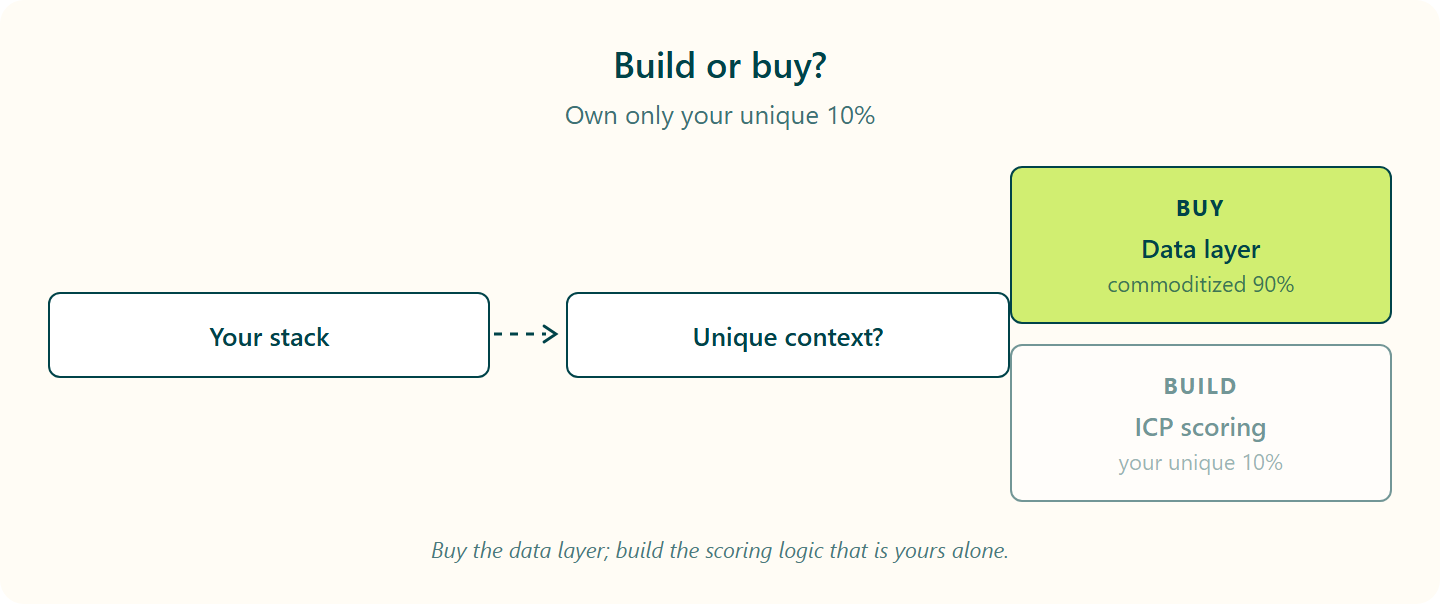
Buy the commoditized 90% of your stack and build only the 10% that encodes your unique context. For the data layer, an MCP server (Model Context Protocol, an open standard that lets AI tools call your APIs) lets your agent decide what to fetch at runtime, no ClickOps, no brittle webhook glue, and synchronous enrichment at form-fill time. Building your own scraping and joining pipeline is usually the 10% you should not own.
🧱 The ClickOps and throttling problem
Start with the pain. Legacy UI-first tools make you click through screens and wait for loads, what one builder called the ClickOps frustrations he had for years.
APIs are not always the escape. As an operator noted, using "Apollo via API and webhook" was "so slow and consistently throttled that it was never really worthwhile," so they fell back to CSV exports. Throttled endpoints quietly break agent workloads at scale, a topic we cover in B2B data API latency and rate limits in production.
🔌 MCP is the USB-C port for your agent
Here is the mental model I like. Anthropic created MCP as, effectively, "a USB socket for AI," a standard port that lets your agent plug into any data API.
That flips who does the fetching. With a REST-only setup, the GTM engineer wires every call in advance. With MCP, the agent decides what to fetch at runtime, a difference we break down in MCP vs REST API for AI agents. The next buyer of your data is an LLM, not a salesperson.
📊 The build-vs-buy call
The debate is real, and both sides have a point. One camp says buy 90% of your AI stack. The Vercel camp argues your own esoteric context is what unlocks the agent, so build on your own cloud.
Practitioners echo both the promise and the pain of these tools:
“The waterfall, automation, and intent features. Best data providers in one subscription, saving up to 70% costs.”
Qais B., Growth Strategist Clay G2 Verified Review
“Credit system is broken. Pricing is broken. Not fully transparent with rollover limit.”
Raphael A., Marketing Lead Clay G2 Verified Review
My read: buy the data layer, and build the scoring logic. This is why we shipped Explorium’s AgentSource as MCP-native, one API, one MCP server, and one credit system, with a sync API benchmarked around 100 queries per second for scale, so the agent chooses what to fetch instead of fighting a throttled endpoint.
Q9. How do you measure AI qualification quality and ship it Monday morning? [toc=9. Measure and Ship]
Measure AI qualification like a new SDR: conversion of routed leads, speed-to-lead SLA (the time from lead arrival to first touch), false-positive rate, and match rate on enriched fields. Add an LLM QA layer to sanity-check every enriched profile, log every human override as training data, and ship a thin version this week, pointing the agent at hot inbound first. If your maybe-pile is growing, your data or rubric is failing.
🎯 Stop guessing, start measuring
Here is the uncomfortable number. By one operator’s account, only about 11% of customers have been genuinely successful with AI.
The reason is rarely the model. It is that teams cannot diagnose failure. As one practitioner told me, deliverability "has just remained a constant challenge," and without instrumentation "you’re just guessing, you can’t really be scientific about how you diagnose the problem." Our guide on data enrichment for inbound scoring tackles exactly this diagnosis gap.
📊 The four metrics that matter
Treat your agent like a new hire on probation. Track four numbers, and nothing vanity.
- Conversion of routed leads. Do the leads it calls hot actually convert?
- Speed-to-lead SLA. Time from form-fill to first touch, in minutes.
- False-positive rate. How often does a high score turn into a dead lead?
- Match rate on enriched fields. What share of records came back complete and verified?
The maybe-pile is your smoke alarm. As a sales leader put it, "yeses are great, nos are great, maybes will kill you." A growing maybe-pile means your data or your rubric is failing, not your reps, so anchor your target to real match rate benchmarks.
🔧 Two guardrails: QA and override logging
Add two cheap guardrails before you scale. First, an LLM QA layer: run an automated check, a Claude check, on every enriched profile to confirm the person, title, and company line up before scoring. Our walkthrough on adding B2B data enrichment to a Claude Code agent shows the pattern.
Second, log every human override as training data. Oracle’s 2025 patent codifies exactly this: the AI suggests, the human chooses, and that choice feeds back as the next training label. Your corrections become the model’s tuition. This is the loop we describe across the lifecycle of data in agent development.
⏰ Ship a thin version this week
Do not wait for the perfect system. Ship a narrow slice by Friday.
- Monday: point the agent at hot inbound only, the people already on your site.
- Tuesday: wire enrichment plus the QA check on every record.
- Wednesday: score against your last 30 won deals and set a routing threshold.
- Thursday: turn on override logging and a speed-to-lead SLA.
- Friday: review the four metrics, then widen the scope.
This is the roulette continuum idea: scale what already works manually, and do not automate a motion you have never closed by hand. If you want a template, our Claude Code outbound sales agent tutorial is a good starting point.
🚀 What you get back
The payoff is time. One founder was running 50 hours of sales calls a week, with only 5 hours spent on qualified buyers.
After qualification moved upstream to the agent, that math flipped and bought back roughly 95% of his week. That is the real prize, not fewer humans, but humans pointed at real buyers, the outcome our GTM engineering use case is built around.
At Explorium, match rate and coverage are first-party metrics you can monitor directly, one API, one MCP server, and one credit pool to power your first qualification agent without stitching four vendors. You can spin this up on our MCP server today. I am still sitting with one open question: as MCP retrieval matures over the next 18 to 24 months, how much of the qualification rubric will the agent tune on its own, and how much stays a human call? I do not have a clean answer yet. If you are building this, tell us what you are running into, because the honest patterns come from the field, not the whiteboard.
FAQs


