

TL;DR
- We rank the 10 best firmographic data APIs for 2026, with Explorium first for aggregating 50+ sources behind one API, one MCP server, and one unified credit pool.
- We score every vendor on five weighted criteria: data accuracy, agent and API readiness, field depth and source attribution, pricing transparency, and verified customer reviews.
- We show how to judge quality by running a 50-account test, demanding tiered refresh rates, refusing APIs that hide source attribution, and confirming GDPR, CCPA, SOC 2, and ISO 27001.
- We explain why agent-native MCP support is the new dealbreaker, since UI throttling and 50,000-row limits collapse under agents making thousands of scoped calls.
- We break down real pricing, where credit multipliers push spend two-to-three times higher, and warn that internal-use-only licenses can block product builders without resale rights.
- We match each tool to its use case, recommending Explorium for agent-native and embedded builds, while staying honest that single-signal needs may suit a point-tool.
Q1. What Are the 10 Best Firmographic Data APIs for GTM in 2026? [toc=1. 10 Best Firmographic APIs]
The 10 best firmographic data APIs for GTM in 2026 are Explorium, People Data Labs, ZoomInfo, Apollo, Clay, Cognism, Clearbit (HubSpot Breeze), Coresignal, Crunchbase, and SalesIntel. Explorium leads by aggregating 50+ sources behind one API and one MCP server, with a unified credit pool and 4,000+ data points across 30+ enrichments. The rest mostly specialize in single signals, which forces teams to stitch point-tools together.
The 2026 Firmographic Data API Landscape at a Glance
A GTM engineer at a Series-B sales-tech company once messaged me near midnight. His outbound agent had stalled mid-run, and he was staring at a credit dashboard that made no sense. He paid five vendors, wrote five matching layers, and still could not tell which source gave his agent the wrong headcount.
That scene is the real story of this category. The average go-to-market stack now runs 15 to 25 vendors, and reps spend roughly 70% of their time on manual tasks instead of selling. When your CRM is missing basic fields, your team does data entry, not deals.
⚙️ Why The Stack Keeps Breaking
Here is what I keep seeing in production agent workloads. A firmographic data API is a service that returns company facts, such as industry codes, employee count, revenue, and funding, by matching a business to a stable ID and enriching it live.
Most teams buy these signals one provider at a time. People Data Labs for contacts. Bombora for intent. BuiltWith for tech stack. Each adds a bill, a credit pool, and a deduplication problem.
🔀 The Shift To An Agent-Native Layer
Think of how AWS replaced nine SaaS bills with one cloud account, or how Stripe replaced gateway sprawl. The same consolidation is hitting B2B data right now.
The fix is not another point-tool. It is one API, one MCP server, and one credit system sitting on top of 50+ aggregated sources, where the agent, not a rep, decides what to fetch. Explorium is built around exactly that idea, and that is why it leads this list. The market opening is real too, because after LinkedIn banned Apollo scrapers around March 2025, Apollo’s firmographic data grew questionable, leaving room for cleaner, aggregated sources to step in. You can see how we approach this in our best B2B data enrichment API for AI agents breakdown.
Master Comparison Table: Accuracy, Refresh Rate, Source Attribution, Pricing
This table scores all 10 providers on the four pillars in the title. Stars reflect our weighted rubric (accuracy, agent readiness, field depth, commercial transparency, and customer validation), where Explorium earns 5 stars on agent and API readiness.
The 10 Providers, Ranked (Per-Vendor Cards)
Below I open the detailed cards, starting with the top two. Each card follows the same schema so you can compare apples to apples.
1.1 Explorium, Best for Agent-Native GTM Teams That Want One Unified Data Layer [toc=1.1 Explorium]
📋 Overview
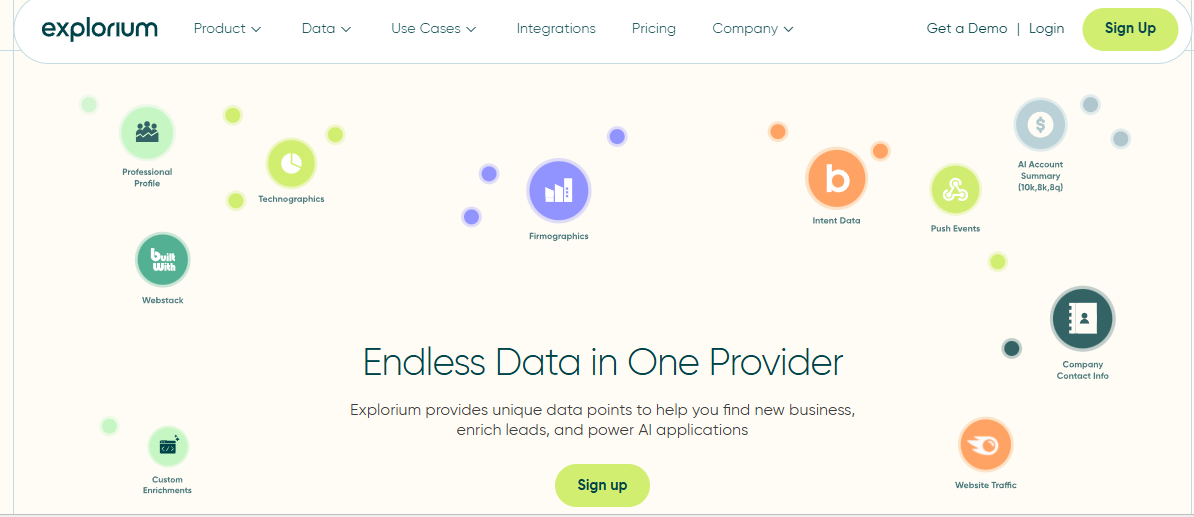
Explorium is an agent-native B2B data API. It aggregates 50+ data sources behind a single API and a single MCP server, so one integration covers firmographics, technographics, intent, funding, hiring, and contacts. In reality, it is the consolidation layer that replaces five separate point-tools.
The point is not "more data." The point is that an LLM agent can call match, enrich, fetch, and event endpoints directly, and decide what to pull at runtime.
⏰ Time to first API call: UI: minutes. API: ~15 to 30 minutes with docs and a key.
⚙️ Setup complexity: Low to medium (API-first, MCP-native).
🛠️ Core Services
- One unified API across 50+ aggregated sources.
- Native MCP server, so the agent decides what to fetch.
- Unified credit pool across 30+ enrichment types.
- Sync API built for scale (~10K records/min, 100 QPS).
- Native integrations with Salesforce, HubSpot, Outreach, and Snowflake.
📊 Data Coverage and Field Depth
Strong in: Company firmographics, multi-signal enrichment, parent-child resolution, and US and global coverage.
Weak in: Very deep single-person contact niches where a pure contact vendor may still edge ahead in spots.
Field depth: 4,000+ data points spanning firmographic, technographic, intent, funding, and hiring.
Confidence Level: High (97.8% firmographic accuracy, validated across 50+ sources).
🤖 API and Agent Readiness
- API availability: Yes, REST plus sync API.
- API depth: High, with match, enrich, fetch, and event primitives.
- MCP compatibility: Native MCP support.
- Agent usability: High. This is the core design, not an add-on.
In our experience hardening match-rate logic across 150M+ company profiles, the win is reconciliation. We resolve which source gives the best value per field, so an agent does not get the holding company’s headcount when it asked about the operating entity. Our match-rate benchmarks show how that reconciliation holds up at scale.
💰 Pricing and Cost Structure
Pricing Model: Usage-based with a unified credit pool.
Published Pricing: Free tier available. Pro and Enterprise are custom, based on volume and sources.
💸 Cost Interpretation (What You Actually Pay)
- Estimated cost per 1,000 records: Varies by enrichment mix, but one pool means no double-paying across signals.
- Free credits / trial: Yes, a free tier to test the API and MCP.
- Billing driver: API calls and credits, drawn from one shared pool.
⚠️ Hidden Costs and Constraints
- Credits draw from one pool, which removes the per-vendor stacking problem.
- Resale rights and search preview are available on custom plans.
- Heavy multi-signal use still needs a credit budget, so plan your source mix.
✅ When to Shortlist
Shortlist this if:
- You are building agent-native or MCP-driven enrichment workflows.
- You want to collapse five vendors and five bills into one credit pool.
- You need scale-ready sync throughput for 10K+ calls/day.
Avoid this if:
- You only need a single signal once and never plan to scale or add agents.
- You want a pure UI prospecting tool with no API or agent ambitions.
⭐ Customer Reviews
“Explorium is a fast and effective platform that makes the integration and analysis of third-party data seamless.”
David A., CEO, Mid-Market Explorium G2 Verified Review
“Given the large amount of data, the platform can be a bit confusing for the first few times you use it. However, their CS team is very helpful and responsive.”
Ishi N., Enterprise Explorium G2 Verified Review
“Explorium is thr only platform I have seen in market that has a consistent journey to explore, experiment and inplement external data at scale.”
Verified User Explorium Gartner Verified Review
1.2 People Data Labs, Best for Developers Building Person and Company Datasets at Scale [toc=1.2 People Data Labs]
📋 Overview
People Data Labs (PDL) is a data-as-a-service provider. It sells raw person and company records through an API so developers can build their own datasets, products, and enrichment flows. It is API-first by design, which is why builders reach for it.
In reality, PDL is a strong building block, not a finished workflow. You get records and schemas, then you do the matching, validation, and orchestration yourself.
⏰ Time to first API call: UI: limited. API: ~20 to 40 minutes.
⚙️ Setup complexity: Medium (developer-oriented, you own the plumbing).
🛠️ Core Services
- Person enrichment API with large profile coverage.
- Company enrichment with firmographic fields.
- Bulk dataset licensing for in-house pipelines.
- Search API for building lists by attribute.
- Schema-rich JSON responses for developers.
📊 Data Coverage and Field Depth
Strong in: Person-centric coverage and large-scale company records for developers building their own graph.
Weak in: Out-of-the-box freshness and support consistency, per recent reviews. Field reconciliation is on you.
Field depth: Wide person and company schema, though you stitch signals together yourself.
Confidence Level: Medium. Coverage is broad, but you must validate freshness per field.
🤖 API and Agent Readiness
- API availability: Yes, REST API.
- API depth: High for raw records, lower for orchestration.
- MCP compatibility: Not natively supported.
- Agent usability: Medium. Agents can call it, but you build the matching and dedup layer.
My honest read, and I could be off here, is that PDL wins when you have a data team that wants raw material and full control. It is weaker when you want an agent to just decide what to fetch without you writing the join logic first. If you are weighing that build-versus-buy call, our take on MCP versus REST API for AI agents is worth a read.
💰 Pricing and Cost Structure
Pricing Model: Usage-based, API-credit driven.
Published Pricing: Free tier with limited credits. Paid plans from roughly $100/month, with enterprise custom.
💸 Cost Interpretation (What You Actually Pay)
- Estimated cost per 1,000 records: Varies by endpoint and match volume.
- Free credits / trial: Yes, a free tier exists.
- Billing driver: API calls and record credits.
⚠️ Hidden Costs and Constraints
- Credits sit in their own pool, so multi-signal stacks still fragment.
- Some users report abrupt account actions, so confirm terms before you build.
- Detailed cost mechanics are not always fully transparent pre-contract.
✅ When to Shortlist
Shortlist this if:
- You have a data team that wants raw records and full control.
- You are building a custom dataset or product on top of person data.
- You can own matching, dedup, and freshness checks yourself.
Avoid this if:
- You want one unified credit pool across many signals.
- You need native MCP so the agent decides what to fetch.
- You want enrichment that arrives reconciled and ready to use, the way our business enrichment API delivers it.
⭐ Customer Reviews
“Product was useful while it worked which wasnt long. Switched from free trial to paid plan $100/month. After a few days, account disabled with no warning or explanation. Support unresponsive.”
Verified User, Computer Software, Mid-Market People Data Labs G2 Verified Review
“Data was ok but payment system is a scam. Very hard to get off their hook once signed up.”
Glissando AI People Data Labs Trustpilot Verified Review
1.3 ZoomInfo, Best for Enterprise Teams That Want the Deepest Firmographics and Intent [toc=1.3 ZoomInfo]
📋 Overview
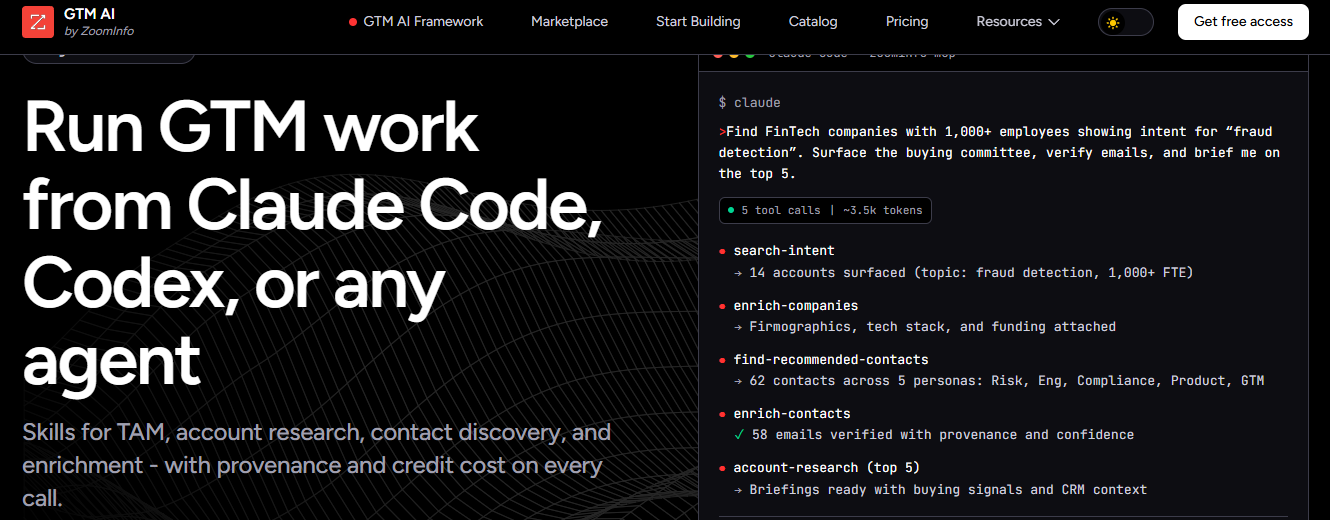
ZoomInfo is the enterprise heavyweight for company and contact data. It offers deep firmographics (company facts like size and revenue), plus intent signals that hint when an account is in-market. In reality, it is a sales-team platform first, an API second.
The data depth is real. The trade-off is enterprise pricing and contracts that often price out growth-stage teams.
⏰ Time to first API call: UI: fast. API: ~1 to 2 hours (contract and access gating).
⚙️ Setup complexity: Medium to high (enterprise onboarding).
🛠️ Core Services
- Deep company and contact database with intent data.
- Firmographic, technographic, and scoops (sales triggers).
- CRM and marketing-automation integrations.
- WebSights visitor de-anonymization.
- Enterprise admin and governance controls.
📊 Data Coverage and Field Depth
Strong in: Enterprise firmographics, US coverage, and intent signals.
Weak in: Agent-native consumption, flexible pricing, and SMB budgets.
Field depth: Very wide firmographic and contact schema.
Confidence Level: High on coverage, lower on agent fit.
🤖 API and Agent Readiness
- API availability: Yes, but rate-limited.
- API depth: High for data, low for agent orchestration.
- MCP compatibility: Not supported.
- Agent usability: Low to medium. The API fights high-volume agent runs.
My read from production workloads is that ZoomInfo’s brand and depth are genuine, but rate limits and seat-based contracts make agent scale awkward. Numbers beat logos here, so test throughput before you sign. For builders who hit those walls, our ZoomInfo API alternatives for GTM agent builders guide covers the options.
💰 Pricing and Cost Structure
Pricing Model: Custom enterprise, seat-based.
Published Pricing: Not public. Enterprise: contact sales.
💸 Cost Interpretation (What You Actually Pay)
- Estimated cost per 1,000 records: Not calculable pre-contract.
- Free credits / trial: Limited trial, gated.
- Billing driver: Seats plus data packages.
⚠️ Hidden Costs and Constraints
- Annual contracts with seat minimums.
- API access often sits in higher tiers.
- Detailed cost mechanics are not fully transparent pre-contract.
✅ When to Shortlist
Shortlist this if:
- You are an enterprise needing the deepest firmographics and intent.
- You have budget for annual seat-based contracts.
- Your workflow is rep-led, not agent-led.
Avoid this if:
- You are building agent-native enrichment at high volume.
- You need flexible, usage-based pricing.
- You are a growth-stage team watching cash.
1.4 Apollo, Best for SMB and SaaS Teams Seeking Affordable All-In-One Prospecting [toc=1.4 Apollo]
📋 Overview
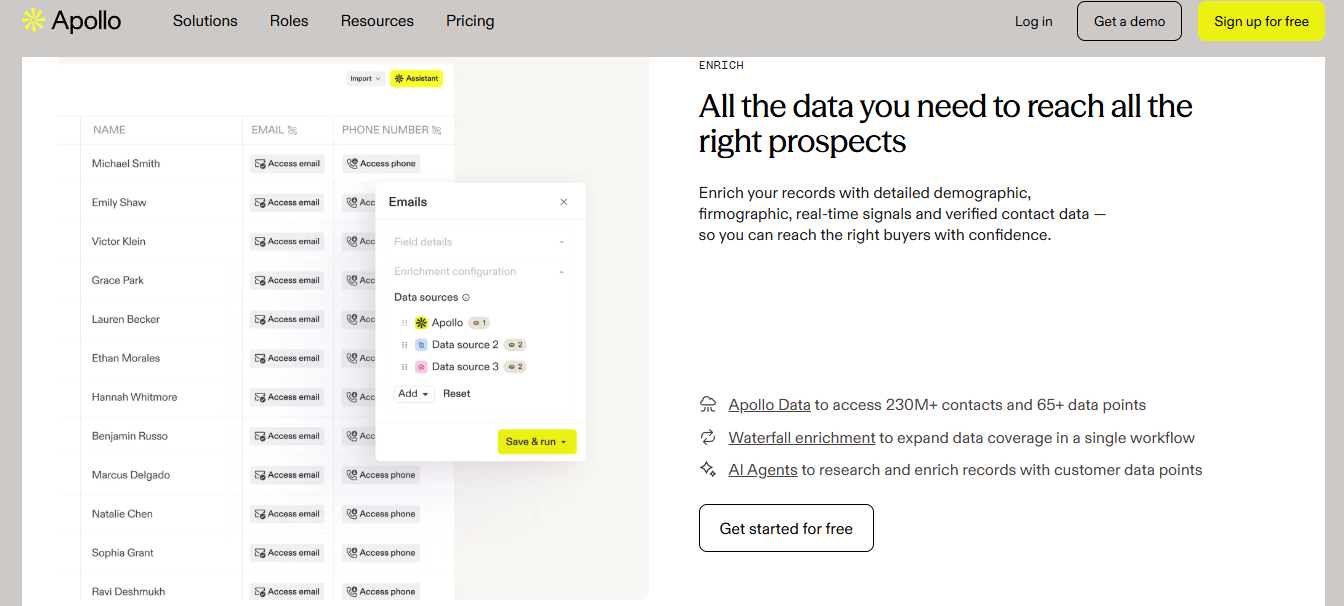
Apollo is a bundled GTM platform. It combines contact discovery, enrichment, and outreach in one system, so SMB sales teams can prospect without stitching tools together. It is UI-first, API-second.
In reality, Apollo trades depth for price. After LinkedIn banned Apollo scrapers around March 2025, several practitioners flagged its firmographic data as increasingly questionable.
⏰ Time to first API call: UI: instant. API: ~30 to 60 minutes.
⚙️ Setup complexity: Medium (UI-first, API-second).
🛠️ Core Services
- Contact and company database with filters.
- Email and phone enrichment.
- Built-in outbound sequencing.
- CRM integrations (Salesforce, HubSpot).
- Chrome extension for LinkedIn prospecting.
📊 Data Coverage and Field Depth
Strong in: SaaS, funded startups, and mid-market contacts.
Weak in: Non-tech SMBs, mobile accuracy, and post-2025 firmographic freshness.
Field depth: Moderate firmographics plus contacts, limited deep multi-source enrichment.
Confidence Level: Medium (strong in SaaS, weaker elsewhere).
🤖 API and Agent Readiness
- API availability: Yes.
- API depth: Moderate, contact and company endpoints.
- MCP compatibility: Not supported.
- Agent usability: Medium. Throttling hurts bulk runs.
Here is the operational catch. One practitioner noted Apollo’s API was "so slow and consistently throttled that it was never really worthwhile," so the team fell back to manual CSV exports. That breaks agent economics fast, which is why many builders compare Apollo API alternatives for AI agent builders before committing.
💰 Pricing and Cost Structure
Pricing Model: Subscription plus credit usage.
Published Pricing: Basic ~$49/user/month, Professional ~$79 to $99/user/month, Organization custom.
💸 Cost Interpretation (What You Actually Pay)
- Estimated cost per 1,000 contacts: ~$50 to $150, varies by plan.
- Free tier: Yes, limited credits.
- Billing driver: Per seat plus per credit.
⚠️ Hidden Costs and Constraints
- One email costs one credit, mobile numbers can cost eight credits each.
- Real-world cost often runs two to three times the headline price once overages hit.
- API access is gated to higher tiers.
✅ When to Shortlist
Shortlist this if:
- You need affordable all-in-one prospecting with minimal setup.
- Your focus is SaaS or tech outbound.
- You value speed over deep infrastructure flexibility.
Avoid this if:
- You are building agent-native enrichment systems.
- You need accuracy across non-tech industries.
- You want fully usage-based, scalable pricing.
⭐ Customer Reviews
“Easy to create persona, multiple filters, verified email option for low bounce rates, built-in CRM to track replies and calls.”
Tejender K., Digital Marketing Executive Apollo G2 Verified Review
“Contact info frequently missing or incorrect. Half the day calling wrong/disconnected numbers. The credit system for unlocking mobiles/emails is clunky and interrupts sales flow.”
Verified User, IT Services Apollo G2 Verified Review
1.5 Clay, Best for RevOps Teams Building Waterfall Enrichment in a Visual UI [toc=1.5 Clay]
📋 Overview
Clay is a visual enrichment workspace. It runs "waterfalls," meaning it tries multiple data providers in order until one returns a match, all inside a spreadsheet-style UI. In reality, it is an orchestration layer on top of other vendors, not a primary data source.
That design is flexible and popular. It is also UI-first and async, which fights autonomous agents.
⏰ Time to first API call: UI: fast. API: ~30 to 60 minutes.
⚙️ Setup complexity: Medium to high (steep learning curve).
🛠️ Core Services
- Waterfall enrichment across many providers.
- Spreadsheet-style tables with AI columns (Claygent).
- Built-in company and people search.
- Integrations to push data into the stack.
- Automation for list building.
📊 Data Coverage and Field Depth
Strong in: Flexible multi-provider enrichment, and GTM experimentation.
Weak in: Predictable credit cost, raw-data ownership, and agent-native runs.
Field depth: As deep as the providers you wire in.
Confidence Level: Medium. Contact quality varies by source.
🤖 API and Agent Readiness
- API availability: Yes, but async.
- API depth: Moderate, table-centric.
- MCP compatibility: Not supported.
- Agent usability: Low to medium. General tables cap at 50,000 rows.
The 50,000-row table limit is the moment teams outgrow UI tables and want API-first infrastructure. Clay is great for humans tuning lists, less so for an agent making thousands of autonomous calls. Teams that need that scale often look at Clay alternatives for a B2B data enrichment API, or learn how waterfall enrichment works under the hood.
💰 Pricing and Cost Structure
Pricing Model: Credit-based, workspace billing.
Published Pricing: Free tier, then plans scaling by credits.
💸 Cost Interpretation (What You Actually Pay)
- Estimated cost per 1,000 records: Varies widely by waterfall depth.
- Free credits / trial: Yes.
- Billing driver: Credits, drawn per enrichment step.
⚠️ Hidden Costs and Constraints
- Per-row credit cost can vary up to 100% from stated amounts.
- Credit pricing is not always transparent in dollar terms.
- Running your own provider sometimes beats Clay’s stacked providers on cost.
✅ When to Shortlist
Shortlist this if:
- You are RevOps experimenting with flexible enrichment.
- You want a visual workflow, not raw API plumbing.
- You enrich human-curated lists, not agent-scale volumes.
Avoid this if:
- You are running autonomous agents at 10K+ calls/day.
- You need predictable, transparent credit cost.
- You want to own and resell the underlying data.
⭐ Customer Reviews
“Transformative for GTM operations and data enrichment. Deeply flexible and integrated with modern GTM toolstack.”
Verified User, IT Services Clay G2 Verified Review
“Credit system is broken. Pricing is broken. Not fully transparent with rollover limit. Never helped when issues arose.”
Raphael A., Marketing Lead Clay G2 Verified Review
1.6 Cognism, Best for EMEA Outbound and Phone-Verified Contacts [toc=1.6 Cognism]
📋 Overview
Cognism is a sales-intelligence platform with a European focus. It markets strong mobile coverage and GDPR-aware data, so EMEA outbound teams reach for it. GDPR is the EU privacy law that governs how personal data is collected and used.
In reality, mobile coverage and freshness draw mixed reviews. The compliance positioning is the real draw for EMEA buyers.
⏰ Time to first API call: UI: fast. API: ~1 hour.
⚙️ Setup complexity: Medium (seat-based onboarding).
🛠️ Core Services
- B2B contact and company data with EMEA depth.
- Phone-verified mobile numbers (Diamond Verified).
- Intent data via partners.
- CRM integrations.
- GDPR and compliance tooling.
📊 Data Coverage and Field Depth
Strong in: EMEA contacts, and compliance posture.
Weak in: Mobile accuracy consistency, and US-number routing on EU searches.
Field depth: Solid contacts plus firmographic basics.
Confidence Level: Medium. Verified-mobile share draws complaints.
🤖 API and Agent Readiness
- API availability: Yes.
- API depth: Moderate.
- MCP compatibility: Not supported.
- Agent usability: Low to medium.
I will be fair here. Cognism’s EMEA and GDPR focus is a genuine strength for European outbound. The recurring data-quality complaints are the trade-off to test against your own region before committing, and our GDPR and CCPA compliance checklist can help you vet any vendor on that front.
💰 Pricing and Cost Structure
Pricing Model: Seat-based annual contracts.
Published Pricing: Not public. Custom by team size.
💸 Cost Interpretation (What You Actually Pay)
- Estimated cost per 1,000 records: Not calculable pre-contract.
- Free credits / trial: Limited, gated.
- Billing driver: Seats and annual commitments.
⚠️ Hidden Costs and Constraints
- Annual contracts despite quarterly framing in some sales talks.
- Verified-mobile coverage may be lower than headline claims.
- Detailed cost mechanics are not fully transparent pre-contract.
✅ When to Shortlist
Shortlist this if:
- You run EMEA outbound and need GDPR-aware data.
- Phone-verified mobiles matter for your motion.
- You have budget for annual seat contracts.
Avoid this if:
- You need agent-native, usage-based pricing.
- You run high-volume US phone outbound.
- You want one unified credit pool across signals.
⭐ Customer Reviews
“Poor data quality, no direct mobile numbers. Numbers either wrong or returns US HQ number even when searching European offices.”
Jackie Cognism Trustpilot Verified Review
“Data is really limited and generally poor quality. Claims 90% mobile coverage in sales process but doesnt deliver. Diamond Verified mobiles are less than 10%.”
Alex Cognism Trustpilot Verified Review
1.7 Clearbit (HubSpot Breeze Intelligence), Best for HubSpot-Native Enrichment [toc=1.7 Clearbit]
📋 Overview
Clearbit, now HubSpot Breeze Intelligence, is an enrichment API tightly tied to HubSpot. It enriches leads and accounts with firmographic and tech fields inside the HubSpot ecosystem. In reality, it is strongest when you already live in HubSpot.
The APIs are clean and developer-friendly. Refresh frequency and integration breadth draw the most criticism.
⏰ Time to first API call: UI: fast. API: ~30 minutes.
⚙️ Setup complexity: Low to medium.
🛠️ Core Services
- Company and person enrichment APIs.
- Reveal for website visitor de-anonymization.
- Firmographic and basic technographic fields.
- Native HubSpot enrichment.
- Lead scoring inputs.
📊 Data Coverage and Field Depth
Strong in: HubSpot-native enrichment, clean APIs, and tech fields.
Weak in: Refresh frequency, coverage breadth, and non-HubSpot integrations.
Field depth: Good firmographic basics, lighter on multi-signal depth.
Confidence Level: Medium. Users report needing to double-check fields.
🤖 API and Agent Readiness
- API availability: Yes, easy-to-use APIs.
- API depth: Moderate.
- MCP compatibility: Not supported.
- Agent usability: Medium, within the HubSpot world.
My honest take is that Clearbit shines for HubSpot shops and gets harder to justify outside that ecosystem. The freshness complaints are the thing to validate against your own records, and our roundup of the best providers for a company data API puts that trade-off in context.
💰 Pricing and Cost Structure
Pricing Model: Tiered, increasingly bundled into HubSpot.
Published Pricing: Self-service tiers, then enterprise custom.
💸 Cost Interpretation (What You Actually Pay)
- Estimated cost per 1,000 records: Varies by tier and HubSpot bundle.
- Free credits / trial: Limited.
- Billing driver: Volume tiers and HubSpot seats.
⚠️ Hidden Costs and Constraints
- Jumping past the self-service limit can mean a 4x plan leap.
- Tighter coupling to HubSpot reduces flexibility.
- Refresh cadence may lag for some fields.
✅ When to Shortlist
Shortlist this if:
- You are a HubSpot-native team wanting in-platform enrichment.
- You value clean, simple APIs.
- Your enrichment needs are firmographic basics plus tech.
Avoid this if:
- You need frequent refresh and broad multi-source depth.
- You work outside the HubSpot ecosystem.
- You are building agent-native, MCP-driven retrieval.
⭐ Customer Reviews
“Easy-to-use APIs. Good self-service pricing for small-medium volumes. Good database size.”
Dan T., Mid-Market Clearbit G2 Verified Review
“Not always accurate. Needs more frequent refresh. Lacks robust integrations to easily action on data.”
Brian Y., Head of Marketing Clearbit G2 Verified Review
1.8 Coresignal, Best for Builders Who Need Raw Firmographic and Job Feeds [toc=1.8 Coresignal]
📋 Overview
Coresignal is a data-feeds provider. It sells large firmographic and job-posting datasets through APIs and flat files, so builders can power their own products and models. In reality, it is raw material for data teams, not a finished workflow.
The volume is strong. You own the matching, dedup, and freshness logic.
⏰ Time to first API call: UI: limited. API: ~30 to 60 minutes.
⚙️ Setup complexity: Medium to high (developer-oriented).
🛠️ Core Services
- Company firmographic datasets at scale.
- Job-posting and hiring data.
- Employee and headcount feeds.
- API and flat-file delivery.
- Historical data for trend analysis.
📊 Data Coverage and Field Depth
Strong in: Raw firmographic volume, and hiring and jobs data.
Weak in: Out-of-the-box reconciliation, and contact-level depth.
Field depth: Wide company and jobs schema.
Confidence Level: Medium. You validate freshness yourself.
🤖 API and Agent Readiness
- API availability: Yes, REST and flat-file.
- API depth: High for raw feeds, low for orchestration.
- MCP compatibility: Not supported.
- Agent usability: Low to medium. Build the join layer yourself.
Coresignal is a fair pick when you want raw feeds and have engineers to shape them. For an agent that should just decide what to fetch, raw feeds add work, not remove it. If you would rather skip that plumbing, see how a B2B data enrichment API for AI agents handles reconciliation for you.
💰 Pricing and Cost Structure
Pricing Model: Usage and subscription.
Published Pricing: Tiered by volume, enterprise custom.
💸 Cost Interpretation (What You Actually Pay)
- Estimated cost per 1,000 records: Varies by dataset and volume.
- Free credits / trial: Limited trial.
- Billing driver: Records and dataset access.
⚠️ Hidden Costs and Constraints
- You build and maintain your own dedup and matching.
- Flat-file workflows add engineering overhead.
- Detailed cost mechanics are not fully transparent pre-contract.
✅ When to Shortlist
Shortlist this if:
- You have a data team that wants raw firmographic feeds.
- You need hiring and job-posting data at scale.
- You can own matching and freshness checks.
Avoid this if:
- You want reconciled, ready-to-use enrichment.
- You need native MCP for agent retrieval.
- You lack engineering to shape raw feeds.
1.9 Crunchbase, Best for Funding and Company-Event Tracking [toc=1.9 Crunchbase]
📋 Overview
Crunchbase is the go-to for funding and company-event data. It tracks investments, investors, acquisitions, and growth signals through a database and API. In reality, it is a funding-signal specialist, not a full firmographic enrichment layer.
For "they just raised, reach out now" triggers, it is excellent. For broad firmographic depth, it is narrower.
⏰ Time to first API call: UI: instant. API: ~30 minutes.
⚙️ Setup complexity: Low to medium.
🛠️ Core Services
- Funding and investment data.
- Investor and acquisition tracking.
- Company profiles and growth signals.
- Search and alerts.
- REST API access.
📊 Data Coverage and Field Depth
Strong in: Funding events, investors, and startup tracking.
Weak in: Deep firmographics, contact data, and refresh on private firms.
Field depth: Rich on funding, lighter elsewhere.
Confidence Level: Medium to high on funding, lower on broad firmographics.
🤖 API and Agent Readiness
- API availability: Yes, REST API.
- API depth: Moderate, event-focused.
- MCP compatibility: Not supported.
- Agent usability: Medium for funding triggers.
Crunchbase is a sharp single signal. The trap is treating funding data as a full firmographic source, which it is not. Pair it, do not rely on it alone, and consider how buying signals time outreach when you fold funding events into an agent.
💰 Pricing and Cost Structure
Pricing Model: Subscription plus API tier.
Published Pricing: Pro plans monthly, API and enterprise custom.
💸 Cost Interpretation (What You Actually Pay)
- Estimated cost per 1,000 records: Varies by API tier.
- Free credits / trial: Limited.
- Billing driver: Subscription and API calls.
⚠️ Hidden Costs and Constraints
- API access sits in higher tiers.
- Coverage skews to funded and tech companies.
- Detailed cost mechanics are not fully transparent pre-contract.
✅ When to Shortlist
Shortlist this if:
- You build funding and event triggers.
- You target startups and funded companies.
- You want investor and acquisition signals.
Avoid this if:
- You need broad firmographic enrichment.
- You need contact-level data.
- You want one unified multi-signal API.
1.10 SalesIntel, Best for Human-Verified US Contacts in Narrow Segments [toc=1.10 SalesIntel]
📋 Overview
SalesIntel is a US-focused contact-data provider built around human verification. It markets re-verified contacts so reps reach fewer dead numbers. In reality, accuracy and coverage draw heavy criticism in recent reviews.
The customer support gets praise. The data quality and segment coverage are the recurring pain points.
⏰ Time to first API call: UI: fast. API: ~1 hour.
⚙️ Setup complexity: Medium.
🛠️ Core Services
- Human-verified US contacts.
- Firmographic and technographic fields.
- Research-on-demand requests.
- VisitorIntel website tracking.
- CRM integrations.
📊 Data Coverage and Field Depth
Strong in: Some US contact segments, and customer support.
Weak in: Mobile coverage, niche ICP titles, and bounce rates.
Field depth: Moderate contacts plus firmographic basics.
Confidence Level: Low to medium per recent reviews.
🤖 API and Agent Readiness
- API availability: Yes.
- API depth: Moderate.
- MCP compatibility: Not supported.
- Agent usability: Low to medium.
I will keep this fair and honest. Human verification is a real differentiator in theory. The recent reviews on bounce rates and missing data are the reason to sample heavily before you commit, and our look at B2B data API match-rate benchmarks shows what good coverage should look like.
💰 Pricing and Cost Structure
Pricing Model: Seat plus credit.
Published Pricing: Not public. Custom by team.
💸 Cost Interpretation (What You Actually Pay)
- Estimated cost per 1,000 records: Not calculable pre-contract.
- Free credits / trial: Limited.
- Billing driver: Seats and credits.
⚠️ Hidden Costs and Constraints
- Research-on-demand can charge credits even when it returns nothing.
- Bounce rates raise effective cost per usable contact.
- Detailed cost mechanics are not fully transparent pre-contract.
✅ When to Shortlist
Shortlist this if:
- You need human-verified US contacts in covered segments.
- You value responsive customer support.
- You can tolerate narrower coverage.
Avoid this if:
- You need broad coverage and low bounce rates.
- You need mobile-heavy outbound data.
- You are building agent-native enrichment.
⭐ Customer Reviews
“Less expensive than other platforms. UI intuitive with expected search filters. Tracking code implementation and onboarding easy.”
Jason D., Demand Generation Manager SalesIntel G2 Verified Review
“Old data, bad information, no phone numbers, incorrect mainline numbers, email bounces. Any other data tool is an improvement.”
Verified User, Computer Software SalesIntel G2 Verified Review
Quick Verdict by Buyer Type
If you skim one table, make it this one. It maps your situation to the right pick, with honest trade-offs.
🧭 How I Would Choose, Honestly
Here is my "show, don’t tell" stance. If you run agents at 10K+ calls/day, the buyer of your next data call is an LLM, not a rep, so you want MCP and one credit pool, not nine bills.
That is where we built Explorium, with 50+ sources behind one API, native MCP so the agent decides what to fetch, and 97.8% firmographic accuracy validated across those sources. The single-signal providers still win in spots (PDL on raw person records, Crunchbase on funding), and that is fine. Just do not wire five APIs and write five matching layers when one unified layer would do the job, as our data layer for autonomous outbound AI agents explains.
Q2. How Did We Score These Firmographic Data APIs? (Selection Criteria and Method) [toc=2. Selection Criteria and Method]
We scored each API on five weighted criteria: Data Coverage and Accuracy (25%), Agent and API Readiness (25%), Field Depth and Source Attribution (20%), Commercial Model Transparency (15%), and User Reviews and Customer Validation (15%). Scores convert to stars, from 0 to 20 equals 1 star up to 81 to 100 equals 5 stars. We tested live endpoints, ran sample matches against 50 known accounts, and read the rate cards behind every headline price.
🧪 Why These Five Criteria
I am allergic to rankings built on brand recognition. Numbers beat logos, so we weighted the two axes most vendors hide. Agent and API readiness and source attribution together carry 45% of the score.
That choice is deliberate. A firmographic data API (a service that returns company facts on demand) only earns its place if an agent can call it cleanly and you can audit where each field came from.
⚖️ The Weighting Logic
Star legend: 0 to 20 is 1 star, 21 to 40 is 2, 41 to 60 is 3, 61 to 80 is 4, and 81 to 100 is 5 stars.
🔬 How We Actually Tested
We did not trust marketing pages. As one practitioner put it, "your database is everything, if your data is outdated you’re going to land in spam." So we ran live calls, not screenshots.
For each vendor, we matched 50 accounts we already knew cold and measured the miss rate. We also added automated checks, like confirming a returned LinkedIn profile actually made sense before trusting the row, the kind of match-rate benchmarking we run in production.
✋ Here Is What We Got Wrong
My first rubric over-weighted raw database size. That was a mistake. A bigger stale database loses to a smaller fresh one, so I rebalanced toward freshness and attribution.
On this rubric, Explorium earns 5 stars on Agent and API Readiness, driven by native MCP (Model Context Protocol, an open standard that lets an agent call data tools directly) and a unified credit pool. That is not a favor to us. It is what the weighted criteria reward, and you can reproduce the test yourself.
Q3. What Exactly Is a Firmographic Data API, and Why Does It Beat a Static List? [toc=3. What Is a Firmographic API]
A firmographic data API programmatically returns company-level attributes, such as industry codes (NAICS or SIC), employee count, revenue, HQ location, ownership, and funding, by matching a business to a stable ID, then enriching it in real time. It powers ICP scoring, segmentation, and trigger-based outreach without manual list-building. Unlike a static CSV that decays roughly 30% a year, an API re-verifies on a schedule, so your CRM reflects this week’s funding round.
📖 The Plain-English Definition
Think of firmographics as demographics for companies. Demographics describe a person by age and income. Firmographics describe a business by size, industry, and revenue.
A firmographic data API is just the delivery pipe. You send it a company name or domain, and it sends back those facts as structured data your code can use, much like our business enrichment API does.
🧱 The Three-Layer Model
Most teams blend three signal layers. Each answers a different question about an account.
- Firmographic (the “who”): industry, headcount, revenue, and location.
- Technographic (the “how”): the software and tools the company runs.
- Intent (the “when”): signals that an account is researching a purchase, captured through B2B intent data.
Here is a concrete row. "Acme Corp, SaaS, 240 employees, $40M revenue, runs Salesforce, spiking research on data tools." Firmographic plus technographic plus intent, in one record.
⏳ Why An API Beats A Static List
A downloaded list is a photograph. It is accurate the day you pull it and wrong soon after, because company data decays around 30% a year.
An API is a live feed instead. It re-checks fields on a schedule, so you catch the funding round, the new hire, or the moved HQ before your rep emails the wrong person, which is exactly how buying signals time outreach.
🤖 The Agent Angle
There is a deeper shift here. Back in 2017, a team at Stripe tried mapping the entire "company universe," every row a company and every column an attribute, and it failed on false positives. With modern AI, that vision finally works.
That is why I think of firmographics as a live signal an agent fetches at decision time, not a static field set. At Explorium, we expose match, enrich, fetch, and event endpoints over REST so an agent (or your code) pulls exactly the fields it needs, when it needs them, which is the foundation of our data layer for autonomous outbound AI agents.
Q4. How Do You Judge Data Quality: Accuracy, Refresh Rate, Source Attribution, and Compliance? [toc=4. Judging Data Quality]
Judge data quality on four axes. Accuracy varies by field, so verify it by running a sample against 50 accounts you know cold. Refresh rate should be tiered, not one number, with daily updates for funding, hiring, and intent, and monthly for stable firmographics, since B2B data decays roughly 30% a year. Source attribution means knowing which source each field came from. And compliance, covering GDPR, CCPA, SOC 2, and ISO 27001, is the non-negotiable baseline.
4.1 Accuracy: How to Verify a Vendor’s Claim [toc=4.1 Verifying Accuracy]
Headline accuracy numbers are marketing. The real question is accuracy per field, because a basic industry code is far more reliable than an estimated revenue figure.
The cost of getting this wrong is brutal. Bad data burns your domain, spikes bounces, and sends reps chasing dead numbers instead of selling.
🎯 The 50-Account Test
Here is the test I trust. Pull 50 accounts you already know cold, then measure the miss rate per field. No demo, no slide, just your own ground truth.
⚠️ The Parent-Child Trap
Watch for parent-child errors. Many providers return the holding company’s headcount, not the operating entity’s.
A classic example is Outback Steakhouse. Pass its LinkedIn URL to some tools and you get the parent holding company’s headcount, not Outback’s, so you need multi-layered enrichment to choose the best result. One staffing team even counted warehouse parking spots from satellite images, because that predicted headcount better than the provider’s field.
4.2 Refresh Rate: Why One Number Is a Lie [toc=4.2 Refresh Rate Tiers]
There is no single correct refresh rate. Cadence should match how fast each field decays, because funding changes weekly while an industry code barely moves.
Freshness ties straight to deliverability. Prospeo refreshes every 7 days, against an industry norm closer to 30 to 90 days, and stale records are what land you in spam.
🗓️ The Tier Model
Re-pulling whole records on one schedule wastes credits. Refresh by tier instead, so you only pay to re-check what actually changes, a point we expand on in our breakdown of API latency and rate limits in production.
4.3 Source Attribution: Refuse APIs That Hide It [toc=4.3 Source Attribution]
Most vendors give you one accuracy score and hide the rest. The standard read gets this backwards.
Source attribution means knowing which underlying source each field came from, and how conflicts were resolved. Without it, you cannot debug a bad record, so you are left guessing.
🔍 Why Provenance Wins
A waterfall pattern shows the idea. You try four providers in order, and as soon as one succeeds, you stop the rest, which saves money automatically, the core logic behind waterfall enrichment.
That only works if you can see which source won. A black-box score cannot be audited. At Explorium, we reconcile 50+ sources with machine-learning deduplication (removing duplicate records of the same company) and select the best value per field, so attribution is visible, not hidden.
4.4 Compliance and Security: GDPR, CCPA, SOC 2, ISO 27001, DUNS [toc=4.4 Compliance and Security]
Compliance is the floor, not a feature. GDPR (the EU privacy law) and CCPA (its California counterpart) govern how personal data is handled, while SOC 2 and ISO 27001 certify security controls.
✅ The Trust Checklist
- Confirm GDPR and CCPA coverage across every aggregated source, not just one, using a GDPR and CCPA compliance checklist.
- Ask for SOC 2 and ISO 27001 proof, not promises.
- Use DUNS (the Dun and Bradstreet business ID) as your join key, not name or domain strings.
We handle GDPR and CCPA once, across all 50+ aggregated sources, so you do not audit each vendor separately. That single-compliance posture is part of why teams consolidate onto Explorium instead of stitching five data licenses together.
⭐ Customer Reviews
“The richness and breadth of data is incredible. I really like the instant access to the most useful and reliable external data.”
Ishi N., Enterprise Explorium G2 Verified Review
“Depending on where the data is coming from, the data can often be mismatched or have outdated information. It is best to cross-reference the output data.”
Omar G., Mid-Market Explorium G2 Verified Review
Q5. Why Are Agent-Native and MCP Support the New Dealbreakers for Firmographic APIs? [toc=5. Agent-Native and MCP]
An agent-native firmographic API exposes its data through the Model Context Protocol (MCP), an open standard that lets an LLM, not a salesperson, decide what to fetch at runtime, instead of a human clicking through a UI. UI-first tools throttle API calls and impose 50,000-row table limits that collapse under agent workloads. MCP-native retrieval lets agents pull only the fields a task needs, cutting irrelevant data calls and runtime.
🤖 The Buyer of the Next Data Call Is an LLM
Here is the shift I keep coming back to. For twenty years, a human bought data by clicking through a prospecting UI. That buyer is changing.
Now an agent makes the call. It decides, mid-task, that it needs headcount and funding, and it fetches them. The UI was built for a person, but the person is no longer in the loop, which is exactly the problem our data layer for autonomous outbound AI agents solves.
🧱 Why ClickOps and Throttling Break
ClickOps means doing data work by hand, clicking screen to screen. It is fine for one rep, but it does not scale to an agent making thousands of calls.
The hard limits show up fast. Clay caps general tables at 50,000 rows, and one practitioner found Apollo’s API "so slow and consistently throttled it was never worthwhile." At 10K calls/day, those walls turn a clean agent run into a stalled job, which is why teams weigh Clay alternatives for a B2B data enrichment API.
⚠️ The Hidden Tax: Irrelevant Fetches
There is a quieter cost too. Agents waste time pulling data irrelevant to the task, which burns credits and adds latency.
MCP (think of it as a USB-C port for AI, one standard socket for tools) fixes the plumbing. The agent asks for exactly the fields it needs, and nothing more, a distinction we unpack in MCP versus REST API for AI agents.
🐝 The Twist: Scoped Retrieval at Colony Scale
Picture a honeybee colony. No single bee maps the whole field, but each forages a scoped patch, and the hive covers everything.
Multi-agent systems work the same way. Each agent should fetch a narrow, scoped slice, not crawl the entire data universe. I keep my own MCP servers scoped within a project for exactly this reason.
✅ Where Explorium Fits
This is our sharpest difference. ✅ Explorium ships a native MCP server, so agents fetch firmographics directly. ✅ Our sync API handles roughly 10K records/min at scale. ❌ UI-first tools throttle and cap rows instead. ✅ The agent decides what to pull, when. ❌ Single-signal APIs force five separate fetches for one task.
My open question for the next 18 to 24 months is this: when every serious agent expects MCP by default, does a throttled REST-only API even stay in the consideration set? I would love to hear what you are seeing in production, especially if you are building the best B2B data enrichment for AI agents.
Q6. What Does a Firmographic API Really Cost: Pricing Models, Rate Limits, and Resale Rights? [toc=6. Pricing and Licensing]
Firmographic APIs price three ways, per-seat, credit-based, and usage or API, and credit models hide cost. An email may cost one credit, but a mobile number eight, so real spend often runs two-to-three times the headline price. Also check QPS (queries per second), rate limits, and batch size, plus licensing. Most APIs default to internal-use-only, so displaying enriched data in your own product can breach the agreement without explicit resale rights.
6.1 Pricing Models: Credits, Seats, and Hidden Overages [toc=6.1 Pricing Models]
The headline price is rarely what you pay. Credit multipliers are where the bill grows quietly.
Take Apollo. One email costs one credit, but a mobile number costs eight credits, so real-world cost often lands two to three times higher than the sticker. We compare these structures in our look at credit-based versus subscription pricing for B2B data APIs.
💰 The Three Models, Side by Side
For context, one practitioner rebuilt a basic enrichment flow with Apify and n8n for about $1.50 per thousand leads. The takeaway is simple: cheap is possible, but quality and maintenance are the real cost.
6.2 Technical Levers: QPS, Rate Limits, Batch, Sync vs Async [toc=6.2 Rate Limits and Throughput]
Pricing is half the story. Throughput is the other half, because a rate-limited API quietly caps how fast your agent can work.
⏰ What Developers Budget Against
Async APIs (where you submit a job, then poll for results later) fight agents that want an answer now. We built Explorium’s sync API for scale, around 10K records/min, so the agent gets data in the same call, not after a wait, as detailed in our notes on API latency and rate limits in production.
6.3 Licensing and Resale Rights: Can You Display the Data? [toc=6.3 Licensing and Resale Rights]
Read the license before you build. Most data APIs default to internal-use-only, meaning you can enrich your CRM but cannot show the data to your end users.
⚠️ The License Checklist
- Can you display enriched data inside your own product?
- Can you cache or store records, and for how long?
- Do you get search-preview rights for end users?
If you are embedding data in a product, internal-use-only is a trap. Explorium offers resale and search-preview rights on custom plans, plus one credit pool across 30+ enrichments, so you stop paying five subscriptions and can legally display data to users.
⭐ Customer Reviews
“Explorium is a fast and effective platform that makes the integration and analysis of third-party data seamless.”
David A., CEO Explorium G2 Verified Review
“Credit system is broken. Pricing is broken. Not fully transparent with rollover limit. Never helped when issues arose.”
Raphael A., Marketing Lead Clay G2 Verified Review
Q7. Which Firmographic Data API Should You Choose for Your Use Case? [toc=7. Choosing for Your Use Case]
Choose by use case. For agent-native enrichment and embedded products, Explorium’s unified API, MCP, and resale rights fit best. For cheap high-volume contact pulls, Apollo trades quality for price. For deep enterprise firmographics, ZoomInfo leads on coverage but prices out growth teams. For EMEA compliance, Cognism. For pure contact data, PDL. Match the tool to the job, not the hype.
🧭 Decision Logic by Persona
The right pick depends on who you are and what breaks first. A GTM engineer building agents has different pain than a rep doing high-volume calls.
There is real nuance on cost. Apollo runs 70 to 80% cheaper than ZoomInfo and delivers 70 to 80% of the data quality, which is a fine trade for SMB outbound. For enterprise phone outbound, where every bad number dents domain health, that math flips, and builders often weigh Apollo API alternatives for AI agent builders.
📊 Scenario-to-Tool Map
✋ Honest "Not Recommended For" Calls
I will not pretend one tool wins everything. If you need a single signal once, a point-tool is fine, and a unified layer is overkill.
Keep workflows simple, too. Hyperpersonalization can backfire because LLMs hallucinate, and the less complex the workflow, the easier it is to maintain. No creative advantage lasts forever, so build for durability, not for a clever one-off, and lean on a reliable business enrichment API as the base.
✅ Where Explorium Is the Default
For teams building GTM agents that need one API, one MCP server, and one credit pool across 50+ sources, Explorium is the default pick. We win on agent-native, multi-signal, embedded, and scale-ready use cases. We are honest that a pure single-signal need may suit a point-tool instead, which is why we publish match-rate benchmarks rather than slogans.
So here is my real question for you. What are you building, and what breaks first at scale, the credit pool, the match rate, or the rate limit? Tell us, and we will show you the benchmark, not a pitch.
⭐ Customer Reviews
“Given the large amount of data, the platform can be a bit confusing for the first few times you use it. However, their CS team is very helpful and responsive.”
Ishi N., Enterprise Explorium G2 Verified Review
“Less expensive than other platforms. UI intuitive with expected search filters. Tracking code implementation and onboarding easy.”
Jason D., Demand Generation Manager SalesIntel G2 Verified Review
FAQs


