

TL;DR
- No single-source people search API wins on accuracy alone; waterfall, multi-source enrichment lifts aggregate match from roughly 65% to 92% on real lists.
- Vendor claims like 95% accuracy are marketing; the only number that matters is your own match rate on a 500-row sample of real target accounts.
- Pricing splits into per-credit, usage-based, and enterprise annual models; normalize every quote to cost per verified result, since Apollo mobiles cost eight credits each.
- GDPR-compliant on a blog means nothing; demand SOC 2 Type 2, ISO 27001, ISO 42001, DPF participation, DNC screening, and a signed DPA.
- Filter depth matters only when filters drive list-building; firmographics, seniority, geography, and contactability carry the load, while most intent and tech scores are fluff.
- Agents, not reps, are the new buyers of data calls, so one MCP-native, multi-source layer beats stitching Apollo, Clay, PDL, and Bombora into credit-pool sprawl.
Q1. What Are the 10 Best People Search APIs for GTM in 2026? [toc=1. Best People Search APIs 2026]
The 10 best people search APIs for GTM in 2026 are Explorium, People Data Labs, Apollo, Clay, ZoomInfo, Cognism, Clearbit (HubSpot Breeze), RocketReach, ContactOut, and Coresignal. Explorium leads for agent-native teams that want one API, one MCP server, and one credit pool across 50+ aggregated sources. Single-signal providers like PDL win only when you need one narrow data type at raw scale.
Choosing a people search API is a high-stakes call for teams building GTM agents, running enrichment at scale, and fighting rising data-accuracy demands. Most B2B deals now involve 6 to 10 buyers, yet if your CRM shows one contact, your reps fly blind and burn hours on data entry instead of selling. For this report, we analyzed 25+ B2B data providers spanning API enrichment, MCP-native delivery, contact and company data, and multi-source aggregation, then scored them on time-to-value, coverage and accuracy, field depth, agent and API readiness, scalability, compliance, and pricing transparency. This guide is built for GTM Engineers wiring enrichment workflows, RevOps teams tuning outbound targeting, AI Product Managers feeding real-time data into LLM apps, and data teams weighing third-party APIs against in-house pipelines.
People Search API Comparison Table
Below, each provider is broken down in detail. We score one to five stars on a 100-point rubric weighting Data Coverage and Accuracy (25%), Agent and API Readiness (25%), Field Depth (20%), Commercial Transparency (15%), and User Validation (15%).
1. Explorium [toc=1.1 Explorium]
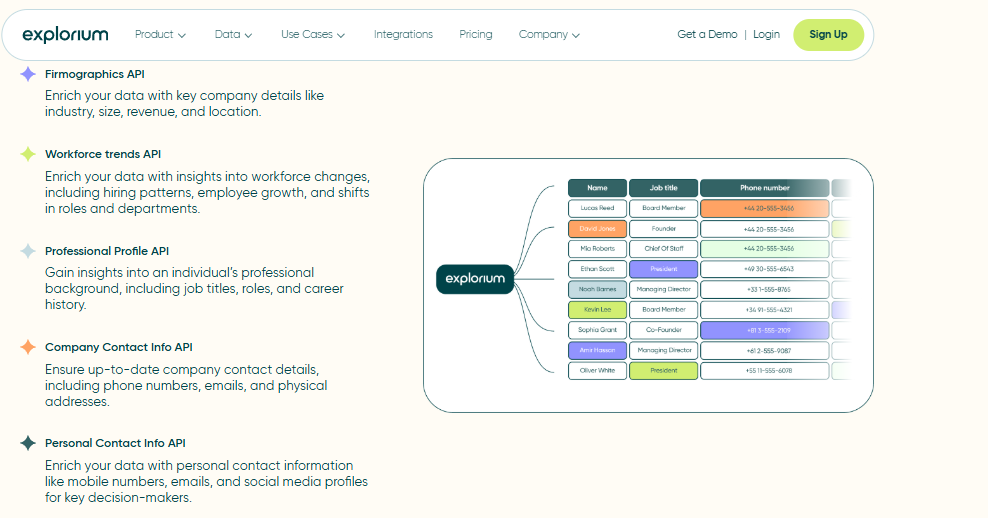
Explorium is an agent-native B2B data layer that puts 50+ aggregated sources behind one API and one MCP server, so an agent, not a salesperson, decides what to fetch. Instead of selling you a UI to click through, it exposes Person Search, Enrichment, and Identify through one schema with a single credit pool. That design exists because the next buyer of a data call is an LLM running inside a workflow, not a rep exporting a CSV.
⏰ Overview & Time to First Call
In our experience running enrichment for teams like Clay, Cognism, and Outreach, the unlock is consolidation: one connection replaces nine. You stop wiring five APIs, paying five bills, and writing five matching layers.
⏰ Time to first API call: UI: minutes. API: ~30 minutes with the SDK.
⚙️ Setup complexity: Low to medium (one integration, one credit system).
✅ Core Services
- Unified Person Search, Enrichment, and Identify endpoints across 50+ sources
- Native MCP server so agents select the right tool autonomously
- Unified credit pool spanning 30+ enrichments (firmographic, technographic, intent, hiring, and funding)
- Sync-ready API tested for high-volume workloads (10K+ calls/day)
- Native integrations with Outreach, Salesforce, HubSpot, and Snowflake
📊 Data Coverage & Field Depth
Strong in: company enrichment, multi-source resolution, and cross-signal coverage.
Weak in: single-narrow-signal use cases where a specialist at raw scale may suffice.
Field depth: wide. Firmographic, technographic, intent, hiring, and funding signals resolve into one schema.
Confidence Level: High for company data; our published company-enrichment match rates lead on fields like NOE, Website URL, and NAICS against ZoomInfo, Apollo, and Clearbit.
🤖 API & Agent Readiness
API availability: Yes, REST plus SDKs.
API depth: High (search, enrich, identify, and bulk).
MCP compatibility: Yes, native. The agent decides what to fetch.
Agent usability: High. The MCP layer is observable and auditable, not a black box.
This is where UI-first platforms struggle. When an agent has to orchestrate nine fragmented sources, it pulls a lot of data that is irrelevant to the task, which slows the first useful response. A unified layer removes that overhead.
💰 Pricing & Cost Structure
Pricing Model: Unified credit pool across 30+ enrichments; custom plans.
Published Pricing: Custom. Contact sales; a free tier is available to start testing.
💸 Cost Interpretation: You spend from one pool, so a mobile lookup and a firmographic enrich draw the same credits. That avoids the multi-pool sprawl where exports bill separately from unlocks.
Billing driver: Pooled credits, not seats.
⚠️ Hidden Costs & Constraints: Custom-plan mechanics are quoted per use case. Resale rights and search preview are available on custom plans, which most providers do not offer.
✅❌ When to Shortlist
Shortlist this if:
- You are building agent-native enrichment and want one MCP endpoint
- You want to collapse a 15-to-25 vendor stack into one credit pool
- You need company-enrichment match-rate leadership backed by reproducible benchmarks
Avoid this if:
- You only need one narrow signal and a specialist at raw scale already covers it
- You want a click-only UI with zero engineering involvement
💬 Customer Reviews
“The richness and breadth of data is incredible. I really like the instant access to the most useful and reliable external data. The platform is very easy to use and extremely versatile.”
Ishi N., Enterprise Explorium G2 Verified Review
“Explorium is a great tool for getting data from multiple subscriptions, databases but at a consolidated cost. Depending on where the data is coming from, the data can often be mismatched or have outdated information. It is best to cross-reference the output data.”
Omar G., Mid-Market Explorium G2 Verified Review
2. People Data Labs [toc=1.2 People Data Labs]
People Data Labs (PDL) is a developer-first data provider that sells access to a large person and company dataset through clean APIs, not a prospecting UI. It is built for engineers who want to query raw records and build their own enrichment logic on top. PDL is where you go when you need scale and schema control more than a polished interface.
⏰ Overview & Time to First Call
PDL’s Person Search API lets you query the full Person Dataset by any schema field, like job title, company, location, or skills, and returns matching profiles. In plain terms, it is a database you rent by the call, not a tool you log into. That is its strength for builders and its limitation for non-technical teams.
⏰ Time to first API call: UI: not the focus. API: ~30 to 60 minutes with the docs.
⚙️ Setup complexity: Medium (developer-oriented, schema-heavy).
✅ Core Services
- Person Search across 800M+ profiles by any schema field
- Person Enrichment for a known identifier
- Person Identify to resolve the correct record
- Company Enrichment and Search endpoints
- Bulk endpoint for high-volume jobs
📊 Data Coverage & Field Depth
Strong in: raw contact scale, developer flexibility, and US professional coverage.
Weak in: turnkey workflows, and reliability of account access per recent reviews.
Field depth: very wide. PDL exposes 200+ data points across the Person Schema.
Confidence Level: Medium to high on coverage; PDL self-reports roughly 95% email and 90% phone accuracy, which is a vendor claim you should test on your own list.
🤖 API & Agent Readiness
API availability: Yes, full REST with Python, JS, and Go SDKs.
API depth: High (search, enrich, identify, and bulk).
MCP compatibility: Not native today.
Agent usability: Medium. The API is clean, but you build the resolution and dedup layers yourself.
In our experience, PDL genuinely wins on contact-info coverage in some segments, and we will say that plainly. The trade-off is that you wire the matching, dedup, and freshness logic, which is engineering time most lean teams underestimate. When that trade-off no longer pays off, our guide on how to migrate a B2B data enrichment provider without downtime walks through the switch.
💰 Pricing & Cost Structure
Pricing Model: Usage-based with custom enterprise plans.
Published Pricing: Custom. A free tier with limited monthly credits is available to start.
💸 Cost Interpretation: You pay per API call and per record returned, so cost scales with volume. For a deeper breakdown, see our take on credit-based versus subscription pricing for B2B data APIs.
Billing driver: API calls and records.
⚠️ Hidden Costs & Constraints: Detailed cost mechanics are not fully transparent pre-contract. Recent reviews flag abrupt account changes, so confirm billing and access terms in writing.
✅❌ When to Shortlist
Shortlist this if:
- You have engineers who want raw dataset access and schema control
- You need contact scale and will build your own enrichment logic
- You want a bulk endpoint for large batch jobs
Avoid this if:
- You need a no-code workflow or a native MCP agent layer
- You want one unified credit pool instead of building dedup yourself
💬 Customer Reviews
“Product was useful while it worked which wasn’t long. Switched from free trial to paid plan $100/month. After a few days, account disabled with no warning or explanation. Support unresponsive after multiple contact attempts, even after waiting 1 week.”
Verified User, Computer Software People Data Labs G2 Verified Review
“Data was ok but payment system is a scam. Very hard to get off their hook once signed up.”
Glissando AI People Data Labs Trustpilot Verified Review
3. Apollo [toc=1.3 Apollo]
Apollo is a bundled GTM platform that combines contact discovery, enrichment, and outreach in one UI. It is a workflow layer for sales teams, not a pure data API. The trade-off shows up the moment you try to run it inside an agent instead of clicking through screens.
⏰ Overview & Time to First Call
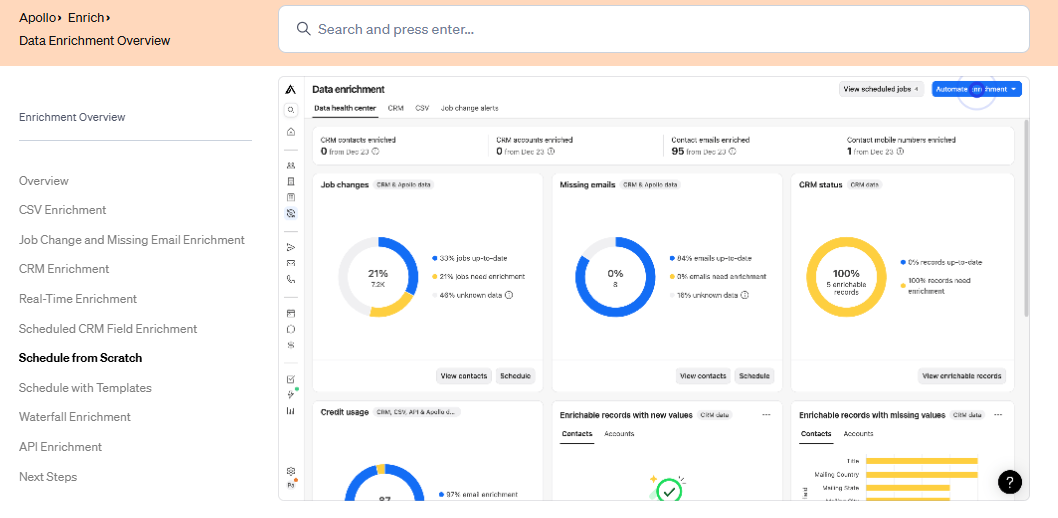
Apollo holds roughly 275M contacts and has been the go-to prospecting database for years. Time to value via the UI is fast; the API takes more setup and tends to throttle at volume.
⏰ Time to first API call: UI: instant. API: ~30 to 60 minutes.
⚙️ Setup complexity: Medium (UI-first, API-second).
✅ Core Services
- Contact and company database with advanced filtering
- Email and phone enrichment (credit-gated)
- Built-in outbound sequencing and CRM sync
- Intent signals and a LinkedIn Chrome extension
- REST API on higher tiers
📊 Data Coverage & Field Depth
Strong in: SaaS, funded startups, and mid-market tech contacts.
Weak in: non-tech SMBs and direct mobile accuracy, per reviews.
Field depth: moderate. Firmographics, contact data, and light intent.
Confidence Level: Medium (strong in SaaS, weaker elsewhere).
🤖 API & Agent Readiness
API availability: Yes. API depth: Moderate. MCP compatibility: Not supported. Agent usability: Medium.
I have tried Apollo via API and webhook, and found it so slow and consistently throttled that it was rarely worth it at scale. Its monthly seat-plus-credit billing also breaks bulk enrichment economics for agents. Teams hitting that ceiling often review Apollo API alternatives for AI agent builders before committing.
💰 Pricing & Cost Structure
Pricing Model: Seat-based subscription plus credits.
Published Pricing: Basic ~$49/user/mo; Professional ~$79 to $99/user/mo; Organization custom.
💸 Cost Interpretation: Revealing one email costs one credit, but mobile numbers cost eight credits each, and exports draw from a separate pool. Estimated cost per 1,000 contacts: ~$50 to $150.
Billing driver: Seats plus credits.
⚠️ Hidden Costs & Constraints: Credits deplete fast during campaigns; export limits and API access are tier-gated.
✅❌ When to Shortlist
Shortlist this if: you want all-in-one UI prospecting for SaaS outbound with minimal setup.
Avoid this if: you are building agent-native enrichment or need accurate non-tech data and clean bulk economics.
💬 Customer Reviews
“Easy to create persona, multiple filters, verified email option for low bounce rates, built-in CRM to track replies and calls. Lack of integrations only Zapier and some API. Support not helpful, no phone calls, chat only.”
Tejender K., Digital Marketing Executive Apollo G2 Verified Review
“Contact info frequently missing or incorrect. Half the day calling wrong/disconnected numbers. Mobiles frequently wrong. Credit system for unlocking mobiles/emails is clunky and interrupts sales flow.”
Verified User, IT Services Apollo G2 Verified Review
4. Clay [toc=1.4 Clay]
Clay is a no-code orchestration tool that runs enrichment waterfalls across many providers inside a spreadsheet-style UI. It is powerful for humans building lists, but its async, visual model fights autonomous agents.
⏰ Overview & Time to First Call
Clay shines when you chain providers and stop at the first valid result. The catch is that general Clay tables cap at 50,000 rows, which stalls large database enrichment. Our breakdown of waterfall enrichment explains where that pattern pays off and where it stalls.
⏰ Time to first call: UI: minutes. API: limited and async.
⚙️ Setup complexity: High (steep learning curve).
✅ Core Services
- Waterfall enrichment across 150+ integrations
- Built-in company and people search
- Claygent AI research agent
- CRM and tool automations
- Per-task credit consumption
📊 Data Coverage & Field Depth
Strong in: flexible multi-provider waterfalls and custom workflows.
Weak in: consistent contact quality, which varies by configuration.
Field depth: wide, but depends on the providers you wire in.
Confidence Level: Medium (quality varies by setup).
🤖 API & Agent Readiness
API availability: Limited. API depth: Async/visual. MCP compatibility: Not native. Agent usability: Low for autonomous agents.
Clay’s async pattern and plan throttles are the most-cited friction point for agent teams. The orchestration lives in the UI, so a human, not the agent, stays the orchestrator. Builders comparing options often look at Clay alternatives for a B2B data enrichment API.
💰 Pricing & Cost Structure
Pricing Model: Credit-based subscription.
Published Pricing: Tiered; custom at scale.
💸 Cost Interpretation: Per-row credit cost can vary up to 100% from stated amounts, per reviews.
Billing driver: Credits per enrichment action.
⚠️ Hidden Costs & Constraints: Rollover limits and dollar equivalents are not fully transparent; 3,000 free credits require a paid plan.
✅❌ When to Shortlist
Shortlist this if: you want flexible, human-run waterfalls and can absorb the learning curve.
Avoid this if: you need agent-native retrieval, predictable per-row pricing, or unlimited row counts.
💬 Customer Reviews
“Credit system is broken. Pricing is broken. Not fully transparent with rollover limit. Never helped when issues arose.”
Raphael A., Marketing Lead Clay G2 Verified Review
“Transformative for GTM operations and data enrichment. Deeply flexible and integrated with modern GTM toolstack. Per-row credit cost can vary 100% from stated amounts e.g., stated 11 credits/row, actual 25. Contact data quality varies wildly feels like a black box.”
Verified User, IT Services Clay G2 Verified Review
5. ZoomInfo [toc=1.5 ZoomInfo]
ZoomInfo is the largest proprietary B2B database for US enterprise sales teams. It leads on signal depth and brand recognition, but its API is rate-limited and its model is annual and enterprise-priced.
⏰ Overview & Time to First Call
ZoomInfo offers 103M+ company records and 839M+ employee records, with strong intent and an AI Copilot. Onboarding is enterprise-grade, meaning contracts and seats, not a quick free key.
⏰ Time to first call: UI: fast after onboarding. API: enterprise setup.
⚙️ Setup complexity: Medium to high.
✅ Core Services
- Large US company and contact database
- Intent data and ZoomInfo Copilot
- Direct dials and verified emails
- Deep CRM integrations
- Rate-limited REST API
📊 Data Coverage & Field Depth
Strong in: US enterprise firmographics, direct dials, and intent depth (signals depth scored 5.0).
Weak in: freshness (scored 1.8) and EU coverage.
Field depth: very wide on US enterprise.
Confidence Level: High for US enterprise, lower on freshness.
🤖 API & Agent Readiness
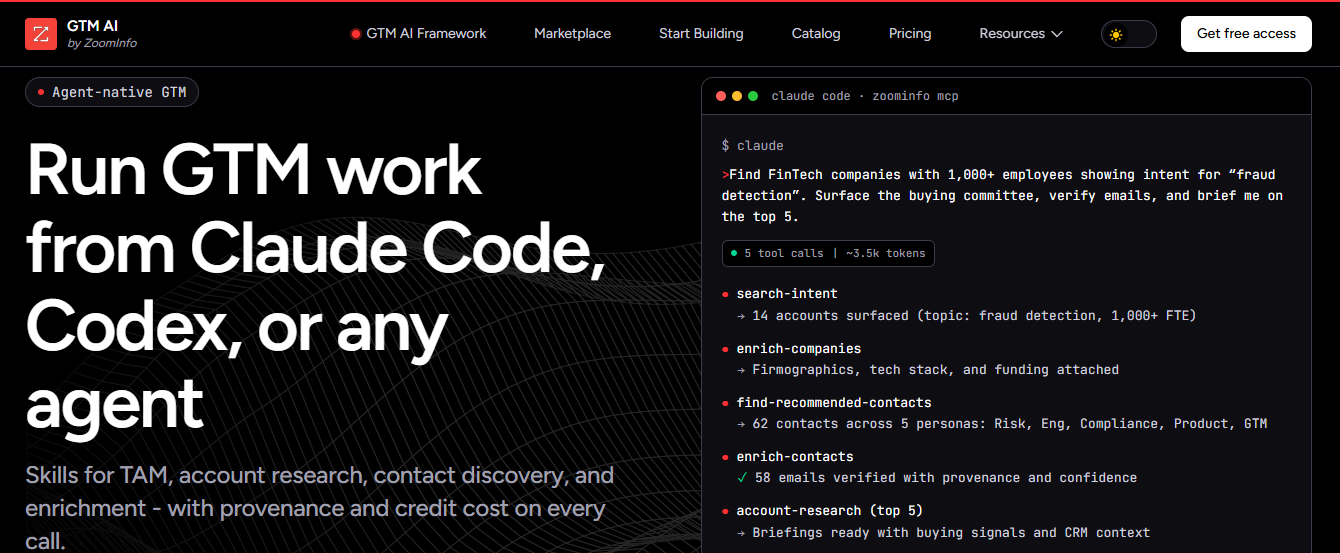
API availability: Yes. API depth: Moderate. MCP compatibility: Developer-assistance MCP only, not runtime data delivery. Agent usability: Medium.
ZoomInfo’s MCP is frequently misrepresented as runtime data delivery, when it is actually a server for writing integration code. Its rate limits force human-in-the-loop orchestration at agent scale. We cover this distinction in detail in our guide to MCP versus REST API for AI agents, and teams evaluating swaps review ZoomInfo API alternatives for GTM agent builders.
💰 Pricing & Cost Structure
Pricing Model: Enterprise annual contract.
Published Pricing: Custom; commonly $10k+/yr.
💸 Cost Interpretation: Annual seat commitments, not usage-based. Detailed mechanics are not transparent pre-contract.
Billing driver: Seats and annual contract.
⚠️ Hidden Costs & Constraints: Locked annual seats and tier-gated API access.
✅❌ When to Shortlist
Shortlist this if: you are a US enterprise sales team prioritizing intent depth and direct dials.
Avoid this if: you need usage-based pricing, fresh data, or true agent-native MCP retrieval.
💬 Customer Reviews
“The accuracy of contact information is second to none. ZoomInfo gives our sales team direct dials and verified emails that actually connect, and the intent data helps us prioritize which accounts to go after first.”
Verified Reviewer, Sales Development Manager ZoomInfo G2 Verified Review
“Locks annual seats. Data really limited and generally poor quality. Claims 90% mobile coverage but doesn’t deliver.”
Verified User ZoomInfo Trustpilot Verified Review
6. Cognism [toc=1.6 Cognism]
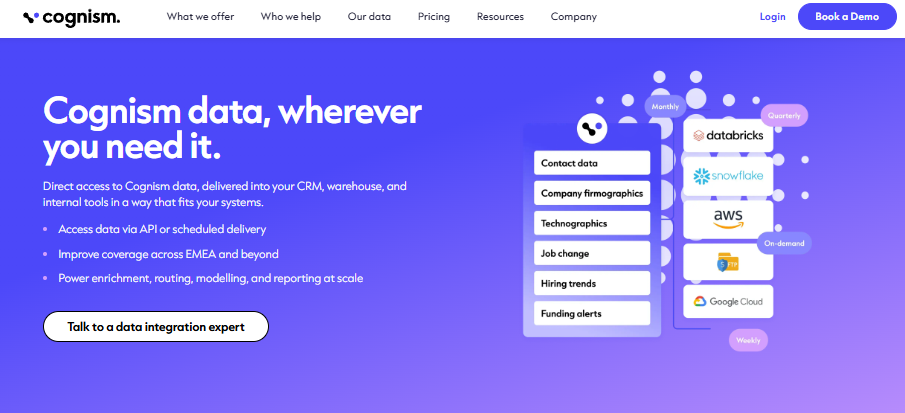
Cognism is a sales-intelligence platform known for GDPR-compliant EU contact data and phone-verified mobiles. It is strong on European outbound, but reviews question how much of its phone coverage is truly verified.
⏰ Overview & Time to First Call
Cognism markets Diamond Verified mobiles, numbers checked by multiple parties. Onboarding is contract-based, similar to other enterprise vendors.
⏰ Time to first call: UI: fast after onboarding. API: moderate setup.
⚙️ Setup complexity: Medium.
✅ Core Services
- EU and US contact data with phone verification
- Diamond Verified mobile numbers
- Intent data via Bombora
- CRM integrations
- REST API
📊 Data Coverage & Field Depth
Strong in: EU contacts and GDPR posture.
Weak in: verified mobile depth (Diamond Verified is under 10% of phone coverage per reviews).
Field depth: moderate, contact-focused.
Confidence Level: Medium.
🤖 API & Agent Readiness
API availability: Yes. API depth: Moderate. MCP compatibility: Not native. Agent usability: Medium.
I will give Cognism real credit on EU compliance positioning. The honest caveat from operators is that mobile accuracy outside the Diamond set is inconsistent. For teams that need verifiable posture across sources, our GDPR and CCPA compliance checklist sets the bar.
💰 Pricing & Cost Structure
Pricing Model: Annual contract / custom.
Published Pricing: Custom; contact sales.
💸 Cost Interpretation: Detailed cost mechanics are not fully transparent pre-contract.
Billing driver: Seats / annual contract.
⚠️ Hidden Costs & Constraints: Reviews flag 12-month commitments framed around quarterly terms.
✅❌ When to Shortlist
Shortlist this if: you run EU outbound and need a GDPR-first contact source.
Avoid this if: you need consistently verified mobiles at scale or agent-native MCP delivery.
💬 Customer Reviews
“Data is really limited and generally poor quality. Claims 90% mobile coverage in sales process but doesn’t deliver. Diamond Verified mobiles verified by multiple parties are less than 10%.”
Alex, AU Cognism Trustpilot Verified Review
“Shady sales tactics reference quarterly terms but sign you up to 12-month arrangement.”
Steven Musico, AU Cognism Trustpilot Verified Review
7. Clearbit (HubSpot Breeze) [toc=1.7 Clearbit / Breeze]
Clearbit, now HubSpot Breeze Intelligence, is an enrichment tool tuned for HubSpot-native teams. Its APIs are clean for small volumes, but coverage and refresh cadence draw consistent complaints.
⏰ Overview & Time to First Call
Clearbit enriches lead records with firmographics and reveals which accounts visit your site. Its self-service pricing works until you cross a limit and face a 4x jump.
⏰ Time to first call: UI: fast inside HubSpot. API: ~30 minutes.
⚙️ Setup complexity: Low to medium.
✅ Core Services
- Firmographic enrichment
- Web-visitor reveal
- HubSpot-native workflows
- REST enrichment API
- Job-title data for qualification
📊 Data Coverage & Field Depth
Strong in: HubSpot-native enrichment and identifying personal emails.
Weak in: refresh frequency and coverage depth; one reviewer found only 20% of known contacts.
Field depth: moderate, firmographic-led.
Confidence Level: Medium.
🤖 API & Agent Readiness
API availability: Yes. API depth: Moderate. MCP compatibility: Not native. Agent usability: Medium.
Clearbit is genuinely easy inside HubSpot. Outside that ecosystem, the monthly refresh and coverage gaps mean you cross-check in LinkedIn, which adds manual steps an agent should not need. A reliable company data API removes that manual loop.
💰 Pricing & Cost Structure
Pricing Model: Tiered, bundled into HubSpot.
Published Pricing: Self-service tiers; Clearbit X requires a yearly agreement.
💸 Cost Interpretation: Self-service limits jump sharply to a 4x plan with little middle ground.
Billing driver: Tier / enrichment volume.
⚠️ Hidden Costs & Constraints: Yearly commitment for higher tiers; no trial on Clearbit X.
✅❌ When to Shortlist
Shortlist this if: you live in HubSpot and want native enrichment plus visitor reveal.
Avoid this if: you need frequent refresh, deep coverage, or agent-native retrieval outside HubSpot.
💬 Customer Reviews
“Easy-to-use APIs. Good self-service pricing for small-medium volumes. Once over self-service limit, must jump to 4x plan, no room to grow realistically. Clearbit X requires yearly agreement with no trial.”
Dan T., Mid-Market Clearbit G2 Verified Review
“Company data doesn’t refresh often enough. Only 20% of known contacts could be found including people at companies for 1 year.”
Verified User, Internet Clearbit G2 Verified Review
8. RocketReach [toc=1.8 RocketReach]
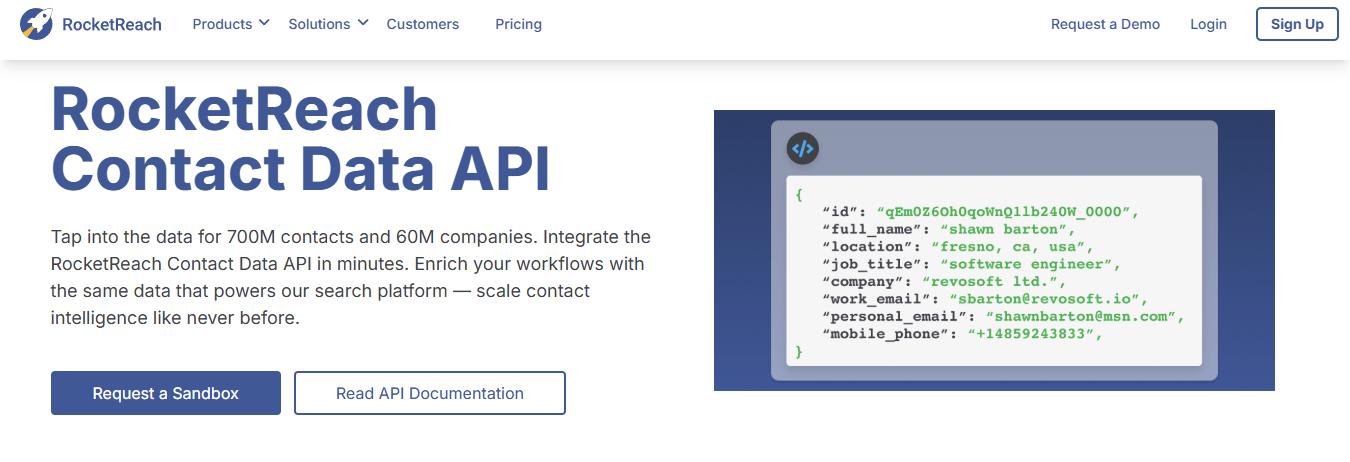
RocketReach is an affordable email and phone lookup tool popular with individual prospectors and recruiters. It rates 4.4 stars across 1,368 G2 reviews, but it is a single-signal contact finder, not an agent data layer.
⏰ Overview & Time to First Call
RocketReach pairs a browser extension with a simple API for quick contact lookups. It is fast to start and cheap to enter.
⏰ Time to first call: UI: instant. API: ~30 minutes.
⚙️ Setup complexity: Low.
✅ Core Services
- Email and phone lookup
- LinkedIn integration and browser extension
- Bulk lookups
- REST API
- CRM exports
📊 Data Coverage & Field Depth
Strong in: broad email coverage and quick verified contact finds.
Weak in: deep firmographic and multi-signal enrichment.
Field depth: narrow, contact-focused.
Confidence Level: Medium.
🤖 API & Agent Readiness
API availability: Yes. API depth: Moderate. MCP compatibility: Not native. Agent usability: Medium-low.
RocketReach is a fine single-purpose lookup. To power an agent, you would still wire firmographics, intent, and dedup from elsewhere, which is the integration sprawl this article keeps flagging. A single data layer for autonomous outbound AI agents collapses that sprawl.
💰 Pricing & Cost Structure
Pricing Model: Per-credit subscription.
Published Pricing: Entry around $39/mo.
💸 Cost Interpretation: Lookups consume credits; cost scales with volume.
Billing driver: Credits / lookups.
⚠️ Hidden Costs & Constraints: Credit caps and tiered export limits.
✅❌ When to Shortlist
Shortlist this if: you want cheap, fast contact lookups for recruiting or light outbound.
Avoid this if: you need multi-signal enrichment or agent-native MCP retrieval.
💬 Customer Reviews
“RocketReach makes it easy to find verified contact information quickly. Its integration with LinkedIn and browser extension makes outreach seamless.”
Verified G2 Reviewer RocketReach G2 Verified Review
“RocketReach allows me to find experts and has benefitted my career. People often say Gary can find anyone.”
Verified User RocketReach G2 Verified Review
9. ContactOut [toc=1.9 ContactOut]
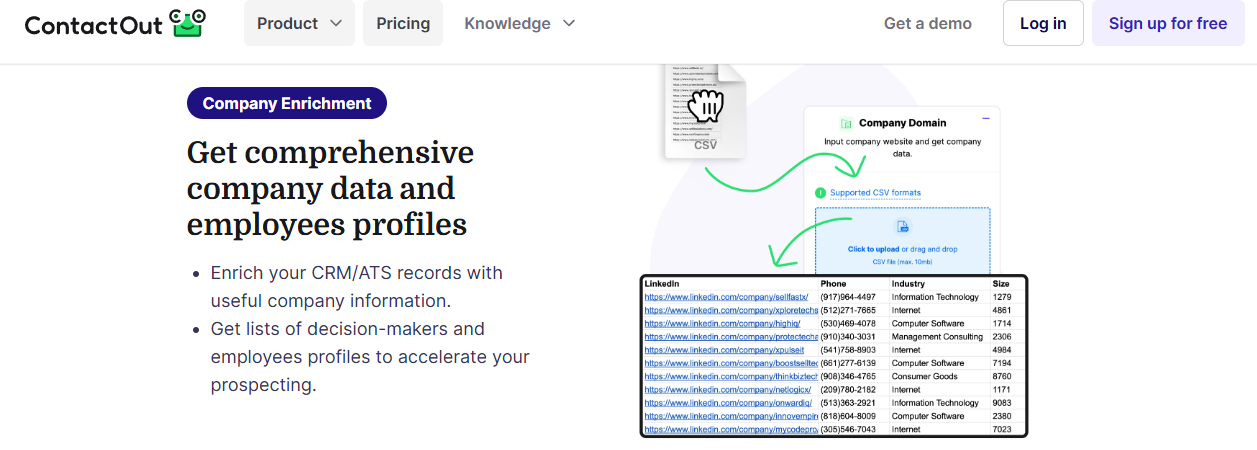
ContactOut is a contact finder trusted for LinkedIn prospecting and recruiting, with strong personal-email coverage. It claims up to 97% email accuracy via dual verification, refreshed every 15 days.
⏰ Overview & Time to First Call
ContactOut covers 300M+ professional profiles and leans on a LinkedIn-centric workflow. It is quick to start through the extension.
⏰ Time to first call: UI: instant. API: ~30 to 60 minutes.
⚙️ Setup complexity: Low to medium.
✅ Core Services
- Personal and work email lookup
- Phone number finding
- LinkedIn Chrome extension
- CRM/ATS enrichment
- REST API
📊 Data Coverage & Field Depth
Strong in: personal emails and recruiting use cases.
Weak in: broad firmographic and intent depth.
Field depth: narrow, contact-focused.
Confidence Level: Medium to high on email, lower on multi-signal.
🤖 API & Agent Readiness
API availability: Yes, with hourly data refresh. API depth: Moderate. MCP compatibility: Not native. Agent usability: Medium.
ContactOut is solid for recruiter-style reach. Like other single-signal tools, it leaves company, intent, and dedup work for you to assemble, so it is one of five integrations rather than a full layer. For hiring use cases specifically, see our B2B data API for recruiting automation agents.
💰 Pricing & Cost Structure
Pricing Model: Subscription.
Published Pricing: Entry around $99/mo.
💸 Cost Interpretation: Plan-based with lookup limits.
Billing driver: Seats / lookups.
⚠️ Hidden Costs & Constraints: Tier-gated API access and export limits.
✅❌ When to Shortlist
Shortlist this if: you recruit or prospect heavily on LinkedIn and need personal emails.
Avoid this if: you need a unified, multi-signal, agent-native data layer.
💬 Customer Reviews
“ContactOut is an excellent source of email addresses and phone numbers for our marketing operations. It helps us find verified leads without any inconveniences.”
Verified G2 Reviewer ContactOut G2 Verified Review
“The dashboard is clean, easy to navigate, and keeps my saved contacts organized. Overall, it’s a tool that genuinely reduces effort and makes outreach more efficient.”
Verified User ContactOut G2 Verified Review
10. Coresignal [toc=1.10 Coresignal]
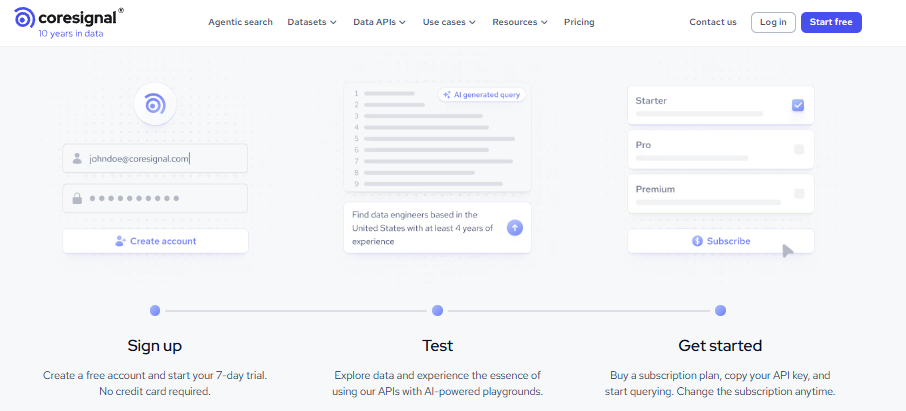
Coresignal is the largest publicly sourced B2B dataset for developers, offering raw company, employee, and job data with a real-time API. It is excellent for custom modeling and hiring signals, weaker on polished contact accuracy.
⏰ Overview & Time to First Call
Coresignal delivers 4,000+ data points globally, with monthly refresh plus a real-time scrape endpoint. It is built for data teams comfortable handling raw delivery.
⏰ Time to first call: UI: minimal. API: ~30 to 60 minutes.
⚙️ Setup complexity: Medium to high.
✅ Core Services
- Raw company and employee datasets
- Job postings and hiring signals
- Real-time profile API
- Bulk data delivery to warehouses
- Multi-source aggregation
📊 Data Coverage & Field Depth
Strong in: hiring signals, job postings, and raw data for custom modeling.
Weak in: phone/email contact accuracy and SDK polish.
Field depth: very wide on firmographic and employee history.
Confidence Level: High for hiring data, medium for contact.
🤖 API & Agent Readiness
API availability: Yes, REST plus real-time. API depth: High for raw data. MCP compatibility: Not native (no streaming push). Agent usability: Medium.
Coresignal wins on freshness and raw access for modeling. The trade-off is that you build the resolution, contact validation, and agent layer yourself. Teams that want hiring triggers without that overhead can use buying signals for AI sales agents instead.
💰 Pricing & Cost Structure
Pricing Model: Usage-based / custom.
Published Pricing: Affordable entry tiers for indie data teams.
💸 Cost Interpretation: Pay per dataset or API usage.
Billing driver: API calls / data volume.
⚠️ Hidden Costs & Constraints: Raw delivery means engineering overhead for cleanup and matching.
✅❌ When to Shortlist
Shortlist this if: you need fresh hiring signals and raw data for custom models.
Avoid this if: you need turnkey contact accuracy or native MCP agent retrieval.
💬 Customer Reviews
“The Coresignal team is incredibly pleasant and professional to work with.”
Verified G2 Reviewer Coresignal G2 Verified Review
Where Explorium Fits Across This List
Reading these ten profiles back to back, one pattern stands out: every UI-first platform forces a human to orchestrate, and every single-signal provider leaves you wiring four more tools behind it. ✅ Explorium unifies 50+ sources behind one API and one MCP server, so the agent decides what to fetch. ✅ Our company-enrichment match rates lead on fields like NOE, Website URL, and NAICS against ZoomInfo, Apollo, and Clearbit. ❌ Apollo’s eight-credit mobiles and ZoomInfo’s developer-only MCP fight agent workloads. ✅ One credit pool replaces nine bills, the way Snowflake consolidated the warehouse. ❌ PDL and Coresignal win on raw scale, but you still build the dedup and matching they leave behind. You can see how the unified approach works inside Explorium AgentSource.
Q2. How Did We Score These People Search APIs (and What Should You Evaluate)? [toc=2. Scoring Methodology]
We scored each people search API on five weighted criteria totaling 100 points: Data Coverage and Accuracy (25%), Agent and API Readiness (25%), Field and Filter Depth (20%), Commercial Model Transparency (15%), and User Reviews (15%). Tools earn 1 to 5 stars by band. Before scoring, know the three endpoints you pay for: Search finds candidates, Enrich completes a known person, and Identify resolves the right record. Confusing them burns credits fastest.
⚖️ The Weighted Rubric
The weights reflect how a GTM Engineer actually evaluates, not what looks impressive on a feature grid.
🤖 Why Agent Readiness Carries 25%
I weight Agent and API Readiness as heavily as raw coverage on purpose. The next buyer of a data call is an LLM, not a salesperson, so async APIs that fight agents score lower no matter how big the database. Star bands are simple: 5 stars (90 plus), 4 (75 to 89), 3 (60 to 74), and down. Explorium earns 5 stars here, and I will disclose that conflict openly rather than bury it. Our take on MCP versus REST API for AI agents explains why this weighting matters.
🔍 Search vs Enrich vs Identify (Plain English)
Think of one email address as your input. Search asks "who matches these filters?" and returns a list of candidates. Enrich takes one known person and fills in the rest of their profile. Identify resolves which record is truly the right one when several look similar.
The credit lesson is concrete. Separate discovery (Search) from resolution (Enrich/Identify) in your agent code, so you only spend credits resolving records you actually intend to act on. It is the same logic as an email-to-LinkedIn waterfall: as soon as one provider succeeds, you stop the rest, which saves money automatically. Our breakdown of credit-based versus subscription pricing goes deeper on this.
💬 What Reviewers Say About Methodology Trust
“The richness and breadth of data is incredible. I really like the instant access to the most useful and reliable external data.”
Ishi N., Enterprise Explorium G2 Verified Review
“Depending on where the data is coming from, the data can often be mismatched or have outdated information. It is best to cross-reference the output data from other enriched information.”
Omar G., Mid-Market Explorium G2 Verified Review
At Explorium, our 5-star result comes from one schema exposing Search, Enrich, and Identify across 50+ aggregated sources, all drawing from one credit pool. The agent picks the endpoint, so you stop paying nine bills to run one workflow. You can see how this works inside the Explorium AgentSource toolkit.
Q3. How Deep Are the Filters, and Which Ones Are Just Fluff? [toc=3. Filter Depth]
Filter depth ranges from a handful of fields to 200 plus queryable attributes (PDL) and 300 plus data points (The Companies API). But depth only matters if filters drive list-building. Firmographics, role and seniority, location, and verified contactability move revenue. Many "advanced" intent, funding, and technology-score filters are fluff that look advanced but rarely change who you reach. Score filter depth by usable fields, not total count.
🧮 More Filters Is Not Better Data
Most teams think a longer filter menu means better targeting. The standard read gets this backwards. From what surfaces when you actually run these queries at scale, roughly four field families carry the load: firmographics, seniority, geography, and contactability.
Everything else, the buying-intent scores, the education filters, and the speculative technology signals, is often noise. It bloats the platform and the demo without lifting pipeline. I might be wrong for a few niche plays, but the pattern holds across most GTM motions. Our guide on how to identify your ICP and prioritize optimal leads focuses on exactly those load-bearing fields.
🛰️ When the Real Signal Isn’t in the Menu
Here is the moment that reframed filters for me. A staffing firm needed company headcount, and no data source had it accurately. So they counted parking spots from satellite images with AI, because car-count predicted headcount better than any listed field.
The lesson sticks. The filter that wins is sometimes one no vendor exposes, which means filter depth should be judged on usable signal, not raw field count. Rich firmographic data resolved into one schema beats a longer menu of speculative scores.
📊 Filter Depth, Scored by Usable Fields
Explorium’s depth comes from breadth, 50 plus aggregated sources resolved into one schema, with the agent composing filters at query time rather than scrolling a longer list of speculative scores. Our guide to filtering and enriching search results shows how that plays out in practice.
Q4. Which People Search API Has the Highest Match Accuracy, Coverage, and Freshness? [toc=4. Match Accuracy & Coverage]
No single-source people search API wins on accuracy, because single-source databases null on a large share of inputs, and match rate on one source typically sits below 85 to 90%. Waterfall, multi-source APIs query several providers per record and return the first verified result, pushing aggregate match from roughly 65% to 92%. Vendor-claimed "95% accuracy" is marketing. The only number that matters is your own match rate on a 500-row sample of real target accounts.
🪜 Why Single-Source Caps Out
We have tested this directly. A single provider returns nulls on a meaningful slice of any list, so its ceiling is fixed. Waterfall enrichment chains fall through providers in order and stop at the first verified hit, which is why aggregate match climbs into the 90s. Our explainer on waterfall enrichment walks through the mechanics.
PDL self-reports about 95% email and 90% phone accuracy on verified results. That is a vendor claim, not your result, and it says nothing about the records it never matched. The honest test is your own list, which is why we publish B2B data API match-rate benchmarks you can reproduce.
🥩 Accuracy Is Resolution, Not Raw Count
Picture enriching "Outback Steakhouse." Many providers return the parent holding company’s headcount, which is wrong for the location you care about. A multi-layered resolution step picks the correct child entity instead of the easy parent match.
This is the part competitors skip. Phone and email coverage and refresh cadence matter too, since 62% of business calls go unanswered and stale data quietly inflates bounce. Refresh ranges widely, from real-time scrapes to a 30-to-90-day industry norm, with a few providers refreshing weekly. Latency and freshness are exactly what we cover in B2B data API latency and performance in production.
🧪 A 4-Step Test You Can Run Monday
- Pull a 500-row sample of your real target accounts, not a vendor demo list.
- Send identical inputs to each API and log match rate, null rate, and bounce.
- Normalize cost to dollars per verified result, not list price.
- Pick on fill rate against your accounts, not on the brand or the claimed number.
💬 What Operators Report
“Contact info frequently missing or incorrect. Half the day calling wrong/disconnected numbers. Mobiles frequently wrong.”
Verified User, IT Services Apollo G2 Verified Review
“Data is really limited and generally poor quality. Claims 90% mobile coverage in sales process but doesn’t deliver. Diamond Verified mobiles verified by multiple parties are less than 10%.”
Alex, AU Cognism Trustpilot Verified Review
Explorium resolves across 50 plus sources with a multi-layered match step, the same logic that fixes the Outback parent-child problem, which is why our company-enrichment match rates lead rather than hit a single-source ceiling. The cost of skipping this test is a 4-to-6-week deliverability feedback loop spent guessing, which is why we built a data layer for autonomous outbound AI agents that resolves before it sends.
Q5. Is Using a People Search API GDPR and CCPA Compliant? [toc=5. GDPR/CCPA Posture]
Compliance depends on the vendor’s posture, not a badge on a blog. APIs built on publicly sourced professional data generally argue a lawful basis for B2B use, but "GDPR-compliant" is marketing unless backed by verifiable evidence: SOC 2 Type 2, ISO/IEC 27001, ISO/IEC 42001 AI governance, Data Privacy Framework (DPF) participation, do-not-call (DNC) screening, and a signed data processing agreement (DPA). Demand the certification number before approving any data source.
⚠️ Why "GDPR-Compliant" on a Blog Means Nothing
Lawful basis means a vendor has a legal reason to process personal data, often "legitimate interest" for B2B contacts. That argument can be sound, but a blog claim does not prove it.
You, the buyer, share liability as the data controller, the party deciding how data is used. If your vendor mishandles GDPR, regulators can hold you partly responsible, so the evidence has to survive procurement, not just a landing page. Our SOC 2 compliance guide for B2B data vendors shows what to verify first.
✅ The Evidence Checklist to Demand
Ask every provider for named, current proof, not adjectives. A strong posture looks concrete.
- SOC 2 Type 2: audited security controls over time
- ISO/IEC 27001:2022: information security management
- ISO/IEC 42001:2023: AI governance, increasingly relevant for agent data
- DPF participation: lawful EU-to-US and Swiss-US data transfer
- DNC screening and a signed DPA: before any production deployment
6sense is a useful benchmark here, because it actually publishes the stack: SOC 2 Type 2 across all five AICPA criteria, ISO/IEC 27001:2022, ISO/IEC 42001:2023, annual TRUSTe GDPR and CCPA validations, plus DPF participation. That is the bar. Most top organic rankers assert "compliant" and cite nothing. Our full GDPR and CCPA compliance checklist turns this into a procurement-ready list.
💡 Why This Ties Back to Deliverability
The compliance angle is also a hygiene angle. If your data is outdated, you land in spam, and if your contacts are wrong, you waste money reaching the wrong people.
I might be slightly cautious here, but my read is that compliance and freshness are the same discipline wearing two hats. At Explorium, we hold enterprise-grade certifications including ISO/IEC 27701, and we apply GDPR and CCPA posture once across all 50 plus aggregated sources, so you are not re-vetting nine vendors one at a time. Resale rights and search preview on custom plans make that posture auditable in procurement, not just claimed in a blog, which matters most when you weigh resale rights and licensing for what you build.
Q6. How Do People Search API Pricing Models Compare, and How Do You Normalize Them? [toc=6. Pricing & Cost-Per-Result]
People search API pricing splits into per-credit plans ($39 to $99/mo entry: RocketReach, Apollo, ContactOut), usage-based custom contracts (PDL, Coresignal), and enterprise annual deals ($10k+/yr ZoomInfo; roughly $40k to $55k/yr median for 6sense). The trap: some charge per call regardless of result, others only for verified results, and Apollo’s mobile numbers cost eight credits each. Normalize every quote to cost-per-verified-result against your own fill rate.
💰 Why List Prices Are Not Comparable
A "$49/month" sticker tells you almost nothing. Two vendors at the same price can differ 5x in what you actually pay per usable contact.
The reason is the billing driver: seats, credits, API calls, or exports. Until you convert to one unit, you are comparing apples to invoices. Our breakdown of credit-based versus subscription pricing for B2B data APIs covers each model in depth.
💸 The Credit-Model Trap
Apollo is the cleanest example. Revealing one email costs one credit, but a mobile number costs eight credits, and exporting draws from a separate export credit pool. So a "single" contact can quietly cost nine-plus credits across two pools.
By contrast, raw scraped leads can run near $1.50 per 1,000 with a tool like Apify, and Clay tables cap at 50,000 rows, so cost and scale ceilings vary wildly by model. Before signing, review what SLA terms to look for in a B2B data API contract.
🧮 Normalize to Cost-Per-Verified-Result
Here is the formula I would use Monday. Take the plan cost, divide by the number of verified results on your own sample, not the vendor’s demo list.
Cost per verified result equals total spend divided by verified matches on your accounts. A cheap plan with a 40% fill rate often costs more per usable contact than a pricier plan at 90%, which is exactly why we publish reproducible match-rate benchmarks.
💬 What Buyers Report on Pricing
“Credit system is broken. Pricing is broken. Not fully transparent with rollover limit. Never helped when issues arose.”
Raphael A., Marketing Lead Clay G2 Verified Review
“Removed a user from the plan but a task by that user kept running and consumed all credits. Happened twice. Bug cost $1000. Support refused responsibility. No refund.”
Amulya P. Apollo G2 Verified Review
Explorium runs one unified credit pool across 30 plus enrichments, with no separate export pool and no eight-credits-per-mobile surprise, which keeps cost-per-verified-result predictable as you scale. You can map spend against your own list inside the best B2B data enrichment API for AI agents.
Q7. Which People Search API Is Built for AI Agents, One MCP Layer or a Stack of Point-Tools? [toc=7. Agent & MCP Readiness]
Most people search APIs were built for humans clicking a UI, not agents calling tools. Agent readiness means a native MCP server, clean tool-use schemas, generous rate limits, low latency, and a scale-ready sync API, so the LLM, not a rep, decides what to fetch. Stitching point-tools (Apollo, Bombora, BuiltWith, Clay) multiplies credit pools and CSV friction. A unified layer collapses it. Explorium ships that MCP-native layer.
🤔 What Changes When the Buyer Is an LLM?
Here is the question I keep sitting with. When the thing requesting the next data call is an agent, not a salesperson, what should the data layer look like?
The honest answer reframes the whole stack. A rep tolerates clicking, exporting, and waiting. An agent in a loop does not, and throttling breaks it outright. Our guide on MCP versus REST API for AI agents unpacks why.
🐝 Why Point-Tool Stacks Break at Agent Scale
I have tried Apollo via API and webhook, and found it so slow and consistently throttled that it was rarely worthwhile. Apollo’s API caps at a fixed 200 requests per minute, with no smoothing across the window.
Fragmented systems also force agents to pull a lot of data irrelevant to the task, which burns latency and credits. Think of a multi-agent system like a bee colony: it only works if each agent fetches exactly what it needs, fast. That is the production reality we describe in B2B data API latency, rate limits, and performance.
🔌 MCP Is the USB-C Port for AI
The Model Context Protocol, the open standard Anthropic published in November 2024 on JSON-RPC 2.0, is effectively a universal socket for AI. Servers expose tools, resources, and prompts, and any client that speaks MCP can use them without a bespoke adapter.
That is the decision rule. If you are building agents, adopt one MCP-native, multi-source layer instead of wiring five REST tools, five bills, and five matching layers behind your agent. Our MCP v2 release shows how that retrieval works at scale.
💬 What Builders Report
“Transformative for GTM operations and data enrichment. Deeply flexible and integrated with modern GTM toolstack. Per-row credit cost can vary 100% from stated amounts. Contact data quality varies wildly feels like a black box.”
Verified User, IT Services Clay G2 Verified Review
“Explorium is a fast and effective platform that makes the integration and analysis of third-party data seamless.”
David A., CEO Explorium G2 Verified Review
Explorium is agent-native by design: one MCP server (installable from the Claude or ChatGPT Connectors directory) lets the agent decide what to fetch, backed by a sync API tested for scale and a unified credit pool across 50 plus sources. This is the layer that replaces the Apollo-plus-Clay-plus-PDL-plus-Bombora stack, and it is exactly where UI-first platforms and single-signal providers structurally cannot follow. You can see the unified toolkit inside Explorium AgentSource.
So here is what I am sitting with going into the next 18 to 24 months: as agents become the default buyers of data calls, does the per-seat, per-click pricing model survive at all? Tell us what you are building, and where your current stack breaks at scale.
FAQs


