

TL;DR
- Account enrichment APIs append firmographics, tech stack, funding, and intent to a company record; account-first resolves the whole entity, not one contact.
- Judge vendors on match accuracy (is the record correct?), not vendor-claimed match rate (did it return anything?), and test on known-good records.
- Single-source APIs return nulls on 20 to 40% of inputs; waterfall enrichment chains providers and stops at the first verified hit to maximize coverage.
- Headline pricing hides separate credit pools, where a mobile costs ~8 credits and exports draw a different pool, pushing real cost 2 to 3x the sticker.
- B2B data decays more than 3% monthly; top APIs refresh on a 7-day cycle versus the 30 to 90-day norm, and intent needs score decay.
- Agent-native means an LLM is the buyer, requiring an MCP server, high QPS, bulk-per-call, and predictable async behavior, not a UI clicker.
Q1. What Are the 11 Best Account Enrichment APIs for GTM in 2026? [toc=1. Best APIs Ranked]
The best account enrichment APIs for GTM in 2026 are Explorium, People Data Labs, Apollo, Clearbit (HubSpot Breeze), Cognism, Clay, ZoomInfo, Coresignal, Crust Data, Cleanlist, and Data Legion. Explorium leads for agent-native teams: one API, one MCP server, and one unified credit pool across 30+ enrichments aggregating 50+ sources, versus single-signal providers (PDL for contacts, Bombora for intent) and UI-first prospecting platforms (Apollo, ZoomInfo, Clay).
Why This List Exists, and the Problem It Solves
A GTM engineer at a Series-B sales-tech company once pinged me near midnight. His agent kept stalling mid-run, and his CRM showed one contact per account when the deal needed six.
That is the real pain. Most B2B purchases involve six to ten people. When your CRM shows one, your reps stop selling and start doing data entry, hunting emails and piecing together org charts by hand.
The tooling sprawl makes it worse. The average go-to-market stack now runs 15 to 25 vendors, and each one ships its own credit pool, its own match logic, and its own bill. That is the case for a single B2B data enrichment API for AI agents.
⚙️ How I’d Read This List
I rank these on numbers, not logos. My current read: match rate, freshness, and agent-readiness matter more than brand recognition for teams shipping production agents.
Two buyer lenses run through the whole list. The evaluator picks on accuracy, coverage, and cost. The builder picks on API depth, rate limits, and whether an LLM can call the tool without a human in the loop.
I will be fair to competitors. People Data Labs wins on raw contact-data scale in some segments, and Crust Data is genuinely cheaper for early-stage teams. Numbers beat adjectives, so I will show trade-offs, not just winners.
The 11 Best Account Enrichment APIs at a Glance
This table scores all 11 players. Stars come from the weighted rubric in the next section, where Explorium earns 5 stars on tested match-rate leadership in company enrichment (97.80% NOE, 97.80% website URL, 97.31% NAICS versus ZoomInfo, Apollo, Clearbit, and Experian).
🤖 The Column Most Listicles Skip
Notice the Agent/API readiness column. The standard read gets this backwards: most "best enrichment API" lists rank on database size and ignore whether an LLM can actually drive the call.
That gap matters now because the buyer of the next data call is increasingly an agent, not a salesperson. UI-first platforms force a human to orchestrate, which breaks the moment you scale past manual review. This is where the difference between MCP and a REST API for AI agents starts to matter.
I will detail each provider below, in order, with the same sections so you can compare apples to apples.
1. Explorium [toc=1.1 Explorium] ⭐⭐⭐⭐⭐
📋 Overview
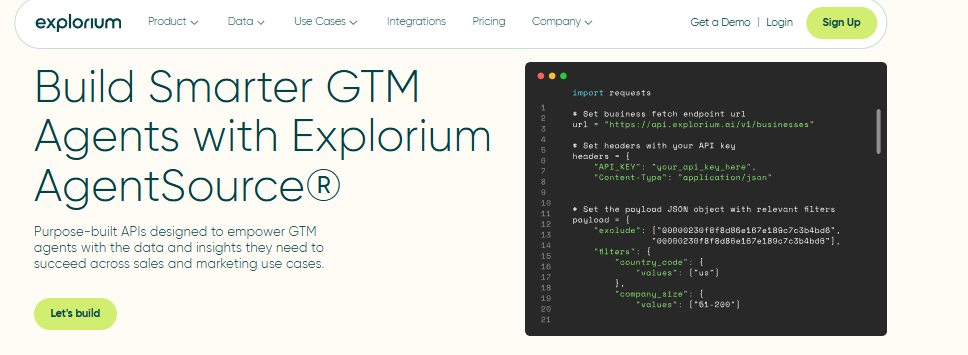
Explorium is an agent-native B2B data layer. In plain terms, it puts 50+ external data sources behind one API and one MCP server, so an agent can fetch firmographic, technographic, intent, hiring, and funding data from a single integration.
MCP, the Model Context Protocol, is Anthropic’s open standard that lets an AI tool call your APIs directly. Think of it as a USB-C port for AI: one socket, many sources, and the agent decides what to fetch.
We built it so routine enrichment scales without a human clicking through a UI. You wire one integration, draw from one credit pool, and let the agent select the right source per record.
⏰ Time to first API call:
- UI: ~minutes (search preview on custom plans)
- API call: ~15 to 30 minutes with key plus docs
⚙️ Setup complexity: Low to medium (API-first, MCP-native)
🛠️ Core Services
- Company and account enrichment across 150M+ company profiles
- 50+ aggregated sources behind one unified credit pool across 30+ enrichments
- MCP server so the agent, not a rep, decides what to fetch
- Sync-ready API built for 10K+ calls/day with native Salesforce, HubSpot, Snowflake, and Outreach integrations
- Resale rights and search preview on custom plans
📊 Data Coverage & Field Depth (Reality Check)
✅ Strong in: Company-level firmographics, multi-signal coverage (firmographic, technographic, intent, hiring, and funding), and entity resolution across sources.
❌ Weaker in: Pure person-level contact volume in some niche segments, where a specialist like PDL can edge ahead. I could be off here, but that is what surfaces when you actually run both side by side.
Field depth: Deep. One call returns aggregated attributes that would otherwise need five separate vendors.
Confidence Level: High on company enrichment. Our published benchmarks show 97.80% NOE, 97.80% website URL, and 97.31% NAICS match rates versus ZoomInfo, Apollo, Clearbit, and Experian.
🤖 API & Agent Readiness
- API availability: Yes, REST plus MCP server
- API depth: High, 30+ enrichments from one integration
- MCP compatibility: Yes, native, the agent selects the tool
- Agent usability: High, 100 QPS synchronous enrichment built for production loops
When we cut an outbound agent’s credit burn by switching from per-vendor billing to one pooled credit system, the win was not just cost. The agent stopped wasting calls joining fragmented data across five APIs, which is where so much agent latency quietly hides.
💰 Pricing & Cost Structure
Pricing Model: Usage-based with one unified credit pool (Custom enterprise plans available)
Published Pricing: Custom / contact sales (free preview available on custom plans)
💸 Cost Interpretation (What You Actually Pay):
- Billing driver: API calls and credits drawn from a single pool, not nine separate vendor bills
- Free credits / trial: Search preview on custom plans
- One bill beats nine, which is the whole point of consolidating the stack
⚠️ Hidden Costs & Constraints:
- Headline pricing is custom, so detailed per-record mechanics are scoped per contract
- One pooled credit system removes the multi-vendor credit-pool gotchas common elsewhere
✅ When to Shortlist
Shortlist this if:
- You are building agent-native enrichment workflows and want MCP retrieval
- You run high-volume enrichment (10K+ calls/day) and need sync-ready scale
- You want to consolidate a 15-to-25-vendor stack into one API and one credit pool
❌ Avoid this if:
- You only need a tiny one-off list and never plan to call an API
- Your single need is raw person-level contact volume in a niche segment a specialist covers better
💬 Customer Reviews
“Explorium is a fast and effective platform that makes the integration and analysis of third-party data seamless. Their lead enrichment still has a long way to go, but the results so far are promising.”
David A., CEO, Mid-Market Explorium G2 Verified Review
“The richness and breadth of data is incredible. I really like the instant access to the most useful and reliable external data. Given the large amount of data, the platform can be a bit confusing for the first few times you use it.”
Ishi N., Enterprise Explorium G2 Verified Review
“Explorium is thr only platform I have seen in market that has a consistent journey to explore, experiment and inplement external data at scale.”
Verified User Explorium Gartner Peer Insights Verified Review
2. People Data Labs [toc=1.2 People Data Labs] ⭐⭐⭐⭐
📋 Overview
People Data Labs, usually shortened to PDL, is a data-as-an-API company. It sells raw person and company records through a developer-first REST API, rather than a prospecting UI.
In reality, PDL is a building block, not a finished workflow. You query it programmatically and assemble your own enrichment, scoring, and CRM-sync layers on top.
That suits engineering teams who want raw coverage and full control. It suits non-technical RevOps teams far less, since there is no point-and-click surface.
⏰ Time to first API call:
- UI: Limited (developer dashboard, not a prospecting UI)
- API call: ~30 to 60 minutes with key plus docs
⚙️ Setup complexity: Medium (API-first, you build the layers)
🛠️ Core Services
- Large-scale person dataset for contact enrichment
- Company dataset for firmographic lookups
- Bulk and single-record REST endpoints
- Identity resolution on email, name, and company inputs
- Raw data licensing for teams building their own pipelines
📊 Data Coverage & Field Depth (Reality Check)
✅ Strong in: Raw person-data scale and contact coverage in some segments, which is where PDL genuinely wins over broader platforms.
❌ Weaker in: Finished firmographic workflows, deduplication, and account-level resolution, since you build those yourself. Coverage can also vary by region.
Field depth: Wide on person attributes, lighter on aggregated multi-signal account context.
Confidence Level: Medium to high on contacts, lower on out-of-the-box account enrichment.
🤖 API & Agent Readiness
- API availability: Yes, developer-first REST
- API depth: High on person and company endpoints
- MCP compatibility: Not natively supported
- Agent usability: Medium, the API is callable but lacks an MCP layer, so the agent cannot natively select the tool
From what surfaces when you actually wire PDL into an agent, you end up writing your own matching and QA layer. That is fine if you have engineers to spare, and a tax if you do not. Many teams compare this against a managed business enrichment API before committing.
💰 Pricing & Cost Structure
Pricing Model: Usage-based, per-record credits
Published Pricing:
- Free tier: Limited trial credits
- Paid: Reported entry around $100/month, scaling with usage
- Enterprise: Custom
💸 Cost Interpretation (What You Actually Pay):
- Billing driver: API calls and per-record credits
- Free credits / trial: Yes, limited
- You pay per record, so cost tracks volume directly
⚠️ Hidden Costs & Constraints:
- Account standing can change quickly; one verified reviewer reported an abrupt paid-account disablement
- Detailed enterprise mechanics are scoped pre-contract
✅ When to Shortlist
Shortlist this if:
- You are an engineering team wanting raw person data via API
- You need contact-level scale and will build your own enrichment layers
- You want data licensing rather than a finished UI
❌ Avoid this if:
- You need account-level enrichment and dedupe out of the box
- You want native MCP retrieval so an agent selects the source
- You lack engineers to build matching and QA on top
💬 Customer Reviews
“Product was useful while it worked which wasnt long. Switched from free trial to paid plan $100/month. After a few days, account disabled with no warning or explanation. Support unresponsive after multiple contact attempts, even after waiting 1 week.”
Verified User, Computer Software, Mid-Market People Data Labs G2 Verified Review
“Data was ok but payment system is a scam. Very hard to get off their hook once signed up.”
Glissando AI People Data Labs Trustpilot Verified Review
3. Apollo [toc=1.3 Apollo] ⭐⭐⭐
📋 Overview
Apollo is a bundled GTM platform, not a pure data API. It combines a contact and company database, enrichment, and outbound sequencing into one UI-first system.
In reality, Apollo wants to be the workflow layer where a rep prospects and sends, all in one tab. The API exists, but it sits behind the UI rather than leading. Builders evaluating Apollo API alternatives for AI agent builders usually hit this wall first.
That bundling helps small teams without data engineers. It works against builders who want clean, agent-driven enrichment at scale.
⏰ Time to first API call:
- UI: Instant
- API call: ~30 to 60 minutes
⚙️ Setup complexity: Medium (UI-first, API-second)
🛠️ Core Services
- Contact and company database with advanced filtering
- Email and phone enrichment
- Built-in outbound sequencing
- Salesforce and HubSpot integrations
- Chrome extension for LinkedIn prospecting
📊 Data Coverage & Field Depth (Reality Check)
✅ Strong in: SaaS, funded startups, and mid-market contact discovery.
❌ Weaker in: Non-tech SMBs, founder-level accuracy in niche sectors, and direct mobile coverage in lower tiers.
Field depth: Moderate to wide on firmographics and contacts, lighter on technographics and intent.
Confidence Level: Medium (strong in SaaS, weaker in SMB and traditional sectors).
🤖 API & Agent Readiness
- API availability: Yes
- API depth: Moderate (contact and company endpoints)
- MCP compatibility: Not supported
- Agent usability: Medium, and rate-limiting bites at scale
From what surfaces when you actually run Apollo via API and webhook, it throttles. A practitioner I trust gave up and went back to manual CSV exports because the API was too slow to be worthwhile.
💰 Pricing & Cost Structure
Pricing Model: Seat-based subscription plus credit usage
Published Pricing:
- Basic: ~$49/user/month
- Professional: ~$79 to $99/user/month
- Organization: Custom
💸 Cost Interpretation (What You Actually Pay):
- Estimated cost per 1,000 contacts: ~$50 to $150
- Free tier: Yes, limited credits
- Billing driver: Per seat plus per credit, so you pay for access AND usage
⚠️ Hidden Costs & Constraints:
- One email reveal costs one credit; a mobile number costs eight
- Exporting to CSV or CRM draws from a separate export credit pool
- API access is gated to higher tiers
- Monthly billing breaks bulk enrichment economics for agents
✅ When to Shortlist
Shortlist this if:
- You want an all-in-one prospecting platform with minimal setup
- Your focus is SaaS or tech outbound
- You value speed over data-infrastructure flexibility
❌ Avoid this if:
- You are building agent-native enrichment systems
- You need accuracy across non-tech industries
- You want fully usage-based, scalable pricing
💬 Customer Reviews
“Easy to create persona, multiple filters, verified email option for low bounce rates. Lack of integrations only Zapier and some API. Support not helpful, no phone calls, chat only.”
Tejender K., Digital Marketing Executive Apollo G2 Verified Review
“Contact info frequently missing or incorrect. Half the day calling wrong/disconnected numbers. The credit system for unlocking mobiles/emails is clunky and interrupts sales flow.”
Verified User, IT Services Apollo G2 Verified Review
4. Clearbit (HubSpot Breeze) [toc=1.4 Clearbit] ⭐⭐⭐
📋 Overview
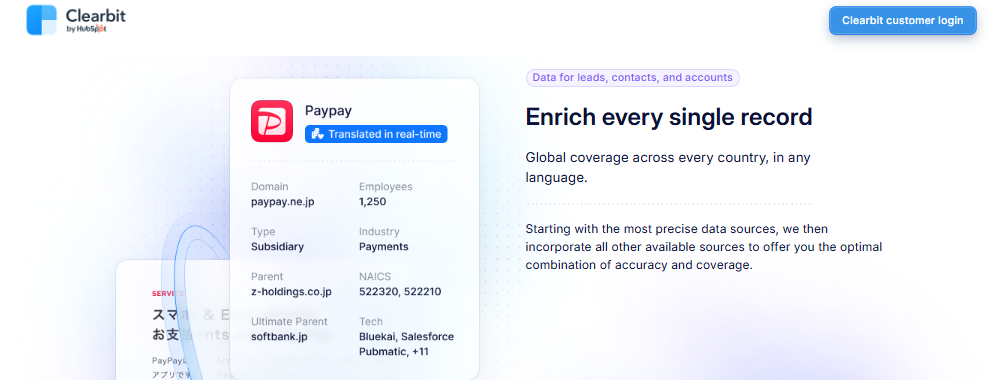
Clearbit, now folded into HubSpot as Breeze Intelligence, is a firmographic and web-intent enrichment tool. It shines for teams already living inside HubSpot.
In reality, its strongest pull is the in-CRM experience: enrich a new lead, see job-title data, and watch which accounts visit your site via Reveal.
The trade-off is independence. Once it is bundled into HubSpot, it works best there and less well as a neutral, standalone API.
⏰ Time to first API call:
- UI: Instant inside HubSpot
- API call: ~30 to 45 minutes
⚙️ Setup complexity: Low to medium (best inside HubSpot)
🛠️ Core Services
- Company firmographic enrichment
- Web-intent via Reveal (de-anonymizes site visitors)
- Lead enrichment on form fills
- Easy-to-use REST APIs
- Native HubSpot data sync
📊 Data Coverage & Field Depth (Reality Check)
✅ Strong in: Tech-company firmographics and self-serve API for small to medium volumes.
❌ Weaker in: Refresh frequency and contact completeness; reviewers flag stale company data.
Field depth: Solid firmographics plus web intent, lighter on contact and mobile.
Confidence Level: Medium, with refresh as the recurring complaint.
🤖 API & Agent Readiness
- API availability: Yes
- API depth: Moderate (firmographic and intent)
- MCP compatibility: Not supported
- Agent usability: Medium, but the HubSpot bundling narrows independent agent use
My current read: Clearbit is excellent glue inside HubSpot and a weaker fit when you want a vendor-neutral company data API your agent calls directly.
💰 Pricing & Cost Structure
Pricing Model: Bundled with HubSpot tiers (legacy self-serve plus enterprise)
Published Pricing: Custom / bundled with HubSpot
💸 Cost Interpretation (What You Actually Pay):
- Billing driver: HubSpot tier plus enrichment credits
- Free tier: Limited, tied to HubSpot
- Detailed cost mechanics are not fully transparent pre-contract
⚠️ Hidden Costs & Constraints:
- Self-serve limits jump steeply to enterprise plans
- Enterprise agreements can be yearly with limited trial
- Best value only realized inside HubSpot
✅ When to Shortlist
Shortlist this if:
- You are a HubSpot-native team
- You want in-CRM firmographic plus web-intent enrichment
- You value ease over multi-source depth
❌ Avoid this if:
- You need frequent firmographic refresh
- You want a vendor-neutral, agent-callable API
- You need deep contact and mobile coverage
💬 Customer Reviews
“APIs enrich new lead notifications with job title data for qualification. Reveal product shows which accounts visit your website. Not always accurate. Needs more frequent refresh.”
Brian Y., Head of Marketing Clearbit G2 Verified Review
“Easy-to-use APIs. Good self-service pricing for small-medium volumes. Once over self-service limit, must jump to 4x plan, no room to grow realistically.”
Dan T., Mid-Market Clearbit G2 Verified Review
5. Cognism [toc=1.5 Cognism] ⭐⭐⭐
📋 Overview
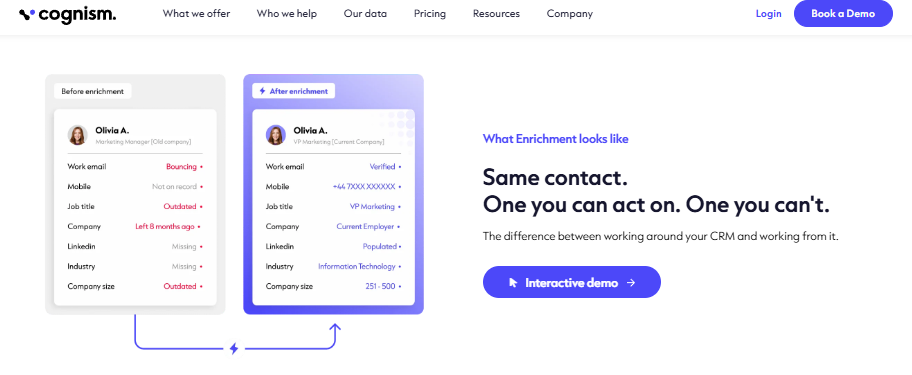
Cognism is a sales-intelligence platform built around compliant European contact data. It markets strong mobile coverage and GDPR-aligned sourcing.
In reality, it is a UI-first prospecting tool with an API attached, aimed at outbound teams targeting EMEA and the US.
The mobile-quality claim is contested. Several reviewers say verified mobiles fall short of the marketing.
⏰ Time to first API call:
- UI: Instant
- API call: ~30 to 60 minutes
⚙️ Setup complexity: Medium (UI-first)
🛠️ Core Services
- B2B contact and company data, EMEA focus
- Mobile-number enrichment
- Intent data via partnership
- CRM and sequencer integrations
- Compliance-led sourcing
📊 Data Coverage & Field Depth (Reality Check)
✅ Strong in: European company coverage and compliance posture.
❌ Weaker in: Mobile accuracy and depth, per multiple reviewers.
Field depth: Moderate firmographics plus contacts, with intent as an add-on.
Confidence Level: Medium, with contested mobile quality.
🤖 API & Agent Readiness
- API availability: Yes
- API depth: Moderate
- MCP compatibility: Not supported
- Agent usability: Medium, rate-limited and UI-first
I could be off here, but the architecture is built for a human in a UI, not an agent in a loop. That shows up the moment you push volume through the API, where API latency and rate limits in production become the real constraint.
💰 Pricing & Cost Structure
Pricing Model: Annual seat-based license
Published Pricing: Custom / contact sales
💸 Cost Interpretation (What You Actually Pay):
- Billing driver: Seats plus annual contract
- Free tier: No, demo-gated
- Detailed cost mechanics are not fully transparent pre-contract
⚠️ Hidden Costs & Constraints:
- Annual commitment common, even when quarterly terms are referenced
- Seat-based pricing limits agent-scale economics
- Add-ons for intent and extra credits
✅ When to Shortlist
Shortlist this if:
- You run EMEA-focused outbound
- You prioritize compliance-led sourcing
- You work primarily through a UI
❌ Avoid this if:
- You need agent-native, usage-based pricing
- You depend on high mobile accuracy
- You want to avoid annual lock-in
💬 Customer Reviews
“Poor data quality, no direct mobile numbers. Numbers either wrong or returns US HQ number even when searching European offices. Not worth the money.”
Jackie Cognism Trustpilot Verified Review
“Data is really limited and generally poor quality. Claims 90% mobile coverage in sales process but doesnt deliver. Diamond Verified mobiles are less than 10%.”
Alex Cognism Trustpilot Verified Review
6. Clay [toc=1.6 Clay] ⭐⭐⭐
📋 Overview
Clay is a spreadsheet-style enrichment and orchestration tool. Its signature feature is waterfall enrichment: chaining many providers so if one misses a field, the next is tried.
In reality, Clay is powerful and complex. It is a visual workspace where RevOps builds tables, not a clean API an agent calls.
That visual, async design is the catch. It is human-first by nature, which fights agent-scale automation.
⏰ Time to first API call:
- UI: ~minutes
- API call: Async, ~setup-heavy
⚙️ Setup complexity: High (flexible but steep)
🛠️ Core Services
- Waterfall enrichment across many providers
- AI research via Claygent
- Company and people search
- Hundreds of tool integrations
- Table-based workflow automation
📊 Data Coverage & Field Depth (Reality Check)
✅ Strong in: Multi-provider waterfall and flexible AI-driven enrichment.
❌ Weaker in: Cost transparency and consistency; contact quality varies by provider.
Field depth: As deep as the providers you wire, with extra credit cost per layer.
Confidence Level: Medium, with a noted black-box feel on contact data.
🤖 API & Agent Readiness
- API availability: Yes, but async and visual-first
- API depth: Moderate, orchestration-focused
- MCP compatibility: Not supported
- Agent usability: Low to medium, async API and a 50,000-row table limit cap large jobs
From what surfaces when you actually scale Clay, general tables hit a 50,000-row ceiling. To enrich an unlimited database, you move to headless, API-first infrastructure anyway, which is why teams explore Clay alternatives for a B2B data enrichment API.
💰 Pricing & Cost Structure
Pricing Model: Credit-based subscription
Published Pricing:
- Starter: ~$149/month
- Higher tiers scale with credits
💸 Cost Interpretation (What You Actually Pay):
- Billing driver: Per-row credits, variable by provider
- Free tier: Limited, 3,000 credits only on paid plans
- Per-row credit cost can drift far above the stated amount
⚠️ Hidden Costs & Constraints:
- Credits get consumed by wrong operations easily
- Rollover limits are not fully transparent
- Your own data provider can be cheaper than Clay’s chain
✅ When to Shortlist
Shortlist this if:
- You want flexible, multi-provider waterfalls in one UI
- Your RevOps team enjoys deep customization
- You run mid-size lists, not unlimited databases
❌ Avoid this if:
- You need clean, agent-callable API retrieval
- You want transparent, predictable credit costs
- You enrich beyond the 50,000-row table limit
💬 Customer Reviews
“Transformative for GTM operations and data enrichment. Per-row credit cost can vary 100% from stated amounts, e.g., stated 11 credits/row, actual 25. Contact data quality varies wildly, feels like a black box.”
Verified User, IT Services Clay G2 Verified Review
“Credit system is broken. Pricing is broken. Not fully transparent with rollover limit. Never helped when issues arose.”
Raphael A., Marketing Lead Clay G2 Verified Review
7. ZoomInfo [toc=1.7 ZoomInfo] ⭐⭐⭐
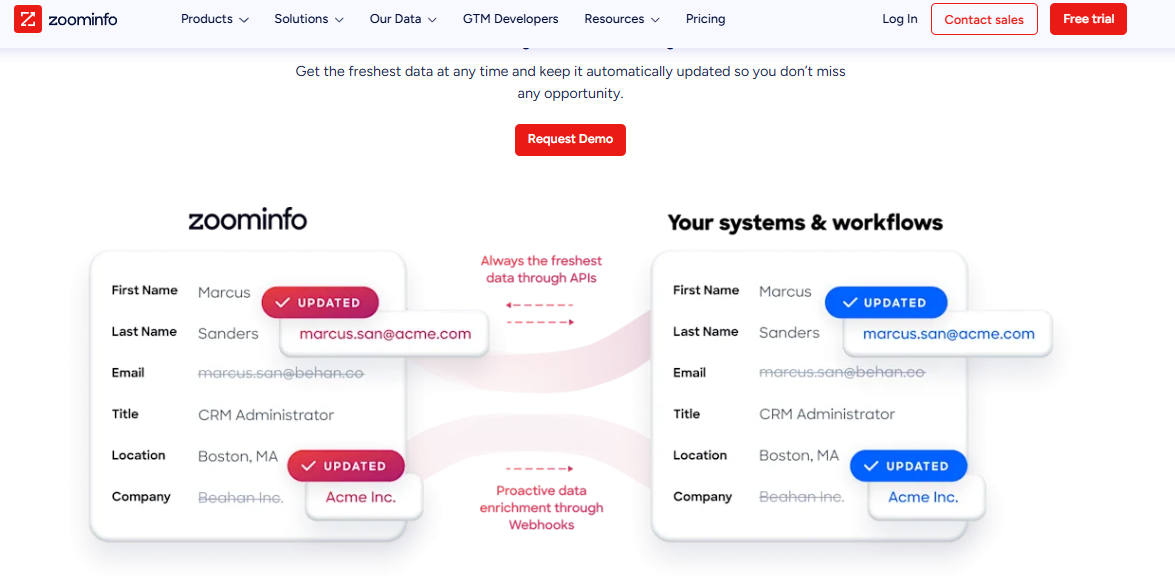
📋 Overview
ZoomInfo is the enterprise incumbent for sales intelligence. It offers deep firmographic data plus intent, sold as an annual platform.
In reality, it is comprehensive and expensive, built for large sales orgs with budget and seats.
The API exists but is rate-limited, and the commercial model is enterprise-first. That suits big teams more than lean builders, so many evaluate ZoomInfo API alternatives for GTM agent builders.
⏰ Time to first API call:
- UI: Instant
- API call: ~setup plus enterprise provisioning
⚙️ Setup complexity: Medium to high (enterprise-gated)
🛠️ Core Services
- Deep firmographic and contact database
- Intent data
- Enterprise CRM integrations
- WebSights visitor de-anonymization
- API and bulk enrichment (tier-gated)
📊 Data Coverage & Field Depth (Reality Check)
✅ Strong in: US enterprise and mid-market depth, plus intent.
❌ Weaker in: Price-to-value for small teams, and agent-friendly flexibility.
Field depth: Deep across firmographics, contacts, and intent.
Confidence Level: Medium to high on US coverage; premium cost is the trade-off.
🤖 API & Agent Readiness
- API availability: Yes
- API depth: Moderate to high, but rate-limited
- MCP compatibility: Not supported
- Agent usability: Medium, annual contracts and rate limits constrain agent loops
When we measured our company match rate against ZoomInfo on US mid-market accounts, the gap favored aggregated sourcing on coverage of NOE, website URL, and NAICS fields. Numbers beat logos, so I would benchmark match rates before signing an annual deal.
💰 Pricing & Cost Structure
Pricing Model: Annual enterprise contract
Published Pricing: Custom / contact sales
💸 Cost Interpretation (What You Actually Pay):
- Billing driver: Seats plus annual platform fee
- Free tier: No
- Detailed cost mechanics are not fully transparent pre-contract
⚠️ Hidden Costs & Constraints:
- Annual lock-in is standard
- API and bulk access often gated to higher tiers
- Add-ons for intent and advanced features
✅ When to Shortlist
Shortlist this if:
- You are an enterprise sales org wanting depth plus intent
- You have budget for an annual platform
- You work primarily in a UI
❌ Avoid this if:
- You are a lean, usage-based builder
- You need agent-native, MCP retrieval
- You want to benchmark before committing annually
8. Coresignal [toc=1.8 Coresignal] ⭐⭐⭐
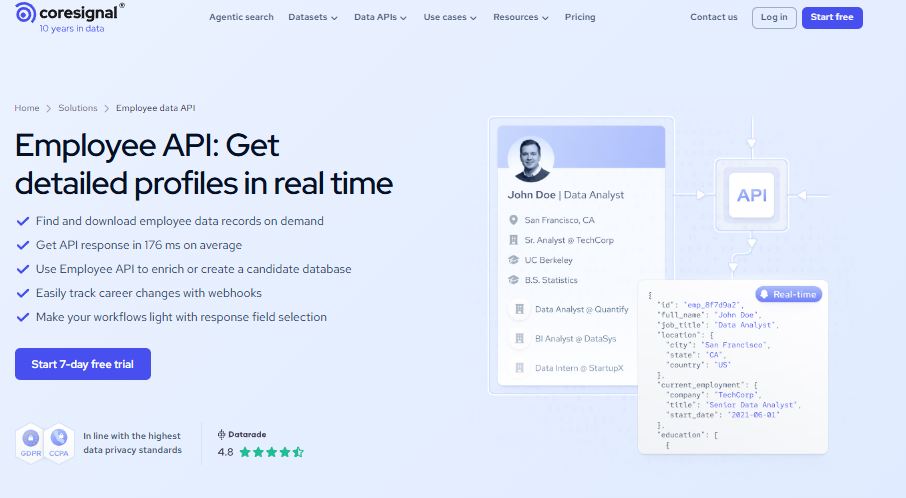
📋 Overview
Coresignal is a raw-data provider for company, employee, and job-posting feeds. It sells datasets and APIs for teams building their own models.
In reality, it is infrastructure, not a finished workflow. You take raw feeds and build enrichment and resolution yourself.
That fits data engineering teams. It does not fit non-technical RevOps users.
⏰ Time to first API call:
- UI: Limited
- API call: ~30 to 60 minutes
⚙️ Setup complexity: Medium to high (raw data, you build on top)
🛠️ Core Services
- Company firmographic datasets
- Employee and headcount data
- Job-posting feeds (hiring signals)
- REST plus bulk delivery
- Historical data snapshots
📊 Data Coverage & Field Depth (Reality Check)
✅ Strong in: Raw firmographic and job-posting feeds for custom modeling.
❌ Weaker in: Out-of-the-box resolution, dedupe, and contact enrichment.
Field depth: Wide raw fields, lighter finished context.
Confidence Level: Medium, depends on your own matching layer.
🤖 API & Agent Readiness
- API availability: Yes, developer-first
- API depth: High on raw feeds
- MCP compatibility: Not supported
- Agent usability: Medium, you write your own agent-facing layer
My current read: Coresignal is a strong feed if you have engineers. Without them, the integration tax shows up fast.
💰 Pricing & Cost Structure
Pricing Model: Usage-based
Published Pricing: Tiered usage / custom
💸 Cost Interpretation (What You Actually Pay):
- Billing driver: API calls and data volume
- Free tier: Limited trial
- Detailed cost mechanics are not fully transparent pre-contract
⚠️ Hidden Costs & Constraints:
- You build matching and dedupe yourself
- Bulk volumes can scale cost quickly
- Tier-based access to richer feeds
✅ When to Shortlist
Shortlist this if:
- You have engineers to build on raw feeds
- You need hiring and headcount signals
- You want historical snapshots
❌ Avoid this if:
- You need finished account enrichment
- You want native MCP retrieval
- You lack a data-engineering team
9. Crust Data [toc=1.9 Crust Data] ⭐⭐⭐
📋 Overview
Crust Data is a real-time company and people signals API, popular with early-stage teams. Its pull is fresh signals at accessible pricing.
In reality, it is a developer-first feed for tracking company changes and people moves, not a full prospecting suite.
It genuinely wins on early-stage pricing. I want to be fair about that, because budget is real money sitting in a runway.
⏰ Time to first API call:
- UI: Limited
- API call: ~30 to 45 minutes
⚙️ Setup complexity: Medium (developer-first)
🛠️ Core Services
- Real-time company signals
- People and headcount tracking
- Job-change and hiring data
- REST API delivery
- Dataset access for builders
📊 Data Coverage & Field Depth (Reality Check)
✅ Strong in: Fresh signals and early-stage affordability.
❌ Weaker in: Breadth versus enterprise incumbents and finished resolution.
Field depth: Good on signals, lighter on full firmographic depth.
Confidence Level: Medium, strongest on freshness.
🤖 API & Agent Readiness
- API availability: Yes, developer-first
- API depth: Moderate to high on signals
- MCP compatibility: Not supported
- Agent usability: Medium
From what surfaces when you actually run signal-led plays, freshness is the edge that decays fastest. No signal advantage lasts forever, so build for constant iteration with timely buying signals for AI sales agents.
💰 Pricing & Cost Structure
Pricing Model: Usage-based, low entry
Published Pricing: Accessible entry tiers / custom
💸 Cost Interpretation (What You Actually Pay):
- Billing driver: API calls
- Free tier: Trial available
- Detailed cost mechanics are not fully transparent pre-contract
⚠️ Hidden Costs & Constraints:
- Breadth gaps may need a second source
- Signal freshness needs ongoing tuning
- Scaling cost rises with call volume
✅ When to Shortlist
Shortlist this if:
- You are early-stage and budget-sensitive
- You want fresh, real-time signals
- You are comfortable with a developer-first API
❌ Avoid this if:
- You need enterprise-grade breadth
- You want native MCP retrieval
- You need finished, deduped account records
10. Cleanlist [toc=1.10 Cleanlist] ⭐⭐
📋 Overview
Cleanlist is a lightweight account enrichment API for small teams. It exposes a simple endpoint and a free monthly tier.
In reality, it does a focused job: send a record, get back a handful of clean fields with a high email-accuracy claim.
That simplicity is the appeal and the limit. It is not built for deep multi-signal, agent-scale enrichment.
⏰ Time to first API call:
- UI: Limited
- API call: ~15 to 30 minutes
⚙️ Setup complexity: Low
🛠️ Core Services
- Account enrichment via POST /v1/enrich/account
- 7+ core fields per record
- ~98% email-accuracy claim
- cURL, Node, and Python examples
- Free monthly credit tier
📊 Data Coverage & Field Depth (Reality Check)
✅ Strong in: Simple, fast account enrichment for small volumes.
❌ Weaker in: Multi-signal depth and large-scale coverage.
Field depth: Shallow but clean, with credits_used exposed in the response meta.
Confidence Level: Medium for basic fields.
🤖 API & Agent Readiness
- API availability: Yes, clean REST
- API depth: Low to moderate
- MCP compatibility: Not supported
- Agent usability: Medium for simple calls
I like that the schema is honest: it returns credits_used and providers_queried so you can gate writes. That is the right primitive, just on a thinner dataset.
💰 Pricing & Cost Structure
Pricing Model: Credit-based with free tier
Published Pricing: Free 30 credits/month, paid tiers scale
💸 Cost Interpretation (What You Actually Pay):
- Billing driver: Per-record credits
- Free tier: Yes, 30 credits/month
- Costs are transparent at small scale
⚠️ Hidden Costs & Constraints:
- Thin field set may need a second source
- Scale limits for large databases
- Best for light, focused enrichment
✅ When to Shortlist
Shortlist this if:
- You are a small team wanting simple account enrichment
- You value a free tier and clean schema
- You need a few core fields, fast
❌ Avoid this if:
- You need deep multi-signal data
- You enrich at high volume
- You want native MCP retrieval
11. Data Legion [toc=1.11 Data Legion] ⭐⭐
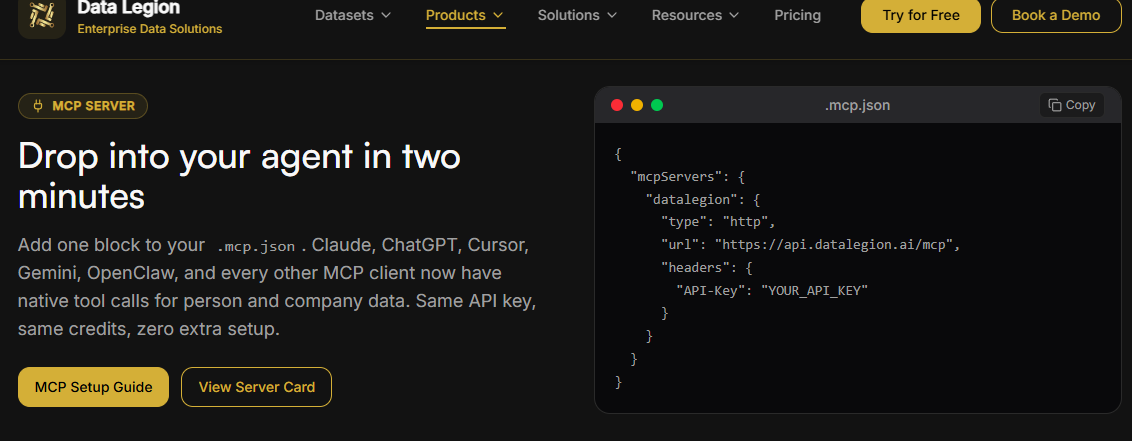
📋 Overview
Data Legion is a company enrichment API focused on confidence-scored matching. It returns 50+ data points with six matching methods.
In reality, it is a developer-facing match-and-enrich endpoint, useful when you want explicit confidence scores per result.
That scoring is its best idea. The dataset and ecosystem are smaller than the incumbents.
⏰ Time to first API call:
- UI: Limited
- API call: ~30 to 45 minutes
⚙️ Setup complexity: Medium
🛠️ Core Services
- Company record matching and enrichment
- 50+ data points per record
- Six matching methods with confidence scores
- REST API at 100 req/min
- Multiple match keys (name, domain, and more)
📊 Data Coverage & Field Depth (Reality Check)
✅ Strong in: Confidence-scored company matching.
❌ Weaker in: Overall scale and finished workflow versus larger vendors.
Field depth: Moderate, 50+ fields with scores.
Confidence Level: Medium, with explicit scoring as a plus.
🤖 API & Agent Readiness
- API availability: Yes
- API depth: Moderate, 100 req/min
- MCP compatibility: Not supported
- Agent usability: Medium
Confidence scores per match are exactly what an agent needs to gate writes. I would lean on that and add my own QA layer on top.
💰 Pricing & Cost Structure
Pricing Model: Usage-based
Published Pricing: Usage tiers / custom
💸 Cost Interpretation (What You Actually Pay):
- Billing driver: API calls
- Free tier: Trial / limited
- Detailed cost mechanics are not fully transparent pre-contract
⚠️ Hidden Costs & Constraints:
- Smaller dataset may need a second source
- Rate cap at 100 req/min limits burst volume
- Tier-based access to richer fields
✅ When to Shortlist
Shortlist this if:
- You want confidence-scored company matches
- You build your own gating logic
- You need multiple match keys
❌ Avoid this if:
- You need enterprise-scale breadth
- You want native MCP retrieval
- You need high burst throughput
🧭 How This List Nets Out
The pattern across all 11 is clear. UI-first platforms (Apollo, ZoomInfo, Clay, and Cognism) force a human to orchestrate, and single-signal or thin providers (PDL, Coresignal, Crust Data, Cleanlist, and Data Legion) leave you wiring several APIs, paying several bills, and writing several matching layers.
We built Explorium to collapse that sprawl: one API, one MCP server, one unified credit pool across 30+ enrichments, and benchmark-led company match rates of 97.80% NOE, 97.80% website URL, and 97.31% NAICS. The same way Snowflake consolidated the warehouse and Stripe consolidated payments, the agent-native data layer consolidates the stack so the agent, not the rep, decides what to fetch.
Q2. How Were These Account Enrichment APIs Tested and Scored? [toc=2. Scoring Methodology]
Each API was scored on five weighted criteria: Data Coverage and Match Accuracy (25%), Agent and API/MCP Readiness (25%), Field Depth and Signal Quality (20%), User Reviews and Customer Validation (15%), and Commercial Model Transparency (15%). Tools earn 1 star (0 to 20) through 5 stars (81 to 100). Scores reflect tested match accuracy on known-good records, not vendor-claimed match rate.
Why Match Accuracy, Not Match Rate
The standard read gets this backwards. Most listicles rank on database size, then quote a vendor’s own "match rate."
A match rate only tells you the API returned something. It says nothing about whether that something is correct or current.
So I split the quality question into three distinct axes that listicles routinely blur:
- Match rate: Did the API return a record at all?
- Match accuracy: Is the returned record actually correct?
- Refresh cadence: Is the record still current today?
📊 The Weighted Rubric
Stars map cleanly: 0 to 20 is 1 star, 21 to 40 is 2, 41 to 60 is 3, 61 to 80 is 4, and 81 to 100 is 5 stars.
How the Accuracy Test Actually Ran
I do not trust accuracy claims I cannot reproduce. Show, do not tell.
So accuracy is measured on a held-out set: records where the true answer is already known. You enrich them, then count correct fields and real bounces on send.
🌍 The Geo-Stratified Sample
Coverage is not uniform across regions. A vendor strong in North America can collapse in APAC or LATAM.
To control for that, the sample is geo-stratified across North America, EMEA, APAC, and LATAM. This stops a single strong region from inflating a global score.
Freshness matters because data rots. If your data is outdated, you land in spam, and if your contacts are wrong, you waste money reaching people who never respond. Top-tier providers refresh on roughly a 7-day cycle, while the industry norm sits closer to 30 to 90 days, as we cover in our guide to firmographic data.
⭐ Where Explorium Lands
Explorium earns 5 stars, anchored on the Coverage and Accuracy pillar. Our published first-party match-rate benchmark on US company enrichment shows 97.80% match on number of employees (NOE), 97.80% on website URL, and 97.31% on NAICS industry code, measured against ZoomInfo, Apollo, Clearbit, and Experian.
That score is not a logo award. It reflects tested accuracy on known company fields, which is exactly the axis this rubric weights most.
I could be wrong on any single competitor’s edge case, so treat these as directional. The method, not the marketing, is what you should copy when you run your own bake-off.
Q3. What Makes an Account Enrichment API Agent-Native and Account-First? [toc=3. Agent-Native & Account-First]
An account enrichment API appends firmographic and signal data to a company record: you send a domain, and it returns industry, employee count, revenue, funding, tech stack, and intent signals with confidence scores. Account-native means it resolves the whole company entity and buying committee, not one person. Agent-native means an LLM, not a UI clicker, is the buyer, so it needs an MCP server, high QPS, bulk-per-call, and predictable async behavior.
Concept: Account-First vs Contact-First
Most "enrichment" tools are contact-first. They fill in a person: name, title, and email.
Account-first enrichment resolves the company itself, then maps the people around it. That matters because most B2B deals involve six to ten buyers, and a one-contact CRM leaves you flying blind.
🔍 Example: One Domain In, Fifty Fields Out
Picture sending stripe.com to the API. A contact tool hands back one email.
An account-first API returns the firmographic core (industry, NOE, and revenue), the tech stack, recent funding, hiring signals, and confidence scores per field. Cleaner providers even expose credits_used and providers_queried in the response, so you can audit each call. This is the foundation of a strong business enrichment API.
Application: What "Agent-Native" Actually Requires
Agent-native is not a label. It is a set of properties an LLM needs to call a tool inside a loop without a human babysitting it.
MCP, the Model Context Protocol, is Anthropic’s open standard for letting AI tools call your APIs. Think of it as a USB-C port for AI: one socket, many sources, and the agent decides what to plug in. We break down the choice in our guide on MCP versus REST API for AI agents.
🤖 The Agent-Readiness Lens
Here is the failure mode I see most. When data is fragmented across providers, agents spend their time pulling and joining data that is irrelevant to the actual task.
Latency compounds it. A practitioner I trust gave up on Apollo’s API because it was so slow and consistently throttled that it was never worthwhile, which is why many move to a data layer built for autonomous agents.
✅ Where Explorium Fits
Explorium is the only fully agent-native option on this list. We expose 50+ sources behind one API and one MCP server, with 100 QPS synchronous enrichment across 150M+ company profiles, so the agent, not a rep, decides what to fetch.
💬 Customer Reviews
“The richness and breadth of data is incredible. I really like the instant access to the most useful and reliable external data.”
Ishi N., Enterprise Explorium G2 Verified Review
“Instead of connecting to multiple data sources and APIs, we only require one connection, Explorium! Access to more point-in-time data will be very useful, I understand that its on the way.”
Mirit H., Mid-Market Explorium G2 Verified Review
Q4. Why Do Single-Source APIs Miss Accounts, and How Do You Evaluate Match Accuracy? [toc=4. Waterfall & Match Accuracy]
No single database is complete. Single-source APIs return nulls on 20 to 40% of inputs. Waterfall enrichment chains providers and stops at the first verified hit, maximizing coverage while charging only for success. Judge vendors on match accuracy (is the record correct?), not match rate (did it return anything?), and on concrete specs: endpoint shape, JSON schema, bulk batch size, rate limits, and confidence scores.
The Problem: The Null-Rate Tax
Every database has holes. One vendor knows revenue but misses headcount; another nails the tech stack but lags on funding.
So a single-source call quietly fails on a big slice of your list. You do not see it as an error. You see it as blank fields and a half-empty CRM.
⚠️ Match Rate Is a Costume
A 95% match rate paired with 80% deliverability is a bad API wearing a good costume. The only honest test is sending real messages and counting bounces.
That is why accuracy beats rate. A confident-looking wrong record costs more than an obvious blank, because you act on it.
The Agitation: Building Waterfall Yourself
Waterfall is the standard fix, and it works. Send one input, try provider one, and if it succeeds, stop the rest, which saves money automatically.
But hand-rolling it is a tax. You maintain four provider integrations, four credit pools, four schemas, and a fallback graph that breaks when any vendor changes a field. Our breakdown of waterfall enrichment covers this in depth.
🛠️ The Builder’s Spec Checklist
Before you sign, pressure-test these concrete specs, not the marketing:
I also run a cheap insurance step. Use an LLM as a QA layer to check that the returned record makes sense before it writes to the CRM. The same logic applies when you weigh credit-based versus subscription pricing.
The Solution: Waterfall You Do Not Maintain
This is where aggregation earns its keep. We built Explorium so 50+ sources sit behind one API and one credit pool, which means you get waterfall coverage with confidence scoring, without writing or maintaining the fallback logic yourself.
The parallel is Stripe replacing a sprawl of payment gateways. One integration absorbed the mess so builders stopped maintaining nine connections, the same way you can migrate enrichment providers without downtime.
My current read: the next 18 to 24 months reward teams who treat coverage as an infrastructure problem, not a per-vendor shopping list. Numbers beat logos, so benchmark your own held-out set before committing.
Q5. How Do Firmographic Refresh and CRM-Native Sync Actually Work? [toc=5. Refresh & CRM Sync]
B2B data decays more than 3% per month, so over a third of your CRM rots yearly. Top APIs refresh on a 7-day cycle versus the 30 to 90-day norm. Track firmographic fit and buying intent as separate axes: fit is durable, intent expires fast and needs score decay. CRM-native sync should write enriched fields straight into Salesforce or HubSpot with correct mapping, not a manual CSV, and not limited to one CRM connection.
The Decay Problem Nobody Budgets For
Start with the number that should scare you. Company data decays at more than 3% a month, which means a third of your records go stale within a year.
People change jobs, companies rename, and headcounts swing. Your CRM does not auto-correct, so it quietly drifts wrong.
⏰ Refresh Cadence Is the Fix
The fix is a re-verification loop on a sub-90-day cycle. Best-in-class providers refresh roughly every 7 days, while the industry norm sits at 30 to 90 days.
Faster cadence is not vanity. Outdated data lands you in spam, and wrong contacts burn money on people who never reply. Strong firmographic data depends on that loop.
Fit and Intent Are Not the Same Signal
Here is where most teams blur two very different things. Firmographic fit (industry, size, and revenue) is durable and changes slowly.
Buying intent is the opposite. It spikes, then fades, so it needs score decay, where the signal loses weight as it ages. Our work on B2B intent data treats it on its own axis.
⚠️ Not Every Signal Is Useful
A contrarian note from running these in production: no signal advantage lasts forever. Many "intent" feeds are noise dressed as insight.
I would rather track a few decaying signals well than chase fifty I cannot act on. Treat fit and intent on separate axes, and let intent expire on schedule, especially when timing outreach around buying signals.
CRM-Native Sync: The Real Mechanics
Sync is where good data goes to die in spreadsheets. The goal is a write-back, where enriched fields flow straight into the CRM, no manual CSV.
A clean recipe in a tool like n8n looks like this:
- HTTP or MCP node: call the enrichment API with the account domain.
- Code node: map returned fields to your CRM schema.
- CRM node: write back to Salesforce or HubSpot, with a fan-out for bulk records.
🔌 Where UI-First Tools Break
The cracks show at scale. Apollo allows only one CRM connection at a time, so multi-CRM teams bolt on middleware like Zapier.
Clay hits a 50,000-row table ceiling, which forces a move to API-first infrastructure for larger jobs. One RevOps lead I spoke to was, in their words, sick and tired of clicking around in Dataverse to patch the gaps. That pain pushes teams toward Clay alternatives for a B2B data enrichment API.
✅ How Explorium Handles It
We built Explorium to run continuous firmographic refresh, separate intent signals, and scale-ready multi-CRM sync, all from one credit pool. The same n8n write-back recipe fans out across 1,000-record batches without single-connection middleware, the way our data layer for autonomous outbound agents is designed to work.
💬 Customer Reviews
“Explorium is a fast and effective platform that makes the integration and analysis of third-party data seamless. Their lead enrichment still has a long way to go, but the results so far are promising.”
David A., CEO Explorium G2 Verified Review
“Company data doesnt refresh often enough. Only 20% of known contacts could be found, including people at companies for 1 year.”
Verified User, Internet, Mid-Market Clearbit G2 Verified Review
My open question for the next 18 months: will refresh cadence become a contractual SLA, the way uptime did for cloud? I think builders should start demanding it, and asking what SLA terms to look for in a B2B data API contract.
Q6. What Do Account Enrichment APIs Really Cost, and Are They Compliant? [toc=6. Pricing & Compliance]
Headline per-call pricing hides the real bill: separate credit pools (one email is 1 credit, a mobile is 8 credits, and a CRM export comes from a different pool) push actual cost 2 to 3x above the sticker. The honest metric is cost-per-valid-record, since a 95% match rate with 80% deliverability is expensive once bounces count. On compliance, confirm GDPR, CCPA, and SOC 2 posture and your shared data-controller obligations before signing.
The Problem: Credit Pools Hide the Bill
Sticker pricing lies by omission. The structure underneath is where the money leaks.
Take a common model: one email unlock costs one credit, a mobile number costs eight, and CRM exports draw from a separate export pool. You budget for one number and pay three.
💰 The Hidden-Cost Table
The Agitation: Cost of Bad Data
Wrong data is not free; it compounds. The 1-10-100 rule says it costs $1 to verify a record, $10 to clean it later, and $100 to act on it wrong.
Gartner has pegged poor data quality at roughly $15M a year for the average organization. So cost-per-valid-record is the only honest unit.
💸 A Worked Example
Say an API charges $100 per 1,000 records at a 90% match rate. That is 900 records.
If only 80% are actually correct, you have 720 valid records, so your true cost is closer to $0.14 each, not $0.10. The gap is the bad-data tax, which is why the credit-based versus subscription pricing choice matters.
The Solution: Unified Credits and Compliance
This is the case for one pool. We built Explorium so 30+ enrichments draw from a single unified credit pool, which kills the multi-pool gotchas above. One bill beats nine, as our credit details explain.
A useful dedupe hack: do not re-rent your own leads. Enriching only new records means you pay for new data, not data you already own.
✅ The Compliance Checklist
Compliance is a trust signal, not a footnote. Before you sign, confirm:
- GDPR and CCPA: lawful basis and opt-out handling across all aggregated sources.
- SOC 2: audited security controls.
- Data-controller role: your shared obligations when you act on the data.
Explorium clears GDPR and CCPA once across every aggregated source, maintains a SOC 2 posture, and offers resale rights plus search preview on custom plans, so builders keep ownership through clear resale rights and licensing.
💬 Customer Reviews
“Removed a user from the plan but a task by that user kept running and consumed all credits. Happened twice. Bug cost $1000. Support refused responsibility. No refund.”
Amulya P. Apollo G2 Verified Review
“Credit system is broken. Pricing is broken. Not fully transparent with rollover limit.”
Raphael A., Marketing Lead Clay G2 Verified Review
I keep asking myself: will unified credit pricing become table stakes once finance teams audit GTM spend line by line? My current read is yes.
Q7. Which Account Enrichment API Should You Choose for Your Use Case? [toc=7. Choose by Use Case]
Choose by scenario, not brand. Building production GTM agents? Pick an MCP-native, high-QPS API like Explorium. Running high-volume phone outbound where bad numbers cost domain health? Weight match accuracy and refresh cadence above price. On a tight bulk-firmographics budget? A cheaper single-source API may suffice. Before signing, run 100 known-good accounts through your finalists and count correct fields and real bounces.
The Decision Framework
Stop shopping by logo. Match the tool to the job, then pressure-test it.
A useful operating rule: buy 90% of your data, and build the 10% that is truly unique to you. Reliability beats flash, because the less complex a setup is, the easier it is to maintain. That is the core of choosing the best B2B data enrichment API for AI agents.
🤖 Scenarios and Where to Land
- Building production GTM agents: Choose an MCP-native, high-QPS API like Explorium. Not recommended for: a team that only needs a one-time list.
- High-volume phone outbound: Weight match accuracy and refresh cadence above price. Not recommended for: chasing the absolute cheapest per-record rate.
- Tight bulk-firmographics budget: A single-source API may be enough. Not recommended for: multi-signal agent decisioning that needs intent plus tech plus funding.
- HubSpot-native enrichment: An in-CRM tool fits. Not recommended for: vendor-neutral, agent-callable retrieval.
⚠️ The Contested Middle
Be honest about trade-offs. Apollo can run 70 to 80% cheaper, but reviewers peg it at roughly 70 to 80% of the data quality.
For low-stakes prospecting, that math works. For phone outbound, where wrong numbers torch your domain health, the cheaper option gets expensive fast. Builders often weigh Apollo API alternatives at this point.
The Pre-Purchase Test Protocol
Do not trust any vendor’s self-reported numbers, including mine. Show, do not tell.
Run the same 100 known-good accounts through every finalist. Count correct fields and real bounces on send, then compare cost-per-valid-record against published match-rate benchmarks.
✅ Gate Your Writes
One last builder move: use the result_type field to gate CRM writes, so only verified records land. Pair it with an LLM as a cheap QA layer that sanity-checks each record before it saves.
We position Explorium as the default for the agent-native scenario, and I will say plainly when it is overkill: if you need a single field once, a single-source tool is the right call. For deeper builds, our agent-native data product is the fit.
Here is the question I am sitting with. As agents become the buyers of the next data call, does "which tool" slowly become "which data layer my agent can reason over"? If you are wrestling with that, I would genuinely like to compare notes.
FAQs


